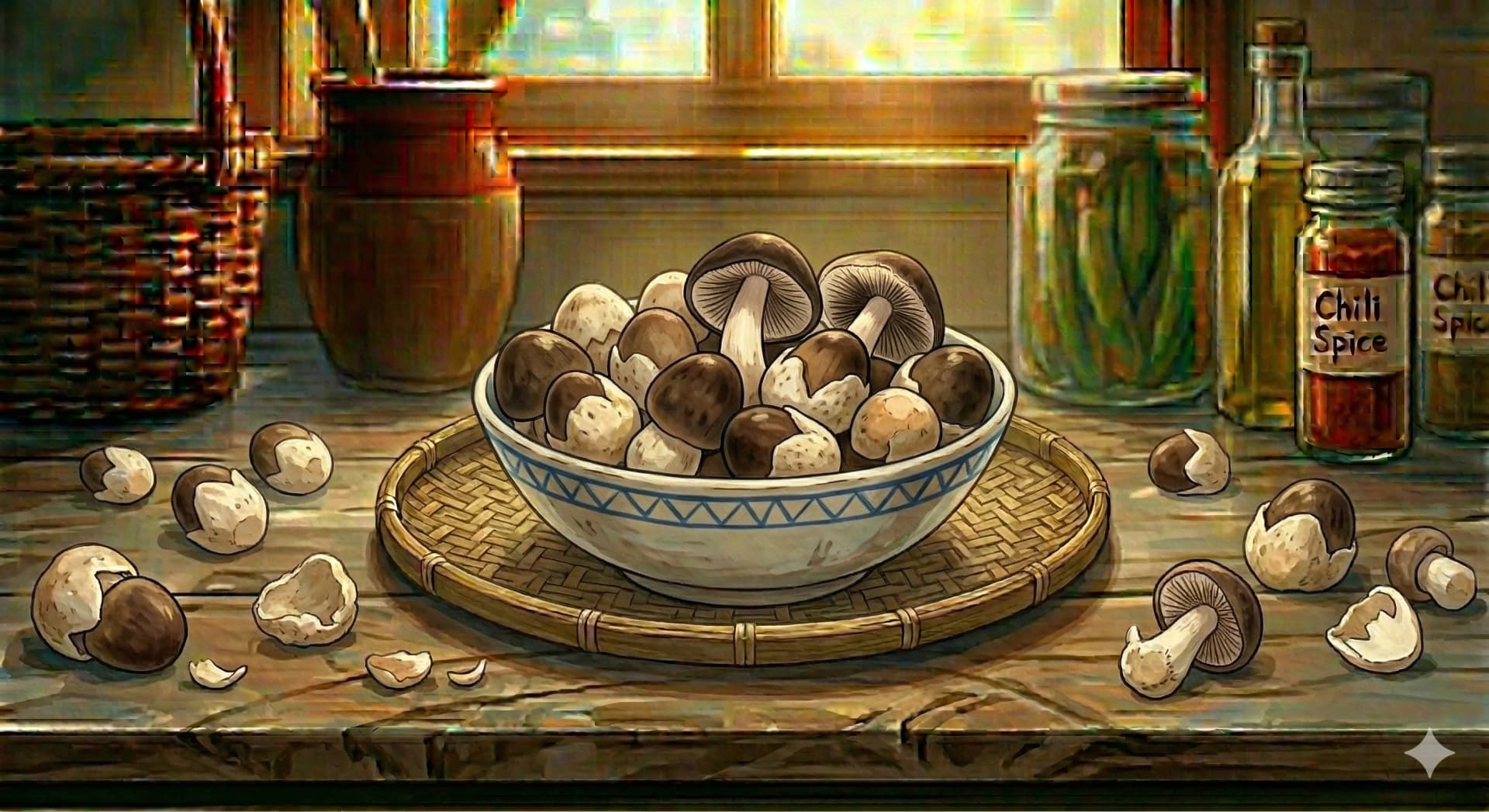
Straw Mushrooms
Also known as: Cao Gu, Paddy Straw Mushrooms, Volvariella volvacea, Rice Straw Mushrooms
Straw mushrooms are small, round, smooth-capped mushrooms with a mild, earthy flavor and a slippery, velvety texture.
Grown traditionally on beds of rice straw (hence the name), they are more common in canned or preserved form outside of Asia, where fresh straw mushrooms are difficult to find due to their extremely short shelf life.
In Cantonese and Thai cooking, straw mushrooms add a distinctive meaty texture and subtle earthiness to stir-fries, soups, and curry preparations.
Key facts at a glance:
- Grown on beds of rice straw — closely tied to rice agriculture
- Extremely short shelf life — mostly available canned or preserved outside Asia
- Slippery, velvety texture — mild, earthy flavor adds body without dominating
- Over 300 years of cultivation in China — originated in the Pearl River Delta
- Contains immunomodulatory polysaccharides — similar to other culinary mushrooms
Flavor Profile
Origin
Guangdong, Southern China, Southeast Asia
Traditional Medicine Perspectives
Traditional Chinese Medicine
Straw mushrooms (Cao Gu) are classified as cool and sweet in TCM, associated with the Spleen and Stomach. They are used to clear heat, tonify Qi, support the Spleen and Stomach, and benefit the digestion. Like other mushrooms in TCM, they are considered nourishing, tonifying foods appropriate for most constitutions.
Modern Scientific Research
Straw mushrooms contain beta-glucans and immunomodulatory polysaccharides, similar to other culinary mushrooms.
Research shows antioxidant properties and potential anti-tumor activity from Volvariella volvacea polysaccharides in laboratory studies.
They are a good source of B vitamins, copper, and selenium. The high water content (typical of fresh mushrooms) means they are low in calories.
Cultural History
Straw mushrooms have been cultivated in China for over three hundred years, originally grown on rice straw in the fields of the Pearl River Delta in Guangdong.
They spread to Southeast Asia through Chinese diaspora communities and became central to Thai, Vietnamese, and Malay cooking. Their cultivation is closely tied to rice agriculture — the straw left after harvest provides the growing substrate.
In Cantonese cooking, straw mushrooms are used in stir-fries, soups, and braised preparations where their mild, meaty quality adds body without dominating other flavors.
Culinary Uses
Add to Cantonese stir-fries with oyster sauce, garlic, and other vegetables. Use in clear soups and hot pots.
Add to Thai curries and stir-fries. Combine with tofu and leafy greens for simple, clean preparations.
Canned straw mushrooms should be rinsed and blanched before use to remove any tinned flavor.
Preparation Methods
Fresh straw mushrooms (if available): use within 1–2 days, wipe clean, trim bases.
Canned: drain, rinse thoroughly under cold water, and blanch briefly.
If whole, they can be halved for stir-fries. Cook briefly — they are already fully edible from the can and need only to be heated through.
Comments
Share your thoughts on this ingredient.
Sign in to comment0 Comments