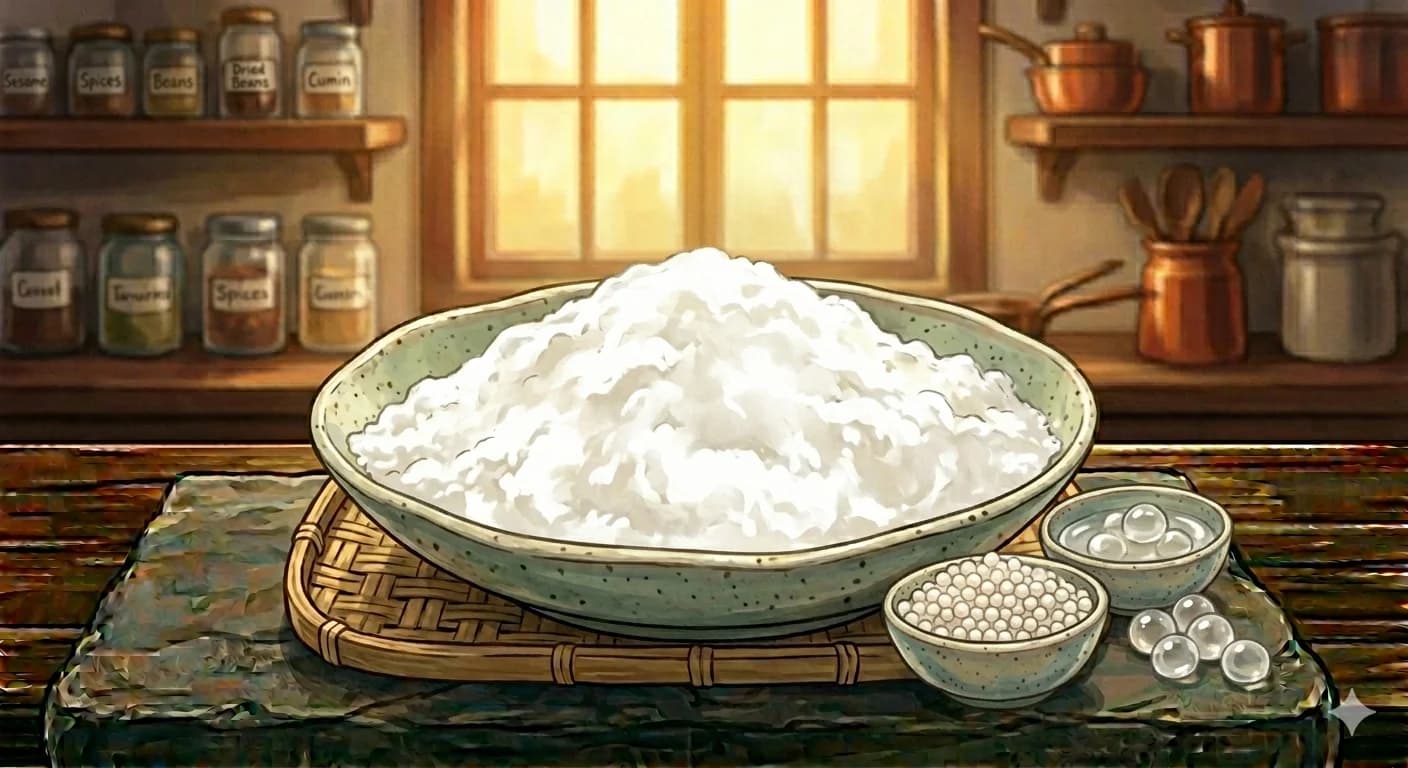
Tapioca Starch
Also known as: Tapioca Flour, Cassava Starch, Bot Nang, Fecula de Mandioca, Sagu, Manioc Starch
Tapioca starch is the refined starch extracted from the cassava root (Manihot esculenta) — a fine white powder that performs a very specific magic in the kitchen: it creates stretch, chew, and translucency that no other starch can replicate.
When you bite into a har gow dumpling wrapper and it stretches slightly before yielding, when a banh cuon has that delicate elasticity, when a Brazilian cheese bread (pao de queijo) pulls apart in stretchy strands — that is tapioca starch at work. It is the starch of choice when you want a texture that is simultaneously tender, chewy, and slightly bouncy.
Tapioca starch and tapioca flour are the same product (unlike potato starch vs. potato flour). It is pure starch, with virtually no protein, fat, or fiber. This purity makes it a predictable, reliable thickener and texture modifier that plays well with other starches and flours.
Key facts at a glance:
- Pure starch from the cassava root — tapioca starch and tapioca flour are the same thing
- Creates stretch and chew — essential for translucent dumpling wrappers and chewy textures
- Naturally gluten-free — one of the most important starches in gluten-free cooking
- Used in key recipes on the site — from dim sum wrappers to Vietnamese crepes
- Neutral flavor — contributes texture without taste
Flavor Profile
Origin
South America (cassava origin), Brazil, Southeast Asia, Vietnam, Thailand, China (Guangdong), Indonesia, West Africa
Traditional Medicine Perspectives
Traditional Southeast Asian Use
In Southeast Asian folk traditions, tapioca and cassava-based preparations are considered easily digestible and cooling. Tapioca in sweetened coconut milk is a common convalescent food across the region, given to those recovering from illness as a gentle, easy-to-digest source of energy.
South American Indigenous Traditions
Cassava and its derivatives hold a central place in the food traditions of Amazonian and other South American indigenous peoples. Cassava processing itself is a sophisticated technology — the removal of naturally occurring cyanogenic glycosides through soaking, pressing, and cooking is an ancient practice that made the plant safe for consumption. The starch was valued as an easily digestible energy source, particularly for children and the elderly.
Modern Scientific Research
Tapioca starch is composed almost entirely of two glucose polymers: amylopectin (approximately 83%) and amylose (approximately 17%). The high amylopectin ratio is responsible for the characteristic stretchy, chewy texture when cooked — amylopectin chains branch extensively and create a gel network that is elastic rather than rigid.
The high amylopectin content (approximately 83%) is what gives tapioca starch its unique stretchy, elastic texture when cooked — a property that other common starches cannot match.
Research in Carbohydrate Polymers has examined the gelatinization properties of tapioca starch and found that it gelatinizes at a relatively low temperature (approximately 60-70 degrees C), forming a clear, stretchy gel. This low gelatinization temperature is why hot water (not cold) is used when making har gow dough — the starch needs to hydrate and gel immediately.
Tapioca starch is often used as a resistant starch source in food science research. When cooked and cooled (retrograded), some of the starch becomes resistant to digestion, functioning as a prebiotic. Studies have also highlighted tapioca starch's utility in gluten-free product development, where its stretchy properties partially compensate for the absence of gluten's elasticity.
Cultural History
Cassava is native to South America, where indigenous peoples have cultivated it for at least eight thousand years. The plant spread to Africa and Asia through Portuguese and Spanish trade routes in the 16th and 17th centuries, and tapioca (the processed starch from cassava) became a staple across the tropical world.
In Southeast Asia, tapioca starch was adopted into existing culinary traditions with remarkable creativity. Vietnamese cooks incorporated it into rice flour batters to add the elasticity needed for banh cuon and other delicate steamed preparations. In Thailand and Indonesia, it became the basis for tapioca desserts and was blended with other starches for noodle making.
The most technically demanding use of tapioca starch is in Cantonese dim sum. The translucent, stretchy wrapper of har gow (crystal shrimp dumplings) is made from a dough of wheat starch and tapioca starch mixed with boiling water. The wheat starch provides the translucency; the tapioca starch provides the stretch and chew that allows the wrapper to be rolled thin without tearing. This wrapper is considered one of the most technically challenging preparations in the dim sum kitchen, and the balance of starches is critical.
Culinary Uses
The defining use of tapioca starch is in translucent dumpling wrappers. The classic har gow (crystal shrimp dumpling) wrapper combines wheat starch with tapioca starch in a ratio of roughly 2:1, mixed with boiling water to form a pliable, translucent dough. The wheat starch alone would crack; the tapioca starch adds the flexibility to pleat and fold without tearing. The same principle applies to other dim sum like fun gor and crystal dumplings.
In Vietnamese cooking, tapioca starch is blended with rice flour to create batters with the right combination of crispness and chew. Banh cuon benefits from a small addition of tapioca starch, which gives the steamed rice crepe its slight elasticity. In rad na (wide noodle dishes), tapioca starch thickens the gravy to a glossy, clinging consistency.
As a thickening agent, tapioca starch produces a clearer, more glossy result than cornstarch or flour. It is particularly good for fruit fillings (pie fillings, compotes) because it thickens without clouding. Mix with cold water to form a slurry before adding to hot liquids.
Tapioca starch is also the key to chewy boba pearls (the tapioca balls in bubble tea), Brazilian pao de queijo (cheese bread), and many Southeast Asian desserts. In all of these, the starch's unique stretchy-chewy quality is the defining textural element.
Preparation Methods
For dim sum dough (har gow and similar), combine wheat starch and tapioca starch, then add boiling water while stirring vigorously. The boiling water is critical — it gelatinizes the starches immediately, creating a pliable, workable dough. Knead briefly, then keep covered with a damp cloth as you work. The dough dries out quickly and becomes unworkable if exposed to air.
For thickening sauces and gravies, make a slurry by mixing tapioca starch with an equal amount of cold water. Stir into simmering liquid gradually. Tapioca starch thickens at a lower temperature than cornstarch and produces a more elastic, stretchy consistency. Be aware that tapioca-thickened sauces can become stringy if overcooked — add the slurry near the end of cooking.
For batter blending (as in Vietnamese crepes or noodles), tapioca starch is typically mixed with rice flour at ratios between 1:3 and 1:5, depending on how much chew is desired. More tapioca starch means more elasticity; less means a crisper, more brittle result. Store in an airtight container in a cool, dry place. Tapioca starch keeps indefinitely but clumps readily if exposed to moisture.
Comments
Share your thoughts on this ingredient.
Sign in to comment0 Comments