Cross-Cultural · Thailand
Gravy Noodles (Rad Na / ราดหน้า)
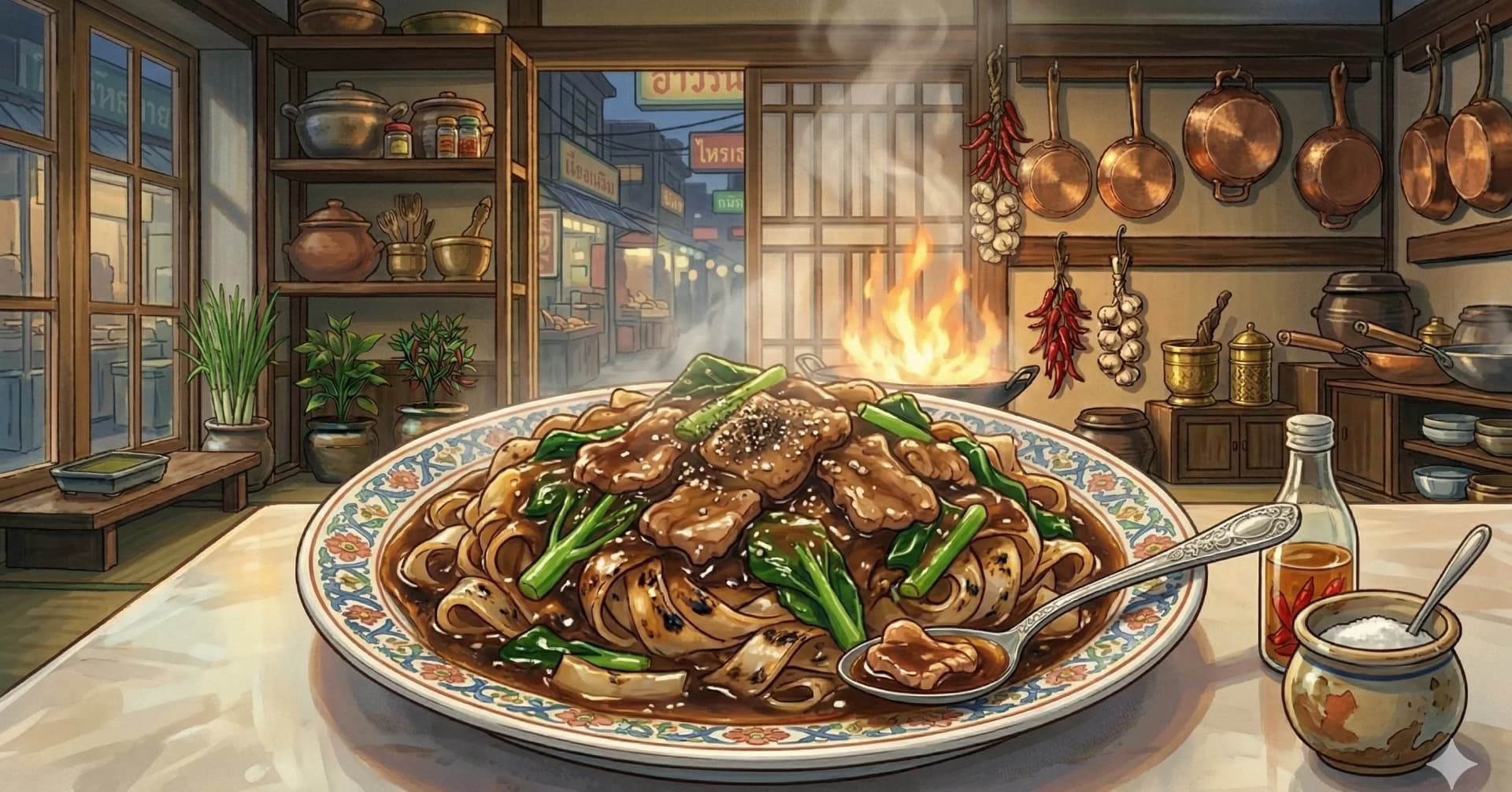
Charred wide rice noodles topped with a thick pork and Chinese broccoli gravy seasoned with fermented soybean paste and white pepper
Rad na means "pour on the face," which is exactly what you do: char wide rice noodles in a hot wok until they stick together slightly and develop dark, toasted edges, then ladle a thick, savory gravy over the top. The gravy breaks the noodles apart, the starch-thickened sauce coats every strand, and the contrast between the slightly chewy, smoky noodles and the rich, silky gravy is what makes this one of Thailand's most beloved comfort foods.
The dish has Chinese origins: no chilies, no lemongrass, no coconut milk, no fish sauce. Instead, fermented soybean paste (tao jiew) provides the savory backbone. Pork shoulder is marinated with egg white and tapioca starch in the Chinese velveting style. The noodles are the part that requires courage. You want them to char. Really char. When the gravy goes on, the charred surfaces soften just enough to eat while keeping their smoky character. Serve with chili vinegar on the side.
At a Glance
Yield
4 servings
Prep
30 minutes
Cook
20 minutes
Total
50 minutes
Difficulty
Medium
Ingredients
Marinade Ingredients
- 12 ozpork shoulder, sliced thin, about 1/8 inch
- 1 tbspsoy sauce
- 1 tbspoyster sauce
- 1 tsptoasted sesame oil
- 2 tbsptapioca starch
- 1large egg white
Noodle Ingredients
- 25 ozfresh wide rice noodles, 700g
- 1 tspblack soy sauce, or dark soy
Sauce Ingredients
- 3 tbspneutral oil, divided (1 for noodles, 2 for gravy)
- 6garlic cloves, chopped
- 3 tbspThai fermented soybean paste (tao jiew), or low-sodium miso
- 3 cupspork or chicken stock, unsalted, homemade preferred
- 1 1/2 tbspsoy sauce, for gravy
- 1 tbspGolden Mountain sauce, or Maggi or oyster sauce
- 1 1/2 tbspsugar
- 1/2 tspground white pepper
- 7 ozChinese broccoli (gai lan), stems sliced on bias, leaves chopped
- 1/4 cuptapioca starch, mixed with 1/4 cup water for slurry
Method
- 1
Marinate pork with soy, oyster sauce, sesame oil, sugar, white pepper, tapioca starch, egg white. At least 20 min.
- 2
Make chili vinegar: slice Thai chilies, cover with white vinegar, rest 15 min.
- 3
Char noodles: toss with black soy, then sear in hot wok until dark toasted edges form. Remove.
- 4
Build gravy: saute garlic + tao jiew, add stock + soy + Golden Mountain + sugar + white pepper + sesame oil. Boil.
- 5
Add pork, spread out. Add gai lan. Return to boil. Thicken with half the tapioca slurry, add more if needed.
- 6
Ladle gravy over charred noodles. Serve with chili vinegar.
Key Ingredient Benefits
Wide rice noodles (sen yai): Flat, broad rice noodles, traditionally made fresh and cut into 1-inch wide ribbons. Fresh sen yai have a chewier, more tender bite than dried versions. Made from rice flour and water, they are naturally gluten-free and provide about 40 g of carbohydrate per serving. The wide surface area is what allows the noodles to char and absorb sauce in this dish.
Pork shoulder: A well-marbled cut that stays tender when sliced thin and quickly stir-fried. The fat marbling melts into the gravy as it cooks, adding richness. Pork shoulder is high in protein (about 22 g per 100 g) and provides B vitamins, particularly B1 (thiamine) and B6. Velveting with egg white and tapioca starch keeps the pork silky in the gravy.
Chinese broccoli (gai lan): The defining vegetable of rad na. The thick stems are sliced on a bias to expose more surface area, the leaves are roughly chopped. Gai lan contributes a slightly bitter, mineral note that balances the rich gravy. High in vitamins A, C, K, and calcium. Cannot really be substituted — broccoli florets work but produce a fundamentally different character.
Fermented soybean paste (tao jiew): The umami backbone of the gravy. Whole soybeans fermented with salt and rice, similar to Chinese yellow bean sauce but milder and more nuanced. Tao jiew provides concentrated glutamates and the slightly complex, almost cheese-like depth that distinguishes Thai-Chinese gravies from generic stir-fry sauces.
Tapioca starch: The thickener. Mixed with water into a slurry and added at the end to thicken the gravy to a glossy, sauce-like consistency. Tapioca starch produces a cleaner, more transparent thickening than cornstarch — the gravy stays glossy and doesn't cloud over time.
White pepper: Provides the dish's signature peppery warmth without the visible specks of black pepper. White pepper is essential for the authentic flavor profile.
Oyster sauce and Golden Mountain sauce: The Thai pantry's "soy sauce" equivalents. Golden Mountain sauce (Thai brand of seasoning sauce) provides salt and a faint sweetness; oyster sauce provides marine umami and glossy mouthfeel.
Why This Works
Charring the noodles is the technique that defines rad na. The wide noodles go into a screaming hot wok with minimal oil, get pressed against the metal surface for 30 to 60 seconds without moving, then flipped and charred on the other side. The result is dark brown spots, slightly stuck-together strands, and an unmistakable toasted-rice aroma. This is not a mistake — the toasted noodle character is the dish's signature. The same principle drives pad see ew and many other Thai noodle dishes.
Velveting the pork (marinating with egg white and tapioca starch) creates a thin protective coating that keeps the meat silky in the long gravy simmer. Without velveting, thin pork slices would quickly become rubbery. The egg white acts as a binder and the starch absorbs marinade liquid, forming a gel-like layer when cooked. This technique is borrowed from Chinese stir-fry cooking and is the secret to restaurant-quality protein in any noodle gravy dish.
Building the gravy in stages produces deep, layered flavor. The fermented soybean paste is sautéed first in oil to bloom its volatile aromatics. Garlic goes in next, briefly. Pork follows, just to sear. Then the liquids (broth, oyster sauce, soy sauce, Golden Mountain sauce) are added and brought to a simmer. The gai lan goes in toward the end so it retains some crunch. Finally, the tapioca starch slurry thickens the gravy to the right consistency.
The tapioca starch slurry must be added with constant stirring and brought to a brief boil to fully activate. Adding starch slurry to non-boiling liquid produces lumps; adding to boiling liquid without stirring produces uneven thickening. The fully activated starch creates the glossy, slightly translucent quality that defines a proper rad na gravy.
The dish is meant to be served as two separate elements (charred noodles + gravy) and combined at the moment of eating. Mixing the gravy into the noodles in the kitchen would let the sauce soak in too thoroughly and lose the textural contrast between toasted noodle edges and silky gravy. The right approach: char the noodles, plate them, ladle the hot gravy over the top just before serving.
Substitutions & Variations
Wide rice noodles (sen yai): Fresh sen yai from Asian groceries is ideal. Dried sen yai works — soak in warm water for 30 minutes, then drain. Cut fresh lasagna sheets into 1-inch ribbons in a pinch (texture is different but produces an acceptable result). Pad Thai noodles are too thin and not appropriate.
Pork shoulder: Pork tenderloin works but is leaner. Beef sirloin or chicken thigh substitutes well. Shrimp also works. For vegetarian, use pressed firm tofu cubes (skip the velveting step).
Chinese broccoli (gai lan): Cannot really be substituted authentically. Regular broccoli florets work but produce a different character. Napa cabbage or baby bok choy can substitute but lack the slight bitterness.
Fermented soybean paste (tao jiew): Chinese yellow bean sauce (huang dou jiang) is the closest substitute. Japanese miso (white) works but is sweeter. Avoid Korean doenjang — too funky for this dish.
Tapioca starch: Cornstarch substitutes but produces a slightly less glossy result. Potato starch works well. Wheat flour is not appropriate (too dense, clouds the sauce).
Golden Mountain sauce: Light soy sauce + a pinch of sugar approximates. Maggi seasoning is a close non-Thai substitute. The dish remains good without it.
Oyster sauce: Vegetarian oyster sauce (mushroom-based) works. Cannot be skipped without losing the glossy quality.
White pepper: Black pepper substitutes but changes the character. Use freshly ground for maximum impact.
Chili vinegar (table condiment): Thai chilies (3 to 4, thinly sliced) soaked in 1/4 cup white vinegar for 30 minutes. Cannot be substituted with bottled hot sauce — the bright, sharp vinegar character is essential.
Serving Suggestions
Rad na is comfort food in Thailand, sold at street stalls, mall food courts, and home kitchens. The dish is typically eaten as a one-bowl meal — noodles + gravy + protein + vegetable all in one serving. No accompanying rice is needed.
The essential condiment is chili vinegar (Thai chilies sliced in white vinegar), set on the table in a small bowl. Diners drizzle a spoonful over each serving to add brightness and heat. Without chili vinegar, rad na can feel heavy; with it, the dish comes alive.
Other table condiments include fish sauce, sugar (yes, sugar — for those who want extra sweetness), and dried chili flakes. These four condiments — chili vinegar, fish sauce, sugar, chili flakes — appear at virtually every Thai noodle restaurant and allow diners to customize the dish to taste.
For a complete Thai meal, pair with Tom Yum soup as a starter and mango sticky rice as dessert. The pairing covers all five Thai flavor profiles (sour, salty, sweet, spicy, bitter) across the meal.
For a more casual presentation, serve as the centerpiece of a Thai family-style dinner alongside pad krapow (basil pork) and a simple Thai salad. The brothy, mild rad na balances spicier dishes.
Pair with Thai iced tea, beer (Singha, Chang, or Tiger), or coconut water. Avoid wine — the fermented soybean paste clashes with most wines.
In Thailand, rad na is often paired with goong tod (fried shrimp wafers) or fried wontons as a starter — the crispy elements provide textural contrast to the silky noodles and gravy.
Storage & Reheating
Refrigerator: Store the gravy and noodles separately in airtight containers for up to 3 days. Combining and refrigerating produces soggy noodles. The gravy stores excellently and actually improves in flavor over 24 hours.
Reheating: Re-char fresh noodles in a hot wok for 1 to 2 minutes (or use store-bought rice noodles if no leftovers). Reheat the gravy in a saucepan over medium heat until simmering, with a splash of water if it has thickened too much. Ladle gravy over noodles just before serving.
Make-ahead components: The gravy can be made up to 3 days in advance and refrigerated. The pork can be sliced, velveted, and held refrigerated up to 24 hours ahead. The vegetables can be cut a day in advance. The actual cooking goes fast once mise-en-place is ready.
Freezing: The gravy freezes acceptably for up to 2 months. The noodles should not be frozen — texture suffers badly.
Restaurant trick: Many Thai restaurants prepare the gravy in large batches at the start of service and hold it warm. The noodles are charred to order. This approach is exactly what works at home — prep the gravy in advance, char the noodles fresh when ready to eat.
Charred noodle leftovers: If you must refrigerate leftover charred noodles, re-crisp briefly in a hot wok with a splash of water before adding the reheated gravy.
Texture considerations: The charred noodle character is the dish's signature. Soggy reheated noodles miss the point — better to char fresh noodles each time and just store the gravy.
Cultural Notes
Rad na (ราดหน้า, literally "pour over the face") is one of Thailand's most beloved comfort foods and a defining dish of Thai-Chinese fusion cuisine. The dish is part of a broader category called kuay teow (ก๋วยเตี๋ยว) — Thai rice noodle dishes that descend from Chinese culinary traditions but evolved their own distinct character in Thailand.
The dish's Chinese origins are immediately apparent from its ingredient profile: no chilies in the cooking (only on the table), no fish sauce, no lemongrass, no coconut milk. Instead, it relies on fermented soybean paste, oyster sauce, soy sauce, and other Chinese pantry staples. The dish is closely related to Cantonese gan chao niu he (dry-fried beef ho fun) and Hokkien noodle preparations, and was likely introduced to Thailand by Hokkien and Teochew Chinese immigrants in the 19th and early 20th centuries.
The dish has thoroughly integrated into Thai food culture despite its Chinese origins. Rad na appears at street stalls, school cafeterias, mall food courts, family dinner tables, and high-end Thai restaurants. The dish is so widely available and so universally beloved that most Thais consider it fundamentally Thai despite its Chinese origins.
The four-condiment system at Thai noodle restaurants — chili vinegar, fish sauce, sugar, chili flakes — is itself a cultural artifact. The system reflects Thai cooking's emphasis on the diner's role in finalizing flavor balance. A bowl of rad na from the kitchen is intentionally under-seasoned; the diner adjusts each spoonful with the condiments to taste. This contrast with Western fine-dining practice (where the chef determines final seasoning) is a defining feature of Thai street food culture.
Regional variations of rad na exist throughout Thailand and Southeast Asia. Penang (Malaysia) has a similar dish called lai pen kuay teow with regional adjustments. Hokkien noodle dishes in Singapore and Penang share the underlying gravy concept. Even within Thailand, Bangkok-style rad na differs from Chiang Mai or southern versions in subtle ways.
The dish's name — "pour over the face" — reflects the dramatic visual presentation. A plate of dark-charred noodles is brought to the table, then a separate bowl of glossy brown gravy is ladled over the top, the gravy "falling on the face" of the noodles. This presentation is part of the dish's appeal and distinguishes it from other Thai noodle dishes where everything is combined in the wok.
In Thai-Chinese restaurant culture, rad na is one of the most-ordered noodle dishes alongside pad see ew (similar but drier, no gravy), pad thai (sweeter, tamarind-based), and various rice noodle soups. Each dish reflects different aspects of Thai-Chinese culinary fusion.
Nutrition Facts
Calories: 749kcal (37%)|Total Carbohydrates: 79.6g (29%)|Protein: 31.9g (64%)|Total Fat: 31.9g (41%)|Saturated Fat: 9.5g (48%)|Cholesterol: 139mg (46%)|Sodium: 2144mg (93%)|Dietary Fiber: 1.4g (5%)|Total Sugars: 12g
You Might Also Like
 Medium
Thai Cuisine
Boat Noodles (ก๋วยเตี๋ยวเรือ)
3 hours 15 minutes
 Medium
Vietnamese Cuisine
Spicy Beef Noodle Soup (Bún Bò Huế)
3 hours 45 minutes
 Medium
Vietnamese Cuisine
Cháo Lòng (Vietnamese Pork Organ Rice Porridge)
2 hours 15 minutes
 Easy
EasyCross-Cultural · China
Braised Pork with Potatoes (薯仔炆豬肉)
40 minutes
Ratings & Comments
Ratings & Comments
Ratings
Share your thoughts on this recipe.
Sign in to rate and comment