Goan · Indian Cuisine
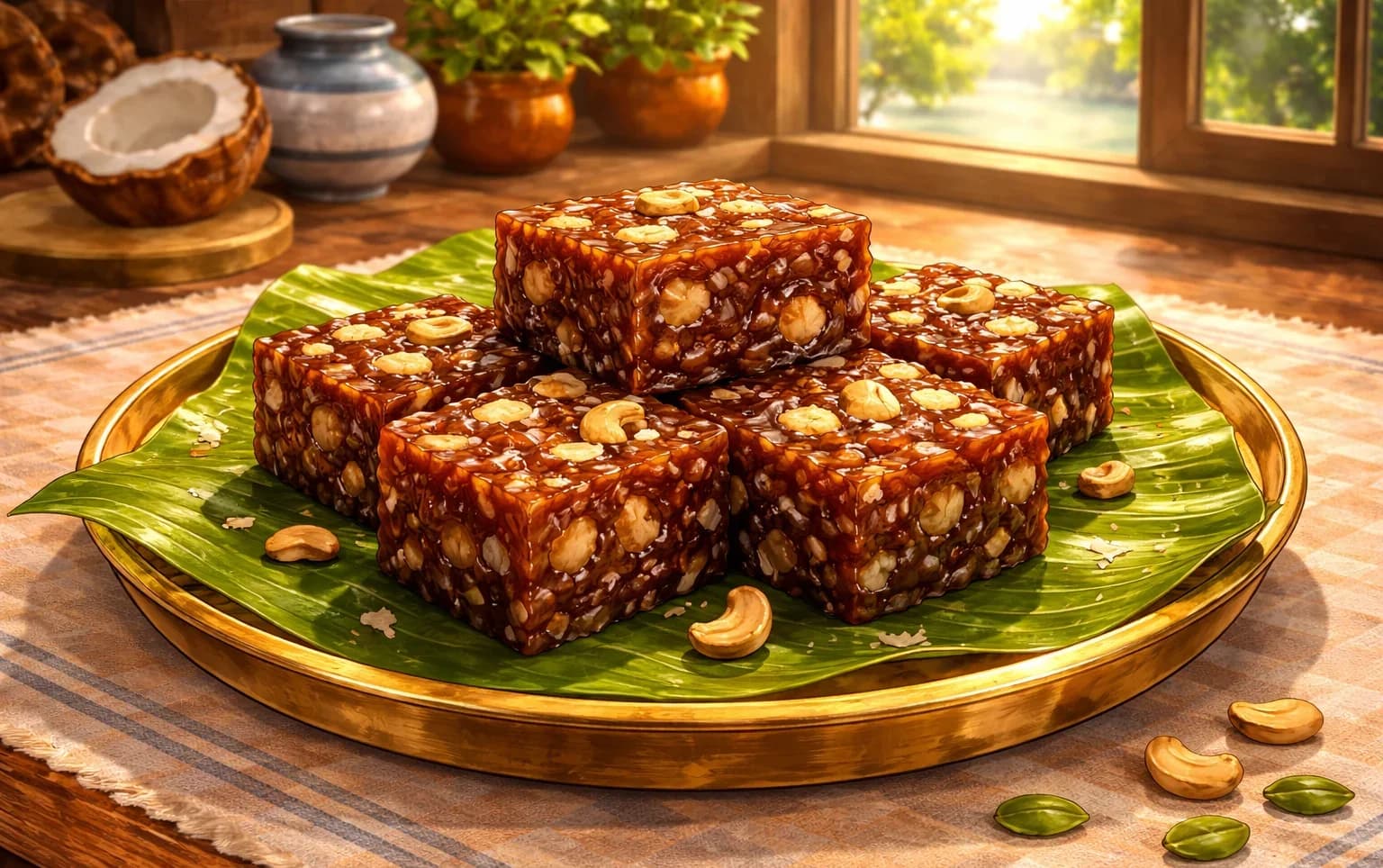
Palm Sugar Sticky Fudge (Dodol)
Goa's Christmas sweet — dense, dark, and built from hours of stirring
Making dodol is a community act. In traditional Goan Catholic households, it is not made alone. The stirring (which goes on for two hours or more over a medium flame) is passed between arms, a relay of effort, because the mixture grows progressively stiffer and heavier as it reduces and the starches develop. Women sit near the stove in shifts, passing the large wooden paddle between them, watching the colour deepen from a pale buff to a dark, molasses-brown. The smell changes too: from raw coconut sweetness to something roasted, almost caramel, with a faint edge of smoke from the palm jaggery.
Dodol appears in multiple cuisines across Southeast Asia and South Asia. Malaysia, Indonesia, Sri Lanka, and the Philippines all have their versions, all connected by the trade routes that moved coconuts and palm sugar across the Indian Ocean. The Goan dodol is part of this extended family, and its presence at Christmas reflects the layered cultural history of the region: an Indigenous Konkani sweet, made for the Portuguese-introduced festival of Christmas, recognisable to a Malaysian or Sri Lankan cook as a cousin of their own tradition.
The three ingredients are precise in their roles. Coconut milk (extracted in two pressings, thin and thick) provides sweetness, fat, and liquid. Palm jaggery (goa jaggery or madd, made from the sap of the toddy palm) provides sweetness that refined sugar cannot match: dark, complex, with a faint bitterness and smoke. Rice flour provides starch, which sets the dodol as it cools from something pourable to something sliceable, firm at room temperature, slightly yielding at the bite.
The cashews go in partway through, so they remain distinct within the set sweet, a textural counter to the dense, chewy matrix.
This is not a recipe for a rushed afternoon. It rewards a clear morning, a strong arm, and the kind of attention that does not look at the clock.
At a Glance
Yield
Approximately 30–40 pieces, depending on cut size
Prep
30 minutes (coconut milk extraction)
Cook
2–2.5 hours (continuous stirring)
Total
3 hours active, plus 4+ hours cooling
Difficulty
Involved
Ingredients
- 3 wholecoconuts (yielding approximately 600–700 ml thick coconut milk and 1 litre thin coconut milk)
- 4½ lbpalm jaggery (*goa jaggery* or toddy palm jaggery), grated or broken into pieces
- 1 lbrice flour (fine ground; ideally from raw rice)
- 4½ ozcashew nuts, roughly chopped
Method
- 1
Extract the coconut milk. Grate the fresh coconut. Place the grated coconut in a muslin cloth or fine strainer, add 150 ml warm water, squeeze and press to extract the first pressing (the thick milk). Set aside. Return the pressed coconut to the cloth, add 600 ml water, squeeze again for the thin milk. You should have approximately 600–700 ml thick milk and 1 litre thin milk.
- 2
Make the flour mixture. In a heavy-bottomed, large, deep pan, whisk together the rice flour (500 g) and the thin coconut milk until fully combined with no lumps. This is your base.
- 3
Begin cooking. Place the pan over medium heat. Begin stirring immediately, using a long-handled wooden spoon or paddle. Do not stop. As the mixture heats, it will begin to thicken. Within 5–8 minutes it will go from liquid to a thick, uniform porridge. Keep stirring: the bottom and edges will catch if neglected.
- 4
Add the jaggery. Once the mixture has thickened to a smooth porridge, add the palm jaggery (2 kg). Stir continuously as the jaggery melts and incorporates. The mixture will loosen slightly as the jaggery dissolves, then begin to thicken again. The colour will shift from pale to dark brown. Watch it deepen with each passing minute.
- 5
Add the thick coconut milk. About 5 minutes after the jaggery is fully incorporated, pour in the thick coconut milk in a slow, steady stream, stirring all the while. The mixture will again loosen momentarily, then begin the long process of reducing and thickening again.
- 6
Add the cashews. After 5 minutes of stirring with the thick milk incorporated, add the chopped cashews. Continue stirring.
- 7
The long stir. This is the heart of the recipe. Continue stirring continuously over medium heat for 1.5 to 2 hours. You are looking for two signs that the dodol is ready: first, the mixture will begin to pull away from the sides and bottom of the pan cleanly as you stir (you will hear a different, slightly sucking sound as the paddle moves); second, small droplets of oil will begin to appear and pool at the surface and edges of the mixture. These are fats released from the coconut milk as the water evaporates. Both signs together mean the dodol is done. Reduce heat to low in the final 20 minutes to avoid scorching the base.
- 8
Pour and set. Lightly grease a flat tray or baking dish with coconut oil. Pour the hot dodol in and spread to an even layer approximately 2.5–3 cm thick. Do not refrigerate. Allow to cool completely at room temperature, at least 4 hours, preferably overnight.
- 9
Cut. Once set, the dodol will be firm but yielding. Cut into squares or diamond shapes with a lightly oiled knife. The pieces should hold their shape cleanly.
Key Ingredient Benefits
Palm jaggery is made from the sap of the toddy palm (Caryota urens or Borassus flabellifer), collected and evaporated without refinement. It retains iron, magnesium, potassium, and B vitamins in small but meaningful quantities. Ayurvedic medicine considers it cooling and purifying, distinct from cane jaggery, which is considered warming. Research into palm sugar's glycaemic index suggests it is lower than refined sugar, though the quantities in a confection like dodol are substantial regardless.
Rice flour from raw (unparboiled) rice gives a smoother, more cohesive texture in this preparation than wheat flour could; the amylopectin content of short-grain raw rice starch sets to a more elastic, chewy matrix, which is exactly the texture dodol should have.
Cashews in traditional Goan cooking are both a flavour ingredient and a marker of festivity. Cashew cultivation has been central to Goa's economy since Portuguese introduction in the 16th century. The nut, the fruit, and the cashew feni (distilled spirit) are all part of the same agricultural heritage.
Why This Works
The thin coconut milk cooks the raw flour and hydrates the starch. This initial stage is essential for even cooking and preventing raw flour taste in the finished sweet. The thick coconut milk, added later, provides the fat needed for the dodol to eventually release from the sides of the pan. Fat release (oil separating from the emulsion) is the chemical signal that the starch is fully cooked and the water content has reduced to the point of a stable confection.
Palm jaggery behaves differently from cane jaggery or refined sugar in this recipe. Its moisture content is lower and its flavour compounds are more complex; it also contributes to the colour more aggressively, which is part of why dodol is so visibly dark.
Substitutions & Variations
- Palm jaggery: Coconut jaggery or dark cane jaggery can substitute. The flavour will be slightly less complex, but the technique remains the same. Do not use refined sugar; the dodol will lack depth and the colour will be too pale.
- Coconut milk: Fresh extraction is strongly preferred for this recipe. Canned coconut milk can be used in an emergency: use one can (400 ml) as the thick milk and dilute another with equal water for the thin. The flavour will be noticeably different.
- Rice flour: Use fine rice flour, not coarse or glutinous rice flour. Glutinous rice flour (also called sticky rice flour) will produce a different, more uniformly sticky texture. Both are acceptable, but the traditional Goan dodol uses raw rice flour.
Serving Suggestions
Dodol is a standalone sweet, served in small squares after a meal, offered with tea, or packed as a gift. In Goan Christmas tradition, it is made days ahead and given to neighbours and family, individually wrapped in greaseproof paper.
It pairs quietly with strong black tea or a small glass of Goan feni (cashew or coconut spirit), the bitterness of both cutting through the density of the sweet.
Storage & Reheating
Dodol keeps at room temperature in an airtight container for up to 5–7 days, and refrigerated for up to 3 weeks. In Goa, where dodol is made weeks before Christmas, it is stored at room temperature wrapped in greaseproof paper; the high sugar and fat content acts as a natural preservative.
Do not freeze; freezing breaks the emulsion and causes the texture to become grainy on thawing. Dodol does not need reheating; it is always served at room temperature.
Cultural Notes
Dodol (दोदोल) in the Indian context refers to the Goan Christmas-season confection of coconut milk, jaggery, and rice flour slowly cooked together over low heat for hours with constant stirring until the mixture transforms into a thick dark sticky toffee-like sweet that cuts into firm squares once cooled. The dish belongs to the Goan Christmas consoada (the Christmas sweet box tradition) alongside bebinca, kulkuls, neureos, doce de grão, and the broader Goan Christian sweets canon that the Portuguese colonial era and its Goan adaptations produced. The Goan dodol traveled to Goa through the broader Portuguese-Asian trading network that connected the Goan port city with Portuguese trading posts in Malacca, Indonesia, and Sri Lanka, where related dodol traditions exist.
The dish's wider Asian distribution is documented in food-history scholarship. The Indonesian dodol (also called jenang in Java), the Malaysian dodol, the Sri Lankan kalu dodol (the Sinhalese version), and the Philippine kalamay are all related confections built on the same technical principle of slow-cooking coconut milk, rice flour, and palm sugar or jaggery until the mixture caramelizes and thickens into a chewy sticky sweet. The technique probably moved through the trading routes that connected coastal South Asia with island Southeast Asia from the medieval Islamic merchant period through the European colonial era, with each regional variant adapting to local available ingredients and tastes. The Goan version specifically uses Goan palm jaggery (with its distinctive smoky-toffee flavor) and adds cashew nuts (Goa being a major Indian cashew-producing region), while the Sri Lankan version often adds coriander and a small amount of dark Sri Lankan kithul jaggery for a deeper flavor.
The technique demands patience and continuous stirring. Coconut milk (both thin and thick, used in succession) is the base liquid: thin coconut milk first, brought to a simmer in a heavy wide pot. Rice flour is whisked into a small portion of cold coconut milk to form a slurry, then added to the simmering pot to thicken the base. Jaggery (powdered or chopped) is added and dissolved into the mixture. The pot is reduced to low heat, and the mixture is stirred continuously with a long wooden spoon for two to three hours, with thick coconut milk added gradually as the mixture reduces and thickens. The stirring is the labor-intensive heart of the dish: any pause allows the mixture to stick to the bottom and burn, ruining the entire batch. The mixture moves through several stages: thin pourable liquid, thick pourable batter, thick sticky mass, and finally a dark glossy toffee-like consistency that pulls away from the sides of the pot. Chopped cashews are added for the Goan version, and the hot mixture is poured into a greased flat tray, smoothed level with a spatula, and cooled completely. The cooled slab is cut into small squares with a knife greased with ghee. The dish keeps for several weeks in an airtight tin.
Nutrition Facts
Calories: 1618kcal (81%)|Total Carbohydrates: 308g (112%)|Protein: 11g (22%)|Total Fat: 44g (56%)|Saturated Fat: 33.1g (166%)|Cholesterol: 0mg (0%)|Sodium: 99mg (4%)|Dietary Fiber: 5.3g (19%)|Total Sugars: 168.4g
You Might Also Like
Ratings & Comments
Ratings & Comments
Ratings
Share your thoughts on this recipe.
Sign in to rate and comment