Andhra · Indian Cuisine
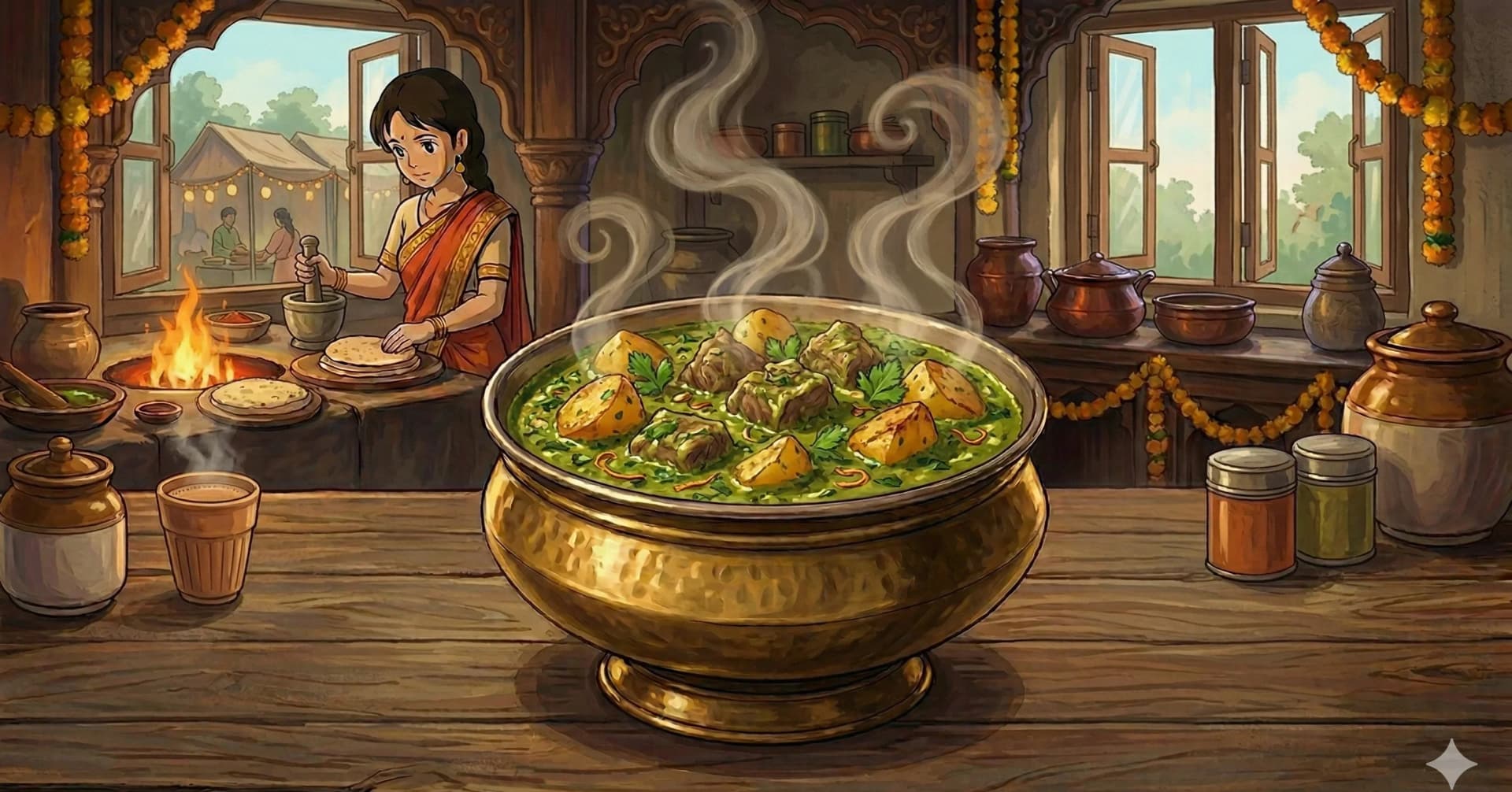
Hyderabadi Lamb Korma
Lamb braised in yogurt, ground nuts, and fragrant whole spices — the Nizam's korma
There are kormas and then there is the Hyderabadi korma. The word comes from the Turkish kavurma — to braise — but in the hands of the Nizam's cooks, the technique became something far more elaborate: yogurt-braised meat suspended in a sauce thickened not with cream or flour but with a ground paste of chironji, almonds, poppy seeds, and dry coconut. The result is a gravy of extraordinary complexity — pale, slightly grainy in the way of ground nuts, faintly sweet at the edges, deeply aromatic, with a warmth from red chilli that builds slowly rather than strikes.
Hyderabad sits at the crossroads of the Persian-Mughal culinary tradition of the north and the coconut-and-dried-nut traditions of the Deccan and deep South. This korma is where those two worlds converge. The whole spices (cardamom, cinnamon) are Mughal; the generous hand with coriander and mint, the green chillies woven through, the coconut in the masala paste, are unmistakably Deccan. Neither dominates. The dish achieves a kind of equilibrium that took centuries of royal kitchens to find.
The hara masala — the paste of fresh coriander, mint, and green chillies — is the detail that separates this from a Mughal korma. Ground and stirred in mid-cook, it turns the gravy a faint celadon and introduces a brightness that keeps the dish from feeling heavy, despite the richness of the nut paste and ghee. Saffron added near the end is not decoration; its earthy, almost metallic perfume weaves into the sauce and gives the finish a dimension that no substitute can replicate.
The potatoes are traditional and important. They absorb the spiced ghee and sauce as they cook, becoming better than any potato cooked any other way.
At a Glance
Yield
Serves 4
Prep
25 minutes
Cook
1 hour 30 minutes
Total
1 hour 55 minutes
Difficulty
Involved
Ingredients
Nut Paste Ingredients
- 3½ ozchironji (*charoli*), soaked in warm water for 15 minutes and drained
- 1¾ ozblanched almonds
- 3½ tbsppoppy seeds (*khus khus*), soaked in warm water for 15 minutes and drained
- 1 ozdry desiccated coconut
Herb Paste Ingredients
- 10⅓ cupfresh coriander (leaves and tender stems), roughly chopped
- 6 cupfresh mint leaves
- ⅓ cupgreen chillies (about 6–8 medium), roughly chopped
Curry Ingredients
- 1 lbbone-in lamb shoulder or leg, cut into 4 cm (1½ inch) cubes
- ½ cupghee
- ½ lbwaxy potatoes (about 1½–2 potatoes), peeled and quartered
- 7 ozonion (about 2 medium), finely sliced
- 4–5green cardamom pods, lightly bruised
- 1 stickcinnamon (about 5 g / 5 cm)
- 2 tspginger-garlic paste
- ⅓ tspturmeric powder
- 7 ozfull-fat yogurt, beaten smooth
- 1¾ tbspred chilli powder
- ¾ ozcaraway seeds (*shahi jeera*)
- 1⅔ tspfine salt, plus more to taste
- ⅞ cupwater, plus extra as needed
- —A large pinch of saffron (about ⅛ g), steeped in 2 tablespoons warm water for 10 minutes
Method
- 1
Make the nut paste. After soaking the chironji (100 g) and poppy seeds (30 g), drain and combine them with the blanched almonds (50 g) and dry coconut. Add 4–5 tablespoons of water (200 ml) and blend to a smooth, thick paste — the texture of marzipan. Set aside.
- 2
Make the hara masala paste. Blend the fresh coriander (200 g), mint (100 g), and green chillies (6–8 medium) with a splash of water to a smooth bright-green paste. Set aside.
- 3
Fry the potatoes. Heat the ghee (7 tablespoons) in a large, heavy-bottomed pot (a Dutch oven or a heavy karahi) over medium-high heat. Add the potato quarters and fry, turning occasionally, for 8–10 minutes until golden on most surfaces and just beginning to soften at the edges. Remove with a slotted spoon and set aside on a plate. Leave the ghee in the pot.
- 4
Bloom the whole spices. In the same ghee over medium heat, add the cardamom and cinnamon (1 stick). Let them sizzle for 30–45 seconds — they will puff slightly and begin to release their fragrance into the fat.
- 5
Caramelise the onions. Add the sliced onions to the pot and increase the heat to medium-high. Cook, stirring regularly, for 18–22 minutes until they are a deep, even golden brown and smell faintly of caramel. Do not rush this — pale onions will give a flat, raw-tasting korma.
- 6
Build the base. Reduce the heat to medium. Add the ginger-garlic paste (2 teaspoons) and turmeric (¼ teaspoon) and stir constantly for 1–2 minutes until the raw smell of garlic gives way to something sweet and rounded. Add the red chilli powder (2 teaspoons) and stir for another 30 seconds.
- 7
Cook in the yogurt. Beat the red chilli powder into the yogurt before adding, then pour the yogurt into the pot in a slow, steady stream, stirring continuously as you pour. This prevents the yogurt from splitting. Continue to cook over medium heat, stirring frequently, for 12–15 minutes until the ghee separates and floats in orange-red pools on the surface of the mixture. This separation is the sign that the base is fully cooked and ready for the meat.
- 8
Add the lamb. Increase the heat to medium-high and add the lamb pieces. Sauté, turning the pieces to coat them thoroughly in the base, for 6–8 minutes until the lamb is sealed on all surfaces and the mixture is fragrant and beginning to stick slightly to the base of the pot. Add the caraway seeds (20 g) and stir through.
- 9
Add the hara masala. Stir in the hara masala paste and cook for 3–4 minutes, stirring, as it loses its raw brightness and melds with the base. The colour of the mixture will shift toward a warm olive-green.
- 10
Add the nut paste and water. Stir in the ground nut-spice paste, then add 200 ml of water and the salt (2 teaspoons). Stir everything together and bring to a gentle simmer. Reduce the heat to low, cover partially, and cook for 40–50 minutes, stirring every 10 minutes and adding small splashes of water as needed if the gravy begins to stick. The lamb is ready when it is tender enough that a piece yields easily to gentle pressure but still holds its shape.
- 11
Wait for ghee to surface, then add potatoes and saffron. When the ghee rises again to the surface of the gravy — the second signal that the base is fully cooked and the flavours have integrated — add the fried potatoes and the saffron steeped in warm water. Stir gently, cover, and continue cooking for a further 15–20 minutes until the potatoes are completely cooked through and have absorbed the spiced gravy.
- 12
Taste and serve. Adjust for salt. The gravy should be thick, glossy, and coating — not watery. If it is too loose, remove the lid and cook over medium heat for a few minutes to reduce. Serve immediately.
Key Ingredient Benefits
Chironji (Buchanania lanzan, also called charoli) is a small, almond-flavoured seed native to India, used extensively in Mughal and Hyderabadi cooking as a thickener and enricher. It has a mild, slightly sweet flavour with less fat than almonds and a particularly clean paste quality. In Ayurveda, chironji is considered a cooling food, traditionally used in preparations for skin and respiratory health; research into its composition shows it is high in oleic acid and plant protein. Its culinary role here is primarily textural and enriching.
Poppy seeds (khus khus) are used in Indian cooking as a thickening agent rather than as a flavour driver — they have an almost neutral, slightly nutty flavour when ground into paste. They are high in calcium and essential fatty acids. In Unani medicine, they are considered calming; Ayurveda classifies them as cooling and grounding. Culinary doses (30 g in a dish for four people) are well within normal food use.
Saffron (Kesar) is the world's most expensive spice by weight and one of the oldest cultivated plants in human history. In Unani medicine, it is considered warming, mood-elevating, and digestive; research suggests its active compounds may have mild antidepressant effects at supplemental doses, though dietary use in cooking delivers far smaller amounts. Its role in this dish is primarily aromatic — a few threads transform the colour and scent of an entire pot.
Ghee functions here both as the cooking fat and as a flavour ingredient. Its high smoke point (around 250°C) makes it ideal for the sustained high-heat frying of onions and potatoes. Traditional Ayurvedic medicine considers ghee a sattvic food — one that supports clarity and digestion — and it has been rehabilitated in modern nutrition as a source of short-chain fatty acids and fat-soluble vitamins. Used in the quantities here, it provides flavour and a coating richness to the finished sauce.
Why This Works
The two-stage ghee separation — first after the yogurt is cooked in, and again after the nut paste and lamb have simmered — is a structural principle of North Indian braising, not a happy accident. When the fat separates from a water-based mixture, it signals that sufficient moisture has evaporated and that the Maillard reaction has had the opportunity to develop properly at the base of the pan. Each time ghee surfaces, the cook knows the flavours have had time to concentrate and that the base is stable enough to accept the next layer of ingredients without turning thin or sour.
The nut paste serves multiple functions simultaneously. Chironji, almonds, and poppy seeds all contribute fat and protein that emulsify into the gravy and create body without any starch thickening. Dry coconut adds a subtle sweetness and another layer of fat that makes the final sauce glossy. Because the paste is added mid-cook rather than at the end, the nuts lose their raw flavour completely, becoming part of the background architecture rather than a detectable flavour note.
Caraway seeds (shahi jeera) rather than common cumin are a characteristic Hyderabadi choice. Their flavour is more complex and faintly camphor-like, less sharp than ordinary cumin. They contribute warmth and an aromatic lift that ties the dish firmly to the Nizam's court cooking tradition.
Saffron added near the end is deliberate. Its active flavour compounds (safranal and picrocrocin) are fragile and would be mostly lost in a long cook. Added late, steeped in warm (not boiling) water to activate their colour and scent, they perfume the sauce with their characteristic warm, slightly honey-and-hay quality that makes the final dish unmistakably luxurious.
Substitutions & Variations
No chironji: Replace with an equal weight of raw cashews. The paste will be slightly richer and less delicate, but the result is still excellent. Soak the cashews as you would the chironji.
Lamb to goat: Traditional versions often use goat (bakra) on the bone — the same quantity, same cooking time. The flavour is more intense; the texture slightly firmer.
Lamb to chicken: Use bone-in chicken pieces (about 800 g for 4 people). Reduce the final braising time to 25–30 minutes total. The gravy will be lighter and the dish more delicate.
Lighter version: Reduce ghee to 50 g and supplement with 2 tablespoons of neutral oil. The korma will be slightly less rich but structurally similar.
Spice level: At 10 g red chilli powder, the dish has a present but not aggressive heat. Reduce to 5 g for a milder korma; increase to 15 g for more pronounced warmth.
Serving Suggestions
Hyderabadi lamb korma is traditionally served with sheermal — a slightly sweet, saffron-tinged leavened flatbread — or with bakarkhani, the layered, crisp-edged bread of the Nizam's court. For a home cook, good-quality naan or even plain roti serves the sauce well. Plain steamed basmati rice is equally appropriate and perhaps more practical for a weekday meal.
Alongside, serve a simple raita of beaten yogurt with thinly sliced cucumber and a pinch of roasted cumin — its coolness and acidity provide relief from the korma's richness. A small salad of thinly sliced raw onion dressed with lemon juice and a scatter of chaat masala acts as a palate-cleanser between bites.
Storage & Reheating
The korma improves overnight as the nut paste fully integrates with the braising liquid and the lamb continues to tenderise in the gravy. Refrigerate in a sealed container for up to 3 days. Reheat gently in a pot over medium-low heat with a splash of water (2–3 tablespoons), stirring occasionally — the nut paste can cause the gravy to thicken significantly as it cools. Freezes well for up to 6 weeks; defrost overnight in the refrigerator before reheating. The potatoes may soften further after freezing but will retain their flavour.
Cultural Notes
Hyderabadi lamb korma (हैदराबादी लैम्ब कोरमा) is the Hyderabadi lamb preparation built on the same Nizami korma technique that anchors the murgh-nizami chicken version: yogurt, fried onions ground into a paste with cashews or almonds, ginger-garlic, Hyderabadi spices, and a slow dum cook that lets the flavors meld over thirty to forty-five minutes. The dish appears at Hyderabadi family kitchens, at Hyderabadi wedding feasts and Eid celebrations, and at the Hyderabadi restaurants that have spread from the Old City to Mumbai, Delhi, and the broader Hyderabadi diaspora restaurants in the United Kingdom and the Gulf.
The Hyderabadi korma distinguishes itself from the Delhi-Lucknow Mughlai korma tradition in several specific ways. Hyderabadi versions use a slightly higher proportion of fried onion to nut paste, which gives a deeper caramelized sweetness and a darker color. The spice mix leans more heavily on black pepper and a small amount of Kashmiri red chili compared with the Mughlai preference for cardamom and mace dominance. The dish also incorporates the Hyderabadi technique of finishing with fresh coriander, mint, and a squeeze of lime, reflecting the Telugu and Andhra influence on Hyderabadi cooking that softens the heavy Persian-Mughlai base with brighter southern aromatics. Pratibha Karan's Hyderabadi Cuisine (2003) and Bilkees I. Latif's The Essential Andhra Cookbook (1999) document the regional variations within the Hyderabadi korma family.
The technique requires patience and gentle heat. Bone-in lamb pieces (shoulder, leg, or a mix) are marinated in yogurt, ginger-garlic paste, and salt for at least two hours, ideally overnight. Onions are sliced thinly and deep-fried until dark brown and crisp, then ground with cashews into a smooth paste. The marinated lamb is sautéed in ghee until lightly colored, then the onion-cashew paste, Hyderabadi spice mix (cinnamon, cardamom, cloves, black pepper, Kashmiri red chili, a small amount of mace), and a small amount of water are added. The pot is sealed with a tight-fitting lid (or traditionally with a flour-and-water dough seal around the rim, the purdah dum) and cooked over very low heat for an hour, with the lid occasionally lifted to give the pot a gentle stir. The dish is finished with a scatter of cilantro, mint, and a small drizzle of cream, and served with hyderabadi-biryani, naan, or basmati rice.
Nutrition Facts
Calories: 857kcal (43%)|Total Carbohydrates: 29.5g (11%)|Protein: 38g (76%)|Total Fat: 65.5g (84%)|Saturated Fat: 27g (135%)|Cholesterol: 136mg (45%)|Sodium: 547mg (24%)|Dietary Fiber: 7.3g (26%)|Total Sugars: 7.8g
You Might Also Like
Ratings & Comments
Ratings & Comments
Ratings
Share your thoughts on this recipe.
Sign in to rate and comment