Indian Cuisine
Momos
Thin-skinned steamed dumplings with a juicy, ginger-bright filling
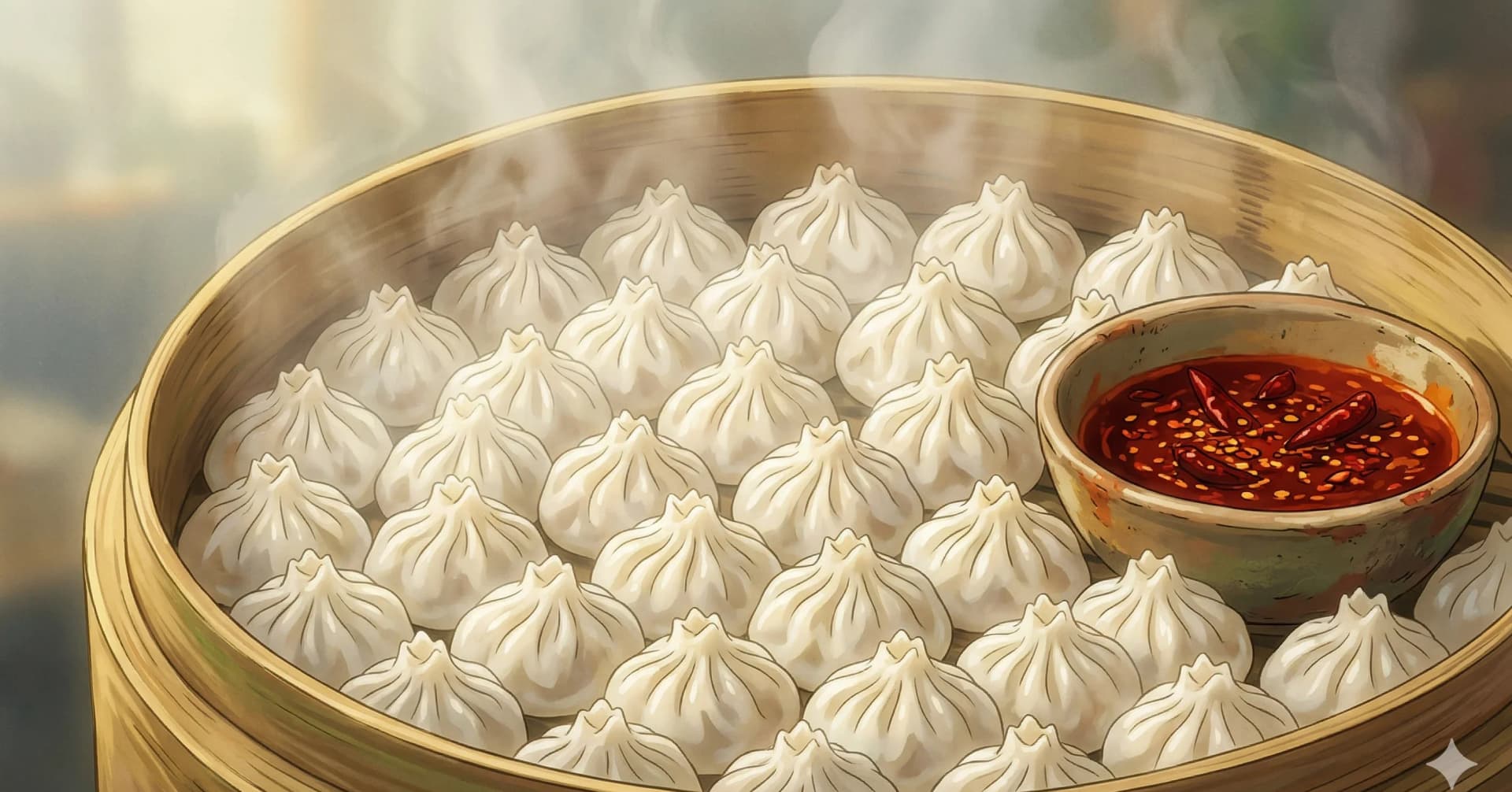
The first sign that momos are ready is the steam: steady white plumes rising from a bamboo basket, filling a small kitchen with the clean, sharp smell of ginger. When you lift the lid after twelve minutes and find the skins translucent, pulled tight over the filling like a second skin, there is a particular satisfaction that belongs entirely to this kind of cooking.
Momos arrived in India's northeastern states (Sikkim, Darjeeling, Assam, Nagaland) through Tibetan and Nepali communities, and they have since migrated everywhere: to Delhi's street stalls, to Mumbai's hawker carts, to canteens from Shillong to Bengaluru. The word itself is Tibetan, and the dumpling tradition reaches back through the Himalayas to Central Asian and Chinese dumpling lineages. What makes the Indian version distinct is a filling often seasoned with soy sauce and sesame alongside fresh ginger and garlic, giving it a bright, aromatic quality different from its Chinese cousins.
The dough demands respect. It should be stiff, noticeably firmer than pasta dough, because a too-soft wrapper will tear during pleating and turn soggy under steam. The rest period is not optional; gluten needs time to relax before the dough will roll thin enough to be nearly translucent. Roll each wrapper individually rather than cutting with a glass: hand-rolled wrappers have uneven thickness, slightly thicker in the center and thinner at the edge, which is exactly what you want for even cooking and a good pleat.
The filling must be wet enough to stay juicy after steaming. Dry mince makes dry momos, and that is the most common failure. A generous hand with ginger, garlic, and sesame oil makes all the difference.
At a Glance
Yield
30–35 momos
Prep
50 minutes (including 30-minute dough rest)
Cook
15 minutes
Total
1 hour 5 minutes
Difficulty
Medium
Ingredients
Dough Ingredients
- 4 cupplain flour (maida)
- 1 cupwarm water
- 1 tspneutral oil
- —Pinch of salt
Filling Ingredients
- ¾ lbchicken mince (or vegetable mince: finely chopped mushroom, tofu, and cabbage)
- 3½ ozcabbage, very finely chopped
- 1¾ ozonion, finely chopped
- ⅓ cupfresh ginger, grated
- 3¼ tbspgarlic (about 6 cloves), finely minced
- 1¼ tbspsoy sauce
- 2 tspsesame oil
- ⅓ cupspring onions, finely sliced
- ⅞ tspsalt
- 1¼ tspblack pepper, freshly ground
Method
- 1
Make the dough. Combine flour (500 g) and salt (1 tsp) in a large bowl. Add warm water gradually, mixing with your hands until a shaggy dough forms. Turn onto a surface and knead for 8–10 minutes until smooth and fairly stiff. It should feel like soft clay, not like bread dough. Brush lightly with oil, cover with a damp cloth, and rest for 30 minutes.
- 2
Make the filling. Combine chicken mince (300 g), finely chopped cabbage (100 g), onion (50 g), ginger (30 g), garlic (6 cloves), spring onions (20 g), soy sauce (20 ml), sesame oil (10 ml), salt, and pepper (1 tsp). Mix well, really getting in with your hands to ensure everything is evenly distributed. The filling should feel moist. Taste and adjust salt. If using vegetable mince, squeeze out any excess moisture from the cabbage and mushroom before combining.
- 3
Portion the dough. Divide the rested dough into small balls, roughly 15–18 g each (about the size of a large marble). Keep covered as you work.
- 4
Roll the wrappers. On a lightly floured surface, roll each ball into a thin circle about 8–9 cm in diameter. The center should be slightly thicker than the edges, which prevents tearing at the base when steaming. Roll a few at a time, keeping unused portions covered.
- 5
Fill and pleat. Place a heaped teaspoon of filling (about 10–12 g) in the center of a wrapper. Lift the edge and begin pleating: pinch a small fold of dough between thumb and forefinger, then fold the next bit of dough over and pinch again, working around the circle to create a gathered, sealed top. Twist slightly at the top to seal completely. A half-moon fold sealed with a simple crimp along the edge is an equally valid alternative if pleating feels difficult.
- 6
Steam. Line a steamer basket with baking paper or cabbage leaves (to prevent sticking). Arrange momos with small gaps between them (they will expand). Steam over vigorously boiling water for 12–15 minutes. The skins will go from opaque white to translucent. Pierce one with a skewer; the juices should run clear.
- 7
Serve immediately. Momos deteriorate quickly as they cool; the skins toughen. Serve direct from the steamer with a sharp dipping sauce.
Key Ingredient Benefits
Ginger provides the defining sharp, bright heat in momos. Fresh ginger (not powdered) is essential here. Its volatile gingerols give a clean, almost citrus-edged warmth that powdered ginger cannot replicate. Ginger has well-documented anti-nausea properties and is traditionally used across Himalayan preparations as both flavouring and digestive aid.
Sesame oil (toasted) is used as a finishing flavour rather than a cooking medium. Its nutty, complex aroma comes from sesamol and sesaminol, antioxidant compounds that also contribute to the oil's stability.
Garlic provides pungency and depth. Its allicin (the sulphur compound responsible for its sharp smell) forms only when garlic is cut or crushed and is partially destroyed by heat, so raw garlic in a steamed filling retains more of its aromatic bite.
Cabbage adds textural contrast, moisture, and mild sweetness. It's a cruciferous vegetable, and in momos it plays a culinary role above all else.
Chicken mince provides lean protein and, crucially, fat. The intramuscular fat in chicken thigh mince (preferred over breast for momos) keeps the filling succulent after steaming.
Why This Works
The stiff dough is a deliberate choice. Lower hydration means less steam absorption during cooking, which keeps the skin from going waterlogged. The gluten network in a stiff dough is also stronger, allowing the wrapper to be rolled thinner without tearing. Critical for that characteristic delicate bite.
Cabbage in the filling does two things: it adds bulk and a mild sweetness, and its water content releases during cooking, creating the juicy interior that distinguishes a great momo from a dry one. Salting and squeezing the cabbage (for vegetarian versions especially) gives you control over exactly how much moisture ends up in the filling. For meat versions, the fat in chicken mince provides sufficient lubrication naturally.
Sesame oil is added raw, not cooked. Its delicate aroma compounds are volatile and would be lost under heat. Added to the filling before steaming, it perfumes the meat gently from within, the steam carrying its fragrance into the wrapper. The soy sauce both seasons and tenderises the protein, its glutamates amplifying the savouriness of the filling.
Substitutions & Variations
- Vegetarian/vegan momos: Replace meat with a mixture of finely chopped mushroom (shiitake or button for umami depth), firm tofu crumbled fine, and shredded cabbage. Squeeze moisture from all components before mixing. Add a small spoon of miso or extra soy sauce for depth.
- Pork momos: Traditional Tibetan momos are often made with pork. Fatty pork shoulder mince gives an even juicier filling and a more complex flavour.
- Pan-fried momos (kothe): After steaming, fry the flat base in a hot oiled pan until deeply golden. The crisp base against the soft steamed skin is one of the great textural contrasts of Northeast Indian cooking.
- Jhol momo: A Nepali-Darjeeling variant served submerged in a thin, sesame-rich broth with tomato and chilli.
- Chilli momos: Toss steamed momos in a sauce of tomato, Kashmiri chilli, and garlic for a spicier street-food treatment popular in Delhi.
Serving Suggestions
Momos are inseparable from their dipping sauce. The classic Darjeeling-style accompaniment is a vivid red sauce made from roasted tomatoes, dried red chillies, garlic, and a touch of ginger, blended smooth and slightly chunky, fiercely hot and bright. A schezwan-style sauce or a thin green chutney of coriander and mint also works well. Serve straight from the steamer basket with sauce on the side; the ritual of dipping each momo, biting carefully so as not to lose the hot juice, is part of what makes them so compelling.
Storage & Reheating
Cooked momos are best eaten immediately; they toughen noticeably within 30 minutes. Uncooked, filled momos can be frozen on a tray until solid (about 2 hours), then transferred to a sealed bag and frozen for up to 1 month. Steam from frozen, adding 4–5 minutes to the steaming time. Do not thaw first. Leftover cooked momos reheat well when pan-fried from cold in a little oil until the skins are crispy and the interior is hot through.
Cultural Notes
Momos (मोमो) are the Tibetan and Nepali steamed or fried dumplings that have spread across India over the past century to become one of the most widely consumed street foods of the urban Indian belt. The dumplings consist of a thin wheat-flour wrapper enclosing a filling of minced meat (chicken, lamb, or pork) or vegetables (cabbage, carrot, onion, paneer), shaped by hand into round pleated or half-moon parcels, and steamed in bamboo or metal multi-tier steamers for ten to twelve minutes. The dish is paired with a fiery red dipping sauce (the momo chutney of ground red chilies, garlic, vinegar, and tomato) that has become as iconic as the dumplings themselves.
The dish's spread reflects the migration patterns of Himalayan communities into mainland India. Tibetan refugees who arrived in India after the 1959 Tibetan uprising (settling in Dharamshala, Bylakuppe, and Darjeeling) brought their dumpling tradition with them, and the dish spread through Nepali Gorkha communities in Darjeeling, Sikkim, Kalimpong, and West Bengal during the late twentieth century. From these Himalayan strongholds momos traveled to Delhi, Mumbai, Bangalore, and the broader urban Indian belt through small Tibetan-Nepali restaurants and street stalls, often run by migrant workers from Sikkim, Darjeeling, and Nepal. The Indianization of the dumpling included the development of the fried-momo variant (deep-fried after steaming for a crisp exterior), the tandoori momo (grilled momos with yogurt marinade), and the chocolate momo (the dessert variant filled with chocolate that emerged in Indian street stalls of the 2010s). The dumpling remains identifiably Tibetan-Nepali in its core form despite the regional adaptations.
The technique requires careful wrapper-making and pleating. A wheat-flour dough is mixed with water, kneaded smooth, and rested for thirty minutes. The dough is divided into small balls (about the size of a marble) and rolled out into thin round wrappers (about three inches across), with the edges slightly thinner than the center (the center holds the filling weight while the edges fold and pleat). A filling is prepared from minced meat or chopped vegetables, mixed with chopped onion, ginger paste, garlic paste, soy sauce, salt, white pepper, and a small amount of vegetable oil for moisture. A teaspoon of filling is placed in the center of each wrapper. The pleating technique varies: the round pleated style gathers the edges into a topknot, the half-moon style folds the wrapper into a crescent and pleats one edge. The shaped momos are arranged in a steamer lined with cabbage leaves (or oiled lightly so they don't stick), and steamed over boiling water for ten to twelve minutes. The momos are served immediately with the fiery red dipping sauce on the side.
Nutrition Facts
Calories: 346kcal (17%)|Total Carbohydrates: 57.6g (21%)|Protein: 15.4g (31%)|Total Fat: 5.3g (7%)|Saturated Fat: 1.3g (7%)|Cholesterol: 36mg (12%)|Sodium: 211mg (9%)|Dietary Fiber: 2.6g (9%)|Total Sugars: 1.1g
You Might Also Like
Ratings & Comments
Ratings & Comments
Ratings
Share your thoughts on this recipe.
Sign in to rate and comment