Indian Cuisine
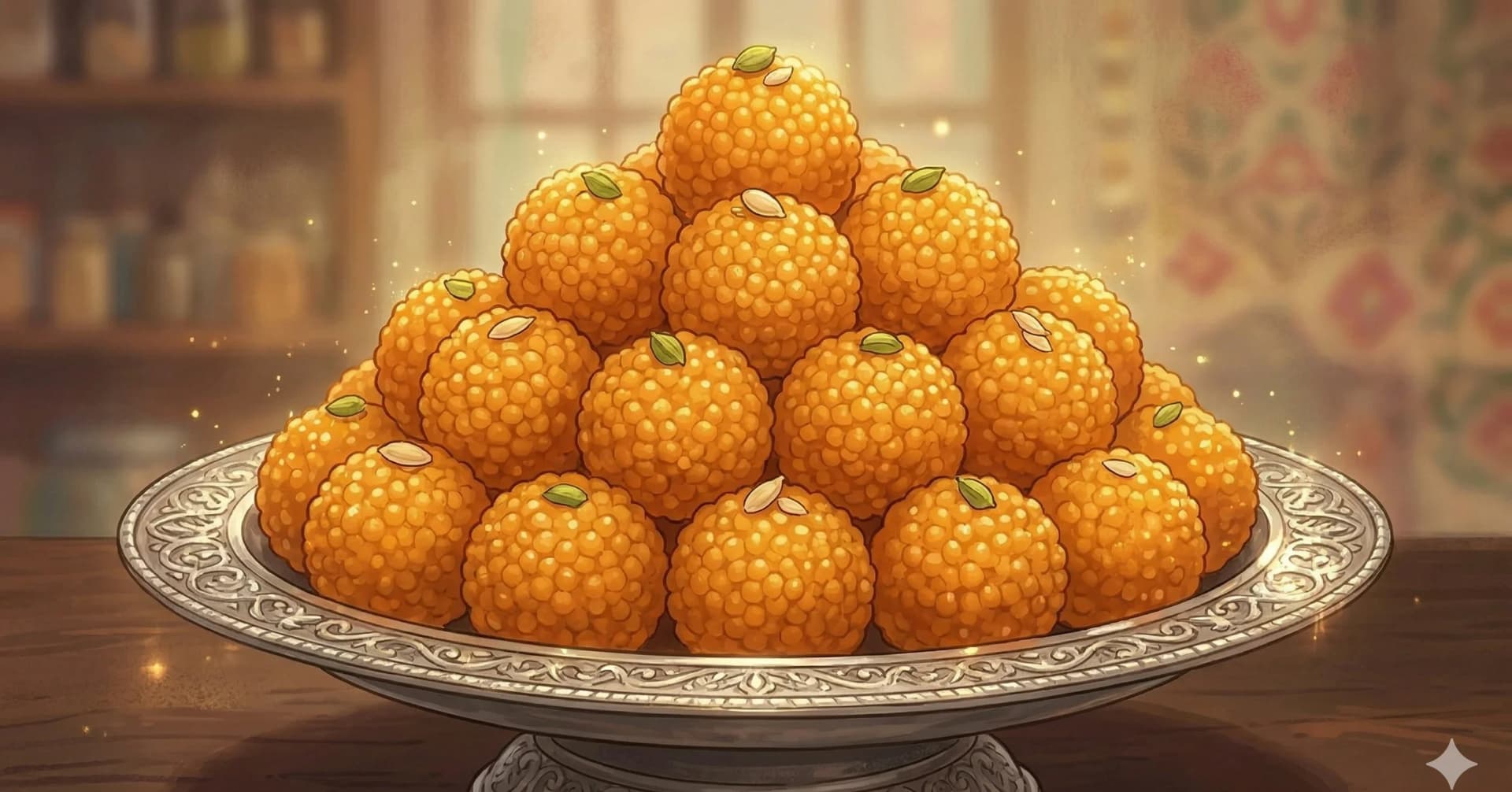
Fine Boondi Sweets (Motichoor ke Ladoo)
Saffron-Tinged Chickpea Flour Ladoo with Cardamom and Melon Seeds
Motichoor ke ladoo are named for the texture of their interior. Moti means pearl, choor means crushed or broken, and inside every smooth round ladoo is a mass of the finest possible boondis: those tiny droplets of chickpea flour batter fried until just cooked and then immediately soaked in warm sugar syrup until they drink it in and soften. When you press the mass of syruped boondis together in your palms while it is still warm, the individual droplets bind to one another and can be shaped. As they cool, they set into a sphere that holds its form.
The sweet has deep religious and ceremonial significance across North India. Motichoor ke ladoo are the prasad most associated with Ganesh puja. Lord Ganesha's fondness for ladoos is documented in iconography across the country, where he is often depicted holding or eating one. They are distributed at weddings, presented as offerings at temples, given to guests at celebrations from births to housewarming ceremonies. A box of motichoor ladoos is both gift and blessing.
The tradition is rooted in Rajasthan and Uttar Pradesh, where halwais have refined the art of boondi-frying over generations. The characteristic orange colour, which ranges from pale gold to vivid turmeric-orange depending on the maker, comes from a small amount of food-grade colour added to the batter; some traditional recipes use saffron water instead.
What these ladoos deliver is an extraordinarily fine crumb: delicate, barely sweet, with cardamom running through every bite and the faint crunch of melon seeds. They dissolve almost as soon as they reach the tongue.
The practical insight: the key variables are batter consistency and frying temperature. The batter must be smooth and of a specific flowing consistency, thin enough to drip through the perforated spoon in small droplets but not so thin that the droplets spread. The oil must be hot enough to set the boondis quickly but not so hot that they brown and crisp. Adjust both before you commit to a full batch.
At a Glance
Yield
4 servings (approximately 12–14 small ladoos)
Prep
30 minutes
Cook
35 minutes
Total
65 minutes
Difficulty
Medium
Ingredients
- 2¼ cupbesan (chickpea flour / gram flour), sifted
- —Approximately 175–200ml water (added gradually to reach correct consistency)
- —A pinch of food-grade orange or yellow food colour (optional; traditionally used for the characteristic colour. Alternatively, steep a pinch of saffron in 2 tbsp warm water and use as part of the measured water)
- —Ghee or neutral oil for frying (enough to fill a karahi or wide pan to a depth of 8–10cm)
- ¾ cupwhite sugar
- ⅓ cupwater
- 3–4green cardamom pods, lightly crushed (or a small pinch of cardamom powder added later)
- 2½ tspgreen cardamom powder
- ¾ ozmelon seeds (chironjee / charoli seeds), lightly rinsed
Method
- 1
Make the batter. Sift the besan into a wide bowl. Gradually add water, whisking continuously, until you have a smooth, lump-free batter. The correct consistency is crucial: the batter should flow off the back of a spoon in a thin, steady stream, thicker than water but thinner than pancake batter. When you hold the perforated spoon over the bowl and pour a little batter through, the drops should fall freely and separately, not in a thick stream. If it is too thick, add water by the teaspoon. If too thin, add a small amount of sifted besan. Add the food colour or saffron water at this stage and mix well.
- 2
Prepare the frying setup. Heat the ghee or oil in a karahi or deep pan over medium heat to approximately 170–180°C. To test without a thermometer: drop a tiny amount of batter into the oil. It should sizzle immediately, rise to the surface, and turn pale gold in about 20 to 25 seconds. Not brown (too hot) and not sluggish (too cool).
- 3
Fry the boondis. Hold the perforated spoon directly over the hot oil, about 8–10cm above the surface. Pour a ladleful of batter over the spoon so that it drips through the holes in small round droplets directly into the oil. The boondis should be small, round, and drop freely without tails. (If the batter is forming teardrop shapes rather than spheres, the batter is slightly too thick. Add a few drops of water.) Fry in small batches for about 20 to 25 seconds, until the boondis are just cooked through and very lightly golden. They should be tender, not crisp. Lift them out with a clean perforated spoon and hold them over the oil for a moment to drain, then transfer to a plate lined with paper towel. Continue until all the batter is used, adjusting the heat as needed.
- 4
Make the one-thread sugar syrup. While the final batch of boondis fries, combine the sugar and 100ml water in a small saucepan with the crushed cardamom pods. Bring to a boil over medium heat, stirring until the sugar dissolves. Continue cooking, without stirring, until the syrup reaches one-thread consistency: dip a clean spoon into the syrup, lift it out, and let a drop fall from the tip. Touch the drop between your thumb and forefinger and pull apart slowly. A single thread should form and hold briefly before breaking. This typically happens around 107–110°C. Remove the cardamom pods.
- 5
Combine boondis and syrup immediately. Timing matters here: both the boondis and the syrup should be warm. Transfer all the fried boondis to a wide bowl. Pour the hot one-thread sugar syrup over the boondis immediately. Stir gently but thoroughly to coat every boondi in syrup. Add the cardamom powder and melon seeds. Stir again. Let the mixture sit for 3 to 4 minutes. The boondis will absorb the syrup and the mixture will become cohesive and slightly sticky. It should hold together when you press a small amount in your palm.
- 6
Shape the ladoos. With lightly greased or damp hands (to prevent sticking), scoop up approximately 40–45g of the boondi mixture while it is still warm and pliable. Press firmly into a round ball, cupping both palms around it and rotating. The mixture should bind and hold its shape. Set each ladoo on a tray or plate. Work quickly. The mixture becomes harder to shape as it cools and the syrup sets.
- 7
Cool and set. Allow the shaped ladoos to cool completely at room temperature, approximately 30 minutes. They will firm up as they cool but remain slightly soft at the centre.
Key Ingredient Benefits
Besan (chickpea flour): Made from ground dried chickpeas. Higher in protein and dietary fibre than wheat flour, with a characteristic mild nuttiness when cooked. In this recipe, the besan is cooked through by frying. Raw besan has a strong, slightly astringent flavour that disappears once cooked.
Ghee: The traditional frying medium for boondis. It contributes a subtle richness to the finished ladoo. Neutral oil (sunflower, refined groundnut) may be substituted and is commonly used in commercial production.
Melon seeds (chironjee / charoli): Small, lens-shaped seeds from the Buchanania lanzan tree. They have a mild, slightly nutty flavour and a delicate crunch. Used in North Indian sweets and biryanis. Traditionally associated with wedding and festival preparations. A source of healthy fats and some minerals. If unavailable, substitute with an equal weight of melon seeds from watermelon (sunflower seeds also work but have a different flavour).
Cardamom: The spice that defines the flavour of motichoor ladoo. It cuts through the sweetness and adds a brightness that prevents the ladoo from being one-dimensional. Green cardamom powder, freshly ground from whole pods if possible, gives the best results.
Sugar: The syrup provides both sweetness and the structural matrix that holds the ladoos together. The ratio of 150g sugar to 200g besan is traditional and produces a moderately sweet result. Do not reduce the sugar significantly. It is also the binder.
Why This Works
The one-thread syrup stage is the structural hinge of this recipe. Under-cooked syrup (less than one thread) will not set and the ladoos will remain sticky and wet. Over-cooked syrup (two-thread or beyond) will crystallise as it cools, making the mixture crumbly and dry and very difficult to shape. One-thread ensures the syrup is concentrated enough to coat and bind the boondis but still fluid enough to be absorbed while both components are warm. The window for shaping is short: once the syrup sets around the cooled boondis, they can no longer be pressed into balls. Shaping while warm is not a recommendation; it is a requirement.
Substitutions & Variations
- No food colour: Simply omit the colour. The boondis will be pale golden. Many traditional households prefer the uncoloured version; the flavour is identical.
- Saffron-tinted: Steep a generous pinch of saffron in 2 tablespoons of warm water for 15 minutes. Use this as part of the measured water in the batter. The colour will be a subtle gold rather than bright orange, and the flavour will have a faint saffron note.
- Larger boondis (boondi ladoo): Use a spoon with larger holes (6–8mm). The boondis will be larger, the texture less fine, and the resulting ladoos will have a more clearly defined pearl structure. This is a distinct variety called plain boondi ladoo.
- Boondi raita (savoury application): The same batter, without colour and without sweetness, can be fried to make plain boondis used in the North Indian yoghurt-based condiment boondi raita, a reminder that the technique spans sweet and savoury.
- Nut additions: Fine-chopped cashews or pistachios can be added with the melon seeds for a richer ladoo.
Serving Suggestions
Motichoor ke ladoo are served at room temperature. They need no accompaniment; they are complete as they are.
They are the correct sweet to serve as prasad: place them on a small brass or steel plate, offer them at the start of a puja, and distribute among guests afterward. At weddings, they are boxed in sets of 11, 21, or 51 and given as gifts to guests.
For a home celebration, arrange a small pyramid of ladoos on a brass thali, garnished with a few silver foil leaves (varak) if available and a scatter of dried edible rose petals.
Storage & Reheating
Room temperature: Store in an airtight container at cool room temperature for up to 5 days. In hot and humid weather, refrigerate.
Refrigerator: Keep in an airtight container for up to 10 days. Bring to room temperature before eating. Cold ladoos are firmer and the cardamom aroma is muted when chilled.
Freezing: Motichoor ke ladoo freeze well for up to 1 month. Thaw at room temperature for 2 to 3 hours before serving.
Note on texture: If the ladoos become dry over time, they cannot be re-moistened. This is why shaping while warm is important. The window for getting the texture right is during preparation, not after.
Cultural Notes
Motichoor ke ladoo (मोतीचूर के लड्डू, "crushed-pearl ladoo") is the North Indian sweet of tiny pearl-sized boondi (chickpea-flour droplets fried in ghee) bound together with hot sugar syrup, ghee, cardamom, and chopped pistachios into round ball-shaped sweets. The dish takes its name from the moti (pearl) shape and color of the tiny boondi droplets, ground or pressed gently into the ladoo form. The dish is one of the canonical North Indian wedding and festival sweets, with particular associations to Hindu religious offerings (where motichoor ladoo is the standard sweet placed before deities at home and temple altars) and to the halwai shops of Banaras (Varanasi) and the broader UP-Bihar belt.
The dish's preparation requires more precision than the everyday boondi ladoo. The standard boondi ladoo uses larger boondi droplets (about the size of a small pea), bound loosely with syrup so the individual droplets remain visible. The motichoor variant uses much smaller droplets (about the size of mustard seeds, hence the pearl name) and binds them more thoroughly so the final ladoo has a smoother more compact texture. The size of the boondi is controlled by the perforated boondi jhaara (a flat spoon with very small holes through which the chickpea-flour batter drips into hot ghee), and the smaller the holes, the smaller the droplets. Achieving uniformly tiny droplets that fry crisp without overcooking is the test of a skilled motichoor maker.
The technique combines the boondi frying with the binding step. Chickpea flour (besan) is whisked smooth with water into a thin pourable batter (the consistency is more important than the absolute proportions: too thick produces irregular droplets, too thin produces flat discs instead of round droplets). Ghee is heated in a wide kadai to about 175°C. The batter is poured onto a perforated boondi jhaara held about six inches above the hot ghee, and the batter drips through the perforations as tiny droplets that fry into round pearls in about thirty seconds. The pearls are scooped out, drained briefly on absorbent cloth, and set aside. A sugar syrup is prepared in a separate pot, cooked to a one-string consistency with cardamom and a few strands of saffron. The hot syrup is poured over the boondi pearls and mixed thoroughly to coat. The mixture is rested for ten minutes to allow the syrup to soak in, then warm portions are pressed gently between greased palms into round ball shapes. Chopped pistachios are pressed into the surface as garnish.
Nutrition Facts
Calories: 455kcal (23%)|Total Carbohydrates: 67.3g (24%)|Protein: 12.6g (25%)|Total Fat: 15.7g (20%)|Saturated Fat: 7g (35%)|Cholesterol: 26mg (9%)|Sodium: 32mg (1%)|Dietary Fiber: 5.4g (19%)|Total Sugars: 42.9g
You Might Also Like
Ratings & Comments
Ratings & Comments
Ratings
Share your thoughts on this recipe.
Sign in to rate and comment