Awadhi · Indian Cuisine
Silver-Leaf Chicken Tikka (Murgh Chaandi Tikka)
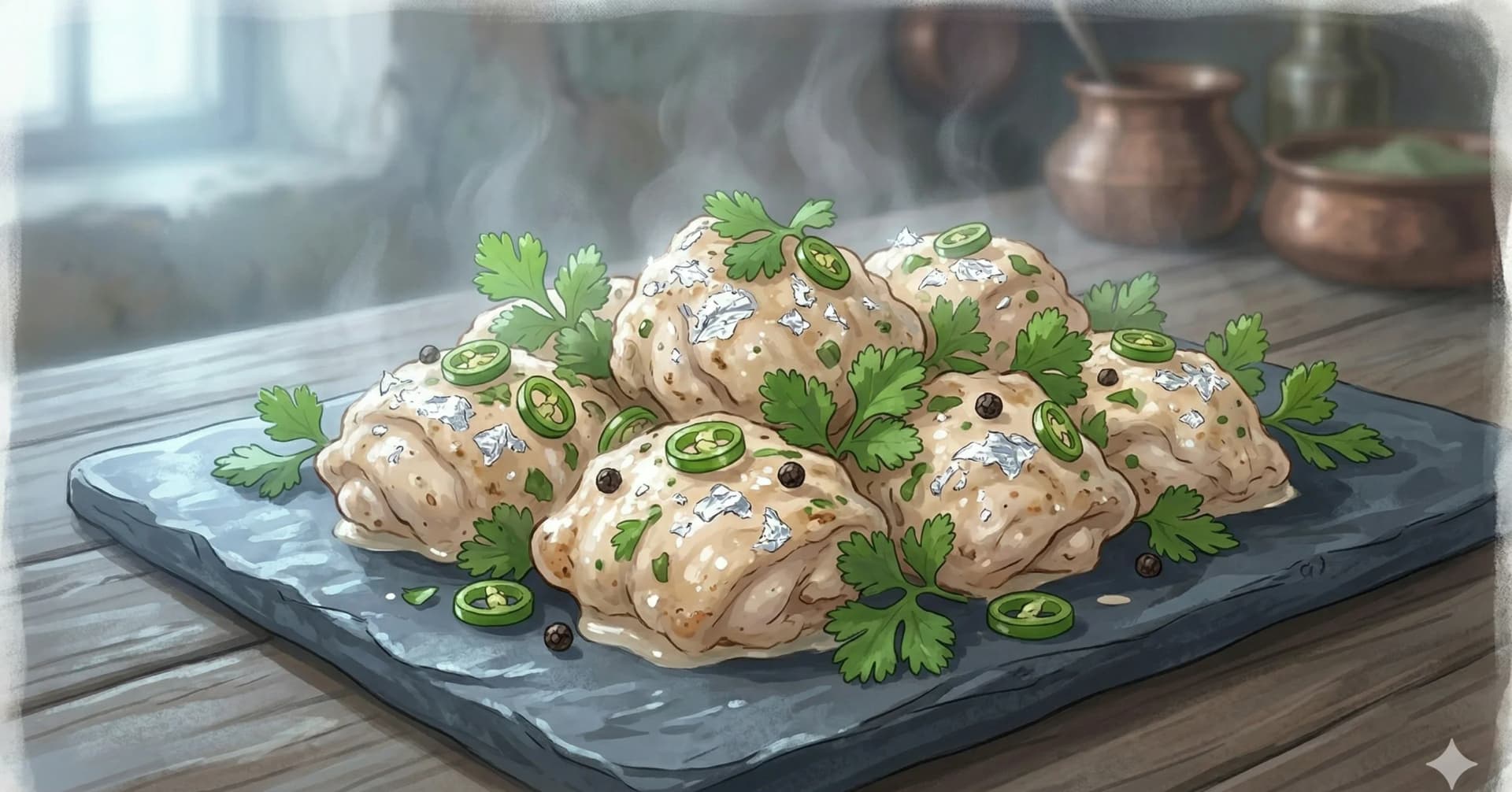
Silver-robed Awadhi chicken from the tandoor, finished with a veil of cream and edible silver
The name tells you everything and nothing at once. Chaandi is silver — and the reference is to the paper-thin edible silver leaf (warq) that is laid over the finished tikka before serving, creating a dish that catches light in a way that no amount of spicing can replicate. This is Awadhi cooking at its most courtly: flavour already in place, presentation elevated to ceremony.
The tikka itself belongs to the white marinade tradition of Lucknow — no turmeric, no red chilli powder, no orange staining. Instead, hung yogurt, processed cheese, cream, shahi jeera, and green cardamom create a pale, silky coating that allows the tandoor's heat to bronze the exterior in soft gold rather than deep rust. The result is a tikka that looks refined but eats with warmth and depth.
Where many tikkas announce themselves aggressively, this one works through restraint. The shahi jeera (black cumin) brings a quieter, earthier note than regular cumin. The cheese adds a subtle richness and helps the marinade adhere through the high-heat cooking. A second layer of cream with fresh coriander and green chilli is applied midway, building a lacquered surface before the final finish of silver.
At home without a tandoor, a very hot oven with the grill on at the end achieves most of what you need — the Maillard browning, the slight char on edges, the firm exterior and moist centre. The warq is optional but worth sourcing for a special occasion; it adds no flavour, only the shimmer that gives this dish its name.
At a Glance
Yield
Serves 4 as a starter
Prep
20 minutes + 2 hours marinating
Cook
20–25 minutes
Total
2 hours 45 minutes
Difficulty
Medium
Ingredients
Marinade Ingredients
- 1 lbchicken breast, cut into 4–5 cm chunks
- 1½ ozhung yogurt (or thick Greek yogurt, strained overnight if possible)
- 1½ ozprocessed cheese, finely grated
- 2 tbspsingle cream
- 1 tbspginger-garlic paste
- ¼ ozshahi jeera / black cumin
- ⅓ tspwhite pepper powder
- ⅔ tspfine salt
- 3–4green cardamom pods, seeds only, finely ground
To Finish
To Serve
- —Juice of ½ lemon
- —Silver warq (edible silver leaf) (optional)
- —Rings of raw onion and lemon wedges
Method
- 1
Prepare the marinade. In a bowl, combine the hung yogurt (40 g), grated cheese, cream (30 ml), ginger-garlic paste (15 g), shahi jeera (¼ teaspoon), white pepper (¼ teaspoon), salt (¾ teaspoon), and ground cardamom. Mix until smooth. Add the chicken chunks and turn to coat thoroughly. Cover and refrigerate for at least 2 hours, or up to overnight.
- 2
To cook in a tandoor or charcoal grill: Thread the chicken onto skewers. Cook over intense heat for 10–12 minutes, turning once or twice, until the exterior is pale gold and the chicken is almost cooked through but still slightly undercooked in the centre.
- 3
To cook in an oven: Preheat to 240°C (220°C fan). Place the marinated chicken on a wire rack set over a foil-lined tray. Roast for 15 minutes until the exterior is set and beginning to colour.
- 4
Apply the cream (25 ml) finish. Mix the cream, coriander (15 g), and green chilli. Remove the chicken from the heat momentarily and brush or spoon this mixture generously over each piece. Return to the tandoor or oven — switch to grill if using an oven — and cook for a further 5–7 minutes until the surface is lacquered and lightly burnished at the edges.
- 5
Rest briefly and apply warq. Transfer the chicken to a warm serving plate. Squeeze over the lemon juice. If using silver warq, lay a sheet gently over the hot tikka pieces immediately before serving — the residual heat will help it adhere. Handle warq with extreme care; it is delicate.
- 6
Serve immediately with raw onion rings, lemon wedges, and a fresh mint chutney alongside.
Key Ingredient Benefits
Shahi jeera (Bunium persicum, black cumin) is distinct from regular cumin — smaller, darker, with a deeper, more resinous warmth. It is a characteristic Awadhi and Mughal-era spice, appearing throughout the cuisine's most refined preparations. In Unani medicine, it is traditionally considered beneficial for digestion and respiratory health.
Green cardamom in the marinade (rather than garam masala) keeps the spicing delicate and floral. Cardamom is traditionally used in Ayurvedic cooking as a digestive and is associated with improving the palatability of heavy foods.
Silver warq (chandi ka warq) is pure edible silver, hammered to near-transparency. It is tasteless and considered safe for consumption. In Mughal cuisine it was used as a mark of distinction and celebration. Look for certified pure silver warq from Indian sweet shops or specialty stores.
Why This Works
The white marinade philosophy — no red chilli, no turmeric — has a double purpose. Aesthetically, it keeps the tikka pale, allowing the silver garnish its full visual impact. Technically, the absence of sugar-rich chilli powder reduces the risk of burning in the tandoor's high heat, giving the chicken more time to cook through evenly.
The processed cheese may seem incongruous in a classical dish, but it serves a practical function: it melts into the marinade and forms a slightly firm coat around the chicken during high-heat cooking, helping the marinade bond to the meat rather than drip away. Restaurants sometimes use paneer instead, which is closer to a traditional version.
Applying a second layer of cream mid-cook builds up the surface gradually — similar to basting a roast. The herbs added at this stage bloom briefly in the final heat without overcooking, landing between raw brightness and full integration.
Substitutions & Variations
No tandoor: A very hot oven with the grill element produces a workable result. The char won't be as deep and the drying effect differs, but the flavour holds. A cast-iron grill pan heated until smoking can also work for smaller batches.
Cheese substitution: Replace processed cheese with finely crumbled paneer or an equal weight of thick labneh for a less processed version. The texture will be slightly more granular but the flavour cleaner.
No silver warq: The tikka is excellent without it. Finish with a scattering of fresh coriander and a light dust of ground cardamom instead.
Chicken thighs: Boneless chicken thighs work better than breast in high-heat cooking — more forgiving, less likely to dry out. Reduce cooking time by 3–4 minutes.
Serving Suggestions
Serve on a flat platter with rings of raw onion, thin cucumber slices, and lemon wedges. A bright green coriander-mint chutney is the classic accompaniment. As part of a larger Awadhi spread, this works as a first course before a biryani or korma. Two to three pieces per person is appropriate as a starter.
Storage & Reheating
Cooked tikka keeps refrigerated for up to 2 days. Reheat in a 200°C oven for 8–10 minutes, or briefly in a hot dry pan, until warmed through with a slight crust returning. Do not microwave — the cream coating becomes rubbery. Raw marinated chicken can be kept refrigerated for up to 24 hours before cooking.
Cultural Notes
Murgh chaandi tikka (मुर्ग चांदी टिक्का, "silver chicken tikka") is the Mughlai chicken tikka preparation in which marinated and grilled chicken pieces are decorated with edible silver leaf (varak or chandi ka warak) before serving, a presentation choice that signals the dish's ceremonial status as a feast or wedding preparation rather than an everyday meal. The dish belongs to the Mughlai banquet tradition and appears at formal Indian Muslim weddings, large family celebrations, and the elaborate menus of Mughlai-tradition restaurants in Delhi, Lucknow, Hyderabad, and beyond.
The use of silver leaf in Indian cooking has a documented history rooted in both Mughal court culture and Ayurvedic tradition. The Mughal emperors patronized silversmiths who developed the technique of beating silver into sheets so thin they become tissue-like and edible, and the resulting silver leaf was used to decorate sweets (kheer, barfi, paan), drinks (royal sherbets), and special-occasion meat preparations. In Ayurvedic tradition silver (called raupya bhasma in its prepared form) is classified as a cooling element, though the small amount in a typical decoration provides ornamentation rather than therapeutic effect. The use of silver leaf as garnish became one of the signals of Mughlai high cuisine, distinguishing wedding and feast preparations from everyday cooking.
The technique follows the standard Mughlai tikka method with a silver leaf finishing step. Boneless chicken pieces (typically cut into one-inch cubes from breast or thigh) are marinated in yogurt, ginger-garlic paste, green chili paste, salt, and white pepper for an hour. A second marinade of cream, ground cashews, and Mughlai spices (green cardamom, mace, white pepper, no Kashmiri red chili in this preparation since the dish stays pale to set off the silver) is applied for another hour. The marinated chicken is threaded onto skewers and grilled in a tandoor or under a high-heat broiler until just cooked through (about eight to ten minutes), staying pale and creamy rather than developing the dark char of a standard tandoori preparation. The hot grilled chicken is arranged on a serving platter, brushed lightly with melted ghee, and the silver leaf is gently transferred onto the chicken pieces directly from its paper backing. The dish is served immediately, with the silver leaf catching the light as the platter is brought to the table.
Nutrition Facts
Calories: 353kcal (18%)|Total Carbohydrates: 2.9g (1%)|Protein: 42.2g (84%)|Total Fat: 18.1g (23%)|Saturated Fat: 8.4g (42%)|Cholesterol: 140mg (47%)|Sodium: 1217mg (53%)|Dietary Fiber: 0g (0%)|Total Sugars: 1.4g
You Might Also Like
Ratings & Comments
Ratings & Comments
Ratings
Share your thoughts on this recipe.
Sign in to rate and comment