Indian Cuisine
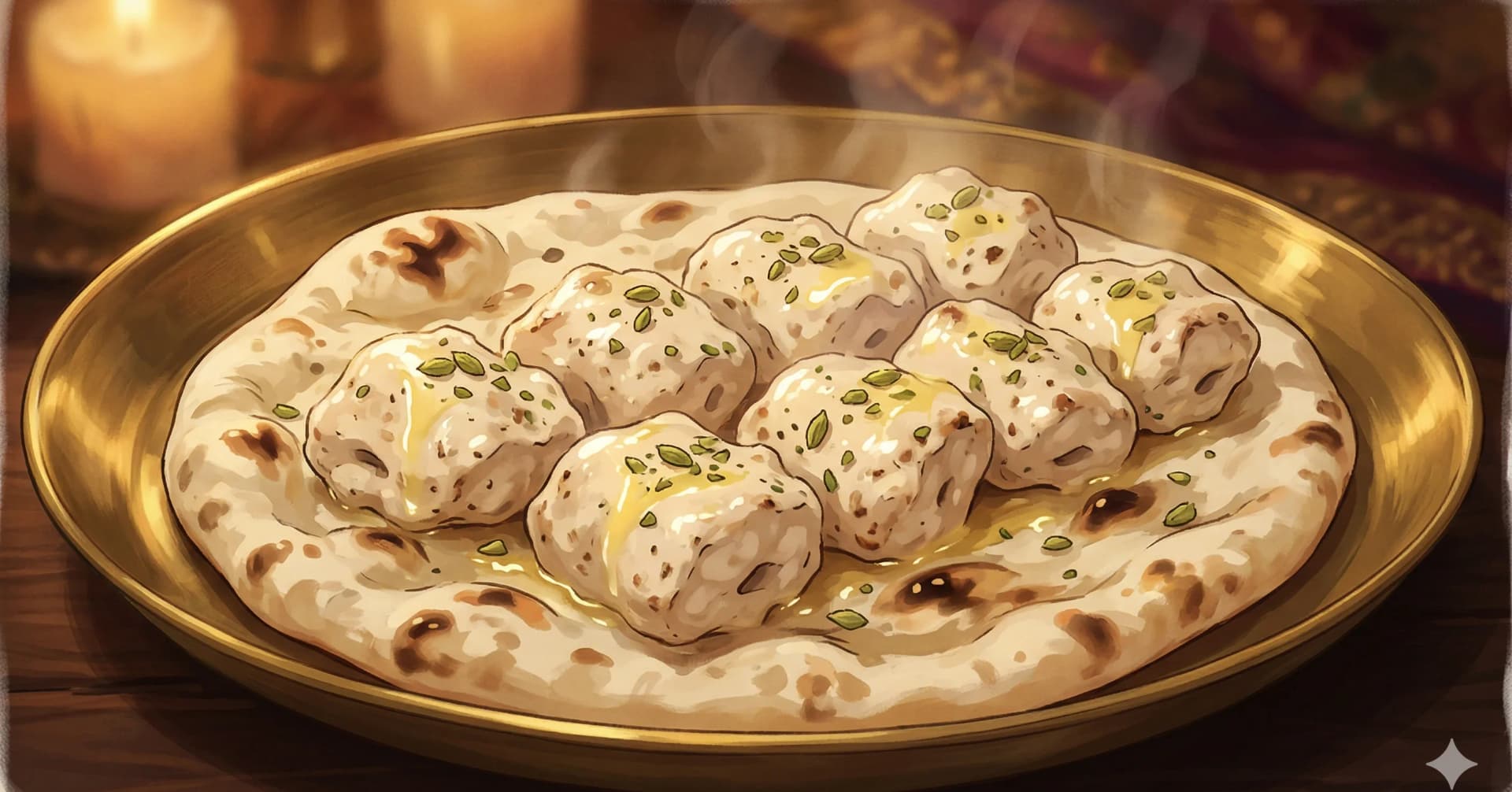
Creamy Chicken Kebab (Murgh Malai Kebab)
Cream and cream-cheese marinated chicken kebab from North India
In the universe of Indian kebabs — where vivid red Kashmiri chilli, charred black edges, and assertive spice are the norm — murgh malai kebab stands apart by doing something almost counterintuitive: it aims for restraint. The finished kebab should be pale ivory to very light gold. There should be no red marinade, no dark char, no dominant heat. What it offers instead is richness: a deep, luxurious, cream-forward flavour with the warmth of cardamom and mace threading through a silky, just-set surface.
Malai means cream in Hindi, and the marinade here is built almost entirely on dairy and nut fat. Cream cheese (or hung yogurt, which achieves a similar thick, tangy creaminess) provides body and a gentle acidity that tenderises the chicken without masking it. Heavy cream adds richness. Cashew paste, made from raw cashews soaked and ground to a smooth paste, contributes a subtle nuttiness and helps the marinade cling to the meat during cooking. The aromatics are deliberate in their mildness: white pepper rather than black or red (for heat without colour), cardamom for its cool floral sweetness, and mace — the lacy outer casing of the nutmeg — for a warm, citrusy-woody depth that makes the dish taste as though it came from a kitchen that understood luxury.
This is a North Indian preparation with roots in the Mughal court tradition of white, cream-based cooking — a style that developed alongside the more characteristically red tandoor preparations. The Mughal kitchen was keenly interested in refined, milk-based dishes as a mark of both culinary skill and affluence, and this kebab belongs to that lineage.
The practical note worth carrying: the most important thing you can do is resist the urge to cook this quickly over scorching heat. A moderate, even heat (whether in a tandoor, under a broiler, or on a well-seasoned grill) is what keeps the kebab pale and juicy rather than charred and dry. The goal is a surface that is golden, not blackened.
At a Glance
Yield
Serves 4
Prep
20 minutes active, plus 4 hours minimum marination (overnight preferred)
Cook
15–18 minutes
Total
4 hours 35 minutes minimum
Difficulty
Easy
Ingredients
First Marinade Ingredients
- 2¼ lbchicken breast or boneless thigh, cut into large 60–70 g cubes
- 1¼ tbsplemon juice (about 1 large lemon)
- ⅞ tspfine salt — for the first marinade
Malai Marinade Ingredients
- 3½ ozcream cheese (or hung yogurt: full-fat yogurt strained overnight through muslin until thick and dry)
- ⅓ cupheavy cream (double cream)
- 2 tbspginger-garlic paste (equal parts fresh ginger and garlic, ground together)
- 1¼ tbspgreen chilli paste (fresh green chillies blended smooth)
- ¾ ozcashew paste (100 g raw cashews soaked in water for 2 hours, then blended very smooth with minimal water)
- 2⅛ tspwhite pepper powder
- 2½ tspgreen cardamom powder (about 1 teaspoon, freshly ground from pods for best flavour)
- 2¾ tspmace powder
- 1⅔ tspfine salt
To Finish
- 2 tbspunsalted butter, melted
To Serve
- —Mint chutney, sliced raw onion rings, and lemon wedges
Method
- 1
First marinade — the tenderising stage. Pat the chicken pieces completely dry with kitchen paper. Toss with the lemon juice (1 large lemon) and 5 g of salt (1 teaspoon). Massage the lemon and salt into the surface of every piece. Set aside at room temperature for 20 minutes. This brief acid marinade begins to denature the surface proteins, opening the chicken's texture to absorb the richer second marinade more deeply.
- 2
Make the cashew paste (20 g). Drain the soaked cashews and transfer to a small blender. Add just enough cold water to get the blender moving — about 2–3 tablespoons. Blend at high speed for 2–3 minutes until completely smooth, with no visible cashew pieces and a consistency like smooth nut butter (30 g). Set aside.
- 3
Make the malai marinade. In a large bowl, combine the cream cheese (or hung yogurt), heavy cream (100 ml), ginger-garlic paste (30 g), green chilli paste (20 g), cashew paste, white pepper (1 teaspoon), cardamom powder (1 teaspoon, freshly ground from pods for best flavour), mace powder (1 teaspoon), and salt (2 teaspoons). Mix thoroughly until you have a smooth, uniform, pale cream-coloured marinade with no lumps remaining. Taste: it should be creamy, gently spiced, faintly sour from the cream cheese, and mildly warm from the pepper and chilli.
- 4
Marinate the chicken. Pat the lemon-marinated chicken dry once more, then add to the cream marinade. Toss to coat every surface thoroughly, pressing the marinade firmly into the chicken. Cover and refrigerate for a minimum of 4 hours. Overnight marination (10–12 hours) produces noticeably more tender, flavourful results — the cream proteins and acids work gradually and deeply.
- 5
Skewer the chicken. Thread the marinated chicken pieces onto metal skewers, pressing them together with no gaps. Wipe away any excess marinade that might drip and burn — a thin, even coating is what you want.
- 6
Cook. If using a tandoor: cook at high heat for 12–14 minutes, rotating the skewers once, until the surface is pale gold and lightly moist. If using a grill or broiler: preheat to high (250°C / 480°F). Place the skewered chicken 15 cm from the element. Cook for 8–9 minutes on the first side, then flip and cook for 6–7 minutes on the second side. The surface should be set and lightly golden — you are looking for the marinade to puff, dry slightly at the surface, and develop a faint golden blush. The edges may show very slight browning, but there should be no black char. The interior should be just cooked through and still moist.
- 7
Baste and rest. Remove the skewers from the heat. Brush generously with melted butter while the kebabs are still hot. Allow to rest on the skewers for 2 minutes.
- 8
Serve immediately with mint chutney, sliced raw onion, and lemon wedges.
Key Ingredient Benefits
Cashews contain predominantly monounsaturated fats (oleic acid), the same fatty acid profile as olive oil, and research associates regular tree nut consumption with improved LDL cholesterol markers and cardiovascular health. In Indian cooking, cashew paste is a traditional thickening and enriching agent in Mughal-era gravies and marinades, valued for its smooth, neutral creaminess.
Mace (Myristica fragrans) is the dried lacy aril covering the nutmeg seed, with a flavour described as a more delicate, citrusy version of nutmeg. In Ayurveda, mace is traditionally associated with digestive support and is used in small quantities in meat preparations thought to aid the digestion of rich foods. Its primary role here is aromatic — its warm, faintly floral note is one of the defining characteristics of this dish.
Green cardamom (Elettaria cardamomum) contributes a cool, camphor-like floral sweetness that contrasts beautifully with the richness of cream and cheese. Research suggests cardamom contains volatile compounds including cineole and terpinene that may have antimicrobial properties. In Indian culinary tradition, cardamom appears in both savoury and sweet preparations as a finishing aromatic.
White pepper (Piper nigrum, harvested before the berry turns fully black) is preferred in this kebab specifically because it provides warmth without the dark speckling that black pepper would leave in an otherwise ivory-white marinade. It is slightly more aromatic and less sharp than black pepper, with a faintly fermented note.
Why This Works
The two-marinade approach — a brief lemon-salt stage followed by the main cream marinade — is standard in tandoor cooking for a specific reason. The first marinade begins to denature surface proteins through acidity and salt, which opens the chicken's texture and allows the thicker, richer second marinade to penetrate more deeply. A single cream marinade applied directly to raw chicken will slide off the surface rather than absorbing.
Cashew paste is the element that holds the marinade together on the skewer. Raw cashew, when ground smooth, creates a thick emulsion of fat and starch that acts as a binder — it keeps the cream and cream cheese coating on the chicken during the high heat of cooking, preventing the marinade from simply liquefying and dripping away. It also adds a subtle fatty richness and slightly sweet flavour that complements the dairy without asserting itself.
Mace and cardamom are chosen over the more common cumin and coriander because their aromatic profiles are floral and warm rather than earthy — they work with dairy fat in a way that cumin does not, enhancing the cream's richness rather than cutting across it.
Substitutions & Variations
Cream cheese to hung yogurt: Equal weight of hung yogurt — yogurt strained overnight to remove whey — is the traditional alternative. The result will be slightly less rich and more tangy but very close to the original.
Cashew paste to almond paste: Blanched almonds soaked and ground smooth can replace cashews. The flavour will be slightly more bitter and less sweet, but the texture and binding function are equivalent.
No mace: If mace is unavailable, substitute half the quantity of freshly grated nutmeg. It is more intense — use sparingly.
Cheese stuffing variation: A popular restaurant variation stuffs the large chicken pieces with a small quantity of grated processed cheese before skewering. On cooking, the cheese melts to a molten centre.
Lamb or paneer: The marinade works equally well for boneless lamb or paneer. For paneer malai tikka, cut paneer into 40 g cubes and marinate for only 1 hour.
Serving Suggestions
Serve as a starter on a flat board or platter with mint chutney, thinly sliced raw onion (optionally separated into rings and soaked briefly in ice water to reduce sharpness), and lemon halves. A few green chillies, lightly charred on the grill alongside the kebabs, are a traditional garnish. At a larger gathering, murgh malai kebab pairs well with the more assertively spiced tandoori murgh — the pale mildness of one setting off the vivid red of the other. Accompanies roomali roti or naan.
Storage & Reheating
Marinated raw chicken can be held in the refrigerator, covered, for up to 24 hours before cooking. Do not freeze in the marinade — the cream will separate on thawing.
Cooked kebabs can be refrigerated for up to 2 days. To reheat, place in a moderately hot oven (180°C / 350°F) for 6–8 minutes, covered with foil to prevent drying out. Alternatively, reheat briefly in a pan with a small knob of butter. The texture will be marginally less tender than fresh-cooked but still very good.
Cultural Notes
Murgh malai kebab (मुर्ग मलाई कबाब, "cream chicken kebab") is the Mughlai grilled chicken preparation built on a marinade of thick cream (malai), yogurt, processed cheese, white pepper, green chili paste, and ginger-garlic. The chicken pieces are grilled until just cooked through, staying pale and creamy rather than darkening into the deep red of a standard tandoori chicken. The dish belongs to the Mughlai banquet tradition and appears at Indian Muslim weddings, family celebrations, and the Mughlai grill menus of Delhi, Lucknow, Karachi, and the diaspora restaurant tradition.
The dish's character distinguishes it from the broader tandoori family. Where standard tandoori-chicken and paneer-tikka marinades use Kashmiri red chili powder and tamarind for tang and color, the malai kebab marinade deliberately stays pale: no chili powder, no turmeric, no tamarind. The flavor is built instead on the richness of cream, the tang of yogurt, the savory depth of cheese, the gentle heat of white pepper and green chili, and the aromatic warmth of cardamom and mace. The result is a grilled chicken that tastes mild, silky, and luxurious rather than spicy and assertive, suited to formal banquet meals where the malai kebab serves as a contrast to the spicier preparations on the table.
The technique relies on the rich marinade and careful grilling. Boneless chicken pieces (typically cut into two-inch cubes from breast or thigh) are first marinated briefly with ginger-garlic paste and salt to season. The main marinade is mixed from thick cream, hung yogurt (yogurt drained for several hours through cheesecloth to thicken), grated processed cheese (the Indian-style processed cheese sold as Amul cheese, which melts smoothly into the marinade), ground white pepper, green chili paste, cardamom powder, and mace powder. The chicken is coated thickly with this marinade and refrigerated for at least four hours, ideally overnight. The marinated pieces are threaded onto skewers and grilled in a hot tandoor or under a high broiler for eight to ten minutes, brushed periodically with melted butter, until the surface develops faint golden spots while the interior stays just cooked. The dish is served hot with mint chutney, sliced raw onion, and lime wedges, often as the opening course of a Mughlai banquet meal.
Nutrition Facts
Calories: 664kcal (33%)|Total Carbohydrates: 3.2g (1%)|Protein: 80.7g (161%)|Total Fat: 34.8g (45%)|Saturated Fat: 16.8g (84%)|Cholesterol: 284mg (95%)|Sodium: 4020mg (175%)|Dietary Fiber: 0g (0%)|Total Sugars: 1.5g
You Might Also Like
Ratings & Comments
Ratings & Comments
Ratings
Share your thoughts on this recipe.
Sign in to rate and comment