Indian Cuisine
Egg Yolk Vermicelli Sweet (Muttamala)
Kerala's Portuguese-Influenced Egg Yolk Garland Sweet
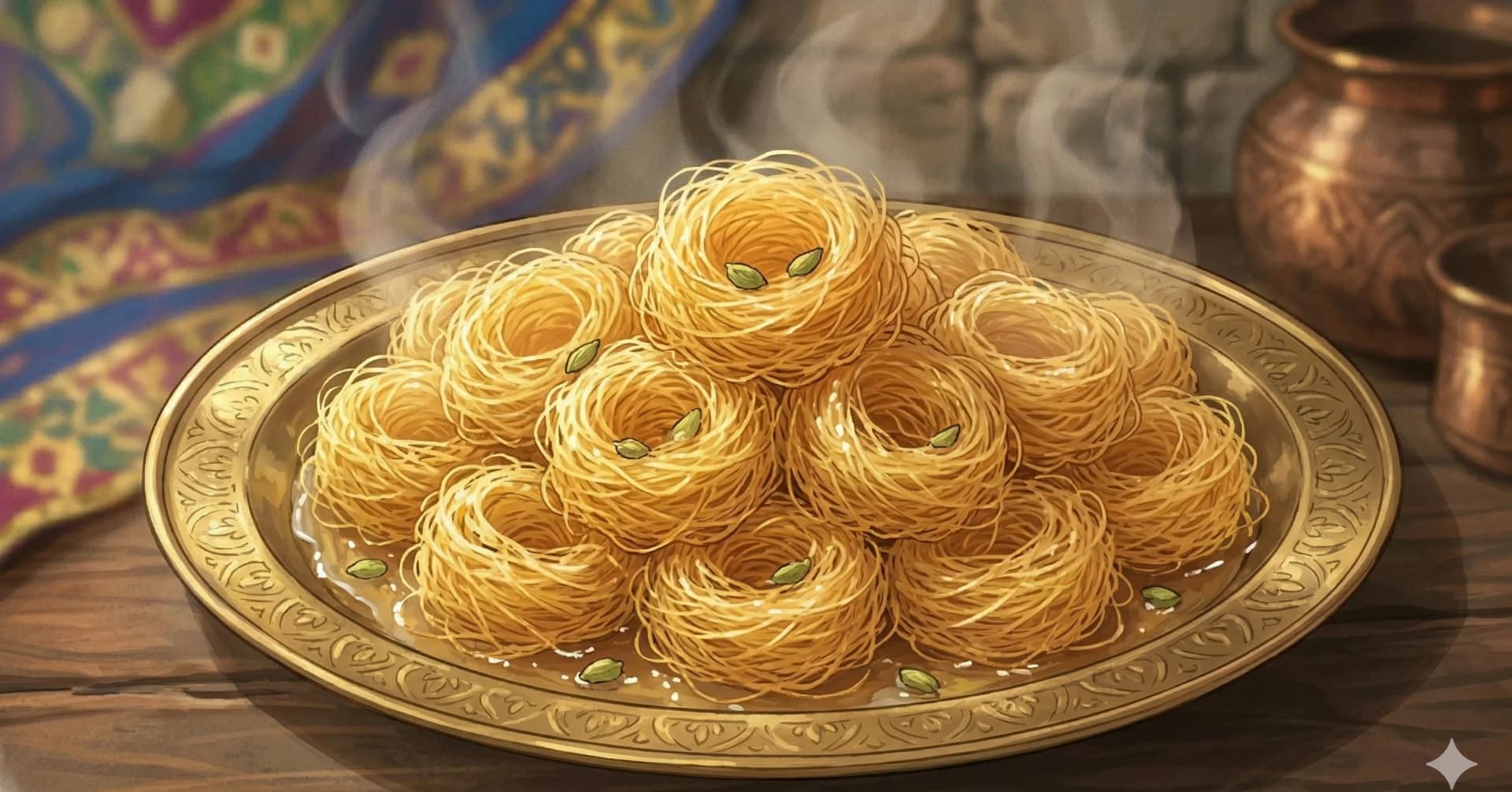
Muttamala (egg garland) is a sweet that arrived in Kerala with the Portuguese and remained, absorbed into the Syrian Christian cooking tradition of central Kerala, transformed by local fragrance (cardamom) and local aesthetic. The flowing form of strands here differs from the geometric precision of Portuguese fios de ovos, though the technique is essentially the same: egg yolk batter dropped through a perforated surface into sugar syrup, cooking into fine, translucent golden threads.
In practice, what you are doing is creating a controlled, continuous drop of egg yolk into hot syrup through small holes. The same principle used to make vermicelli, except the medium is egg yolk and heat rather than dough and pressure. The yolks, beaten smooth with cardamom powder, fall through the perforated spoon in fine streams and cook almost instantly on contact with the hot sugar syrup below, setting into threads that remain flexible and pliable as long as they are kept warm but become slightly brittle when cold.
The sugar syrup must be at exactly two-string consistency. Not one-string (too thin, producing limp syrup-saturated threads) and not three-string (too thick, setting around the threads before they can be separated). At two-string, the syrup coats the threads and gives them a light gloss without drowning them.
The separation of the cooked threads with thin bamboo sticks (or the handle ends of two chopsticks) is the final act of skill. Done while the threads are still in the warm syrup, they separate cleanly. Left too long in cooling syrup, they would mat together into an inseparable mass.
Muttamala is fragile, beautiful, and best eaten on the day it is made.
At a Glance
Yield
Serves 4–6
Prep
15 minutes
Cook
20 minutes
Total
35 minutes
Difficulty
Medium
Ingredients
- 7 ozegg yolks (approximately 10–12 large egg yolks)
- 2½ cupsugar
- 1 cupwater
- 1 tspgreen cardamom powder
- —A perforated spoon, sieve, or ladle with small holes (approximately 3–4 mm diameter)
- —Two thin bamboo sticks or chopstick handles
Method
- 1
Prepare the egg yolks. Separate the eggs carefully, ensuring no white remains with the yolks. Even a small amount of egg white will cause the yolks to foam rather than flow cleanly through the perforations. Beat the yolks with the cardamom powder until completely smooth and free of lumps. Strain through a fine sieve if needed to remove any residual chalazae. The yolk mixture should pour easily and smoothly.
- 2
Make the sugar syrup. Combine the sugar and water in a wide, shallow pan. Bring to a boil over medium heat, stirring until the sugar dissolves completely. Stop stirring and continue cooking until the syrup reaches two-string consistency: when a small drop is placed between thumb and forefinger and pulled apart, two clean, distinct threads form. Keep the syrup hot over the lowest possible flame. It must stay liquid and at a consistent temperature throughout.
- 3
Pour the yolk mixture through the perforated spoon. Hold the perforated spoon 10–12 cm above the surface of the hot syrup. Pour a small amount of the yolk mixture into the perforated spoon so it begins flowing through the holes in thin streams. Move the spoon slowly in circles or figures of eight over the syrup surface, so the falling yolk streams create a lattice or garland of threads across the syrup surface. The threads will cook and turn golden within 30–60 seconds.
- 4
Cook briefly. Allow the threads to cook in the syrup for 2 minutes, undisturbed.
- 5
Remove and separate. Using two thin bamboo sticks or the handle ends of chopsticks, gently lift the cooked threads from the syrup, threading the sticks under the network and lifting carefully. Separate the threads gently by pulling them apart with the sticks while they are still warm from the syrup. Arrange in loose, flowing strands on a serving plate.
- 6
Repeat. Continue with the remaining yolk mixture, working in batches. Keep the syrup temperature consistent. If it begins to cool and thicken, add a tablespoon of hot water to loosen it.
- 7
Serve at room temperature.
Key Ingredient Benefits
Egg yolks are the only structural ingredient here. They contain lecithin, a natural emulsifier that contributes to the smooth, flowing quality of the batter. They're also rich in fat-soluble vitamins and choline. The quantity (200 g, about 10 yolks) is substantial for a serving-sized preparation. This is a rich sweet, served in small amounts.
Cardamom is the only spice, and its job is fragrance. Its aromatic compounds are fat-soluble and blend readily into the egg yolk fat, distributing through every thread rather than sitting on the surface.
Sugar syrup is the cooking medium, the sweetener, and the structure. At two-string consistency (around 65–70% sugar concentration), it has enough body to set around the threads without being so thick it envelops and drowns them.
Why This Works
The physics of muttamala are simple: egg yolk proteins denature and set when they reach approximately 65–70°C. The hot sugar syrup at two-string consistency (approximately 107–108°C) provides a medium hot enough to cook the falling yolk threads almost instantaneously, setting them as they contact the surface. The sugar syrup also coats the cooked threads, providing the light gloss and the sweetness.
The width of the holes in the perforated spoon determines thread thickness. Larger holes give you thicker, cord-like strands; smaller holes give finer, more translucent ones. Traditional muttamala uses the finest holes available for the most delicate result.
Why two-string rather than one-string syrup? A one-string syrup (approximately 105°C, lower concentration) contains more water, which dilutes around the cooked threads and produces limp, mushy strands that mat together. A two-string syrup coats and slightly firms each thread without overwhelming them.
Separating the threads while still warm is essential because egg proteins, once set, are relatively rigid when cold but still slightly flexible when warm. Warm threads can be teased apart without breaking; cold threads snap.
Substitutions & Variations
- Rose water: Add 1 teaspoon of rose water to the beaten yolks before straining for a more floral, Middle Eastern-influenced fragrance.
- Thicker threads: Use a colander with 4–5 mm holes for thicker, more substantial strands. A different aesthetic, but equally traditional in some Syrian Christian households.
- Sweeter threads: Briefly dip the lifted threads back into the syrup for additional coating before arranging.
- Fios de ovos style: For the Portuguese original, strain the yolks, add no cardamom, and create the threads in a more geometric pattern: parallel lines rather than a free-flowing garland.
Serving Suggestions
Muttamala is served at room temperature as a celebration sweet in Kerala's Syrian Christian community, at weddings, Christmas, Easter, and family occasions. It is presented in small, loose nests on a plate or in a shallow dish. Two to three spoonfuls per person is typical. It is rich, and its delicate appearance belies its sweetness. No accompaniment is traditional. Eat with a fork or spoon and appreciate the slight resistance of the threads before they dissolve.
Storage & Reheating
Muttamala is best eaten the day it's made. The threads stay pliable and separate for about 6–8 hours, after which they begin to mat as the syrup cools and thickens. Store loosely covered at room temperature for up to 6 hours. If making in advance, keep the threads submerged in the warm syrup and separate just before serving. Don't refrigerate. The cold causes the threads to stiffen and mat irreversibly.
Cultural Notes
Muttamala (മുട്ടമാല, "egg garland") is the Kerala Mappila (Malabar Muslim) sweet of beaten egg yolks slowly poured through a fine sieve into boiling sugar syrup, where the yolks set into long thin yellow threads that look like miniature garlands. The threads are removed from the syrup, pressed gently between palms to remove excess sugar, and arranged in mounds or pyramids on a plate. The dish is a signature Mappila wedding and festival sweet and appears at the elaborate sweet course of Mappila Muslim weddings across the Malabar coast (the northern Kerala region around Calicut, Kannur, and Malappuram).
The dish has a documented Portuguese culinary parallel that points to its hybrid origin. The Portuguese sweet fios de ovos ("egg threads") uses an identical technique of pouring beaten egg yolks through a sieve into sugar syrup, and it traveled from the Portuguese convent baking tradition of the medieval Iberian peninsula to the Portuguese colonial holdings in Asia and Latin America. The Portuguese arrived on the Malabar coast in 1498 with Vasco da Gama and established trading posts and converted communities across coastal Kerala over the following centuries. The Mappila Muslim community of the Malabar coast, despite remaining Muslim rather than converting to Catholicism, absorbed many of the Portuguese culinary techniques that the colonial presence introduced, including the egg-yolk-and-sugar sweet tradition that produced muttamala alongside the closely related muttassyam and paalada pradhaman variations.
The technique demands patience and a steady hand. Egg yolks are separated carefully from the whites (no white can contaminate the yolks, or the threads will not set cleanly). The yolks are beaten lightly until smooth but not foamy. A sugar syrup is prepared from sugar and water boiled until it reaches the one-string consistency (the syrup forms a single short thread when pressed between thumb and forefinger and pulled apart). The beaten yolks are placed in a fine-mesh sieve held over the boiling syrup, and the yolks are gently pushed through the sieve in a steady stream, dropping into the syrup as long thin threads that cook and set in seconds. The threads are lifted out with a slotted spoon, drained briefly, pressed gently between palms to remove excess syrup, and arranged in pyramidal mounds for serving. The dish appears at Mappila wedding feasts (nikah receptions) alongside the related Mappila wedding sweets muttassyam and unnakkaya.
Nutrition Facts
Calories: 430kcal (22%)|Total Carbohydrates: 84.5g (31%)|Protein: 5.3g (11%)|Total Fat: 8.8g (11%)|Saturated Fat: 3.2g (16%)|Cholesterol: 360mg (120%)|Sodium: 17mg (1%)|Dietary Fiber: 0g (0%)|Total Sugars: 83.5g
You Might Also Like
Ratings & Comments
Ratings & Comments
Ratings
Share your thoughts on this recipe.
Sign in to rate and comment