Awadhi · Indian Cuisine
Paneer in Golden Curry (Paneer Kundan Kaliyan)
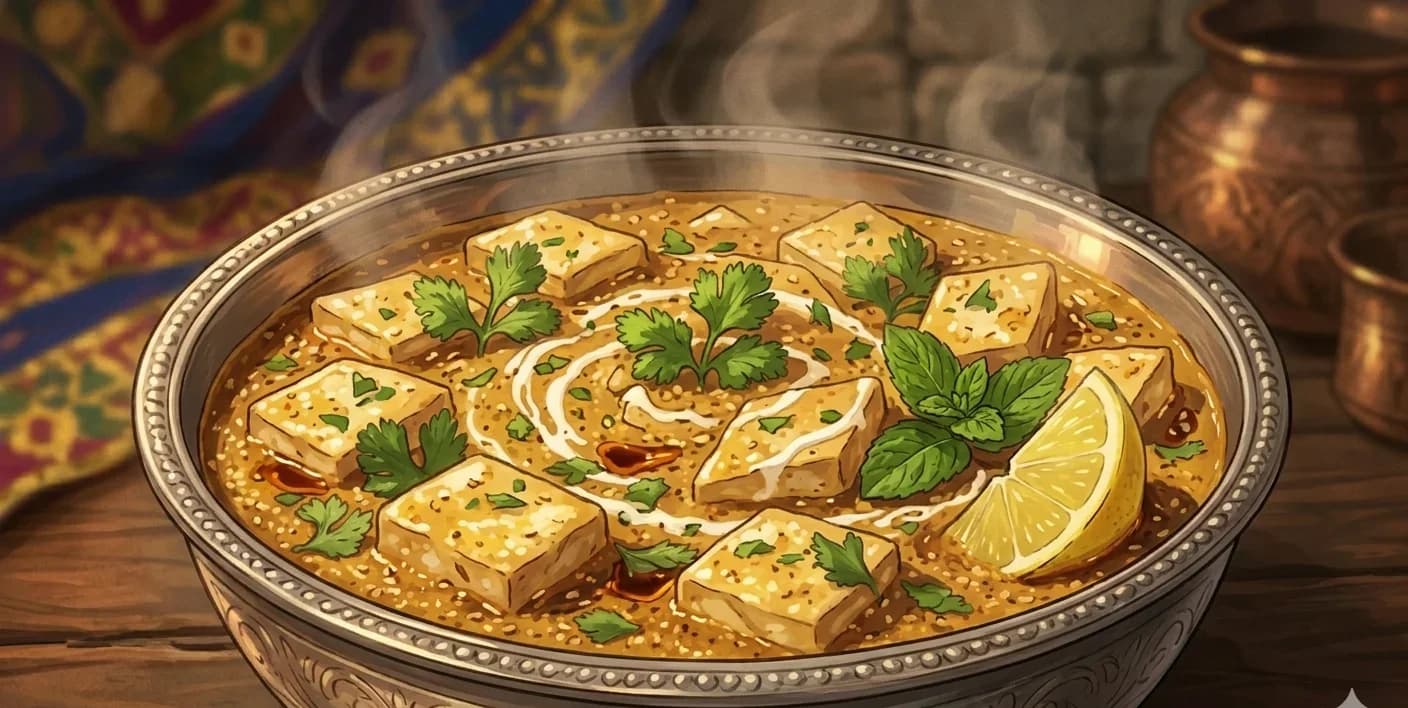
Diamond-cut paneer in a golden, saffron-touched Awadhi gravy of cashews and fenugreek
Kundan means gold. The name refers to the saffron that colours this dish a warm, luminous amber — the same word used for the technique of inlaying pure gold into metal, a craft Lucknow was historically known for. The gravy here is built in the same spirit: layer upon layer of technique, each step adding a quality that can't be shortcut.
The base is an Awadhi-style korma — onion and cashew ground together after boiling, then added to a tempered yogurt gravy — but with fenugreek seeds (methi dana) introduced at the start rather than the end, giving the oil an almost caramelised bitterness before anything else enters the pan. This small act changes the character of the entire dish.
Paneer is cut into diamond shapes (kaliyan), a detail that is partly aesthetic and partly practical — the angled edges catch and hold sauce in a way that cubes don't. The saffron goes in at the end with the cream, blooming into the hot gravy and pulling the whole dish into its final warm, golden register.
This is a rich dish. It belongs to a meal where it can be the centrepiece — served with roomali roti or a lightly spiced pilaf. It is also patient: the flavour improves if the gravy is made a day ahead and the paneer added fresh before serving.
At a Glance
Yield
Serves 4–6
Prep
20 minutes
Cook
35 minutes
Total
55 minutes
Difficulty
Medium
Ingredients
- 1¼ lbpaneer, cut into diamond-shaped pieces (about 4 cm across, 1 cm thick)
- 3½ ozraw cashewnuts, broken
- 4½ ozonion (about ½–1 onion), roughly chopped
- ¾ lbfull-fat yogurt, beaten smooth
- ½ cupneutral oil
- 1⅓ tspmethi dana (fenugreek seeds, about 1 teaspoon)
- 3¼ tbspginger-garlic paste
- 1¼ tspwhite pepper powder
- 2⅛ tspblack pepper powder
- 1¾ tbspKashmiri red chilli powder
- ¾ tspturmeric powder
- ⅓ tspmethi powder (dried fenugreek leaf powder, about ¼ teaspoon)
- —A generous pinch of saffron (about ⅛ g), soaked in 2 tablespoons warm water or milk
- ½ cupfresh cream
- ⅞ tspfine salt, to taste
- —Fresh coriander, to garnish
Method
- 1
Make the cashew-onion paste. Place the cashewnuts (100 g) and chopped onion (125 g) in a small saucepan. Cover with water and boil for 10 minutes until the cashews are soft and the onion is completely tender. Drain, cool slightly, and blend to a completely smooth, fine paste. Add a splash of water if needed.
- 2
Temper the fenugreek. Heat the oil in a heavy pot or karahi over medium heat. Add the fenugreek seeds and let them sizzle for 30–45 seconds until they darken slightly and smell toasty — they should turn a shade or two deeper, releasing a mellow bitterness. Do not let them burn.
- 3
Build the base. Add the ginger-garlic paste (50 g) to the tempered oil and fry for 2–3 minutes, stirring constantly, until the raw smell is gone and the paste begins to colour. Add the white pepper (½ teaspoon), black pepper (1 teaspoon), red chilli powder, turmeric (½ teaspoon), methi powder (1 g), and salt (1 teaspoon). Stir for 1 minute.
- 4
Cook the yogurt. Remove the pot from the heat briefly, then add the beaten yogurt in one go, stirring immediately to prevent it from splitting. Return to medium heat and cook, stirring frequently, for 8–10 minutes until the yogurt is cooked through and the mixture begins to show a slight separation of fat at the edges.
- 5
Add the cashew-onion paste. Stir in the blended paste and cook for 5 minutes more, stirring, until the gravy is thick and fragrant and the fat begins to rise to the surface — this is the sign that the masala is properly cooked.
- 6
Strain the gravy. Pass the gravy through a fine sieve or strainer, pressing well to extract all the liquid. Return the strained gravy to the pot. This step gives the finished dish its silky, refined texture.
- 7
Finish with paneer (4 cm across, 1 cm thick), saffron, and cream (125 ml). Add the paneer diamonds to the gravy and warm gently over low heat. Stir in the saffron (with its soaking liquid) and the cream. Simmer for 3–4 minutes, adjusting seasoning. The gravy should be a warm amber, cling to the paneer, and taste rich, slightly bitter at the base, and perfumed with saffron.
- 8
Serve garnished with a swirl of cream and fresh coriander.
Key Ingredient Benefits
Fenugreek seeds (methi dana) have a complex flavour — faintly bitter, slightly sweet after cooking, with a maple-like undertone. In Ayurvedic tradition they are considered warming and are associated with digestive support. Research has studied their potential to support healthy blood sugar levels, though no culinary serving provides medicinal doses.
Saffron (kesar) is the defining luxury ingredient of Mughal-era cooking. A small amount transforms the colour and adds a honeyed, almost metallic warmth that integrates with cream and yogurt particularly well. Soaking saffron in warm liquid before adding it releases more of its colour and volatile compounds.
Paneer in Awadhi cooking is often made from buffalo milk, which produces a creamier, richer curd than cow's milk versions. Home cooks using regular supermarket paneer can improve the texture by soaking store-bought paneer in warm water for 20 minutes before cooking — it softens and absorbs the gravy more readily.
Why This Works
Boiling and blending cashewnuts with onion — rather than adding them separately — creates a paste that integrates completely into the gravy, giving it body without the graininess of either ingredient alone. The starch and protein from the cashews thicken the sauce while the onion sweetens and grounds it.
Fenugreek seeds at the start, rather than at the end, is the key Awadhi flavour move. High heat extracts their characteristic bitterness into the oil, where it becomes something deeper — a subtle, almost caramelised note running beneath the dish. Fenugreek leaf powder added with the spices reinforces this without compounding the bitterness.
Straining the gravy is what separates this from a home-style korma. The resulting sauce is extraordinarily smooth — closer to a restaurant-quality finish — and the effort, while adding a step, transforms the eating experience.
Substitutions & Variations
Lamb version: This same gravy, without straining, is the base for the lamb version (Gosht Kundan Kaliyan). Replace paneer with bone-in lamb pieces and cook until tender before adding the saffron and cream.
Vegan version: Replace yogurt with unsweetened soy or coconut yogurt, cream with coconut cream, and use a neutral oil throughout. The flavour will shift (the coconut cream adds its own character), but the dish remains rich.
No cashewnuts: Blanched almonds work as a substitute but produce a slightly drier, less creamy paste. Increase the cream by 30 ml to compensate.
Serving Suggestions
This dish is most at home with roomali roti or a buttery naan — breads that can scoop up and hold the silky gravy. For a full Awadhi spread, serve alongside a fragrant biryani or yakhni pulao, with sliced raw onion and a small bowl of raita. A green chutney on the side provides the contrast the richness of the gravy asks for.
Storage & Reheating
The gravy (without paneer) keeps refrigerated for up to 3 days and improves overnight. When ready to serve, reheat the gravy gently, add fresh paneer, and finish with cream and saffron. Freezing is not recommended — the yogurt-cream base can separate on thawing. If freezing is necessary, add the cream only when reheating.
Cultural Notes
Paneer kundan kaliyan (पनीर कुंदन कलियां) is the vegetarian version of the Awadhi-Hyderabadi kundan-kaliyan banquet preparation, in which cubes of fresh paneer (Indian fresh cheese) replace the lamb in the same yellow-gold gravy of yogurt, turmeric, lightly fried onions, almond paste, saffron, and the Mughlai aromatic spices. The dish belongs to the vegetarian banquet repertoire that the Awadhi rakabdar chefs developed for Hindu courtiers and for vegetarian Hindu family celebrations, and it appears at vegetarian weddings, Hindu festival menus, and the vegetarian menus of Awadhi-tradition restaurants.
The vegetarian-meat parallel is central to the Awadhi banquet philosophy. As discussed in the dum-ke-khumbh entry, the Awadhi court tradition developed dedicated vegetarian preparations that mirrored the meat dishes in technique and seasoning rather than treating vegetarian food as a lesser category. Paneer kundan kaliyan applies the same gold-colored kaliya technique used for the lamb version to paneer cubes, allowing a vegetarian guest at a banquet to receive a dish that holds its own beside the meat preparation in technique, aroma, and visual ceremony. The paneer absorbs the saffron-and-turmeric-colored gravy in a way that meat does not, producing a striking gold-tinted cube that visually matches the gravy and the metallic-leaf garnish.
The technique cooks the paneer gently in the prepared kaliya gravy. Fresh paneer (ideally homemade or a high-quality store-bought block) is cut into one-inch cubes. The gravy is prepared as in the lamb version: lightly fried onions ground with soaked almonds into a smooth paste, whisked yogurt, turmeric, ground coriander, white pepper, green cardamom, and a small amount of water cooked together over low heat. The paneer cubes are sautéed briefly in ghee until the surfaces just start to color (no deep browning, which would darken the cubes against the gold gravy). The paneer is added to the gravy and the dish is cooked for ten to fifteen minutes (paneer cooks fast and gets rubbery if overcooked, so the time is short). A pinch of saffron infused in warm milk is added off the heat for the deep gold color and the aromatic finish, and the dish is garnished with silver or gold leaf (varak) and a scatter of slivered almonds before serving with sheermal, naan, or basmati pulao.
Nutrition Facts
Calories: 569kcal (28%)|Total Carbohydrates: 12.9g (5%)|Protein: 23.6g (47%)|Total Fat: 48g (62%)|Saturated Fat: 21.9g (110%)|Cholesterol: 80mg (27%)|Sodium: 880mg (38%)|Dietary Fiber: 0.9g (3%)|Total Sugars: 3.8g
You Might Also Like


Ratings & Comments
Ratings & Comments
Ratings
Share your thoughts on this recipe.
Sign in to rate and comment