Parsi · Indian Cuisine
Fish in Banana Leaf (Patrani Machi)
Parsi Steamed Fish in Banana Leaf with Green Coconut Chutney
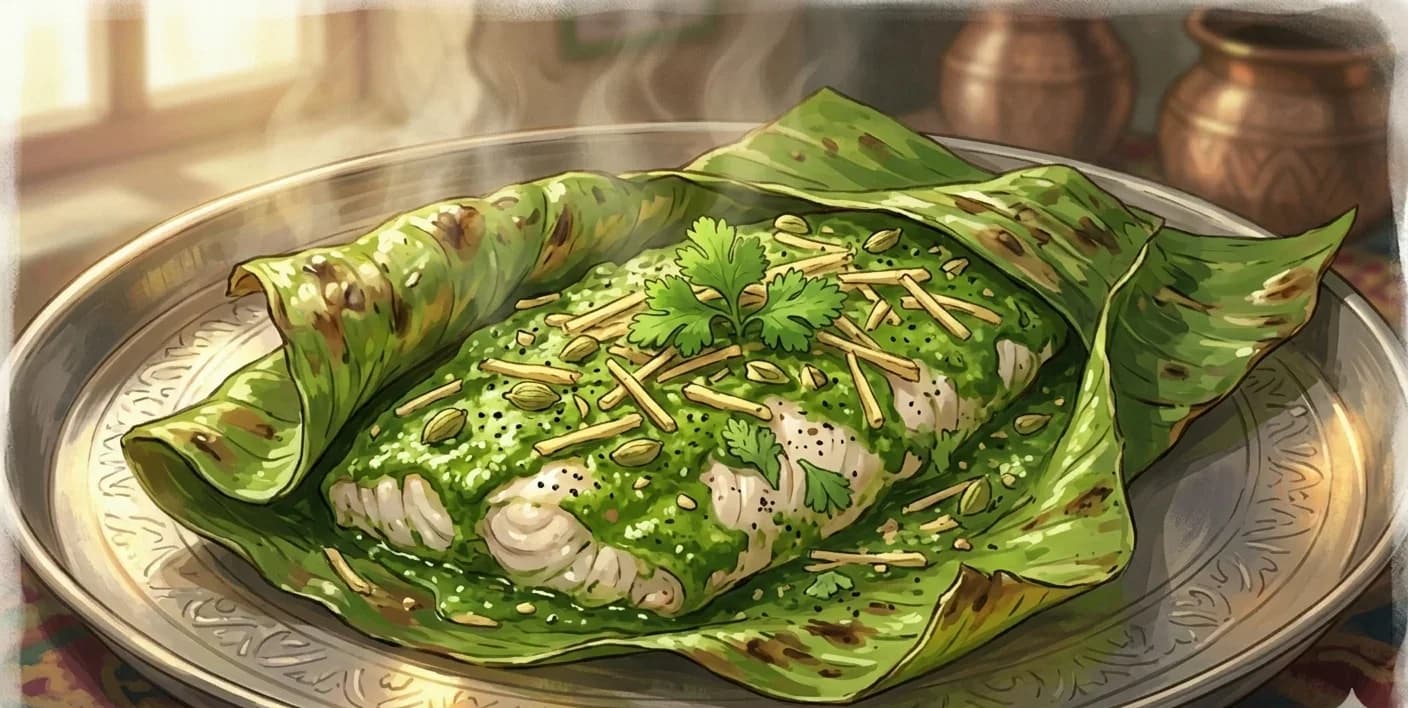
There is a particular pleasure in unwrapping a banana leaf parcel at the table. The leaf has darkened and charred slightly at the folds. Steam escapes as the string is cut, carrying with it something green and herbal and bright, a fragrance unlike any other. Then the fish is revealed inside: gleaming with vivid green chutney, perfectly cooked, having spent the last twenty minutes in its own private little world.
Patrani machi is one of the defining dishes of Parsi cuisine, the cooking tradition of the Zoroastrian community who came to India from Persia over a thousand years ago and settled along the Gujarati coast. Parsi food reflects that double heritage beautifully: the love of fish is deeply Gujarati, the festive significance distinctly Persian in spirit. This dish is served at Navroze (the Parsi new year), at weddings, and at any occasion significant enough to warrant going to some effort. The banana leaf is not merely a presentation conceit. It seals the fish in its own steam, and as it cooks it releases a subtle herbal warmth that becomes part of the flavour of the fish itself.
The chutney is the dish. It is a thick, unapologetically green paste of coconut, coriander, mint, chilli, ginger, and garlic, sharpened with lime and barely sweetened. Applied generously to both sides of the fish, it essentially becomes a cooking medium. The fish steams inside a herb and coconut casing that slowly melts into its flesh.
The practical key to success here is the banana leaf preparation. A leaf taken straight from the plant is stiff and will crack when folded. Pass each piece briefly over a low gas flame or hold over a pot of boiling water. It takes only seconds for the leaf to become pliable, shift colour slightly, and become workable. Do not rush this step and do not overheat it. You want flexibility, not brittleness.
At a Glance
Yield
4 servings
Prep
25 minutes
Cook
20 minutes
Total
45 minutes
Difficulty
Medium
Ingredients
- 1¼ lbpomfret or firm white fish, cut into steaks or fillets (bream, sea bass, snapper, or sole work well)
- —½ tsp salt
- —Juice of half a lime
- —Banana leaves (2 pieces per fish portion), cut into pieces approximately 30x30cm
- —Kitchen string for tying
- 3½ ozfresh coconut, grated (or desiccated coconut reconstituted in 2 tbsp warm water)
- 2⅔ cupfresh coriander (leaves and soft stems), roughly chopped
- 1¾ cupfresh mint leaves, picked
- 1¾ tbspgreen chillies, roughly chopped (seeds in for heat, seeds removed for mild)
- 1¾ tbspgarlic (about 3–4 cloves), roughly chopped
- 1¾ tbspfresh ginger, peeled and roughly chopped
- 1 tbsplime juice (about half a lime)
- 1¼ tspsugar
- 2⅓ tspcumin seeds
- ⅞ tspsalt
Method
- 1
Prepare the fish. If using whole fish steaks, pat them thoroughly dry with kitchen paper. Season lightly on both sides with the salt and a squeeze of lime juice (half a lime). Set aside while you make the chutney.
- 2
Make the green chutney. Combine all chutney ingredients in a blender. Blend to a thick, smooth, vivid green paste. Add 1–2 tablespoons of water only if needed to get the blender moving. The chutney should be very thick, not loose or runny. Taste and adjust: it should be bright, herbal, garlicky, with noticeable lime and a gentle heat. Correct salt, lime, or chilli as needed.
- 3
Prepare the banana leaves. Cut banana leaves into rectangles approximately 30x30cm. Working one piece at a time, hold each piece about 10cm above a low gas flame for 5–8 seconds per side, moving it gently, until it turns a slightly darker, more olive green and becomes supple and flexible. Alternatively, hold over a pot of boiling water. Wipe clean with a damp cloth.
- 4
Wrap the fish. Place a leaf piece on your work surface, shiny side up. Spread a generous layer of green chutney in the centre, thick enough that it will fully coat the fish on this side. Place a fish steak on top of the chutney. Spread more chutney over the top and sides of the fish, pressing it in gently. The fish should be well coated on all sides. Fold the leaf over the fish, tucking the sides in first, then folding the top and bottom over to form a tight parcel. Lay a second leaf piece underneath (or around) for a double layer, which prevents tearing during steaming. Secure firmly with kitchen string tied in both directions. Repeat for each portion.
- 5
Steam the parcels. Arrange the parcels in a steamer basket over vigorously boiling water. Cover and steam for 15–20 minutes. The cooking time depends on the thickness of the fish: a 2cm thick steak will be done at 15 minutes; a thicker piece may need 20. The leaf will darken slightly and the parcels will feel firm.
- 6
Check for doneness. Carefully open one parcel slightly at the fold. The fish should be opaque throughout and flake easily with a fork. If not, reseal and steam for 3–4 minutes more.
- 7
Serve. Bring the parcels to the table intact and unwrap them there. The ritual of opening is part of the pleasure of the dish. Serve with steamed white rice.
Key Ingredient Benefits
Pomfret is the traditional fish for this dish and remains the preference of most Parsi cooks. Its firm, white, sweet flesh holds its shape during steaming and takes the chutney beautifully. Silver pomfret (paplet) and black pomfret are both used. It is relatively expensive and not always available outside coastal cities. See substitutions.
Banana leaves are available fresh or frozen at South and Southeast Asian grocery stores. Frozen leaves work perfectly once thawed and softened over flame. The leaf imparts a mild, grassy, slightly sweet fragrance to the fish as it steams.
Fresh coconut is preferred over desiccated in this recipe. The moisture content of fresh coconut helps the chutney achieve the right consistency and contributes a subtle sweetness. Research suggests coconut provides medium-chain triglycerides (MCTs), which behave differently metabolically than long-chain fats. Traditionally, coconut is considered a cooling, nourishing food in South Asian culinary practice.
Coriander and mint are both traditionally used in Indian and Persian cooking as cooling herbs and digestive aids. The combination is characteristically Parsi. Research suggests coriander contains compounds with antioxidant activity.
Green chilli provides heat without the depth of dried chilli, keeping the chutney tasting fresh and bright. The capsaicin in green chilli has been the subject of research into anti-inflammatory properties. Adjust quantity to personal heat preference.
Why This Works
The banana leaf acts as a steaming chamber within the larger steamer. Each parcel creates its own sealed micro-environment where the fish cooks in its own moisture and the chutney's water and oils. The result is extraordinarily tender flesh that never dries out.
The double leaf layer is practical insurance. Banana leaves can have small tears or thin spots. The second layer ensures the parcel stays sealed and the chutney doesn't leak into the steaming water below.
The chutney's sugar is not a sweetener. It balances the lime's acidity and the chilli's heat, rounding the paste without making it taste sweet. This is a common technique in Parsi chutneys and salads.
Fresh coconut versus desiccated makes a noticeable textural difference. Fresh gives a moist, slightly fibrous body to the chutney. Reconstituted desiccated coconut is a reasonable substitute but produces a slightly drier paste. Compensate by adding an extra tablespoon of lime juice.
Substitutions & Variations
Fish: Pomfret is ideal but sea bass, bream, snapper, sole, or any firm white fish works. Salmon steaks are an untraditional but successful substitution for households that prefer oily fish. Avoid very thin fillets that will overcook in 15 minutes.
Banana leaves: If unavailable, use parchment paper folded into parcels. The dish will not have the banana leaf fragrance, but the cooking method and result are otherwise identical. Foil parcels are a further fallback: functional but without the aroma.
Desiccated coconut: Use 60g desiccated coconut soaked in 3 tbsp warm water for 15 minutes. Drain and use. The chutney will be slightly drier. Add extra lime juice to adjust.
Chutney heat: This dish is traditionally mild enough to be eaten by everyone at a celebration table. Remove all chilli seeds and reduce to 5g for a gentle version. Increase to 15–20g for significant heat.
Vegetarian version: The same chutney preparation method is excellent on firm paneer or thick slices of plantain, wrapped and steamed identically.
Serving Suggestions
Patrani machi is almost always served with plain white rice in Parsi homes. The simplicity of the rice lets the fish and its complex chutney take the centre. Traditional accompaniments include:
- Dar ni pori or brown rice as alternative starches at a Parsi feast
- Lagan nu achaar (Parsi wedding pickle) for a tangy counterpoint
- Sali (thin fried potato straws) scattered alongside for texture
- A wedge of lime for extra acidity
- The banana leaf itself can act as a plate. Traditional at outdoor festive meals.
Storage & Reheating
Best eaten fresh. The fish and chutney are at their best the moment the parcel is opened. The banana leaf fragrance is most pronounced immediately after steaming.
Refrigerator: Cooked fish (removed from the leaf) can be stored in an airtight container for up to 2 days. The chutney will dull slightly in colour and the fish will firm.
Reheating: Rewrap loosely in a fresh banana leaf or in damp parchment and steam gently for 5–7 minutes to reheat without drying. Do not microwave if avoidable. It can make the fish rubbery.
Uncooked assembled parcels can be refrigerated for up to 4 hours before steaming, making this an excellent prepare-ahead dish for entertaining.
The chutney alone keeps refrigerated in an airtight container for 3 days. Useful as a dipping sauce or condiment.
Cultural Notes
Patrani machi (પત્રાણી માછી, "fish in leaves") is the Parsi steamed fish preparation in which fillets of pomfret (the white-fleshed sea fish that is the prized fish of Parsi cooking) are coated in a bright green chutney of fresh cilantro, mint, coconut, green chilies, ginger, garlic, cumin, and lime juice, then wrapped in banana leaves and steamed until the fish is just cooked and the leaves have perfumed the flesh with their grassy aromatic compounds. The dish is one of the most strongly identified preparations of Parsi cuisine and one of the standard items on Parsi wedding banquet menus, family lunches, and the menus of Mumbai Parsi restaurants.
The dish reflects the layered Parsi culinary identity. The use of banana leaves and the green coconut-cilantro chutney are local Gujarati and Konkan influences absorbed by the Parsi community after their arrival on the western Indian coast. The choice of pomfret (the Indian Ocean white-fleshed sea fish, especially the silver pomfret Pampus argenteus) reflects Parsi maritime trade and their long association with the western Indian fishing communities. The result is a dish that is unmistakably Indian in its banana-leaf wrapping and its coconut-chutney coating, but uniquely Parsi in its presentation at specific community celebrations and its place in the Parsi family meal calendar.
The technique relies on the chutney and the steam. The green chutney is ground fresh from a generous amount of cilantro and mint, freshly grated coconut, green chilies, ginger, garlic, cumin seeds, sugar, salt, and fresh lime juice. The consistency should be thick enough to coat the fish but not so thick that it falls off during steaming. Pomfret fillets are scored lightly on both sides, rubbed with turmeric, salt, and lemon juice, then coated thickly with the green chutney on both surfaces. Each coated fillet is wrapped in a banana leaf cut to size (the leaf is first lightly heated over a flame to soften it), tied with kitchen string if needed, and placed in a steamer over boiling water. The fish steams for ten to twelve minutes until just cooked through. The wrapped fillets are served whole on the plate, with the diner opening the leaf at the table to release a cloud of green-herbal aromatic steam. The dish appears at Parsi wedding banquets as the prestige fish offering and is one of the items most strongly associated with Parsi celebration meals.
Nutrition Facts
Calories: 233kcal (12%)|Total Carbohydrates: 4.9g (2%)|Protein: 26.5g (53%)|Total Fat: 11.8g (15%)|Saturated Fat: 7.4g (37%)|Cholesterol: 61mg (20%)|Sodium: 2565mg (112%)|Dietary Fiber: 3.1g (11%)|Total Sugars: 2.8g
You Might Also Like
Ratings & Comments
Ratings & Comments
Ratings
Share your thoughts on this recipe.
Sign in to rate and comment