Chinese Cuisine
Yin Er Tang (Snow Fungus Dessert Soup)
A delicate, lightly sweet soup of slow-simmered snow fungus with goji berries, lotus seeds, and rock sugar
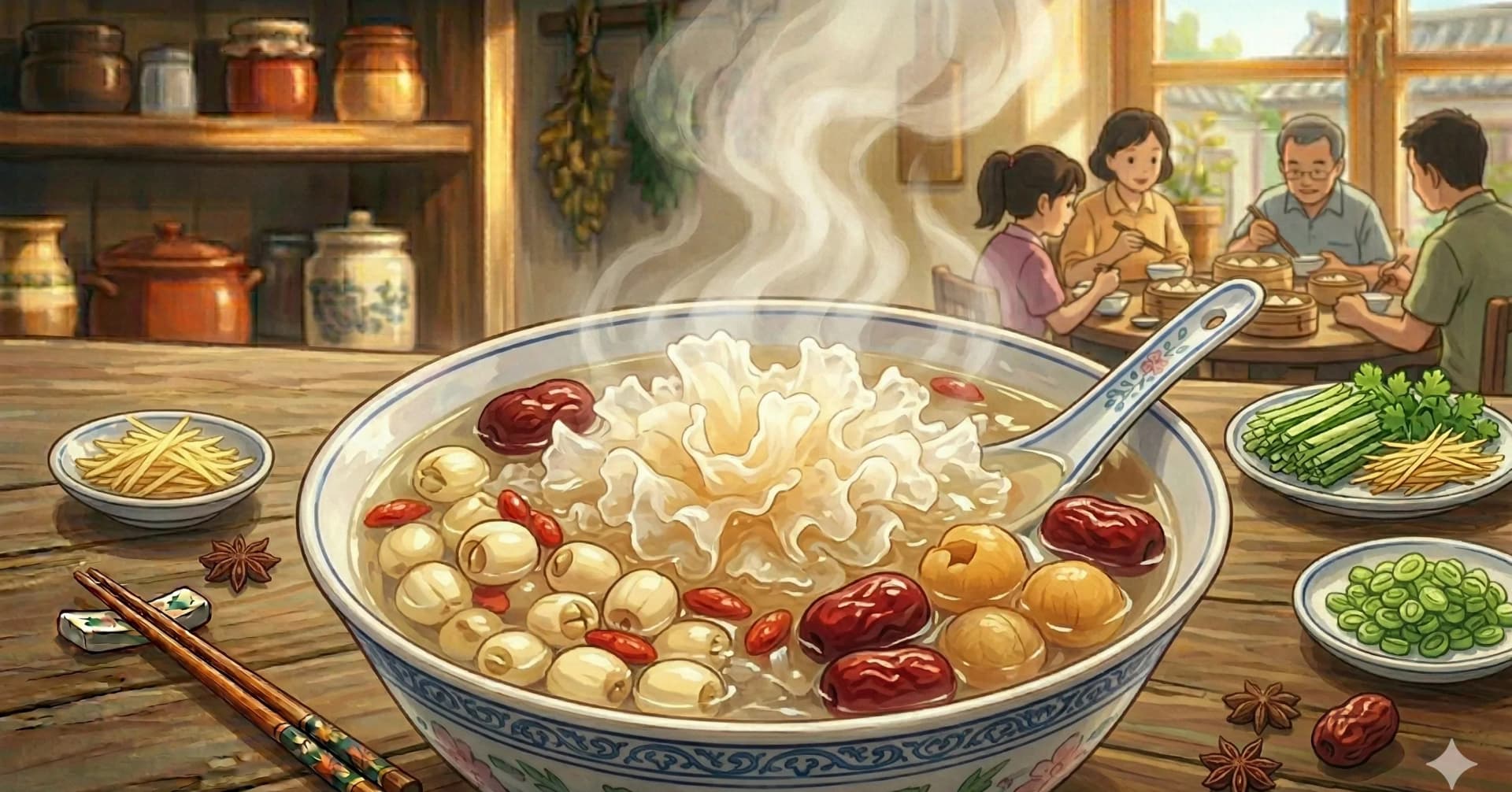
Snow fungus soup looks like something from a fairy tale. The fungus itself, when properly simmered, becomes translucent and trembling, with a texture that falls somewhere between soft jelly and the most delicate custard. Each piece has frilly, petal-like edges that catch the light, suspended in a broth that is barely sweet, faintly golden, and subtly viscous from the natural collagen-like polysaccharides the fungus releases over its long, slow cooking. It is as beautiful as it is nourishing, and it has been prized in Chinese cuisine for centuries for exactly that combination.
In Chinese culture, snow fungus (yin er, or "silver ear") holds a special place as a beauty food. It was historically so rare and expensive that it was reserved for the imperial court and the wealthy elite, consumed specifically for its reputed skin-beautifying properties. Modern cultivation has made it widely accessible, but its cultural associations with beauty, youth, and nourishment persist. The soup is considered especially beneficial in autumn and winter, when dry air can dehydrate the skin and respiratory system.
The supporting ingredients, goji berries, lotus seeds, jujube dates, and dried longan, are all staples of the Chinese herbal pantry. Each contributes its own character: the goji berries bring a gentle, fruity sweetness and a flash of red color. The lotus seeds add a starchy, almost chestnut-like texture. The dates provide deep sweetness. Together, they create a dessert that is light, restorative, and genuinely pleasant to eat.
The practical key is patience. Snow fungus needs at least 90 minutes of gentle simmering to break down and release its polysaccharides, which is what gives the soup its characteristic silky body. Rushed cooking produces firm, rubbery fungus in a thin, watery broth.
At a Glance
Yield
4 servings
Prep
15 minutes (plus soaking)
Cook
90 minutes
Total
105 minutes (plus soaking)
Difficulty
Easy
Ingredients
- ½ ozdried snow fungus (1 large piece)
- 1 ozdried lotus seeds
- ½ ozgoji berries
- 8red jujube dates (hong zao)
- ¼ ozdried longan flesh (gui yuan rou)
- 3¼ tbsprock sugar (adjust to taste)
- 1¼ qtwater
Method
- 1
Soak the dried snow fungus in a large bowl of cold water for at least 1 hour, or up to 4 hours. It will expand dramatically to several times its dried size, becoming soft, white, and ruffled.
- 2
Drain the soaked snow fungus. Trim away the hard, yellowish core at the base, which is tough and will not soften during cooking. Tear or cut the fungus into bite-sized pieces, about 3 cm. Smaller pieces will release their polysaccharides more readily and produce a thicker soup.
- 3
If using dried lotus seeds, soak them in warm water for 30 minutes. If your lotus seeds still have the green bitter core (lian xin), push it out with a toothpick. The core can be brewed as a tea but will make the soup bitter if left in.
- 4
Rinse the goji berries, jujube dates, and dried longan briefly under cool water.
- 5
Place the snow fungus pieces, lotus seeds, jujube dates, and dried longan in a large pot. Add the 1.2 L of water.
- 6
Bring to a boil over high heat. Skim any foam that rises to the surface.
- 7
Reduce the heat to the lowest setting. Cover and simmer very gently for 75 minutes. The snow fungus should become increasingly translucent and the broth should start to thicken slightly, becoming faintly viscous. Stir occasionally to prevent sticking.
- 8
After 75 minutes, check the snow fungus. It should be very soft, almost melting, with a jelly-like consistency. If it still feels firm, continue simmering for another 15 to 30 minutes.
- 9
Add the rock sugar. Stir until dissolved. Taste and adjust sweetness. The soup should be gently sweet, not cloying. In Chinese dessert tradition, the sweetness should serve as a background note, not the dominant flavor.
- 10
Add the goji berries. They are added at the end because they soften quickly and can become mushy if overcooked.
- 11
Simmer for another 5 minutes, just until the goji berries are plump and the sugar is fully incorporated.
- 12
Ladle into bowls, distributing the snow fungus, lotus seeds, dates, longan, and goji berries evenly.
- 13
Serve warm, at room temperature, or chilled. Each temperature offers a different experience: warm is comforting and soothing, chilled is refreshing and light.
- 14
The soup will continue to thicken as it cools, which is the natural behavior of the polysaccharides released by the snow fungus.
Key Ingredient Benefits
Snow fungus contains polysaccharides that research suggests may have moisturizing effects on skin when consumed regularly, potentially stimulating hyaluronic acid production. It is also being studied for its potential immune-modulating and antioxidant properties. In traditional Chinese medicine, it is considered a lung and stomach yin tonic.
Lotus seeds are traditionally associated with calming the mind and improving sleep. They contain alkaloids, including liensinine, that some research suggests may have mild sedative properties.
Goji berries contain zeaxanthin and polysaccharides that are being studied for eye health and immune function. They have been a staple of Chinese herbal medicine for millennia.
Dried longan is traditionally used as a blood tonic and is associated with improved sleep and reduced anxiety. It contains compounds that some research suggests may have neuroprotective properties.
Why This Works
Snow fungus contains high concentrations of polysaccharides, which are long-chain sugar molecules that dissolve slowly in hot water. These polysaccharides are responsible for the soup's viscous, slightly gelatinous texture. They require extended cooking to extract fully, which is why the minimum simmer time is 75 to 90 minutes. The smaller you tear the fungus, the more surface area is exposed, and the more quickly these compounds release.
Rock sugar dissolves more slowly and cleanly than granulated sugar, producing a broth with a clear, crystalline sweetness rather than the flat, one-dimensional sweetness of white sugar. It also contributes a subtle gloss to the finished soup.
The combination of ingredients follows traditional Chinese dietary therapy principles. Snow fungus is considered a yin-nourishing food, associated with moistening and cooling. Goji berries, dates, and longan are yang-supporting, adding warmth and sweetness. Together, they create what practitioners call a balanced formulation.
Substitutions & Variations
- Snow fungus: There is no substitute that replicates its unique texture. Agar-agar can create a jelly-like quality in the soup but is fundamentally different.
- Lotus seeds: Lily bulbs (bai he) are a traditional alternative or addition, providing a different starchy texture and slightly bitter-sweet flavor.
- Rock sugar: Honey can substitute, added after cooking and off heat to preserve its properties. Palm sugar adds a caramel note that is pleasant but non-traditional.
- With pear: Adding Asian pear (ya li), peeled and cubed, during the last 30 minutes of cooking is a popular variation, especially in autumn, when it is considered soothing for the lungs.
- With tremella and red bean: Some versions include cooked red beans (azuki) for a more substantial, porridge-like dessert.
- Pressure cooker: Snow fungus soup can be made in a pressure cooker in about 40 minutes at high pressure. The texture may be slightly different but still excellent.
Serving Suggestions
Serve as a dessert at the end of a Chinese meal, or as a mid-afternoon restorative on its own. It is traditionally consumed in autumn and winter for its moistening properties, but it is equally refreshing served chilled in summer. In Chinese culture, it is often prepared for new mothers, those recovering from illness, or anyone felt to need nourishment and hydration. A small bowl before bed is a common practice, as several of its ingredients are traditionally associated with improved sleep.
Storage & Reheating
Store in an airtight container in the refrigerator for up to 4 days. The soup will thicken significantly when cold as the polysaccharides continue to gel. This is normal and expected. Reheat gently on the stove, stirring occasionally. Add a splash of water if it has become too thick. The soup can also be enjoyed cold, straight from the refrigerator, as a chilled dessert. Freezing is possible for up to 1 month, though the snow fungus may become softer after thawing.
Cultural Notes
Yin er tang shui (銀耳糖水, "silver ear sweet soup") is the Cantonese dessert soup of slow-cooked snow fungus (yin er or bai mu er, also called silver tree-ear or white fungus) simmered with rock sugar, lily bulb, jujube dates, and lotus seeds until the fungus collapses into a glossy translucent gel and the soup takes on a slightly thickened, lightly sweet, faintly floral character. The dish belongs to the broader Cantonese tong sui (糖水, "sweet water") tradition of warm or chilled dessert soups that close the evening meal, and it sits among the most prestigious of the Cantonese sweet soups because of the historical cost and cultural value of snow fungus.
Snow fungus has a long documented history in Chinese tonic cookery. The fungus is described in the Bencao Gangmu (1578) as moistening for the lungs and beneficial for skin clarity, and it has been treated for centuries as a luxury ingredient comparable to bird's nest in cost and prestige. The cultivated form is now widely available and affordable, but the dish retains its association with skincare, longevity, and gentle nourishment. The fungus itself is sold in dried form as small white wrinkled pieces about the size of a peach pit that look almost ornamental; when soaked in water for thirty to sixty minutes, the pieces expand to ten times their dried volume and reveal a fine, frilly, almost coral-like structure.
The traditional preparation soaks the snow fungus, trims off the tough yellow base, breaks the fungus into bite-sized pieces, and simmers everything together with rock sugar, dried lily bulbs (bai he), jujube dates (hong zao), lotus seeds (lian zi), and sometimes Chinese pears (xue li) or wolfberries. The soup cooks for thirty to forty-five minutes until the snow fungus releases its natural polysaccharide compounds and thickens the broth to a glossy semi-gel consistency. The soup is served warm in winter and chilled in summer, in small bowls at the end of a meal or as an afternoon snack. The Cantonese household tradition of preparing tong sui weekly for the family and serving it in the afternoon or evening is the dish's primary cultural setting.
Nutrition Facts
Calories: 139kcal (7%)|Total Carbohydrates: 34g (12%)|Protein: 3g (6%)|Total Fat: 0g (0%)|Saturated Fat: 0g (0%)|Cholesterol: 0mg (0%)|Sodium: 15mg (1%)|Dietary Fiber: 2.7g (10%)|Total Sugars: 22g
You Might Also Like
 Medium
Chinese Cuisine
Niu Rou Yang Cong Jiaozi (Beef and Onion Dumplings)
60 minutes
 Medium
Chinese Cuisine
Bai Qie Ji (White Cut Chicken)
4 hours 30 minutes
 Easy
EasyTraditional Chinese Medicine · China
Beef Brisket Soup (清湯牛腩)
145 minutes
 Medium
Chinese Cuisine
Char Siu (Chinese BBQ Pork)
9 hours (including marinating)
Ratings & Comments
Ratings & Comments
Ratings
Share your thoughts on this recipe.
Sign in to rate and comment