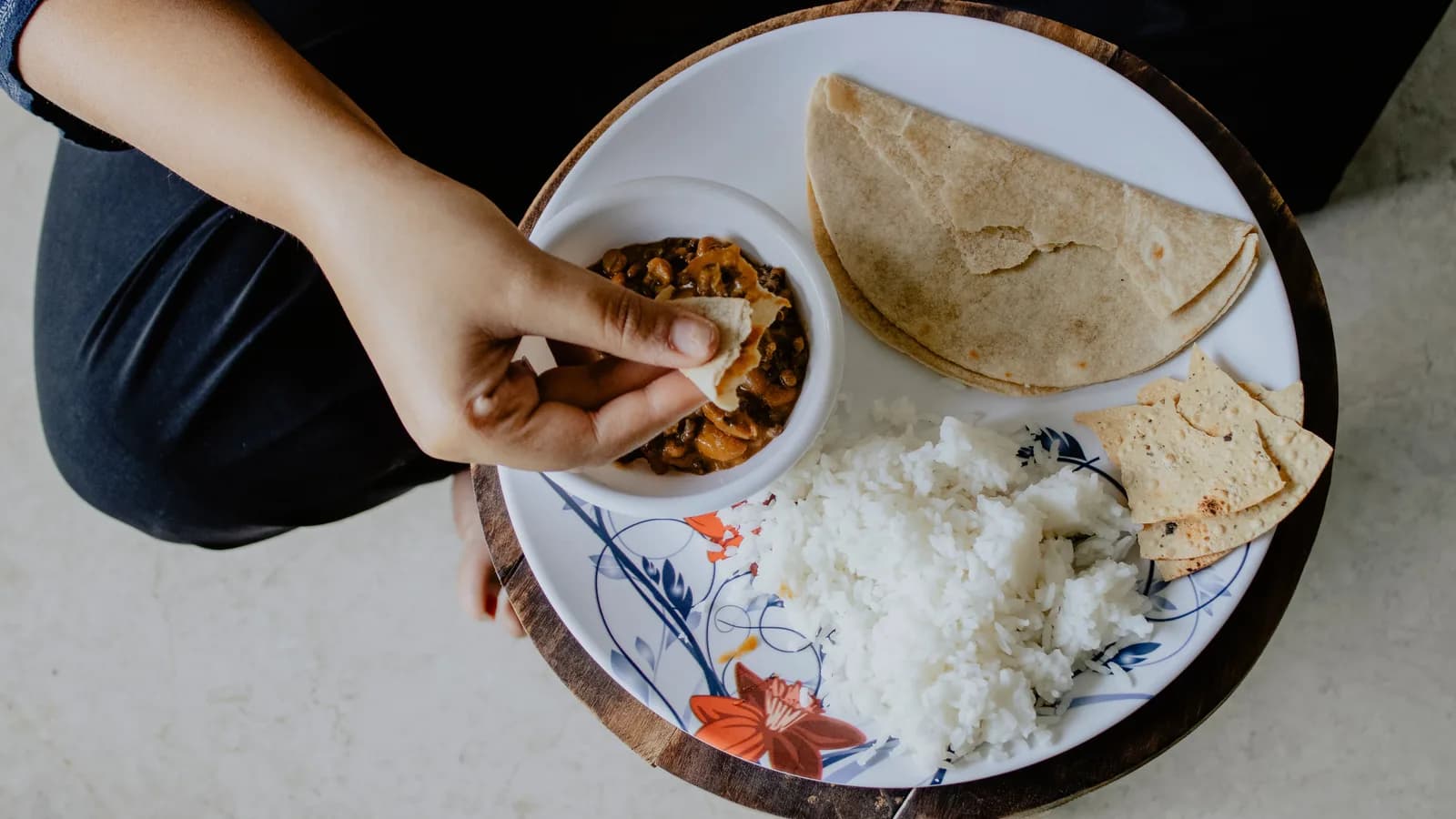
Why Indians Eat With Their Hands
The question gets asked as though it needs a defence. Why do Indians eat with their hands, as if cutlery were the neutral default and everything else a deviation from it.
Turn it around. A fork is a tool for moving food that is already in discrete pieces on a flat plate. Most Indian food is not in discrete pieces on a flat plate. It is rice and a half dozen wet things of different consistencies that have to be combined in varying proportions, bite by bite, and no fork does that well.
What the hand actually does
Eating Indian food properly is an act of assembly. You are mixing a little rice with a little dal, adjusting the ratio, picking up a piece of vegetable, adding a smear of pickle to one bite and not the next.
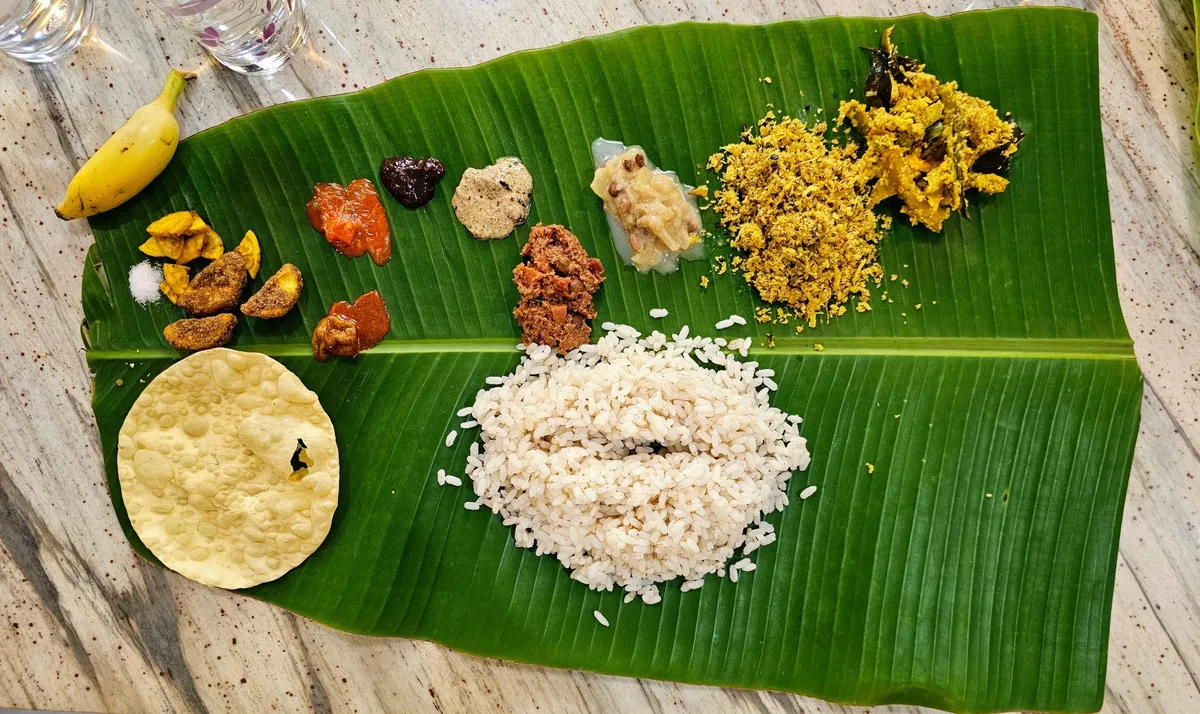
The hand can feel the proportions. It can tell whether a mouthful has enough rice to carry the sourness of the sambar, it can gauge the temperature before the food reaches your mouth, and it can gather a loose mixture into a ball that holds together on the way up. A fork can do none of these things, which is why rice eaten with a fork off a thali tends to arrive dry and unbalanced.
With breads it is even clearer. A piece of roti torn off and folded into a scoop is a purpose-built utensil that you then eat. Appam, dosa, luchi and puttu all assume this. Cutting a dosa with a knife and fork works, in the sense that the food ends up inside you, but it turns a crisp thing into a floppy one and the ratio of filling to crust goes wrong immediately.
The rules, because there are rules
This is the part that gets missed. Eating with hands is not casual and it is not unstructured.
Right hand only, across almost all of India, regardless of which hand you write with. The left is used for other things and is kept off the food, off shared serving spoons, and generally out of the transaction. A left handed visitor who eats left handed will be noticed.
Fingers, not palm, in the north. The convention is to use the first two or three fingers and the thumb, and to keep the food from going past the middle joints. A messy hand is poor form.
The south is more relaxed about this. Tamil and Kerala eating uses more of the hand, because the food is wetter and rice-based, and mixing rice properly with the fingers is a technique in itself.
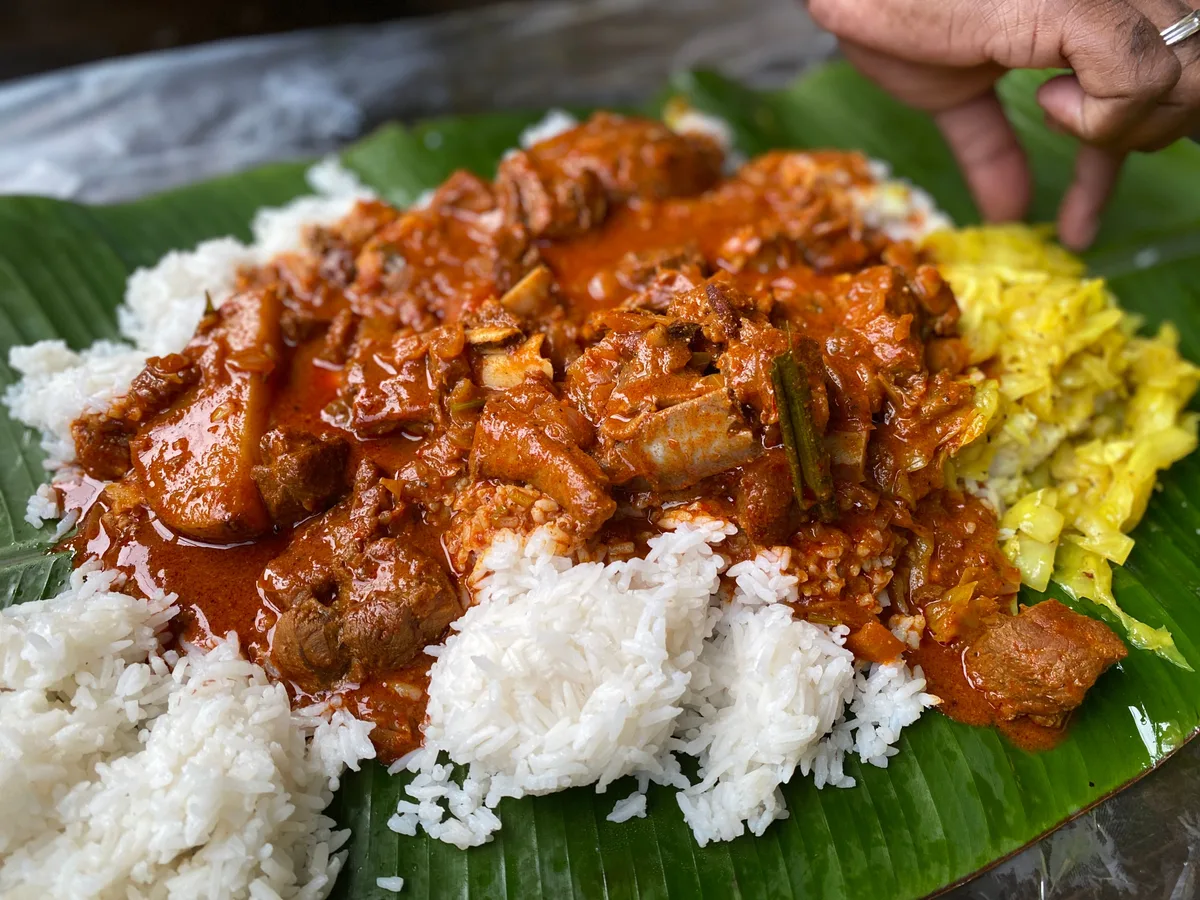
The thumb pushes. That is the actual mechanic people miss: the fingers gather and shape, and the thumb pushes the food off the fingertips into the mouth. Nothing goes in past the fingertips and the fingers should not enter the mouth.
The reasons people give
Three explanations come up, and they differ in how much weight they can carry.
The practical one is the strongest and is everything above. The food is built for it.
The traditional one comes out of Ayurveda, which holds that eating with the hands engages the senses and prepares the body to receive food. Touch registers texture and temperature before the first bite, and the argument is that digestion begins with that anticipation rather than at the first swallow. Whether you take the framework literally or not, the observation about anticipation is not a strange one, and it is the same reasoning behind why food that smells good is easier to eat.
The third explanation, the one offered most often on the internet, is about the microbiome of the hands. It is thin, and it is better to leave it alone than to repeat it.
Where it is not done
India is not uniform on this either. Rice and wet dishes are eaten by hand almost everywhere, but the further north you go the more likely a spoon appears alongside for particularly liquid things.
Sweets, snacks and anything with syrup often get a spoon. Communal dishes are served with serving spoons, always, and reaching into a shared dish with your eating hand is the actual taboo rather than eating with hands at all.
Restaurants in Indian cities lay both. Nobody is judging a visitor for using a fork, and a foreign guest carefully eating by hand is usually met with approval rather than indifference.
Frequently asked questions
Is it rude to use cutlery in India?
Not at all. Plenty of Indians use a spoon for rice dishes, particularly in the north and in cities. The only firm rules are about the left hand and about shared serving dishes.
Why is the left hand avoided?
It is traditionally reserved for personal hygiene and is considered unclean for handling food. The convention is widespread across South Asia and the Middle East and holds even in households where nobody thinks about the origin.
How do you eat rice with your hand without making a mess?
Mix a small area of rice with the dal or curry, press it gently into a loose mass with the fingertips, lift, and push it in with the thumb. Small mouthfuls. The technique takes a few meals to become natural and looks impossible until it suddenly does not.
Do people eat biryani with their hands?
Yes, commonly, and biryani is a good dish to learn on because the rice is dry enough to gather without being sticky.
What to cook
Cook a meal that actually wants hands. Avial with rice is the Kerala argument in one plate, wet and layered and impossible to balance with a fork. Dosa makes the case for bread as a utensil. And khichdi, soft and single-textured, is the easiest thing to practise on before you try a full thali. For how those plates are composed in the first place, see six regions and six thalis.
Comments
Share your thoughts on this post.
Sign in to comment0 Comments