Amchur
Also known as: Amchoor, Aamchur, Dried mango powder, Green mango powder, आमचूर
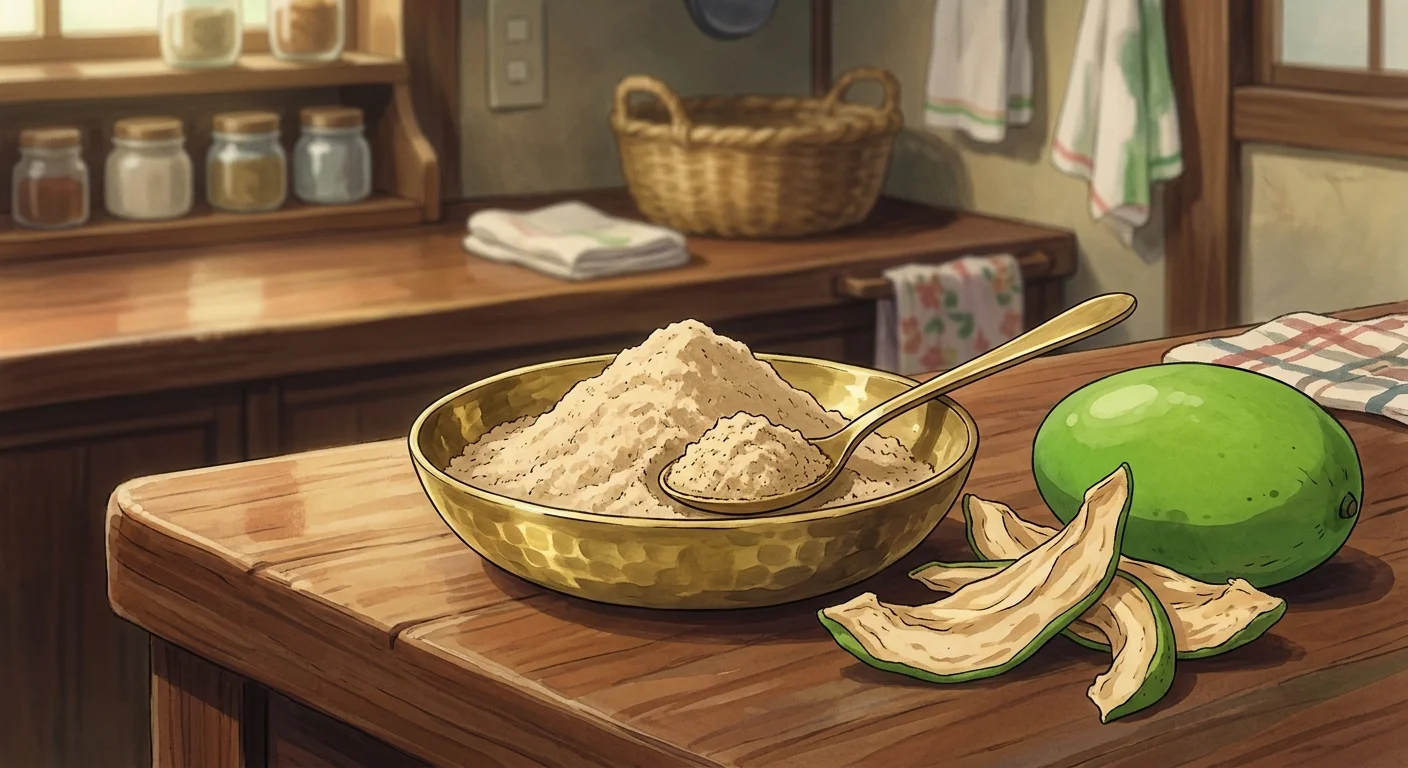
Amchur (आमचूर, also spelled amchoor) is dried green mango powder. Unripe mangoes are peeled, sliced thin, dried in the sun and ground into a fine, pale tan powder. It is a souring agent, doing the job of lime juice or tamarind, but dry.
That dryness is the reason to own it. Lime juice would turn a crisp okra fry soggy or make a samosa filling wet. A spoonful of amchur gives the same sour, fruity tang and adds no liquid at all.
Key facts at a glance:
- Sun-dried unripe mango, ground to a powder
- Sour and fruity, with a faint honey-like smell
- Adds acidity without moisture, so it suits dry dishes, fillings and spice rubs
- One of the main ingredients in chaat masala
- Used in our chana masala and samosa
Flavor Profile
Origin
India
Traditional Medicine Perspectives
Ayurveda
Ayurveda counts sour (amla) as one of the six tastes and traditionally links it with stimulating appetite and digestion. Unripe mango is classed as sour, and Ayurvedic practice advises eating sour foods in moderation, since too much sourness is thought to aggravate pitta, the dosha associated with heat.
Modern Scientific Research
Mango has been widely studied, though mostly the fresh fruit and the parts people throw away. The 2021 review describes the pulp as a source of sugars, pectin, vitamins and polyphenols, and the peel as richer in compounds such as mangiferin and β-carotene, which are studied for anti-inflammatory and anti-diabetic properties.
Amchur is made from peeled fruit, so it carries more of the pulp's compounds than the peel's.
Think of amchur as a flavoring more than a source of nutrients. You use it by the teaspoon.
Drying in the sun also breaks down much of the vitamin C in fresh mango, since vitamin C is sensitive to heat, light and air. What amchur keeps is the fruit's acidity, which is why it tastes so sharp.
Cultural History
Amchur is mostly produced in India, and it comes from the country's favorite fruit. India grows about 55% of the world's mangoes, according to a 2021 review in the International Journal of Environmental Research and Public Health.
Early in the season, some of the mangoes are picked while still green and hard. They are peeled, sliced and laid out in the sun until the slices turn leathery and pale. The dried slices keep for months, and they are ground into powder or sold ready-ground.
The name is Hindi: aam means mango and chur means powder.
In North Indian cooking, amchur is what you use when a dish needs lime juice but has to stay dry.
It is also a key part of chaat masala, the tangy spice mix sprinkled over street snacks like aloo chaat and fruit chaat, where it sits alongside black salt, cumin and chili.
Culinary Uses
Amchur works best near the end of cooking or mixed into fillings and dry rubs, where its sourness stays bright.
- In chana masala, it gives the chickpeas their tang.
- In samosa filling and aloo ki tikki, it sharpens the spiced potato.
- In bhindi masala, it adds acidity without making the okra slimy.
It also goes into chutneys, dals and pickles, and into marinades for meat and kebabs, where cooks use it to help tenderize.
Many cooks swap about 1 teaspoon of amchur for 1 tablespoon of lime juice. Taste and adjust, since brands vary in sourness.
Preparation Methods
Amchur is ready to use as sold. Measure it straight into the pot or the filling.
Keep it in an airtight jar, away from light and humidity. The fine powder soaks up moisture and turns into hard clumps. If that happens, break them up with a spoon; the flavor is still fine.
Ground amchur is best within about a year. When it smells dusty instead of fruity and sour, replace it. Whole dried mango slices last longer and can be ground in a spice grinder as needed, or simmered whole in a dal and removed before serving.
Comments
Share your thoughts on this ingredient.
Sign in to comment0 Comments