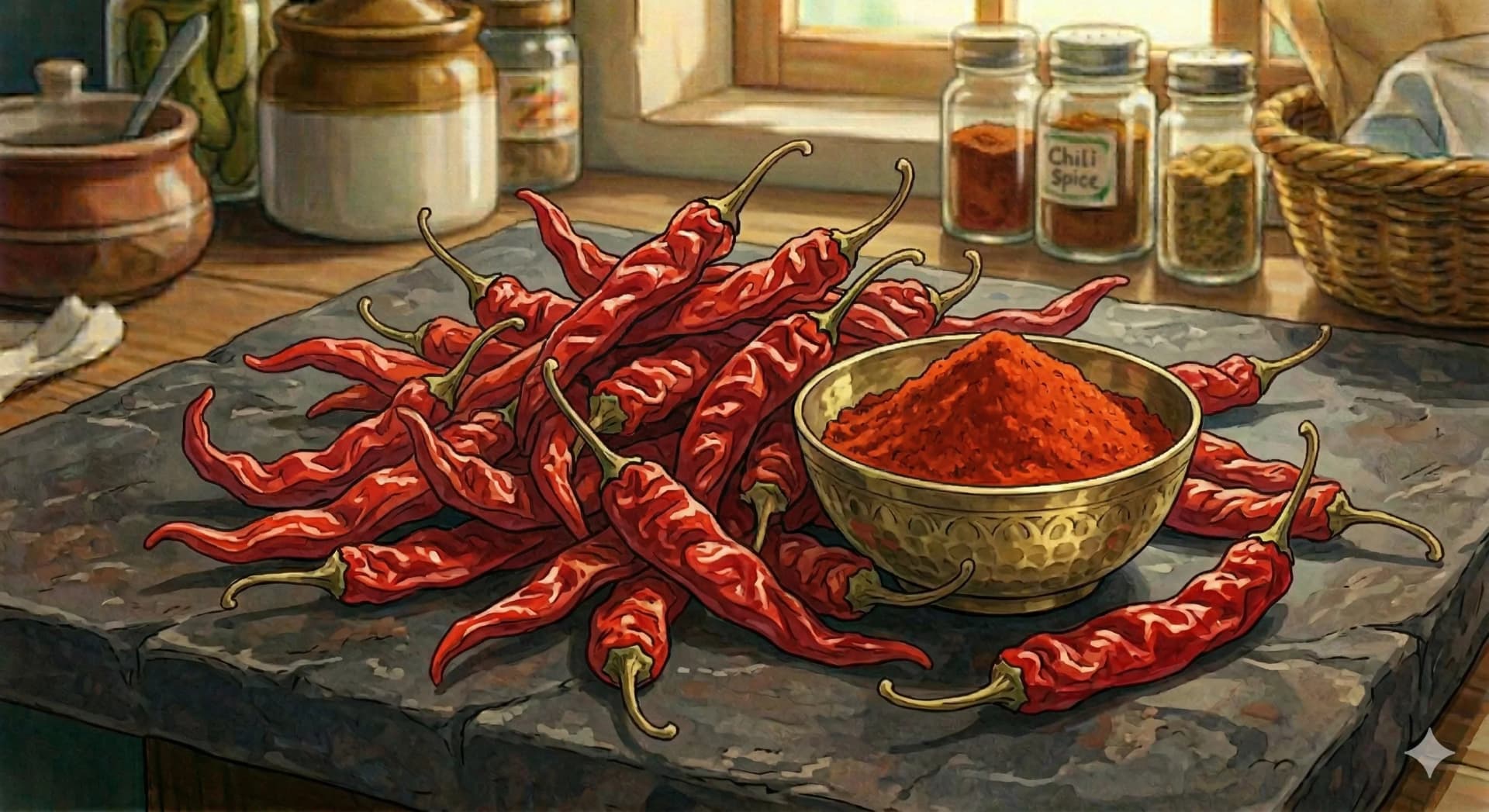
Kashmiri Chilies
Also known as: Kashmiri Mirch, Deggi Mirch (similar variety), Kashmiri Red Chili
Kashmiri chilies are the paprika of Indian cooking. The comparison is apt: like Spanish or Hungarian paprika, Kashmiri chilies are valued primarily for their extraordinary color and their mild, sweet, fruity flavor rather than for capsaicin heat.
They produce the deepest, most vivid brick-red that Indian cooking is known for — the color that makes rogan josh look like it is glowing from within, that gives tandoori chicken its characteristic crimson, and that accounts for the deep terracotta of butter chicken gravy, all without creating dishes that are excessively fiery.
The chilies are grown in the Kashmir Valley at elevations above 1,500 meters, in a climate of warm summers, cold winters, and mineral-rich alluvial soil. This environment produces a fruit with notably high carotenoid content and relatively low capsaicin levels.
The low heat level — typically between 1,000 and 2,000 Scoville Heat Units compared to cayenne's 30,000 to 50,000 — allows cooks to use a generous tablespoon of powder in a dish without creating a fire, while the color payoff is dramatic.
Fresh Kashmiri chilies are long, wrinkled, and a deep, glossy red. Dried, they become papery and very dark red. Ground, they produce a powder that is intensely colored, almost jewel-like in its depth.
Key facts at a glance:
- Color, not heat — valued for extraordinary brick-red pigmentation over capsaicin
- Kashmir Valley grown — high altitude, mineral-rich soil produces high carotenoids
- 1,000–2,000 SHU — mild enough to use by the tablespoon
- Rogan josh essential — the source of the dish's characteristic glowing red
- Distinct from Deggi Mirch — commercial blends mix Kashmiri with hotter varieties for color efficiency
Flavor Profile
Origin
Kashmir Valley, Jammu and Kashmir, India
Traditional Medicine Perspectives
Ayurveda:
In Ayurvedic classification, all chili peppers are considered heating (ushna virya), pungent (katu rasa), and Pitta-aggravating when consumed in excess. Kashmiri mirch occupies a milder position on this spectrum than cayenne or other hot varieties: its lower capsaicin content means it provides a gentler stimulation of digestive fire without the sharp, aggravating heat that stronger chilies produce. For individuals who need the agni-kindling (digestive fire-stimulating) properties of capsicum but who have a Pitta constitution or any Pitta imbalance, including acid reflux, inflammatory skin conditions, or excess body heat, Kashmiri mirch is the preferred choice. It provides enough warmth to be beneficial as a digestive stimulant and circulatory mover without the risk of pushing Pitta into excess. Classical texts that pre-date the introduction of chili to India use long pepper (Piper longum) and black pepper for similar purposes, and Kashmiri mirch is often understood as occupying a comparable niche in post-chili Indian Ayurvedic cooking traditions.
Modern Scientific Research
The scientific interest in Kashmiri chilies centers on their carotenoid profile and their low capsaicin content relative to intense color. The vivid red comes from carotenoid compounds including capsanthin and capsorubin, present in particularly high concentrations.
These compounds are potent antioxidants studied for anti-inflammatory, anticarcinogenic, and visual-health-supporting properties. The high carotenoid-to-capsaicin ratio makes Kashmiri mirch a potentially useful food-based source of these compounds for people who cannot tolerate heat.
In cuisines where it is used generously as a coloring and base flavoring spice, the cumulative capsaicin exposure across a meal may be comparable to smaller amounts of hotter chili, making the mild heat-per-unit calculation less straightforward in practice.
Cultural History
The Kashmir Valley has been producing prized chilies since capsicum varieties were introduced to South Asia via Portuguese trade in the 16th and 17th centuries. The chili plant adapted to the valley's conditions, and over generations the local variety developed its distinctive characteristics.
Wazwan, the formal ceremonial feast of Kashmir, consists of dozens of dishes that are predominantly deep red in color. The red comes from Kashmiri mirch, not from cayenne. The visual impact of a Wazwan spread — table after table of gleaming red dishes — is a deliberate aesthetic statement.
The specialist cooks called wazas who prepared these feasts guarded their specific techniques and spice sourcing as professional secrets, and the quality of the Kashmiri mirch used was a distinguishing factor in the reputation of different waza lineages.
The commercial product called Deggi Mirch, widely sold throughout India, is related but not identical. It is a blend combining Kashmiri chilies with a redder but slightly hotter variety called Teja, formulated for consistent, vivid red color at a lower price point.
Culinary Uses
Kashmiri mirch functions differently from hot chilies. Because it can be used in large quantities without making a dish unbearably spicy, it is used as both a flavor and color foundation, not as a heat accent.
A standard quantity for rogan josh for four people might be one to one and a half tablespoons — a quantity that would be catastrophically hot with cayenne but here creates the dish's characteristic deep red base.
Professional cooks use Kashmiri mirch as a coloring tool alongside their heat source (cayenne or fresh green chilies). This separation of color and heat functions allows complete independent control.
Whole dried Kashmiri chilies can be soaked in warm water for 20 to 30 minutes and blended into a smooth paste, which is how rogan josh gravy is traditionally built.
Preparation Methods
Ground powder in hot oil: Add Kashmiri mirch powder to hot oil or ghee after the initial aromatics have been cooked down. Toast the powder in the oil for one to two minutes, stirring constantly, until it darkens slightly and the oil becomes deeply red-orange. Use one to two tablespoons per four servings for full color.
Soaked whole chili paste: Remove stems and seeds from 6 to 8 dried Kashmiri chilies. Soak in warm water for 25 minutes until soft. Blend with a small amount of the soaking water to a smooth, deep-red paste. Used for restaurant-quality rogan josh.
In marinades: Combine Kashmiri mirch powder with yogurt, salt, lemon juice, and other spices for tandoori-style marinades. The yogurt's proteins protect the carotenoids during high-heat cooking, preserving the color through charring.
Blended with cayenne for controlled heat: Mix three parts Kashmiri mirch to one part cayenne as a customizable heat-with-color blend. This is standard practice in many Indian restaurant kitchens.
Traditional Dishes
- Rogan josh (essential)
- Kashmiri dum aloo
- Yakhni (Kashmiri spiced stock)
- Tandoori chicken marinade
- Butter chicken color base
- Kashmiri chicken curry
- Chole masala
- Seekh kebab
- Shami kebab
- Wazwan feast preparations
- Lamb kofta
Comments
Share your thoughts on this ingredient.
Sign in to comment0 Comments