Indonesian Cuisine
Ayam Goreng Lengkuas (Galangal Fried Chicken)
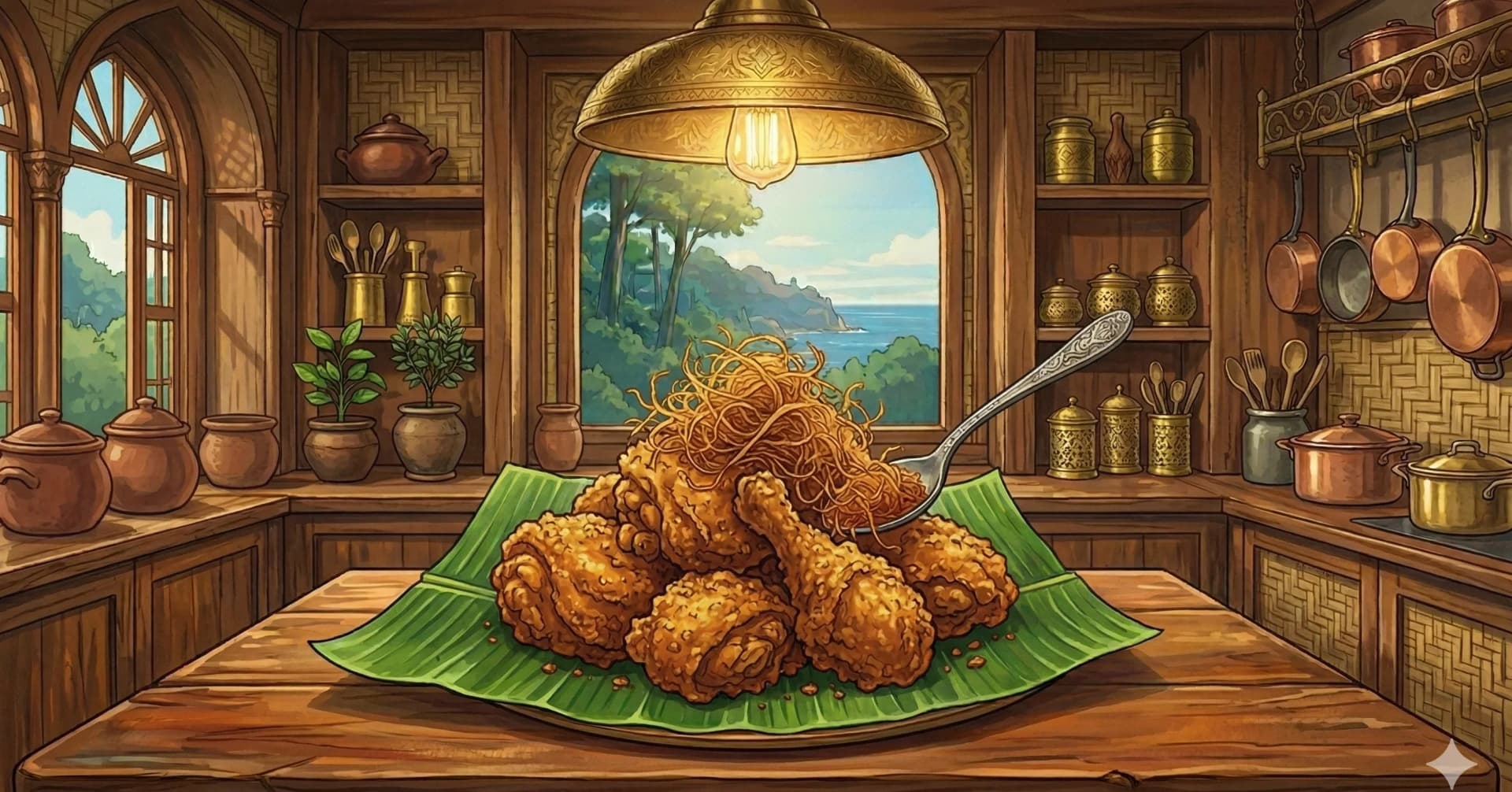
Sundanese double-cooked fried chicken braised in a galangal-rich spice paste, then deep-fried until golden and topped with crispy galangal floss
There is something quietly stubborn about Sundanese cooking. Where other Indonesian regional kitchens layer complexity upon complexity, the food of West Java tends toward clarity. Ingredients are chosen for what they do on their own rather than how they disappear into a crowd. Ayam goreng lengkuas is a good example of that principle taken to its logical extreme: a fried chicken built almost entirely around a single rhizome.
The dish comes from Bandung and the surrounding Sundanese highlands, where galangal grows in abundance and appears in everything from soups to sambals. But where most Indonesian recipes call for a thin slice or two to perfume a braise, this one demands an almost improbable quantity of the stuff. Two hundred grams of freshly grated galangal forms the backbone of the cooking liquid, and the leftover spice pulp gets fried into a crispy floss that crowns the finished chicken. The galangal does double work, flavoring the meat from the inside out during a long simmer, then adding crunch and fragrance on top.
The technique is a double cook. The chicken first braises gently in the spice paste and water until the liquid evaporates and the aromatics have had time to penetrate the meat. The cooked chicken and the spent spice pulp are then separated and fried individually. This two-stage approach is common across Indonesian fried chicken traditions, from the turmeric-stained versions of Padang to the sweet soy renditions of Central Java. It produces a chicken that is seasoned to the bone in a way that a simple dredge-and-fry method cannot replicate. Paired with steamed rice, raw vegetables in the Sundanese lalapan style, and a sharp sambal, it is the kind of meal that feels both ancient and completely direct. If you enjoy the depth of chicken rendang but want something with more textural contrast, this is a natural next step.
At a Glance
Yield
4 servings
Prep
30 minutes
Cook
1 hour 15 minutes
Total
1 hour 45 minutes
Difficulty
Medium
Ingredients
- 8shallots (about 120 g), peeled and roughly chopped
- 4 clovesgarlic (about 16 g), peeled
- 4roasted candlenuts (about 20 g), roughly chopped
- 2¾ tspcoriander seeds
- 3¾ tbspfresh turmeric (about 3 cm), peeled and chopped
- ⅓ cupfresh ginger (about 3 cm), peeled and chopped
- 1 wholechicken, cut into 8 to 10 pieces (about 1.4 kg), washed and patted dry
- 7 ozfresh galangal, coarsely grated or pulsed in a food processor
- 2 stalkslemongrass, white parts only, cut into 8 cm lengths and bruised
- 3kaffir lime leaves, torn
- 2salam leaves (Indonesian bay leaves)
- 1¼ cupwater
- —Salt to taste (about 5 g / 1 teaspoon to start)
- —Neutral oil for deep-frying (about 750 ml), such as peanut or coconut oil
- —Steamed jasmine or long-grain rice
- —Fresh raw vegetables (cucumber, cabbage, tomato, Thai basil) for lalapan
- —Sambal of choice
Method
- 1
Blend the shallots, garlic, candlenuts, coriander seeds, turmeric, and ginger into a fine paste, adding a splash of water if needed to get the blades moving. The paste should be smooth with no large chunks remaining. Set aside.
- 2
Grate the galangal on the coarse holes of a box grater, or pulse it in a food processor until it forms shaggy, fibrous strands. You want visible texture here rather than a smooth puree, since these strands will later become the crispy floss. Keep the galangal separate from the blended spice paste.
- 3
Place the grated galangal, spice paste, lemongrass, kaffir lime leaves, salam leaves, and salt in a deep wok or Dutch oven. Stir everything together until the spices are evenly distributed and the mixture is fragrant.
- 4
Nestle the chicken pieces into the spice mixture, turning each piece to coat it thoroughly. Pour in the water and bring to a boil over medium-high heat. You will notice the kitchen filling with a sharp, piney aroma from the galangal as the liquid heats.
- 5
Reduce the heat to medium-low, cover loosely, and simmer for 45 minutes to 1 hour. Stir and turn the chicken every 15 minutes or so. The liquid will gradually reduce, and the spice paste will begin to cling to the chicken rather than pool around it. The chicken is ready when it is cooked through and the braising liquid has nearly evaporated, leaving behind a thick, fragrant coating.
- 6
Remove the chicken pieces and set them on a wire rack or plate. Pick out and discard the lemongrass stalks, kaffir lime leaves, and salam leaves from the remaining spice mixture. Transfer the leftover galangal and spice pulp to a fine-mesh strainer set over a bowl. Press firmly with the back of a spoon to squeeze out as much liquid as possible. The drier the pulp, the crispier it will fry.
- 7
Heat the oil in a deep wok or heavy pot to 170 C (340 F). Working in batches of 2 to 3 pieces to avoid crowding, lower the chicken into the oil. Fry for 4 to 5 minutes per side, until the skin turns a deep golden brown and the surface feels firm and crisp when tapped with tongs. The chicken is already cooked through from the braise, so you are building color and crust rather than cooking it further. Transfer to a wire rack.
- 8
While the oil is still hot, add the strained galangal pulp in a single layer (you may need to do this in two batches). Fry for 3 to 4 minutes, stirring occasionally, until the strands turn golden and crispy and the sizzling quiets down. The floss is done when it looks dry and holds its shape when lifted with a slotted spoon. Drain on paper towels and season with a small pinch of salt while still warm.
- 9
Arrange the fried chicken on a serving plate and scatter the galangal floss generously over the top. Serve immediately with steamed rice, a plate of fresh lalapan vegetables, and your preferred sambal.
Key Ingredient Benefits
Galangal (lengkuas): A rhizome in the ginger family (Alpinia galanga), galangal has a sharper, more resinous flavor than ginger and cannot be used interchangeably. In traditional Indonesian jamu (herbal medicine), galangal is valued for digestive support and respiratory health. It contains galangin, a flavonoid that has shown antioxidant and anti-inflammatory activity in laboratory studies. Fresh galangal should feel firm and heavy, with smooth, pale skin. Avoid pieces that are soft or wrinkled. See the Galangal ingredient guide.
Candlenuts (kemiri): These waxy, cream-colored nuts are a staple thickener in Indonesian spice pastes. They must always be cooked before eating, as raw candlenuts contain compounds that can cause gastrointestinal distress. Roasting them briefly in a dry pan before blending improves their flavor and reduces any residual toxicity. They are high in healthy fats and calories.
Salam leaves (daun salam): Indonesian bay leaves from the Syzygium polyanthum tree, these are not related to European bay laurel and have a subtler, slightly astringent flavor. They are used in braised dishes throughout Indonesia. If unavailable, they can be omitted without dramatically changing the dish. Curry leaves are a closer substitute than bay laurel.
Turmeric: Fresh turmeric provides both color and an earthy bitterness that balances the piney galangal. The curcumin it contains has been widely studied for anti-inflammatory properties, though absorption is limited without fat or black pepper. The fat in this dish, from both the braise and frying, may aid absorption. See the Turmeric ingredient guide.
Why This Works
The double-cook method solves a problem that all fried chicken faces: how to season the interior without sacrificing the exterior. By braising first, the spice paste has nearly an hour to work its way into the chicken, flavoring the meat far more deeply than any marinade or brine could manage in the same time. The subsequent fry then crisps the surface without needing to worry about underdone interiors, so you can focus entirely on achieving the right color and texture.
Galangal is the structural backbone of this dish for a reason. Unlike ginger, which softens and becomes almost silky when cooked, galangal retains a woody, fibrous quality that makes it ideal for frying into floss. The strands crisp up rather than burning, and they carry their sharp, piney flavor into the crunchy topping. Using 200 grams may seem excessive, but the long simmer mellows the galangal considerably. What remains is aromatic warmth rather than raw bite.
The candlenuts in the spice paste act as a thickener and emulsifier, helping the paste cling to the chicken during the braise rather than sliding off into the liquid. They also contribute a subtle creaminess that rounds out the sharper notes of turmeric and coriander.
Pressing the moisture out of the galangal pulp before frying is the small step that makes the biggest difference. Wet pulp will sputter and steam in the oil rather than crisping, and the resulting floss will be chewy rather than crunchy.
Substitutions & Variations
Galangal: There is genuinely no substitute that replicates the flavor. If fresh galangal is unavailable, frozen galangal (thawed and grated) works nearly as well. Galangal powder can be used in the spice paste at about 15 g for the braise, but you will lose the floss component entirely, which is a significant part of the dish.
Candlenuts: Macadamia nuts are the closest substitute in both fat content and texture. Raw cashews also work. Use the same quantity by weight.
Salam leaves: Omit if unavailable. Curry leaves (3 to 4 leaves) offer a closer flavor profile than European bay leaves, though neither is a true match.
Chicken: Bone-in, skin-on thighs or drumsticks work if you prefer dark meat only. Boneless pieces will cook faster in the braise (reduce to 30 minutes) but will not have the same depth of flavor that bones contribute.
Frying method: For a lighter version, the braised chicken can be finished under a hot broiler for 8 to 10 minutes, turning once, until the skin crisps. The galangal floss will still need to be fried in oil. Air-frying at 200 C for 12 to 15 minutes is another option, though the crust will be less even.
Spice level: The base recipe is not spicy. For heat, add 2 to 4 fresh red chilies to the spice paste, or serve with a fiery sambal on the side.
Serving Suggestions
Ayam goreng lengkuas is traditionally part of a Sundanese rice table, where it sits alongside several complementary dishes. A plate of nasi uduk (coconut rice) is the most natural pairing, elevating a simple steamed rice accompaniment into something richer. For a fuller Indonesian spread, add gado-gado for a vegetable course with peanut sauce, tempeh goreng for a crispy plant-based contrast, and a sambal or two for heat. If you want to build a larger chicken-focused table, ayam bakar (grilled chicken with sweet soy glaze) offers a complementary smoky sweetness that plays against the galangal's piney sharpness. For those who enjoy comparing Southeast Asian approaches to chicken, serve this alongside pad krapow for a study in how different herb-forward traditions handle the same protein. A simple cucumber salad dressed with rice vinegar and a pinch of sugar provides a cool, clean contrast to the richness of the fried chicken.
Storage & Reheating
Refrigerator: Store the fried chicken and galangal floss separately in airtight containers. The chicken keeps well for up to 3 days. The floss should be stored at room temperature in a sealed container for up to 5 days; refrigerating it introduces moisture that softens it.
Reheating: Reheat the chicken in an oven preheated to 190 C (375 F) for 10 to 12 minutes, until the skin is crisp and heated through. A microwave will soften the crust and is not recommended. Top with the galangal floss after reheating so it stays crunchy.
Freezing: The braised (but not yet fried) chicken freezes well for up to 2 months. Thaw overnight in the refrigerator, pat dry thoroughly, and deep-fry as directed. Freezing already-fried chicken is possible but the crust will not recover its original crispness. The galangal floss does not freeze well.
Meal prep: The most practical approach is to complete the braise up to 2 days ahead and refrigerate the chicken and spice pulp separately. The frying then takes about 20 minutes on the day of serving. The galangal floss can also be fried a day or two in advance and stored in an airtight container at room temperature.
Cultural Notes
Ayam goreng lengkuas is a signature dish of Sundanese cuisine, the regional food culture of West Java in Indonesia. The Sundanese people are the second-largest ethnic group in Indonesia after the Javanese, and their cooking is shaped by a preference for fresh raw vegetables (eaten as lalapan, the assortment of fresh greens that accompanies most Sundanese meals), abundant sambal, and a slightly cleaner, less heavily spiced profile than the dense, complex curries of Java and Sumatra.
The double-cooking technique that defines this dish (first braising the chicken in a galangal-and-coconut-water paste, then deep-frying the cooled, sauce-coated bird until the spice paste turns into a crispy floss) is also used for other Sundanese chicken preparations and runs in parallel in Padang Minangkabau cuisine. The technique solves the recurring challenge of producing chicken that is both deeply seasoned to the bone and crispy on the outside, two qualities that are hard to achieve at the same time with a single cooking method.
The signature crispy-galangal topping is the part that most sets Sundanese-style fried chicken apart from the broader Indonesian ayam goreng category. The reserved galangal-spice paste from the braising stage is fried separately until it turns into a brittle, fragrant golden floss that is scattered over the finished chicken at serving time. This technique is rarely found outside Sundanese restaurants and is one of the markers that identifies a true Sundanese kitchen. The most famous restaurant chain serving this dish is Ayam Goreng Suharti, founded in 1969 by Suharti Bramardiyani in Yogyakarta, with locations now spread across Indonesia.
Nutrition Facts
Calories: 642kcal (32%)|Total Carbohydrates: 3g (1%)|Protein: 43g (86%)|Total Fat: 48g (62%)|Saturated Fat: 13g (65%)|Cholesterol: 190mg (63%)|Sodium: 540mg (23%)|Dietary Fiber: 1g (4%)|Total Sugars: 1g
You Might Also Like

Ratings & Comments
Ratings & Comments
Ratings
Share your thoughts on this recipe.
Sign in to rate and comment