Punjabi · Indian Cuisine
Chana Masala
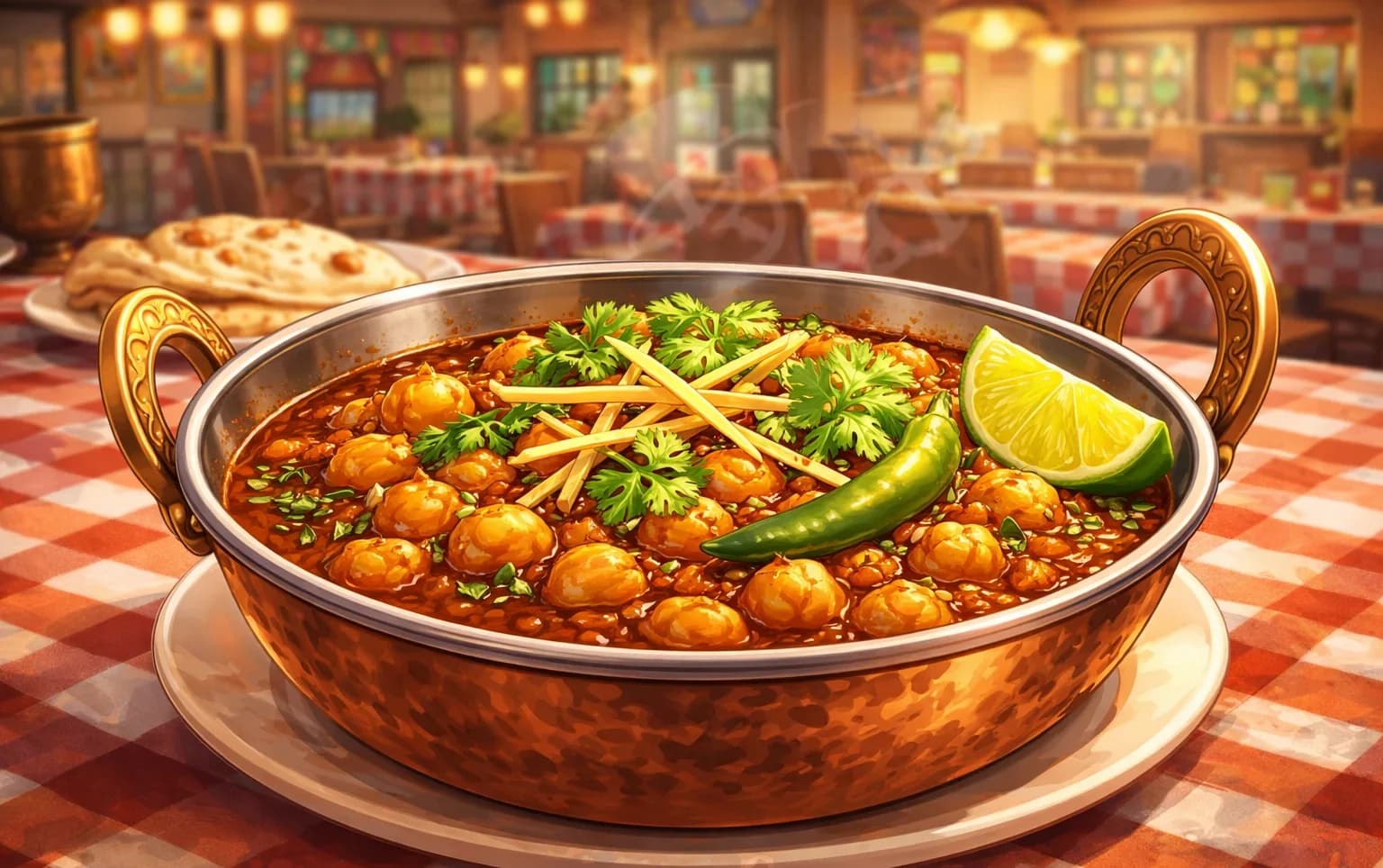
Chickpeas braised in a dark, tangy masala with tea-stained depth
The chickpeas should be dark. Not the pale beige of a lightly simmered chana dal, but a deep, burnished brown that comes from two sources: tea added to the soaking or boiling water, and the long, slow cooking of the masala until it concentrates and stains every chickpea it touches. This darkness is the signature of proper Punjabi chole, and it distinguishes the dish from lighter, quicker versions found elsewhere.
Chana masala, or chole, is one of the pillars of Punjabi street food and home cooking alike. In Old Delhi, it anchors the iconic chole bhature combination: puffy, deep-fried bread served alongside a bowl of dark, tangy chickpeas. At home in Punjab, it appears with rice, roti, or the thinner, crispier puri. The flavoring is assertive: amchur (dried mango powder), anardana (dried pomegranate seed powder), and sometimes a squeeze of lime provide layers of sourness that keep the heavy, starchy chickpeas from feeling leaden.
What makes this dish rewarding to cook is the way the chickpeas transform over time. Soaked overnight, boiled until tender but not splitting, then simmered in a masala that has been cooked to the point of oil separation, they absorb the spiced gravy and darken steadily. The finished dish should be thick, almost dry, with the chickpeas coated in a concentrated masala rather than floating in liquid.
The practical point worth noting is that the quality of the dried chickpeas matters more here than in almost any other legume dish. Fresh crop chickpeas (kabuli chana, the large, pale variety) cook evenly and taste clean. Old, stale chickpeas cook unevenly, with some splitting while others remain hard at the center.
At a Glance
Yield
Serves 4
Prep
15 minutes (plus overnight soaking)
Cook
1 hour 15 minutes
Total
1 hour 30 minutes (plus soaking)
Difficulty
Easy
Ingredients
- ½ lbdried chickpeas (kabuli chana), soaked overnight in plenty of cold water
- 2tea bags (plain black tea) or 1 tablespoon loose black tea tied in muslin
- ⅔ tspbaking soda (about ½ teaspoon, optional, added to soaking water)
- ⅞ tspsalt
- 3 tbspneutral oil or ghee
- 2bay leaves
- 1small cinnamon stick (about 3 cm)
- 4green cardamom pods, lightly crushed
- 3cloves
- 2⅓ tspcumin seeds
- 7 ozonions (about 1–1½ onions), finely chopped
- 1 tbspginger-garlic paste
- ½ lbtomatoes (about 2–2½ tomatoes), finely chopped (or 200 g canned crushed tomatoes)
- 1½ tbspcoriander powder
- 2⅓ tspcumin powder
- 2¾ tspred chilli powder
- 1⅛ tspturmeric
- 2 tspamchur (dried mango powder, about 1 teaspoon)
- ¼ ozanardana (dried pomegranate seed powder, about ½ teaspoon, optional)
- 1⅔ tspgaram masala
- 1 tspsalt
- 2½ tbspfresh ginger, cut into thin matchsticks
- ¾ cupfresh coriander, roughly chopped
- 1green chilli, slit lengthwise
- —Juice of half a lime
Method
- 1
Soak the chickpeas. Drain and rinse the soaked chickpeas. If you added baking soda to the soaking water, rinse them thoroughly. The chickpeas should have roughly doubled in size and feel firm but pliable when pressed.
- 2
Boil the chickpeas with tea. Place the drained chickpeas in a large pot and cover with fresh cold water by at least 5 cm. Add the tea bags (2) and salt (5 g). Bring to a boil over high heat, then reduce to a steady simmer. Cook for 45 to 60 minutes until the chickpeas are tender throughout but holding their shape. They should crush easily between your fingers but not be mushy. The tea will stain the cooking water and the chickpeas a deep brown. Remove and discard the tea bags. Drain the chickpeas, reserving 300 ml of the cooking liquid.
- 3
Build the masala base. Heat the oil or ghee (45 ml) in a wide, heavy-based pan over medium heat. Add the bay leaves (2), cinnamon stick (1), cardamom pods (4), and cloves (3). Let them sizzle for 30 seconds until aromatic. Add the cumin seeds (5 g) and let them crackle for 10 seconds.
- 4
Cook the onions. Add the chopped onions (200 g) and stir to coat. Cook over medium heat for 10 to 12 minutes, stirring regularly, until the onions are deep golden brown and smell sweet and caramelized. Do not rush this step.
- 5
Add ginger-garlic paste. Add the ginger-garlic paste (15 g) and cook for 2 minutes, stirring, until the raw smell fades and the paste turns golden.
- 6
Add tomatoes and ground spices. Add the chopped tomatoes (250 g), coriander powder (8 g), cumin powder (5 g), red chilli powder (5 g), turmeric (3 g), and salt (6 g). Stir well. Cook over medium heat for 10 to 12 minutes, mashing the tomatoes with the back of a spoon, until the mixture is thick, paste-like, and the oil separates from the masala. This should be a dark, concentrated paste, not a wet sauce.
- 7
Add the chickpeas. Add the drained, tea-stained chickpeas to the masala. Stir well to coat every chickpea in the dark masala. Cook for 2 minutes, stirring, allowing the chickpeas to absorb the flavors from the paste.
- 8
Add cooking liquid and simmer. Pour in 200 to 300 ml of the reserved chickpea cooking liquid (or water). Stir, scraping the bottom of the pan. Bring to a gentle boil, then reduce heat to low. Simmer uncovered for 15 to 20 minutes, stirring occasionally. As the liquid reduces, press a few chickpeas against the side of the pan with the back of a spoon to crush them. This releases their starch and thickens the gravy naturally. The consistency should be thick and clinging, with the chickpeas coated rather than swimming.
- 9
Add the sour elements. Add the amchur (5 g) and anardana (3 g, if using). Stir through. These provide the layered tanginess that is characteristic of Punjabi chole. Taste and adjust the sourness; it should be noticeable but not overpowering.
- 10
Add garam masala. Sprinkle the garam masala (5 g) over the surface and fold through. Cook for 1 minute more. The warmth of the garam masala should be immediately aromatic.
- 11
Check the final consistency and seasoning. The chana masala should be dark, thick, and glossy. The chickpeas should be tender, well-flavored, and coated in a concentrated masala. Adjust salt, chilli, and sourness to your preference.
- 12
Finish. Remove from heat. Top with the ginger matchsticks (15 g), slit green chilli (1), and fresh coriander (15 g). Squeeze the lime juice over the top. Serve immediately.
Key Ingredient Benefits
Chickpeas (kabuli chana) are one of the most nutrient-dense legumes available. They are high in plant protein, dietary fibre, folate, iron, and phosphorus. Research suggests that regular legume consumption is associated with improved cardiovascular markers, more stable blood sugar, and better digestive health. Chickpeas have a relatively low glycaemic index, and their high fibre content slows glucose absorption. In the Punjabi diet, chickpeas are one of the primary protein sources for both vegetarian and non-vegetarian households.
Amchur (dried mango powder) is made from unripe green mangoes, dried and ground. It provides a fruity, tangy acidity without the liquid content of fresh citrus or tamarind. In Ayurvedic tradition, sour foods are considered stimulating to digestion. Amchur is also a source of vitamin C and has traditionally been used in preparations where sourness is desired without moisture.
Anardana (dried pomegranate seed powder) adds a slightly sweet-sour, fruity tang that is distinct from both amchur and citrus. Pomegranate seeds contain punicalagins and other polyphenols that research has explored for potential antioxidant and anti-inflammatory properties.
Why This Works
The tea added to the chickpea cooking water is a traditional Punjabi technique that serves both aesthetic and practical purposes. The tannins in black tea darken the chickpeas and contribute a subtle astringency that complements the tangy masala. The color difference between tea-cooked and plain-water chickpeas is immediately visible and the dark appearance is considered essential in authentic Punjabi chole.
Pressing some chickpeas against the pan to crush them is the technique that gives chana masala its thick, clinging gravy without the addition of any thickener. The starch released from the crushed chickpeas acts as a natural binder, creating a sauce that coats each whole chickpea rather than pooling at the bottom of the bowl. The balance between crushed and whole chickpeas is a matter of preference, but roughly one in five should be pressed.
The layering of sour elements, with tomatoes providing one kind of acidity, amchur providing a different, more fruity sourness, and lime juice at the end providing a bright, fresh finish, creates a complexity of flavor that a single acid source cannot achieve. Each sour element operates in a different register, and their combination gives Punjabi chole its characteristic depth.
Substitutions & Variations
Canned chickpeas: Two 400 g cans of chickpeas, drained and rinsed, can replace the dried chickpeas. Skip the soaking and boiling. The tea-staining step can be approximated by simmering the canned chickpeas in 200 ml of strong brewed black tea for 10 minutes before draining and proceeding. The flavor will be less developed but the dish will still be good.
Pressure cooker method: Soak the chickpeas, then cook in a pressure cooker with the tea bags and salt for 15 to 20 minutes at medium pressure. This reduces the boiling time dramatically.
Without amchur: If amchur and anardana are unavailable, increase the lime juice to the full lime and add 1 teaspoon of tamarind paste. The flavor profile will shift slightly but the essential tanginess will be maintained.
Chole bhature: Serve with bhature (deep-fried leavened bread) for the iconic Delhi street food combination. The bhature recipe is a separate preparation involving maida (refined flour), yogurt, and deep frying.
Serving Suggestions
Chana masala is most traditionally served with bhature (deep-fried bread) or puri in the street food context, or with plain rice, jeera rice, or roti in the home kitchen. The thick, dry consistency makes it ideal for scooping with bread. Accompaniments include sliced raw onion, a wedge of lime, green chutney, and pickled chillies. In a full meal, chana masala works alongside a raita, a dry vegetable dish, and rice. It is also excellent stuffed into a wrap or served over a baked potato.
Storage & Reheating
Chana masala improves significantly on the second day, as the chickpeas continue to absorb the masala and the flavors meld. It keeps in the refrigerator for up to 4 days and freezes well for up to 3 months. Reheat over medium heat with a splash of water, as the gravy thickens considerably when cold. The chickpeas hold their texture well through freezing and reheating, making this one of the best legume dishes for batch cooking.
Cultural Notes
Chana masala (छोले मसाला, "spiced chickpeas"; also called chole in Punjab and Delhi) is the North Indian curry of brown chickpeas simmered in an onion-tomato gravy spiced with garam masala, amchur (dried mango powder), and the dish's signature chana masala spice blend. The dish is one of the foundational vegetarian curries of Punjabi home cooking and has spread across India and globally as one of the most internationally recognizable Indian dishes. The classic pairing is with bhature, a deep-fried leavened flatbread, in the combination called chole bhature that anchors Sunday breakfasts and brunches across Punjab, Delhi, and the broader north Indian region.
The specific spice character distinguishes chana masala from the generic Indian chickpea curry. The eponymous chana masala spice blend includes some or all of: roasted cumin, coriander, black cardamom, cassia, bay leaf, cloves, dried red chilies, fennel, and the souring agent anardana (dried pomegranate seed powder) or amchur (dried mango powder), with the sour element being the defining feature. The dish ends up sharp, tangy, and aromatic rather than sweet or coconut-rich (which would mark it as South Indian). The chickpeas themselves are typically the small dark brown kala chana or desi chana variety rather than the larger paler kabuli chana favored elsewhere, since the desi variety holds its shape better during the long simmer.
The cultural place of the dish runs deep through Punjabi and Delhi street food. Chole bhature stalls are a fixture of Old Delhi's Chandni Chowk neighborhood, where shops like Sita Ram Diwan Chand have served the combination continuously since the early twentieth century. The dish also appears at every Punjabi wedding, at every gurdwara langar (community kitchen), and at homes for casual everyday meals and for festival celebrations. Madhur Jaffrey's Indian Cooking and Vivek Singh's Indian Festival Feasts both document regional variations, including the Amritsari pindi chole (a darker, more intensely spiced version from Amritsar), the Lahori chole (a Pakistani-Punjabi version that uses chicken bouillon for added depth), and the simpler home versions that use whatever spices the family pantry holds rather than a strict masala formula.
Nutrition Facts
Calories: 358kcal (18%)|Total Carbohydrates: 53g (19%)|Protein: 15g (30%)|Total Fat: 12g (15%)|Saturated Fat: 4.7g (24%)|Cholesterol: 17mg (6%)|Sodium: 1301mg (57%)|Dietary Fiber: 15.2g (54%)|Total Sugars: 4.3g
You Might Also Like
Ratings & Comments
Ratings & Comments
Ratings
Share your thoughts on this recipe.
Sign in to rate and comment