Traditional Chinese Medicine · China
Chinese Tea Eggs (茶叶蛋)
Soft-boiled eggs marbled with a fragrant brine of black tea, star anise, cinnamon, and soy sauce, soaked overnight for deep flavor
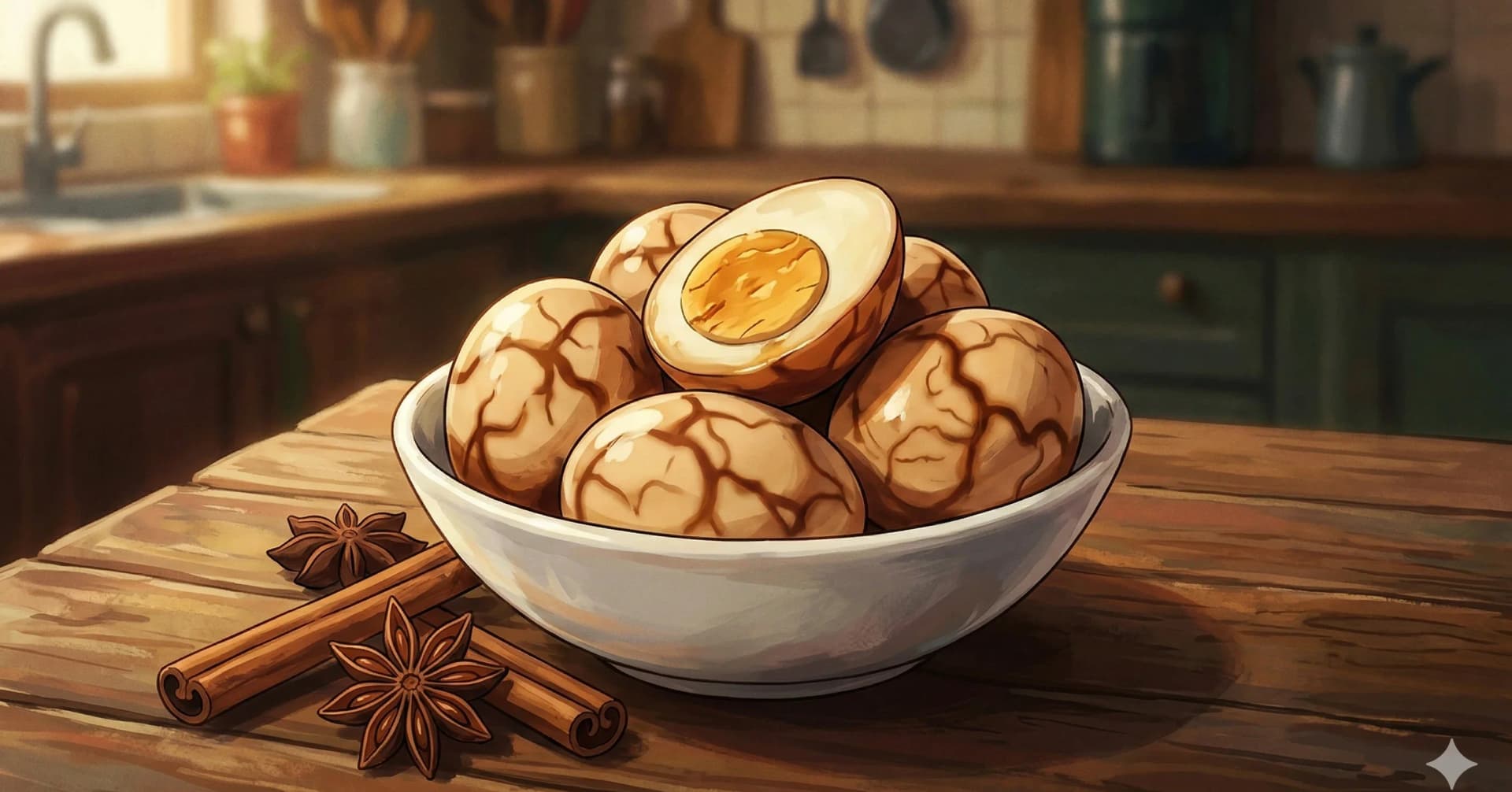
Chinese tea eggs are sold from simmering pots on street corners and in convenience stores across China, their fragrance drifting through morning markets and train stations. You can smell them before you see them. Star anise, cinnamon, black tea, and soy sauce create an aroma that is warm and spiced and deeply savory, the kind that makes you buy one even if you were not hungry.
The technique is simple but requires patience. Eggs are boiled, their shells cracked all over with the back of a spoon to create a web of fine fractures, then submerged in a spiced brine and left to soak for at least 24 hours. The brine seeps through the cracks and stains the egg white in a beautiful marbled pattern, like cracked porcelain. The flavor penetrates gently, giving the white a savory, tea-scented depth without overwhelming the egg itself.
This version uses a shorter initial boil and an ice bath to keep the yolk soft and slightly jammy rather than the traditional fully hard-cooked crumbly yolk. It borrows the timing from Japanese ramen eggs while keeping the Chinese tea egg flavor profile. The result is an egg with a creamy, golden center and a marbled exterior that looks like something from a museum. They keep in the fridge for days and get better as they soak, which makes them one of the best make-ahead snacks in any cuisine.
At a Glance
Yield
12 eggs
Prep
1 day
Cook
15 minutes
Total
1 day 15 minutes
Difficulty
Easy
Ingredients
Eggs
- 12large eggs, brought to room temperature
Brine Ingredients
- 4-5 cupswater, enough to submerge all eggs
- 2slices fresh ginger
- 3whole star anise
- 1cinnamon stick
- 2bay leaves
- 2 tbspblack tea leaves
- 1 tspSichuan peppercorns
- 3 tbsplight soy sauce
- 4 tspdark soy sauce
- 1 tspsugar
- 2 tspsalt
- 2 tbspShaoxing wine
Method
- 1
Make the brine. Add the water, ginger, star anise, cinnamon stick, bay leaves, tea leaves, Sichuan peppercorns, light soy sauce, dark soy sauce, sugar, salt, and Shaoxing wine to a medium pot. Bring to a boil, then reduce to a low simmer. Cover and simmer for 10 minutes. Turn off the heat and let the brine cool completely.
- 2
Boil the eggs. Bring a separate pot of water to a rolling boil. Gently lower the room-temperature eggs into the water one at a time using a large spoon. Boil for exactly 7 minutes.
- 3
Ice bath. Immediately transfer the eggs to a bowl of ice water. Let them sit until completely cool, about 10 minutes.
- 4
Crack the shells. Gently tap each egg all over with the back of a small spoon to create a dense web of fine cracks across the entire surface. Do not tap too hard as the yolk is still soft.
- 5
Soak for 24 hours. Place the cracked eggs in the cooled brine, making sure every egg is fully submerged. Cover and refrigerate for at least 24 hours. Two to three days produces the best results.
- 6
Peel and serve. Remove eggs from the brine and peel carefully. The marbled pattern will be revealed as the shell comes away.
Key Ingredient Benefits
Eggs: Each egg provides about 6 grams of complete protein and is one of the best dietary sources of choline, important for brain function and liver health. Traditional Chinese medicine considers eggs nourishing and mildly cooling, recommended for recovery.
Star Anise: Contains anethole with documented anti-inflammatory properties. In TCM, star anise is classified as warming, used to warm the Kidney and Spleen and relieve cold-related abdominal pain. It is the natural source of shikimic acid, the precursor compound used in the production of oseltamivir (Tamiflu).
Black Tea: The tannins contribute a slight astringency that balances the richness of the soy sauce. Tea polyphenols have been studied for antioxidant properties.
Why This Works
The cracked shell creates channels for the soy sauce, tea, and spices to penetrate, staining the white in a pattern that follows the fracture lines. The 7-minute boil followed by an ice bath produces a yolk that is set but still creamy. The brine is built on layers of flavor: black tea provides tannins, star anise and cinnamon add aromatic sweetness, Sichuan peppercorn contributes a faint numbing quality, and soy sauce provides salt, umami, and color.
Substitutions & Variations
For traditional fully hard-cooked yolk, boil for 12 minutes and skip the ice bath. Any unflavored black tea works; pu-erh makes a darker, earthier version. Omit Sichuan peppercorn if unavailable. Replace individual spices with 2 teaspoons Chinese five-spice powder for a quicker brine.
Serving Suggestions
Eat on their own with a sprinkle of salt, halve them over congee, slice into noodle soup, or pack in a lunchbox. They are one of the most portable snacks in Chinese cooking.
Storage & Reheating
Keep in the brine in the refrigerator for up to 3 to 4 days. Flavor continues to develop as they soak. After peeling, eat within 1 day. Serve at room temperature or cold. Freezing is not recommended.
Cultural Notes
Chinese tea eggs are a street food snack sold from simmering pots across China. The marbled pattern created by cracking the shell before soaking is both beautiful and functional, allowing the brine to penetrate and flavor the egg white.
Nutrition Facts
Calories: 72kcal (4%)|Total Carbohydrates: 0.4g (0%)|Protein: 6.3g (13%)|Total Fat: 4.8g (6%)|Saturated Fat: 1.6g (8%)|Cholesterol: 186mg (62%)|Sodium: 141mg (6%)|Dietary Fiber: 0g (0%)|Total Sugars: 0.2g
You Might Also Like
Ratings & Comments
Ratings & Comments
Ratings
Share your thoughts on this recipe.
Sign in to rate and comment