Indian Cuisine
Dahi Vada
Urad Dal Fritters in Cool Spiced Yogurt with Mustard-Curry Leaf Tempering
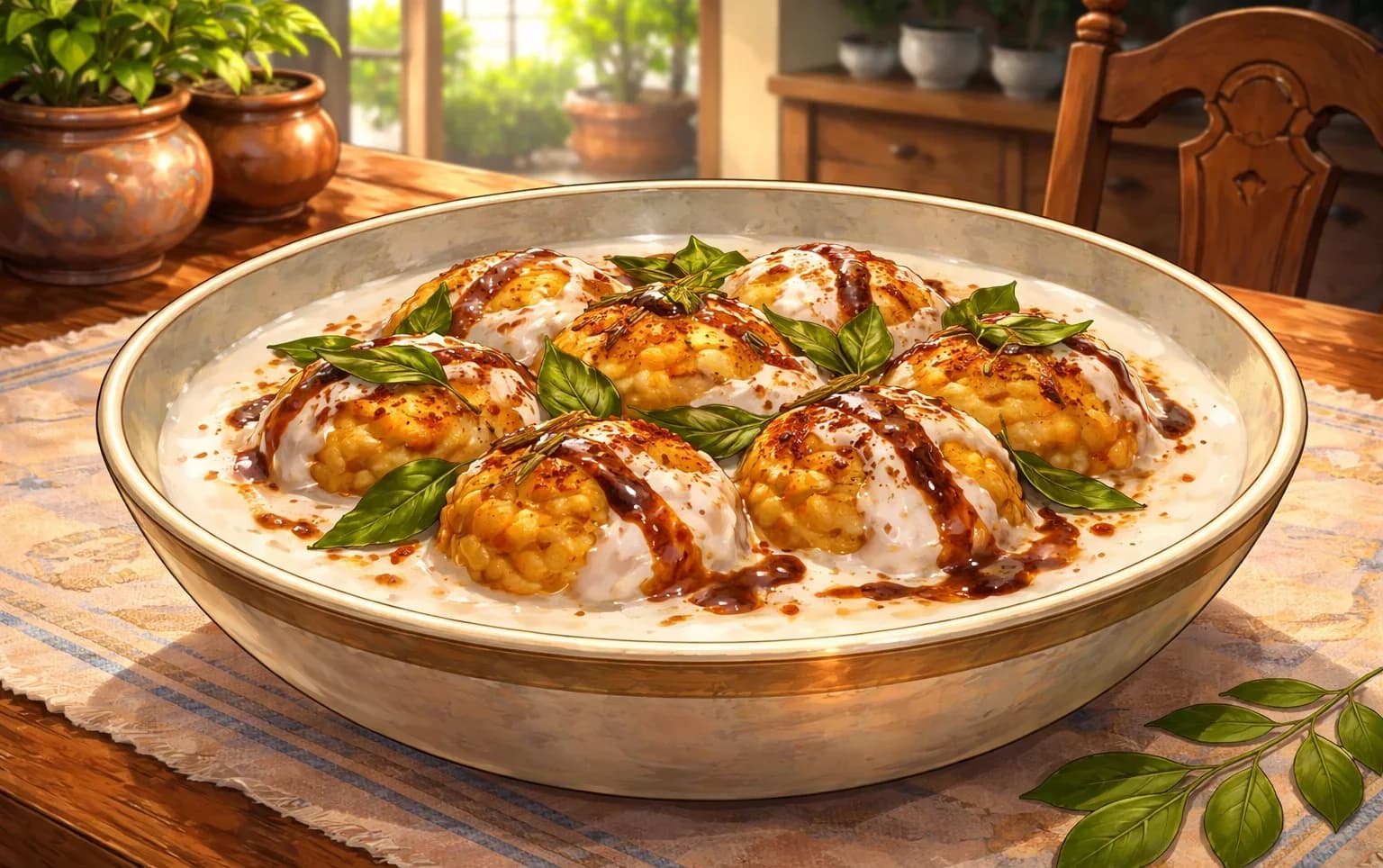
There is a moment in making dahi vada when everything becomes clear: when you lift the warm, freshly fried medu vada and lower it into the bowl of warm water. It hisses softly and begins to soften, releasing its oil into the water in faint amber threads. What goes in is a crisp, golden fritter. What comes out, ten minutes later, after the soak and the gentle squeeze and the submersion in cool whisked curd, is something entirely different: a pillow of yielding, spongy lentil that has absorbed its surroundings completely, barely distinct from the yogurt it rests in, yet still holding enough shape to be lifted whole.
This is the alchemy of dahi vada. Not the frying (any medu vada cook knows the frying) but the water soak, the squeeze, the slow submersion in curd. Each step is doing something real. The warm water soak opens the fried exterior so the curd can penetrate. The gentle squeeze expels the absorbed water without crushing the interior. The curd soak concentrates the sourness into the lentil from the outside in.
The South Indian version presented here is the restrained one. Where the North Indian dahi vada piles on tamarind chutney, chaat masala, and sev, this version finishes with something more direct: a mustard seed and curry leaf tempering crackled in hot oil and poured still hissing over the arranged vadas. The result is clean, the contrast between cold curd and hot tempering sharp and satisfying.
Use pre-made medu vada if you have them, or make them fresh. The only hard rule is the water soak. Skip it and the vadas float in the yogurt, their surfaces slightly greasy, never truly integrated with what surrounds them.
At a Glance
Yield
Serves 4–6
Prep
10 minutes
Cook
20 minutes
Total
40 minutes (plus chill time if desired)
Difficulty
Easy
Ingredients
- 1 lbmedu vada (pre-made or freshly fried)
- 1 lbfull-fat curd (plain yogurt), whisked smooth
- 1⅔ tspsalt, or to taste
- 1⅓ tbspoil
- 1 tspdried red chillies (1–2 whole)
- 1⅔ tspmustard seeds
- ⅓ cupfresh curry leaves (about 1 sprig)
Method
- 1
Soak the vadas. Bring a large bowl of water to warm, not boiling, just comfortably warm to the touch. Submerge the medu vadas in the warm water and leave to soak for 10 minutes. They will soften and swell noticeably.
- 2
Whisk the curd. While the vadas soak, whisk the curd with salt until completely smooth and pourable. Taste. It should be pleasantly sour. If very thick, whisk in a few tablespoons of cold water to loosen it slightly.
- 3
Squeeze the vadas. Remove the soaked vadas from the water one at a time. Hold gently between both palms and squeeze with even, light pressure to expel absorbed water without crushing the shape. The vada should feel lighter and slightly compressed but still intact.
- 4
Arrange in curd. Place the squeezed vadas in a wide, shallow serving dish or individual bowls. Pour the whisked, salted curd over and around the vadas until they are generously bathed, mostly submerged but still visible at the surface. Set aside or refrigerate until ready to serve.
- 5
Make the tempering. Just before serving, heat the oil in a small pan over medium-high heat. Add the mustard seeds and let them splutter and pop. Add the dried red chillies and curry leaves (1 sprig); they will crackle loudly. Remove from heat immediately and pour the still-sizzling tempering over the arranged vadas and curd.
- 6
Serve immediately, while the tempering is hot and the curd is cool.
Key Ingredient Benefits
Urad dal carries significant protein, iron, and calcium. Its unique protein composition allows the batter to aerate when ground, producing an open, sponge-like interior structure that is essential for yogurt absorption. This interior structure is what makes dahi vada possible. A dense fritter would resist soaking entirely.
Full-fat curd matters here. Low-fat yogurt is thinner and watery, producing a dilute sauce that pools rather than coats. Full-fat yogurt has the right viscosity and cling. The lactic acid it contains also continues to gently tenderise the lentil proteins during soaking, contributing to the vada's characteristic melting softness.
Mustard seeds when crackled in hot oil break down into pungent compounds that give mustard its characteristic sharp, nose-clearing quality, considerably different from their raw flavour.
Curry leaves in the tempering provide their most vivid expression: the carbazole alkaloids, volatile and aromatic, bloom fully when they meet hot oil, giving the instant fragrance that defines South Indian cooking.
Why This Works
The warm-water soak is the technical key of the dish. A freshly fried vada has a relatively sealed exterior, the surface starch set by the frying process. Soaking in warm water hydrates and opens the exterior, allowing curd to penetrate during the subsequent submersion. It also rinses away surface oil, which would otherwise prevent the yogurt from adhering and give an unpleasant greasiness.
The two-stage soak (first water, then curd) is deliberate. The water soak softens the vada fully. The curd soak concentrates flavour inward. Together they produce a vada that is moist and yielding to its very centre, not just at the surface.
Frying medu vada to a lighter golden colour (rather than the deep brown used for standalone eating) produces a softer, more absorbent exterior that soaks more completely.
The tempering poured over cold curd creates a sensory contrast, hot and crackling against cool and sour, that is the defining moment of the dish.
Substitutions & Variations
- North Indian dahi vada: After arranging in curd, add tamarind chutney, green coriander-mint chutney, red chilli powder, roasted cumin powder, and chaat masala before serving. Omit or reduce the mustard tempering.
- Perugu vada (Andhra style): Very similar to this version, with the mustard tempering. Andhra versions are typically spicier and may include more dried red chillies and a pinch of asafoetida in the tempering.
- Thayir vada (Tamil style): Garnish with finely grated ginger and green chilli in addition to the tempering. Sometimes a spoonful of thick tamarind extract is stirred into the curd.
- Without the tempering: Serve the vadas in curd with only a dusting of roasted cumin powder and a few torn curry leaves for a simpler preparation.
Serving Suggestions
Dahi vada is best served as a standalone snack or as part of a South Indian tiffin spread. Serve chilled or at cool room temperature. The contrast between cool curd and the warm, just-poured tempering is part of the experience. In South Indian celebrations it often appears on the menu alongside sambar, rice, and other accompaniments as a cooling counterpoint to spicier dishes.
Storage & Reheating
The vadas can be arranged in curd and refrigerated for up to 24 hours before the tempering is added; overnight soaking deepens the flavour and further softens the vadas. Add the tempering only just before serving. Once tempered, serve within 30 minutes. Reheating is not appropriate. This is a cold dish. Leftovers can be refrigerated for up to 12 hours; the vadas will continue absorbing curd and become softer still.
Cultural Notes
Dahi vada (दही वड़ा, "yogurt fritter") is the North Indian and Bengali chilled preparation of soft urad-dal fritters soaked in spiced yogurt, topped with sweet tamarind chutney, green cilantro-mint chutney, and a scatter of roasted cumin powder, chili powder, and chopped fresh cilantro. The dish is one of the foundational chaat (savory snack) preparations and one of the most cooling summer foods of the broader North Indian table, appearing at countless homes during the hottest months and at the chaat stalls of Delhi, Lucknow, Varanasi, and the broader Hindi-speaking north Indian region.
The technique builds the dish in two stages. The vadas are made similarly to medu-vada (the South Indian fritter): split skinned urad dal is soaked, ground to a smooth thick batter, whipped with a whisk to incorporate air, seasoned with chopped ginger and green chilies, and deep-fried in small flat patties until golden. The fried vadas are then drained briefly and immediately submerged in warm salted water for ten to fifteen minutes, which softens them and removes excess oil. The softened vadas are squeezed gently between the palms to remove the soaking water and arranged in a serving dish.
The yogurt and toppings finish the dish. Plain whole-milk yogurt is whisked smooth with a small amount of milk to thin it slightly, a pinch of sugar and salt, and ground cumin powder. The yogurt is poured generously over the squeezed vadas so they are completely covered. The traditional toppings are: sweet tamarind chutney (tamarind, dates, jaggery, cumin, and salt cooked into a thick sauce), green chutney (cilantro, mint, green chili, ginger, lemon juice ground to a smooth paste), and a final scatter of roasted cumin powder, kashmiri red chili powder, chaat masala (a tangy spice blend), and chopped fresh cilantro. The dish is served chilled, typically as a starter or as one of the items in a chaat lineup. The dish has cultural significance as one of the most cooling summer foods of north India and appears as the traditional offering at the Holi festival of colors in March, where the yogurt-soaked fritters provide cooling refreshment after the day of throwing colored powder.
Nutrition Facts
Calories: 546kcal (27%)|Total Carbohydrates: 105g (38%)|Protein: 13g (26%)|Total Fat: 8g (10%)|Saturated Fat: 3.1g (16%)|Cholesterol: 16mg (5%)|Sodium: 1031mg (45%)|Dietary Fiber: 2.5g (9%)|Total Sugars: 6g
You Might Also Like

Ratings & Comments
Ratings & Comments
Ratings
Share your thoughts on this recipe.
Sign in to rate and comment