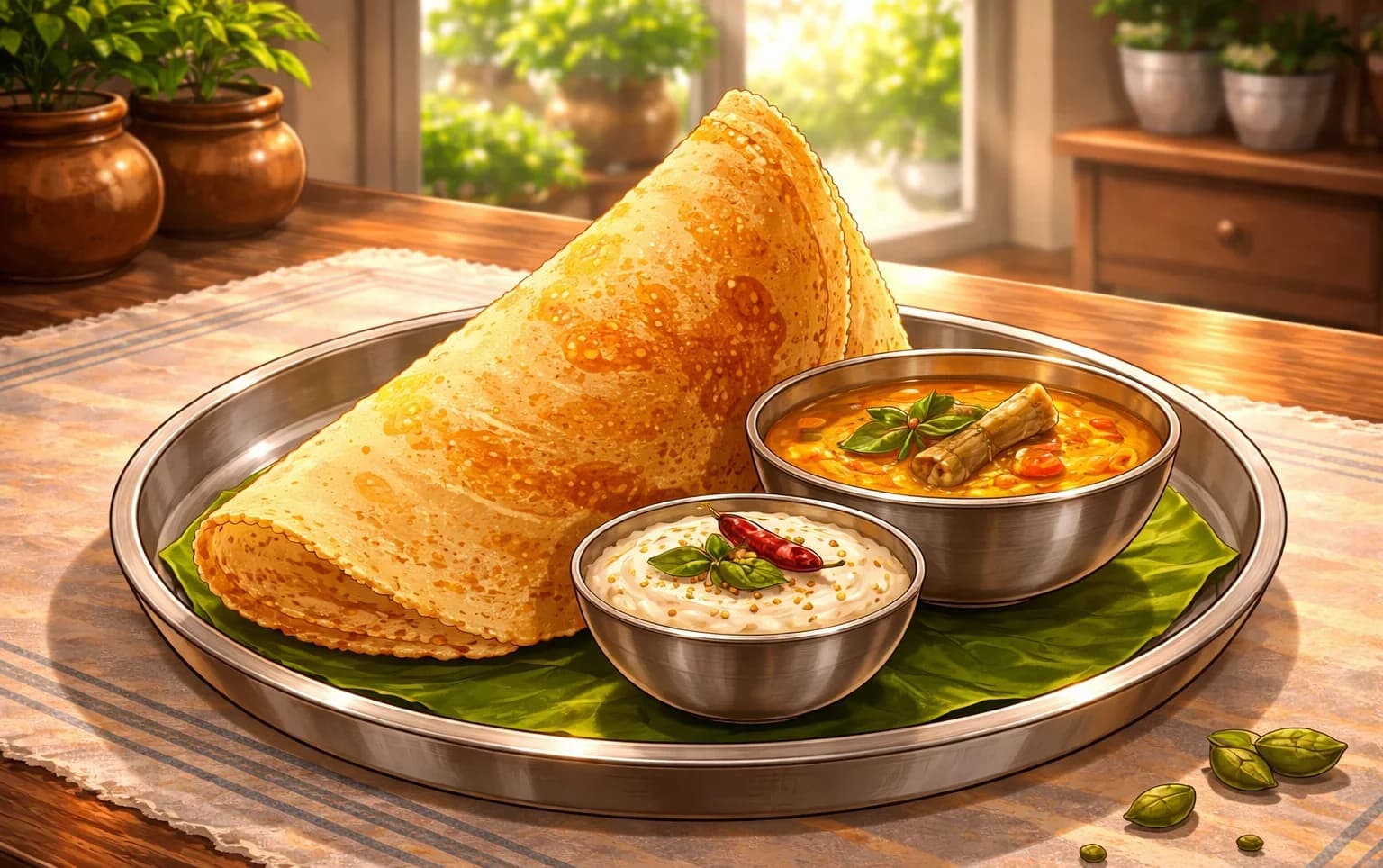
Tamil Nadu · Indian Cuisine
Dosa
The fermented rice and urad dal crepe — thin, crisp and deeply savory, the result of 12+ hours of fermentation
There are foods that seem simple until you try to make them, and then they reveal themselves to be systems — complex biological, chemical, and culinary processes that the cook participates in rather than controls. Dosa is one of these. The thin, lacy, burnished crepe that arrives on a banana leaf in a Tamil restaurant, impossibly crisp and slightly sour, is the product of two grains, water, time, and fermentation. No yeast added. No baking powder. Just the natural microbial activity of wild bacteria working over 12 hours or more, rising and souring the batter into something that sizzles and crisps on a hot tawa in a way that no unfermented rice batter ever could.
The recipe below is a large-batch professional recipe, suited to a restaurant kitchen or a household that makes dosa regularly and maintains a living batter. The ratio of par-boiled to raw rice matters: par-boiled rice contributes colour and a slight stickiness that helps the dosa spread evenly; raw rice contributes the crisp texture. Chana dal adds richness and body. Fenugreek seeds contribute to fermentation and add a gentle bitterness. Urad dal is the protein and structure — its mucilaginous character when ground is what gives the batter its ability to spread thin without tearing.
The fermentation is everything. A well-fermented batter smells faintly sour, has risen noticeably, and will bubble faintly when stirred. It is alive. The tawa, properly heated and wiped, should hiss when the batter is poured. The batter should spread without resistance in a thin circular motion. The dosa should release cleanly from the pan when it is ready. These cues are not fully captured in any recipe — they are learned by repetition.
At a Glance
Yield
Large batch — 60–80 dosas
Prep
30 minutes + 14–16 hours soaking and fermenting
Cook
2–3 minutes per dosa
Total
16+ hours (mostly passive)
Difficulty
Medium
Ingredients
Method
- 1
Wash thoroughly. Wash the rice (both types combined) under running water at least 4 times, until the water runs nearly clear. Mix the washed rice with the urad dal, chana dal, and fenugreek seeds.
- 2
Soak. Cover with cold water and soak for 6–8 hours. The grains and dal will swell and soften. Soaking is essential — it softens the grains enough to grind smoothly and begins the process of breaking down phytic acid in the outer bran.
- 3
Grind in portions. Drain the soaked mixture. Grind in a wet grinder in small portions. Use ice-cold water during grinding — the friction of the grinding stone generates heat, which can trigger premature fermentation. Add water gradually to achieve the right consistency: slightly thick, pouring like heavy cream. It should not be completely smooth — some granularity from the rice is correct and contributes to the final crisp texture.
- 4
Ferment. Pour all the ground batter into a large vessel — allow room for the batter to rise by 30–50%. Cover and leave at room temperature for 6–7 hours (longer in cold weather, shorter in warm). The batter is ready when it has visibly risen, smells faintly sour and yeasty, and has a slightly bubbly surface.
- 5
Season. Add salt and mix thoroughly. Some cooks add a small pinch of sugar — it helps with colour on the tawa and marginally feeds residual microbial activity.
- 6
Heat and wipe the tawa. Heat a cast-iron or heavy steel tawa over medium-high heat until very hot. Sprinkle a few drops of oil and water onto the surface, then wipe with an oiled cloth. The surface should be lightly oiled and hissing. This removes any residue from the previous dosa and prepares the surface for even spreading.
- 7
Make the dosa. Pour a ladle of batter onto the centre of the hot tawa. Immediately use the back of the ladle to spread the batter in a thin circular motion from the centre outward. Work quickly — the batter sets almost immediately. The final circle should be thin, roughly 25–30 cm in diameter. Sprinkle a teaspoon of oil over the dosa and around its edges.
- 8
Cook and remove. Cook without disturbing until the edges begin to lift and turn golden, and the surface appears set and dry. This takes 90 seconds to 2 minutes. A dosa is typically cooked on one side only. Slide a flat spatula under it, roll or fold, and serve immediately with sambar and coconut chutney.
Key Ingredient Benefits
Fermented batter: Fermentation increases the bioavailability of some minerals by reducing phytic acid, and produces B vitamins as a byproduct of microbial activity. The sour flavour is due to lactic acid — the same compound responsible for the tartness in yogurt and sourdough.
Urad dal: Contains mucilaginous compounds that produce a smooth, spreadable batter with structural integrity. High in plant protein.
Fenugreek seeds: Added to promote fermentation — the soluble fibre (galactomannans) provides food for the fermenting microbes. They also contribute a slight bitterness that deepens the dosa's flavour.
Par-boiled rice: Higher in resistant starch than regular white rice — resistant starch passes through the small intestine undigested, acting as prebiotic fibre. It also contributes to the slightly soft, non-brittle texture of the finished dosa.
Chana dal: Adds body and a gentle nuttiness to the batter. Its starch gelatinizes at a higher temperature, giving the dosa structure even when spread very thin.
Why This Works
Fermentation does more than add sourness. The lactic acid bacteria and wild yeasts in the rice-dal environment produce carbon dioxide, aerating the batter, and lactic and acetic acids, which change the starch structure, making it more extensible and crisp-forming under heat. The acids also improve digestibility by breaking down some of the phytic acid that would otherwise bind minerals.
Ice-cold water during grinding prevents heat generation from triggering premature fermentation. A warm batter ground on a hot day can ferment before grinding completes, producing a bitter, over-sour result.
The combination of par-boiled and raw rice is a calibrated texture choice. Par-boiled rice's partially gelatinized starch contributes softness and adhesion; raw rice contributes structure and crispness. The ratio here produces the classic restaurant dosa: lacy and crisp without brittleness.
Substitutions & Variations
- Masala dosa: Fill with spiced potato before rolling — see the separate Dosa Masala recipe.
- Ghee dosa: Replace oil with ghee for a richer, more aromatic result.
- Set dosa: Thicker batter, smaller portions, softer texture — not spread thin. A shorter ferment and higher dal ratio.
- Reducing batch size: Scale all ingredients proportionally. Fermentation dynamics remain the same.
Serving Suggestions
- With sambar (lentil and vegetable curry) and fresh coconut chutney — the foundational combination.
- With tomato chutney for a sharper, brighter pairing.
- As masala dosa with the potato filling enclosed.
- With ghee and sugar for a simple, indulgent version.
- Dosas are always eaten immediately after cooking — they do not wait.
Storage & Reheating
Batter: Fermented dosa batter keeps in the refrigerator for 3–4 days. It will become more sour over time — later-day dosas from the same batch will be noticeably tangier. Stir well before each use and adjust with a little water if it has thickened. The batter does not freeze well — the fermentation cultures die and the texture changes.
Cooked dosa: Does not store or reheat well. Cook only as many as you plan to eat immediately.
Cultural Notes
Dosa (दोसा, dōsai in Tamil, dose in Kannada) is the South Indian fermented crepe of rice-and-urad-dal batter cooked thin and crisp on a hot griddle, served folded around a savory filling or eaten plain with chutney and sambar. The dish is one of the foundational breakfast staples of Tamil Nadu, Karnataka, Andhra Pradesh, and Kerala, and one of the most internationally recognized South Indian foods after chicken-tikka-masala and biryani. The dish has been documented in Tamil literature since at least the sixth century CE, where it appears in Manimekalai and other classical Tamil texts, predating the broader north Indian wheat-based flatbread tradition by several centuries.
The fermentation is the technical foundation. Raw rice and split skinned urad dal are soaked separately for several hours, then ground together (traditionally with a stone grinder, modern households use wet grinders or high-powered blenders) with a small amount of fenugreek seed and water to form a smooth thick batter. The batter is left to ferment at room temperature for eight to twelve hours, during which wild yeast and lactic acid bacteria naturally present on the rice and dal produce carbon dioxide bubbles and develop the sour-tangy flavor that defines a proper dosa. The fermentation also breaks down the starch and protein structure of the rice and dal, making the finished crepe lighter, more digestible, and richer in nutrients than the unfermented version.
The cooking method produces the characteristic thin crisp texture. A heavy iron griddle or a non-stick pan is heated until just smoking, brushed with oil or ghee, and a ladleful of the fermented batter is poured in the center and quickly spread outward in a spiral motion with the back of the ladle to produce a very thin pancake (a properly made dosa is six to ten inches across and almost transparent at the edges). The dosa cooks until the bottom turns golden and crisp, ten to fifteen seconds for the thinnest "paper dosa," sixty to ninety seconds for the standard dosa, sometimes longer with the addition of a savory potato filling for the famous dosa-masala variation. The dish has spawned dozens of regional variations: the Mysore masala dosa, the Bangalore-style benne (butter) dosa, the Tamilnadu sada (plain) dosa, the Andhra-style pesarattu (made with green gram dal), and many others. Madhur Jaffrey's A Taste of India and Chandra Padmanabhan's Dakshin: Vegetarian Cuisine from South India both document the dish's regional variations in detail.
Nutrition Facts
Calories: 1581kcal (79%)|Total Carbohydrates: 301g (109%)|Protein: 51g (102%)|Total Fat: 18g (23%)|Saturated Fat: 2.8g (14%)|Cholesterol: 0mg (0%)|Sodium: 544mg (24%)|Dietary Fiber: 27g (96%)|Total Sugars: 0g
You Might Also Like
Ratings & Comments
Ratings & Comments
Ratings
Share your thoughts on this recipe.
Sign in to rate and comment