Indian Cuisine
Gulab Jamun
Deep-fried khoya dumplings soaked in saffron and rose cardamom syrup
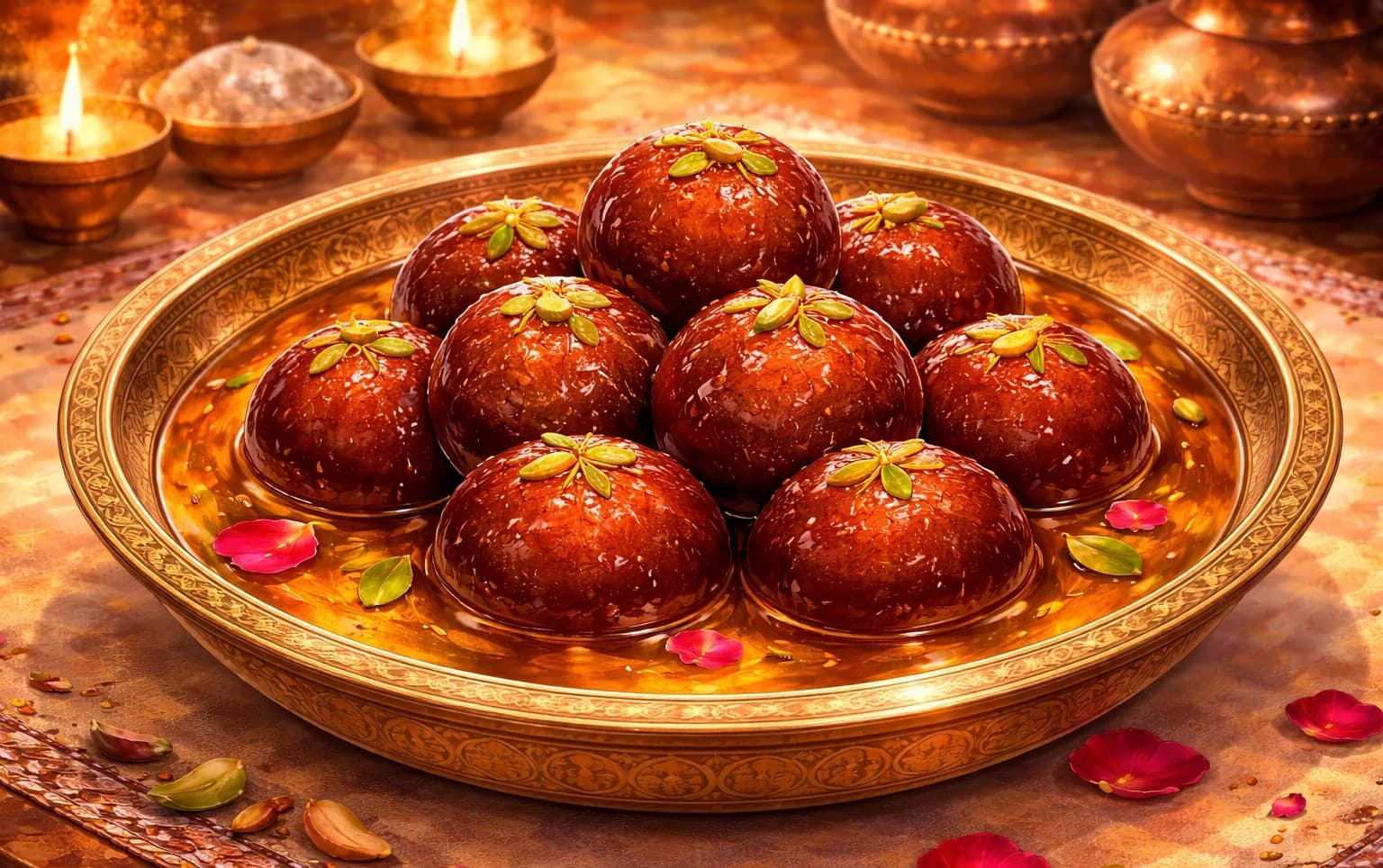
The name alone is evocative: gulab, rose; jamun, the small dark berry whose shape the sweet echoes. But the fragrance is the first thing. That particular warm sweetness of rose water and cardamom in a saffron-tinted syrup that carries across a room and signals something celebratory is happening. Then comes the gulab jamun itself: a deep amber ball, softened and swollen with syrup, yielding instantly to a spoon, its interior warm and dense and almost fudge-like from the khoya at its core.
The sweet traces its lineage to Mughal court kitchens, where Persian and Central Asian influences shaped a new repertoire of milk-based sweets unlike anything that existed in the subcontinent before. Khoya (milk reduced to a dense solid by slow cooking) became the foundation of an entire family of North Indian sweets, and gulab jamun is its most famous expression. Today it appears at virtually every celebration in India, from Diwali and Eid to weddings and birthday parties, usually served warm in its syrup, sometimes over a scoop of vanilla ice cream.
The dough must be handled with exceptional lightness. Khoya is already cooked milk protein, and overworking it develops toughness rather than tenderness. The ideal dough comes together in a few minutes of gentle kneading, just enough to bind, no more. The balls should be shaped without any pressure seams or surface cracks; a crack in the raw dough will open explosively in hot oil and split the ball.
The most critical step is temperature control during frying. The oil must be at a low, steady heat, roughly 140–150°C. Too hot, and the outside browns before the inside cooks through, leaving a raw dense core. Too cool, and the balls absorb too much oil and become greasy. At the right temperature, they take a full 10–12 minutes to reach deep golden-brown, rolling gently in the oil and inflating evenly.
At a Glance
Yield
20–22 pieces
Prep
20 minutes
Cook
30 minutes
Total
1 hour + soaking
Difficulty
Medium
Ingredients
Method
- 1
Make the Syrup. Combine the sugar and water in a saucepan and bring to a boil, stirring to dissolve the sugar. Once boiling, reduce to a simmer and cook for 5–7 minutes until you can feel a single thread form when a little syrup is stretched between a wetted thumb and forefinger (one-string consistency). Add the cardamom powder, rose water, and saffron strands. Stir gently. Keep the syrup warm over the lowest possible heat. It must be warm, not hot, when the fried balls go in.
- 2
Make the Dough. Combine the crumbled khoya, maida, semolina, and baking powder in a wide bowl. Using the tips of your fingers, bring the mixture together gently. At this stage it will feel crumbly and loose. Add milk, one tablespoon at a time, mixing just enough to bind. The dough should come together into a soft, smooth ball that does not stick to your hands. It should feel similar to firm playdough: pliable but not wet. Do not knead aggressively. Cover with a damp cloth and rest for 10 minutes.
- 3
Shape the Balls. Divide the rested dough into 20–22 equal portions. Roll each between the centre of your palms using a light, circular motion. No pressing, just rolling. The surface must be perfectly smooth with absolutely no cracks. Even a hairline crack will split open during frying. If a crack appears, gently smooth it with a drop of milk on your fingertip.
- 4
Fry Low and Slow. Heat oil or ghee in a heavy kadhai or deep pan to approximately 140–150°C. This is noticeably cooler than most frying temperatures. Test with a small piece of dough: it should rise to the surface slowly and sizzle gently without immediately browning. Carefully lower the balls in batches of 4–5. Do not crowd the pan. Fry over low heat, agitating the oil gently with a spoon to ensure even browning on all sides. The balls will slowly expand and deepen in colour over 10–12 minutes. You are looking for a deep, rich brown, darker than you might expect, almost the colour of dark caramel. This ensures the interior is cooked through. Remove with a slotted spoon and drain briefly.
- 5
Soak in Syrup. Add the hot fried balls directly into the warm (not boiling) syrup. They will hiss softly as they hit the liquid. Leave to soak for a minimum of 30 minutes. During this time the balls will absorb the syrup and expand slightly, becoming softer, more pillowy, and deeply flavoured throughout. They can be left in the syrup for hours or overnight.
- 6
Serve. Serve 3–4 gulab jamun per person in a small bowl with a spoonful of syrup. They are excellent warm, at room temperature, or slightly heated. A few slivered pistachios scattered over the top make a fine garnish.
Key Ingredient Benefits
Khoya (mawa) is milk reduced to a dense, dry solid by sustained boiling in an open pan. The process concentrates milk proteins, fats, and natural sugars, producing a rich, slightly grainy ingredient with a deep, roasted-milk flavour. It is the foundational ingredient in a wide range of North Indian sweets including barfi, pedha, and halwa.
Rose water is a steam distillate of rose petals and has been used in South Asian and Middle Eastern confectionery for centuries. Its presence in gulab jamun is one of the dish's defining characteristics; the name itself references it. Add it with restraint; it should scent rather than dominate.
Saffron contributes both its vivid golden colour and its complex, honey-like fragrance to the syrup. Research suggests the active compound crocin may have antioxidant properties, though culinary amounts are small. Saffron has been used in Ayurvedic and Unani medicinal traditions across the subcontinent for centuries.
Sugar and fried dough: Gulab jamun is a rich, high-calorie sweet combining fried dough with a sugar syrup soak. It is a traditional festive food and is most enjoyed as an occasional celebratory treat.
Why This Works
Khoya as the base provides pre-cooked milk solids that create a uniquely dense, fudge-like interior after frying. Fresh cheese or paneer would produce a different, firmer texture.
Semolina in the dough provides a subtle structural binder and slightly rough surface that helps the balls absorb syrup more readily after frying. Too much semolina, however, makes the dough tough.
Baking powder provides a small amount of internal leavening during frying, helping the balls puff slightly and lightening the dense khoya interior.
Low frying temperature is the single most important variable. Khoya cooks slowly. The low heat allows the interior to cook fully before the exterior over-browns. It also allows the baking powder to work gradually, producing a more even puff.
Substitutions & Variations
Instant gulab jamun mix: Commercial mixes use milk powder in place of khoya. The result is lighter and slightly spongier, acceptable, though lacking the depth of flavour that khoya provides.
Ghee instead of oil for frying: Produces a richer, more aromatic result with a slightly different browning quality. Traditional and worth trying if you have good-quality ghee.
Kala Jamun: A darker, denser variation where the balls are fried at slightly higher heat for longer, resulting in a very dark exterior and a slightly firmer bite. Sometimes stuffed with a small piece of mawa or nut.
Stuffed Gulab Jamun: Press a small piece of pistachio or a raisin into the centre of each ball before rolling smooth for a surprise interior.
Serving Suggestions
Serve warm in individual bowls with a generous spoonful of fragrant syrup. Gulab jamun is particularly good alongside vanilla ice cream. The contrast of warm, syrup-soaked dumpling and cold cream is a beloved combination at Indian-restaurant dessert menus across the world.
At festive occasions, they are served as part of a dessert spread alongside kheer, jalebi, or barfi. They are also commonly offered during Diwali mithai exchanges.
Storage & Reheating
Store gulab jamun submerged in their syrup in an airtight container in the refrigerator for up to 5 days. The flavour deepens over time as the balls absorb more syrup.
To reheat: place in a small saucepan with their syrup over very low heat for 5 minutes, or microwave gently on medium power for 30–45 seconds. Do not boil vigorously or the balls may fall apart.
Cultural Notes
Gulab jamun (गुलाब जामुन, "rose berry") is the North Indian and Bengali sweet of small round dough balls (made from khoya, reduced milk solids, with a small amount of flour for binding) deep-fried at moderate heat until they turn deep golden, then soaked in a warm sugar syrup perfumed with rose water and cardamom. The dish is one of the most internationally famous Indian sweets, alongside roshogolla and rasmalai, and appears at every wedding banquet, festival meal, and special occasion across the broader North Indian sweet tradition.
The dish has a documented Persian origin and was brought to India through the Mughal courts of the medieval period. The name gulab (rose) and jamun (the dark purple Indian berry that the finished sweet resembles in shape and color) reflect the dish's hybrid identity: a Persian-style fried-and-soaked dough form adapted to Indian milk-solid traditions and Indian aromatics. The earliest documented Indian versions appear in Mughal-era cookbooks, and the dish has been continuously prepared in Indian sweet shops and home kitchens since.
The technique is precise about the khoya and the frying temperature. Khoya (whole milk reduced over low heat for ninety minutes to two hours until it becomes a thick crumbly paste) is the foundational ingredient. The khoya is kneaded with a small amount of all-purpose flour, a pinch of cardamom powder, and just enough milk to bring the mixture together into a smooth elastic dough. The dough is divided into small portions and rolled smooth between the palms into balls about an inch and a quarter across. The balls slide into oil heated to a moderate temperature (around 140°C, much lower than typical Indian frying temperatures) and fry slowly for eight to ten minutes, turning gently so all sides develop a deep golden color without burning. The fried balls are drained briefly, then transferred immediately to warm sugar syrup flavored with green cardamom, rose water, and sometimes a small amount of saffron. The balls swell as they absorb the syrup, doubling in size over two to three hours, and the dish is served warm or at room temperature with two or three jamuns per serving and a small ladle of syrup. The dish appears at every Punjabi, Bengali, and broader Indian wedding banquet sweet table, at festival distributions during Diwali, Eid, and Raksha Bandhan, and at the global Indian restaurant tradition as the most common dessert option.
Nutrition Facts
Calories: 115kcal (6%)|Total Carbohydrates: 19g (7%)|Protein: 1.5g (3%)|Total Fat: 4g (5%)|Saturated Fat: 2.5g (13%)|Cholesterol: 8mg (3%)|Sodium: 25mg (1%)|Dietary Fiber: 0g (0%)|Total Sugars: 16g
You Might Also Like

Ratings & Comments
Ratings & Comments
Ratings
Share your thoughts on this recipe.
Sign in to rate and comment