Indian Cuisine
Milk Cake Fudge (Kalakand)
Alwar's Crumbly Grainy Milk Fudge
Kalakand comes from Alwar, a city in eastern Rajasthan with a particular claim on one of North India's most distinctive sweets. The name derives from kala kand: not "black" as kala usually means, but from the Persian kand, meaning sugar candy. What the city's halwais developed was something unlike any other milk sweet in the Indian repertoire: a fudge that is simultaneously crumbly and moist, with a visible granular texture that comes from a specific technique, partially curdling the milk rather than fully curdling it.
This partial curdling is the technical heart of the recipe. Full curdling, as in chenna or paneer-making, separates the milk proteins into a firm, compact curd and a thin whey that is drained away. Partial curdling, achieved by adding tartaric acid in very small, controlled amounts to hot milk, makes the proteins begin to aggregate without fully separating from the liquid. The result is a thick, slightly grainy milk mass in which the proteins are loosely bound together, not drained, not fully separated, still bathed in concentrated milk. When sugar and cardamom are cooked into this mixture and the water evaporates, these loose protein granules set into the characteristic texture of kalakand: grainy, slightly moist, crumbly, and yielding all at once.
The difference between kalakand and ordinary barfi is in this texture. Barfi, made from smoothly kneaded chenna and sugar, has a uniform, dense consistency. Kalakand's granular character, visible to the eye and felt on the tongue, is what makes it specific and unmistakable.
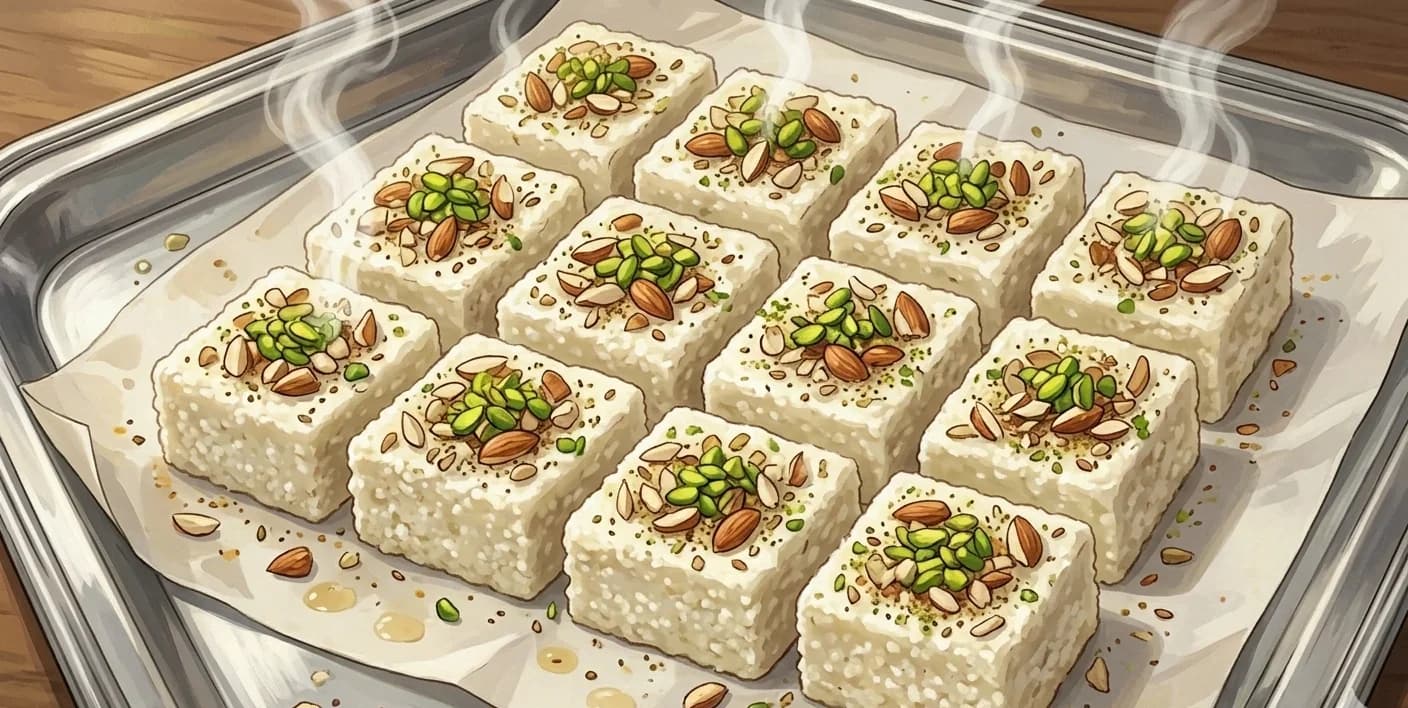
The finished slab should be pale ivory, its surface slightly tacky, pressed with chopped nuts while still warm. It sets firm enough to cut cleanly, but the cut face will be visibly granular, each grain distinct.
At a Glance
Yield
20–24 pieces
Prep
10 minutes
Cook
50–60 minutes
Total
1 hour 15 minutes (plus setting time)
Difficulty
Medium
Ingredients
Method
- 1
Prepare the tray. Grease a shallow tray (approximately 20 x 25 cm) with ghee or oil. Spread the chopped nuts evenly across the base of the greased tray and set aside.
- 2
Dissolve the tartaric acid. Dissolve the tartaric acid in 2 teaspoons of water. Prepare a dropper or small spoon for controlled addition.
- 3
Boil the milk. Pour the milk into a wide, heavy-bottomed pan. Bring to a full boil over medium heat, stirring occasionally.
- 4
Begin partial curdling. Once the milk is boiling, add 2 drops of the tartaric acid solution. Stir the mixture well. The milk will begin to look very slightly granular. This is the beginning of the curdling. Continue adding the acid solution drop by drop, stirring well after each addition and watching the texture carefully. Add only enough to make the milk look granular and thick. Do not add enough to cause complete separation into curds and whey. The milk should look like a thick, slightly lumpy cream, not like fully curdled chenna.
- 5
Thicken by cooking. Continue cooking the partially curdled milk over medium heat, stirring frequently, until it reduces and thickens considerably. This takes 20–30 minutes. The mixture will gradually become denser, stickier, and more fudge-like in consistency. Stir frequently to prevent burning at the base.
- 6
Add sugar and cardamom. When the milk mixture has thickened significantly and is beginning to look fudge-like, add the sugar and cardamom powder. Stir well. The sugar will initially loosen the mixture slightly. Continue cooking and stirring on low heat for a further 10–15 minutes until the mixture is once again thick, fudge-like, and pulls away from the sides and base of the pan.
- 7
Test for consistency. Press a small portion of the mixture onto a plate and allow it to cool for a minute. It should be firm enough to hold its shape when pressed but still slightly sticky. If it is too soft, continue cooking.
- 8
Pour and set. Pour the mixture immediately into the prepared tray over the nuts. Spread evenly with a spatula and smooth the surface. Press additional chopped nuts into the top surface while the mixture is still warm.
- 9
Cool and cut. Leave in a cool place (or refrigerate) until completely set firm, at least 1 hour. Invert the set slab onto a clean board (the nut layer will now be on top). Cut into squares or rectangles and serve cold.
Key Ingredient Benefits
Whole milk is the starting point and the vast majority of the final weight. Full-fat milk is essential. Lower-fat milk produces a leaner, drier kalakand with less of the characteristic moist creaminess. The extended cooking concentrates the milk's proteins and sugars naturally, producing a richer, more intensely dairy result.
Tartaric acid is a naturally occurring organic acid found in grapes and tamarinds. In kalakand it serves as the curdling agent, chosen over lime juice or vinegar because it is gentler and more controllable. It is available at baking supply stores and some Indian grocery stores. Small quantities are used. The total dose is just a few drops of a dilute solution, producing no detectable flavour in the finished sweet.
Sugar is added after partial curdling rather than before because sugar's presence inhibits the protein aggregation that tartaric acid is trying to achieve. Adding sugar first would require more acid to achieve the same degree of curdling and would produce a different texture.
Cardamom is the primary aromatic, providing the clean, resinous warmth that balances the dairy richness of the kalakand without overwhelming it.
Why This Works
Tartaric acid, used in controlled drops, changes the electrical charge of the milk proteins (caseins), causing them to begin aggregating without fully precipitating out of solution. This produces a suspension of loosely bound protein granules in concentrated milk, unlike the complete separation achieved when acid is added rapidly in large quantities (as in paneer-making). The granules, still bathed in milk, cook down with the liquid and set together with the sugar into the characteristic crumbly, grainy texture.
The key is control: add the acid solution slowly, drop by drop, stirring constantly, and stop adding as soon as the milk looks visibly granular. Too much acid and the milk curdles fully, producing a result closer to kheer-soaked chenna than kalakand.
Inverting the tray to serve places the nut layer on top, a practical technique that ensures the nuts are visible and accessible without requiring them to be pressed decoratively into the top surface.
Substitutions & Variations
- Lime juice instead of tartaric acid: Use 1–2 tablespoons of strained fresh lime juice in place of the tartaric acid. Add gradually in the same controlled manner. The result will be slightly more tart, and the lime flavour may be faintly detectable in the finished sweet.
- With saffron: Dissolve 10–12 saffron strands in 1 tablespoon of warm milk and add to the mixture along with the sugar for a saffron kalakand, golden-hued and more aromatic.
- Chocolate kalakand: Add 30 g of cocoa powder with the sugar for a contemporary variation that retains the granular texture.
Serving Suggestions
Kalakand is served cold, cut into squares, as a dessert or festival mithai. It is associated with North Indian celebrations and is a standard offering at Diwali and Holi. Serve on a plate or in small paper cups. The cold temperature is important; kalakand at room temperature is softer and less pleasantly textured than when properly chilled. Two to three pieces per person is typical.
Storage & Reheating
Store in an airtight container in the refrigerator for up to 5 days. Kalakand keeps best cold and is best eaten cold. It does not reheat well. Warming softens it unpredictably and may cause the granular structure to collapse. Serve directly from the refrigerator or bring to cool room temperature for 15 minutes before serving if you prefer a slightly softer texture.
Cultural Notes
Kalakand (कलाकंद, "art-piece" or "milk-piece") is the North Indian and Bengali sweet of slow-cooked milk reduced with cottage cheese (or chhena), sugar, cardamom, and topped with chopped pistachios or almonds, set into a tray and cut into small squares. The dish is one of the most widely produced mithai (Indian sweets) across the broader north Indian sweet shop tradition, appearing at every major sweet shop from Delhi to Kolkata and across the diaspora. The dish has dual claims of origin: one traces it to the Rajasthani town of Alwar (where a similar sweet called Alwar ka Mawa has been documented since the late nineteenth century), and another traces it to the broader Indian chhena-and-milk sweet tradition centered in Bengal.
The technique builds the sweet from a slow milk reduction. Whole milk is brought to a low simmer in a heavy pot and reduced for sixty to ninety minutes until it has thickened considerably and become slightly grainy in texture. A small amount of acid (lemon juice, vinegar, or alum) is added at this stage to partially curdle the reduced milk, producing the slightly grainy textural character that distinguishes kalakand from the smoother rasmalai rabri. Sugar is stirred in, the mixture continues to cook for another fifteen to twenty minutes until it forms a thick paste that pulls away from the sides of the pot, then green cardamom powder is folded in for aroma.
The finished mixture is poured into a greased flat tray, smoothed with a spatula, sprinkled generously with chopped pistachios, almonds, or both, and allowed to cool for three to four hours before being cut into small squares. The squares are served at room temperature and keep well for several days. The dish appears at every major sweet shop in the north Indian sweet tradition (Haldiram's, Bikanervala, Aggarwal Sweets in Delhi; KC Das and Balaram Mullick in Kolkata; smaller regional chains across the country), and at home preparation during festivals like Diwali, Eid, and Raksha Bandhan. The dish is one of the standard wedding sweet box items distributed to guests at north Indian weddings, often presented in decorative metal boxes alongside other classics like gulab-jamun, jalebi, and motichoor-ke-ladoo.
Nutrition Facts
Calories: 198kcal (10%)|Total Carbohydrates: 27.7g (10%)|Protein: 6.2g (12%)|Total Fat: 7.6g (10%)|Saturated Fat: 3.3g (16%)|Cholesterol: 23mg (8%)|Sodium: 76mg (3%)|Dietary Fiber: 0.5g (2%)|Total Sugars: 27.3g
You Might Also Like
Ratings & Comments
Ratings & Comments
Ratings
Share your thoughts on this recipe.
Sign in to rate and comment