Bengali · Indian Cuisine
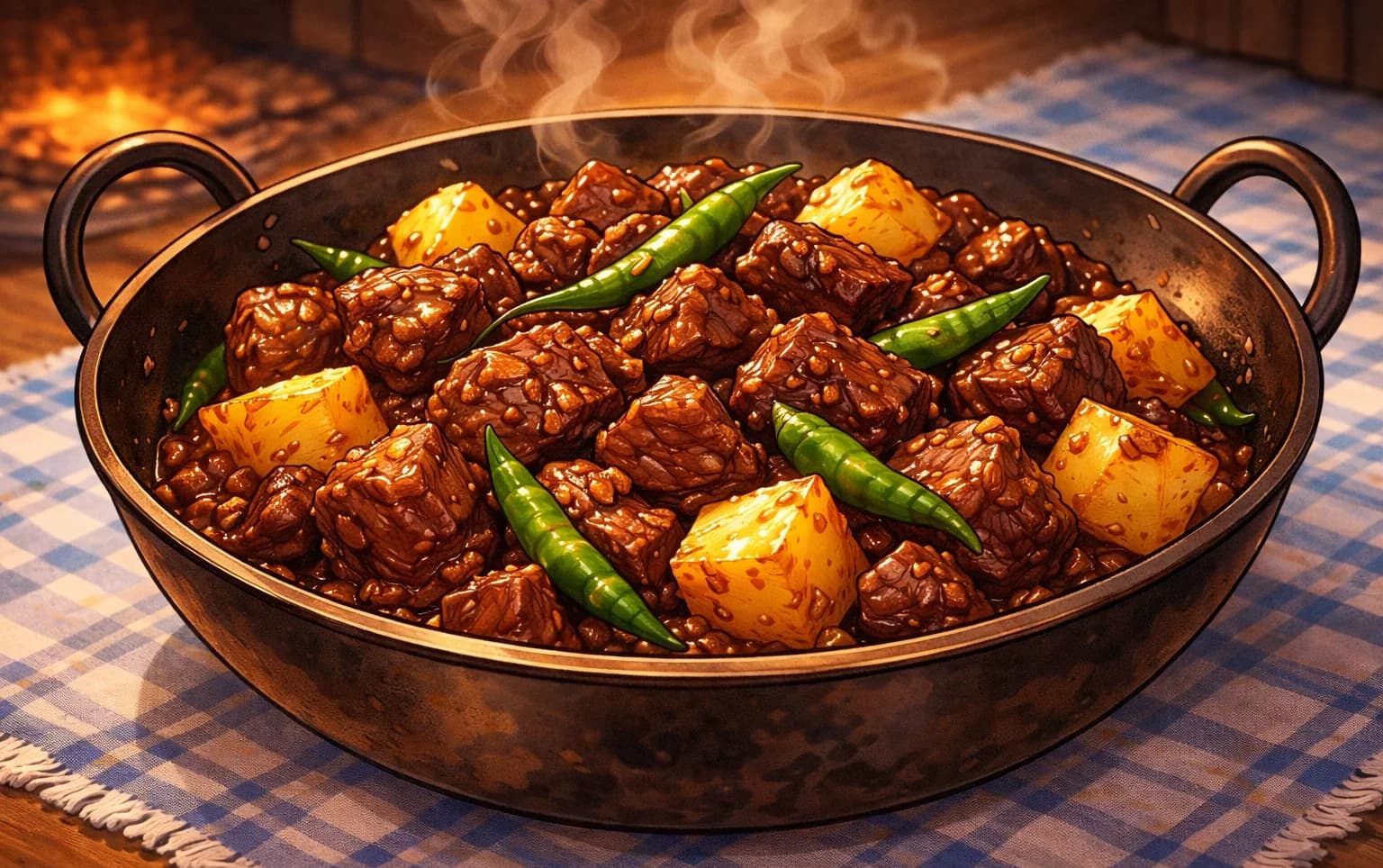
Bengali Dry Mutton Curry (Kasha Mangsho)
Dry-braised mutton with the soul of mustard oil and patience
Kasha is not simply a cooking method. It is a philosophy. The word means to be worked, to be cooked dry and with intensity, and it describes a technique that is at the core of Bengali meat cookery. Kasha mangsho — kasha-cooked mutton — is not a curry with gravy. It is mutton where the sauce has been cooked away, worked back into the meat through continuous stirring and heat, until each piece of bone-in mutton is coated in a dense, deep-mahogany masala that clings rather than pools. Every mouthful is concentrated, slightly fierce, intensely satisfying.
The dish is inseparable from Durga Puja — the five-day autumn festival that is the most important cultural event in the Bengali calendar. Across Kolkata and Bengali households worldwide, kasha mangsho is what gets cooked the morning of the feast day, in large quantities, in heavy iron karahis that are almost never washed between uses. The patina built up in those pans over years of mustard oil, onion, and spice is itself a seasoning.
Mustard oil is essential and specific. Its sharp, slightly bitter, pungent quality is not a background note in this dish. It is a protagonist. Bengali cooking uses mustard oil for precisely the reason that French cooking uses butter: the fat carries flavour and transforms everything it touches. Heated to smoking and then allowed to cool slightly before use, its raw bitterness converts to a complex, forward flavour that becomes more integrated as the meat cooks in it.
The bhunai technique — continuous stirring of the meat and masala over high heat, pressing the mixture against the base of the pan — is what kasha cooking is entirely about. It develops a fond, a concentrated layer of caramelised spice and meat juices at the base of the pan, which is then incorporated back into the meat with each stir. Repeat this cycle for twenty-five minutes, adding tablespoons of water only when the mixture threatens to burn, and the mutton arrives at a place that slow-braising with liquid can never reach.
At a Glance
Yield
Serves 4–5
Prep
20 minutes (plus 1 hour optional marinating)
Cook
1 hour 20 minutes
Total
1 hour 40 minutes
Difficulty
Medium
Ingredients
- 2¼ lbmutton, bone-in pieces (shoulder, neck, or leg)
- 3½ ozyogurt, beaten
- 7 ozonion (about 2 medium onions), thinly sliced
- 3⅓ tbspmustard oil
- 3¼ tbspginger paste
- 3¼ tbspgarlic paste
- 1¾ oztomato (about 1 medium tomato), finely chopped
- ⅓ cupred chilli powder
- 1¼ tbspturmeric
- 1½ tbspcumin powder
- 1¾ tbspcoriander powder
- 1 tspgaram masala
- 1⅔ tspfine salt
- ¼ ozbay leaves (about 2 leaves)
- ⅔ tspwhole black peppercorns
- 3¼ tbspgreen chillies (about 4 chillies), slit
- 1¾ ozpotato (about 1 medium potato), cut into large cubes and deep-fried until golden
Method
- 1
Marinate if time allows. Toss the mutton (1 kg) pieces with the beaten yogurt (½ cup), a teaspoon each of red chilli (6 teaspoons) and turmeric (2 teaspoons), and half the ginger-garlic paste. Cover and refrigerate for 1 hour, or up to overnight. This step deepens the flavour considerably but the dish works without it if time is short.
- 2
Heat the mustard oil (50 ml). In a heavy-based karahi, wok, or deep pan, heat the mustard oil over high heat until it smokes. Watch for the wisps of white smoke and the slight lightening of the oil's colour. Remove from heat and allow to cool for 1–2 minutes, then return to medium-high heat. This is not optional. Raw mustard oil has a harsh bitterness that the smoking step removes.
- 3
Temper and build. Add the bay leaves (2 leaves) and whole black peppercorns (1 teaspoon) to the hot oil. They will sputter and pop. After 30 seconds, add the sliced onions. Cook over medium-high heat, stirring regularly, for 18–22 minutes until the onions are deep golden-brown — past soft, past golden, to a deep mahogany that smells sweet and almost caramelised.
- 4
Add ginger-garlic paste. Add all the remaining ginger paste (3 tablespoons) and garlic paste (3 tablespoons). Cook for 3–4 minutes, stirring constantly, until the raw smell disappears completely and the paste begins to dry and catch lightly on the base of the pan.
- 5
Add the mutton and begin bhunai. Increase heat to high. Add the mutton pieces (including any yogurt marinade). Begin the bhunai: stir the mutton continuously, pressing it against the base of the pan periodically. The mutton will initially release liquid as it cooks. Keep the heat high and stir constantly as this liquid evaporates. After 10–12 minutes, the liquid will be gone and the mutton will start to stick and catch. Add the tomatoes at this point and stir vigorously. Add the red chilli powder, turmeric, cumin powder (2 teaspoons), and coriander powder (2 teaspoons). Continue to bhuno — stir, press, allow to catch, stir again, adding a splash of water (2–3 tablespoons at a time) when the mixture threatens to burn. You are building a deep, dark masala coating on each piece of meat.
- 6
Cook down. Add 250 ml of warm water and the slit green chillies (4 chillies). Bring to a boil, then reduce to a steady simmer. Cover and cook for 35–40 minutes until the mutton is tender — the meat should be giving when pressed but not falling apart. During this time the sauce will reduce significantly.
- 7
Final kasha. Remove the lid. Increase the heat to medium-high. Begin bhunai again — stirring, pressing, and working the thickened sauce back into the meat until virtually all the liquid has gone and each piece of mutton is coated in the concentrated masala. This final 10–12 minute stage is what gives kasha mangsho its character. The masala should cling, not pool.
- 8
Finish. Add the garam masala (¾ teaspoon) and the fried potato (1 medium potato) pieces. Stir gently. Taste for salt (2 teaspoons). Serve immediately.
Key Ingredient Benefits
Mustard oil carries a flavour profile that is unique in the cooking fat world — sharp, penetrating, with a slight bitterness that converts to complexity under heat. It is very high in monounsaturated fatty acids and has one of the most favourable omega-6 to omega-3 ratios among common cooking oils. It contains erucic acid; the safety of erucic acid at normal dietary cooking amounts has been studied and no adverse effects have been found in human populations with a long history of mustard oil consumption.
Mutton from bone-in cuts (shoulder, neck, or leg) contains collagen in the connective tissue that converts to gelatin during long cooking. This gelatin, once the excess liquid cooks off, is what gives the masala coating its particular thick, glossy character. Lean boneless mutton would not produce the same result. The coating would be dry rather than silky.
Red chilli powder is used here in quantities that are assertive by most standards. Bengali cooking, especially festive meat preparations, uses chilli generously. The heat is an integral part of the flavour profile, not an accent. Research suggests capsaicin, the active compound in chilli, is associated with thermogenic effects and may support metabolic rate in regular dietary use. Adjust to your own tolerance; the dish is excellent at half the chilli quantity.
Turmeric and garam masala together provide both base warmth and finishing fragrance. Turmeric's earthy, slightly bitter warmth underpins the sauce throughout the long cook; garam masala's cardamom, clove, and cinnamon notes are added only at the finish, where their volatile aromatics are preserved as top notes in the final dish.
Why This Works
The bhunai technique generates something that braising in liquid cannot: a fond. Every time the meat and masala make contact with the hot base of the pan, the sugars and proteins in the spice paste caramelise momentarily before the next stir lifts them back into the meat. Over twenty minutes of this cycle, dozens of thin layers of caramelised flavour are built into the coating of each piece of mutton. The result is a depth that tastes as if the dish has cooked for hours — because in a sense, at the surface of each piece of meat, it has.
Mustard oil changes character as it cooks. In its raw state it is pungent and forward; after heating to smoke, it becomes a complex cooking fat that contributes a distinctive sharpness and body to everything it touches. As the bhunai progresses, the mustard oil integrates into the masala coating, binding the spices together and contributing the characteristic slightly bitter, deeply savoury note that makes kasha mangsho unmistakably Bengali.
The fried potatoes are added at the end rather than cooked in the gravy. In the Bengali domestic tradition, the potatoes are always pre-fried, which means their exterior is sealed and slightly crisped, so they absorb the final coating of masala without dissolving into the sauce. They provide a textural counterpoint, and their starchy sweetness is a natural foil for the intense, sharp meat coating.
Substitutions & Variations
Mutton to goat: Interchangeable. Goat meat has a slightly stronger flavour and may need an additional 10–15 minutes of cooking time.
Mutton to beef: Beef short rib or brisket pieces work beautifully. Increase the braising time to 50–60 minutes covered. The bhunai technique works identically.
Potato variation: Some cooks add the raw potato directly to the dish 20 minutes before the end of cooking, allowing it to braise in the gravy. This produces a softer, more integrated potato. Both approaches are traditional.
Less mustard oil: Replace half the mustard oil with neutral vegetable oil. The dish will be less distinctive but still very good.
Serving Suggestions
Kasha mangsho is traditionally served with luchi — small, puffed deep-fried breads made from white flour, which are the celebratory bread of Bengali culture. The contrast of the crisp, airy luchi against the dense, intensely flavoured mutton is one of those combinations that seems obvious in retrospect. Plain steamed rice is also entirely appropriate and soaks up the concentrated masala beautifully. Alongside, serve a simple Bengali dal (moong or masoor) and a side of fried aubergine (begun bhaja) for a complete Durga Puja plate.
Storage & Reheating
Kasha mangsho actually improves overnight. The masala coating continues to deepen and the meat becomes more tender as the spices permeate further. Store in a sealed container in the refrigerator for up to 4 days. Reheat in a covered pan over low heat, adding 2–3 tablespoons of water to prevent the masala from scorching. Stir gently and warm through completely. Kasha mangsho freezes well for up to 2 months in a sealed container; defrost overnight in the refrigerator and reheat as above.
Cultural Notes
Kosha mangsho (কষা মাংস, "well-browned mutton") is the Bengali mutton (goat) preparation in which bone-in goat pieces are slow-cooked with onions, ginger-garlic paste, yogurt, mustard oil, and Bengali whole spices until the meat is fork-tender and the gravy has reduced to a deep dark coating that clings to every piece. The dish is one of the foundational meat preparations of Bengali home and restaurant cooking, and it appears at every Bengali wedding banquet, Durga Puja celebration, and special family meal as the central non-vegetarian course. The word kosha refers to the deep browning that the meat develops during the long cooking process, which produces a darker, more concentrated dish than the lighter Bengali jhol (thinner gravy) preparations.
The technique demands patient slow cooking. Bone-in goat (the Bengali preference is khasi, castrated young goat for tenderness and flavor) is marinated in yogurt, ginger-garlic paste, turmeric, kashmiri red chili powder, and salt for at least two hours and ideally overnight. The cooking starts with a deep browning of finely sliced onions in mustard oil (the Bengali signature cooking oil) until they turn deep golden brown, then ginger-garlic paste, ground cumin, ground coriander, and turmeric bloom briefly in the oil. The marinated meat is added and stirred over moderate heat for ten to fifteen minutes without adding water, during which the yogurt and the meat juices form a sauce that gradually thickens and darkens. Water is added only when the meat begins to stick, and the cooking continues for ninety minutes to two hours over low heat until the meat is fork-tender. A final addition of garam masala and ghee at the end brings the dish to its concentrated finished state.
The cultural place of the dish is the centerpiece of the Bengali non-vegetarian meal. Kolkata's heritage restaurants including Bhojohori Manna, Oh! Calcutta, and the older institutions of the Bengali bhadralok dining tradition serve canonical versions, and the dish is the standard "mutton" offering at every wedding banquet. The pairing with luchi (puffed Bengali bread) for breakfast or with plain steamed rice for lunch is universal across Bengali households, and the dish has spread through the global Bengali diaspora (London, New York, Dubai, and across Bangladesh) as one of the most strongly Bengali items in the regional cuisine. The Bengali food writer Chitrita Banerji's Bengali Cooking: Seasons and Festivals documents the dish's preparation and its cultural significance in detail.
Nutrition Facts
Calories: 614kcal (31%)|Total Carbohydrates: 11.9g (4%)|Protein: 42.2g (84%)|Total Fat: 42.9g (55%)|Saturated Fat: 17.2g (86%)|Cholesterol: 149mg (50%)|Sodium: 223mg (10%)|Dietary Fiber: 1.4g (5%)|Total Sugars: 3.2g
You Might Also Like

Ratings & Comments
Ratings & Comments
Ratings
Share your thoughts on this recipe.
Sign in to rate and comment