Kashmiri · Indian Cuisine
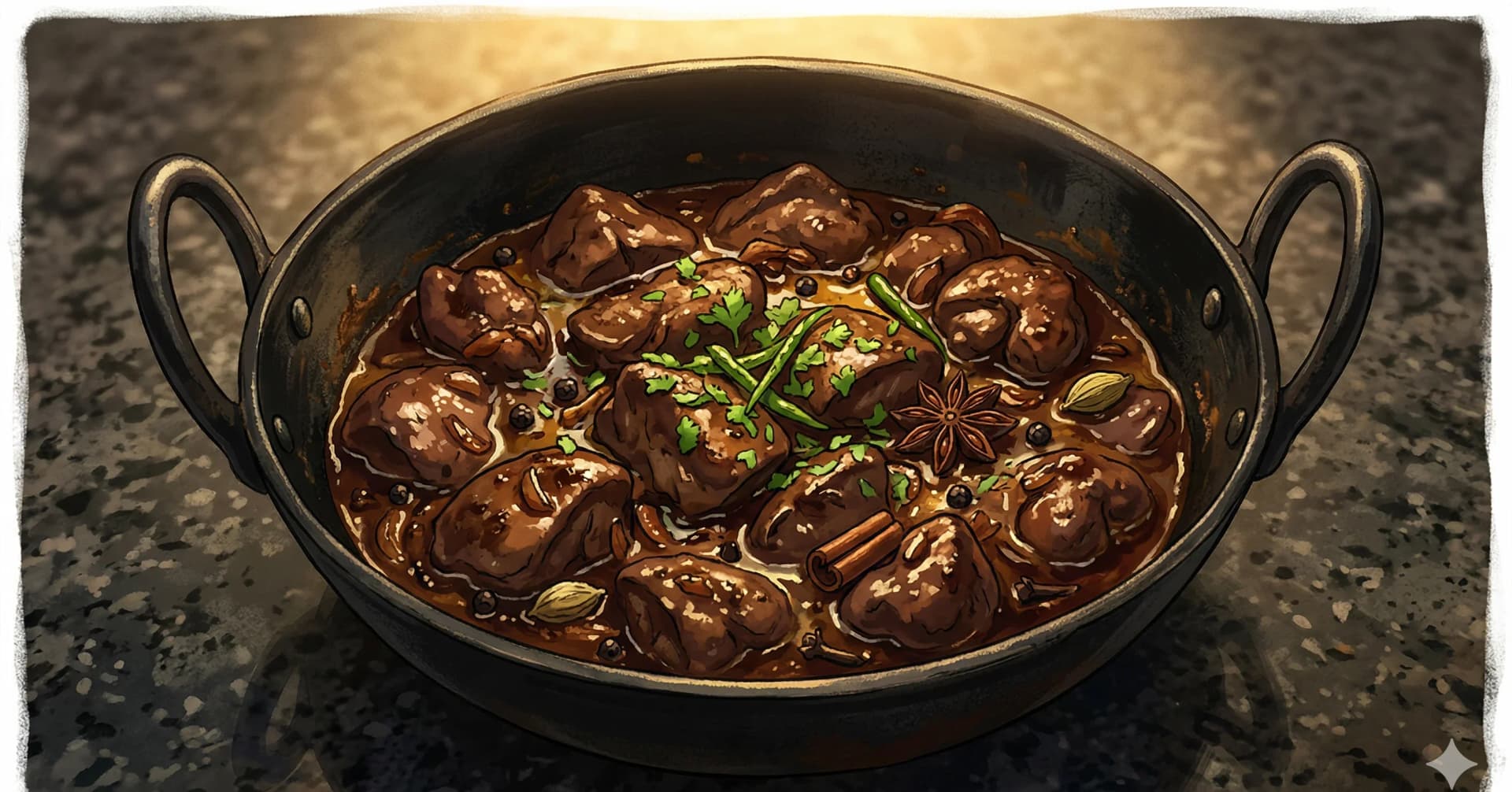
Sour Kidney & Liver Curry (Khatti Gurda Kaleji)
Sour Kashmiri kidney and liver with tamarind, fennel and ghee
There is a category of cooking that exists to use everything — not as afterthought, but as discipline. Khatti Gurda Kaleji belongs to it. "Gurda" is kidney, "kaleji" is liver, and "khatti" announces the sourness that defines the dish: tamarind, arriving in quantity, turning what could be a heavy preparation into something bright and appetite-sharpening.
Offal has always held a place of honor in Kashmiri cooking. The valley's culinary traditions, shaped by Persian influence, trade routes, and long winters, have always understood the value of meat in its entirety. Liver and kidney both cook fast, which is part of their virtue. Overcook either and you have something chalky and dull; cook them correctly and they are yielding but still giving, with an iron-rich depth that no muscle meat can replicate.
The technique here is quick and confident. Onions go in first, cooked to a proper brown — not softened, not blonde, but genuinely caramelized, with color that will anchor the sauce. The offal follows. Then the spices, which in this dish lean heavily toward fennel and cardamom (the signature Kashmiri aromatic pair) along with turmeric and the warmth of red chilli. Tamarind pulp comes last, a generous pour, and the whole thing cooks together just long enough for the sourness to round and integrate.
This is not delicate food. It is decisive, built for cold air and appetite. Eat it hot, with flatbread or rice, immediately after cooking.
At a Glance
Yield
4–6 servings
Prep
20 minutes
Cook
25 minutes
Total
45 minutes
Difficulty
Easy
Ingredients
- 2¼ lblamb liver, cleaned and cut into 3–4 cm pieces
- 1 lblamb kidney, cleaned, halved, core removed, cut into pieces
- 7 ozonion (about 1–1½ onions), finely sliced
- ½ cupghee
- 1⅔ tspsalt, or to taste
- 1¼ tbspturmeric powder
- ⅓ cupred chilli powder
- 3¼ tbspcardamom powder
- 2¾ ozfennel powder
- 1 lbtamarind, soaked in 400 ml warm water and strained to make pulp
Method
- 1
Prepare the offal. Kidney requires a little care: split each kidney in half lengthwise, remove the white fatty core with scissors or a sharp knife, and cut into bite-sized pieces. Soak in cold salted water for 10–15 minutes if you want to mellow the flavor, then drain and pat dry. Cut liver into even pieces, removing any tough membranes or bile duct remnants.
- 2
Brown the onions. Heat the ghee in a wide, heavy pan over medium-high heat. Add the sliced onions and cook, stirring regularly, for 12–15 minutes until they are a deep, even brown. Don't rush this step — the color of the onions becomes the foundation of the sauce's body and sweetness.
- 3
Add offal. Raise the heat to high. Add the kidney pieces first — they benefit from a moment of direct sear. Then add the liver. Stir and cook for 3–4 minutes. The offal will release some liquid; let this cook off before moving to the next step.
- 4
Spice. Add the turmeric, red chilli powder, cardamom powder, fennel powder, and salt. Stir vigorously to coat the offal and onions in the spices. Cook for 2 minutes over high heat, stirring continuously — the spices should smell toasted rather than raw.
- 5
Add tamarind. Pour in the strained tamarind pulp. Stir everything together. The pan will hiss and steam. Reduce the heat to medium and cook for 8–10 minutes, until the sauce has reduced and thickened slightly around the offal, and the tamarind has lost its raw edge.
- 6
Check and serve. Taste for salt and sourness — add more tamarind if you want it sharper. Serve immediately while the liver is still just yielding. This dish does not wait.
Key Ingredient Benefits
Lamb liver: Among the most nutrient-dense foods available, extremely high in vitamin A, B12, iron, and folate. Traditional cooking systems across the world have long prized organ meats for exactly this reason. Vitamin A from animal liver is highly bioavailable; those with concerns about pre-formed vitamin A should note that liver is very rich in it.
Lamb kidney: Has a more pronounced mineral flavor than liver. High in protein and B vitamins. The white core (the fatty renal capsule) should always be removed before cooking; leaving it in creates an unpleasant texture and amplifies any strong flavor.
Tamarind: Provides the sourness through tartaric acid. It is widely used across South Asian cooking and is associated in traditional medicine with cooling and digestive effects. Some research looks at its polyphenol content, though evidence remains preliminary.
Fennel powder: In large amounts, as used here, fennel becomes structural rather than merely aromatic. Its anise character is muted when cooked long with tamarind, leaving a background sweetness.
Why This Works
Offal, particularly liver, is one of the most time-sensitive proteins to cook. Liver is largely composed of proteins that begin to contract and toughen past 70°C internal temperature, so the window between correctly cooked and overdone is narrow. Cooking it quickly over high heat, in a pan with already-cooked onions and ghee, means the protein hits high heat fast and finishes fast — by the time tamarind is added and reduced, the liver should be just cooked through.
Tamarind's acidity serves two functions: it lifts the richness of the ghee and offal, and it acts as a tenderizer for any protein fibers still contracting during the final minutes of cooking. The fennel, used in substantial quantity, is the Kashmiri accent that prevents the dish from reading as generic. Its sweetness softens the liver's iron notes.
Substitutions & Variations
- Liver only: The dish works as a pure kaleji preparation if kidney is unavailable or unwanted. Increase the liver quantity to 1.5 kg.
- Kidney only: A more strongly flavored result. Soak kidney longer (30 minutes in cold water) and reduce cook time slightly.
- Tamarind: Amchoor (dry mango powder) can provide sourness in a pinch, though the character is lighter. Use 2–3 tablespoons.
- Ghee: Can be replaced with a neutral oil for a lighter result, though the richness it brings is part of the dish's identity.
Serving Suggestions
- Eat with roti, naan, or plain rice.
- A raw onion salad dressed with lemon juice and chilli makes a sharp, bright counterpoint.
- Khatti gurda kaleji is typically a standalone dish, not part of a multi-component spread.
Storage & Reheating
Best eaten immediately. Liver hardens as it cools and reheated offal is rarely as good. If you must store it, refrigerate in an airtight container for up to 1 day. Reheat gently over very low heat with a tablespoon of water. Do not reheat more than once. Freezing is not recommended.
Cultural Notes
Khatti gurda kaleji (खट्टी गुर्दा कलेजी, "sour kidney and liver") is the Hyderabadi-Awadhi offal preparation of lamb kidney (gurda) and lamb liver (kaleji) cooked together in a tangy yogurt-and-tamarind gravy with onion, ginger-garlic, Kashmiri red chili, ground coriander, and the Hyderabadi spice mix. The khatti (sour) name describes the deliberate sour finish from the tamarind and yogurt combination, which serves both as a flavor element and as a culinary technique for cutting the richness of organ meats.
The cultural attitude toward offal shaped the dish's character. Across South Asian cooking traditions, organ meats (liver, kidney, brain, tongue, sweetbreads, tripe) have been used both as everyday economical proteins and as prestige preparations at banquet menus, depending on the regional context. The Hyderabadi-Awadhi tradition treats organ meats with the same culinary respect given to whole-muscle cuts, developing dedicated preparations that handle their particular textures and flavors. Kidney has a distinctive mineral pungency that can become unpleasant if not handled correctly, and the sour treatment of khatti gurda kaleji uses acidity (tamarind, yogurt) to balance and round the pungency rather than mask it. Liver has a softer richer character that the same sour gravy brings into balance.
The technique requires careful prep work to handle the offal correctly. Lamb kidneys are split lengthwise, the white core removed, and rinsed thoroughly in cold water. Lamb liver is sliced into thin pieces and rinsed in salted water for fifteen minutes to draw out some of the metallic flavor. Both are patted dry and seasoned briefly with salt and turmeric. Sliced onions are sautéed in ghee until deep golden, then ginger-garlic paste, ground coriander, Kashmiri red chili, ground cumin, and a small amount of turmeric are added. The seasoned kidney is added first (kidney needs slightly more cooking time than liver) and seared for two minutes, then the liver is added and seared briefly. Whisked yogurt and tamarind paste (or thick tamarind extract) are added off the heat to prevent splitting, then returned to low heat for ten to twelve minutes. The dish is finished with a scatter of fresh cilantro and a small drizzle of ghee, and served with naan or steamed basmati rice.
Nutrition Facts
Calories: 574kcal (29%)|Total Carbohydrates: 48.8g (18%)|Protein: 49.3g (99%)|Total Fat: 21.2g (27%)|Saturated Fat: 10.5g (53%)|Cholesterol: 925mg (308%)|Sodium: 388mg (17%)|Dietary Fiber: 4g (14%)|Total Sugars: 26.7g
You Might Also Like


Ratings & Comments
Ratings & Comments
Ratings
Share your thoughts on this recipe.
Sign in to rate and comment