Dum · Indian Cuisine
Slow-Baked Squash (Lagan Ka Tinda)
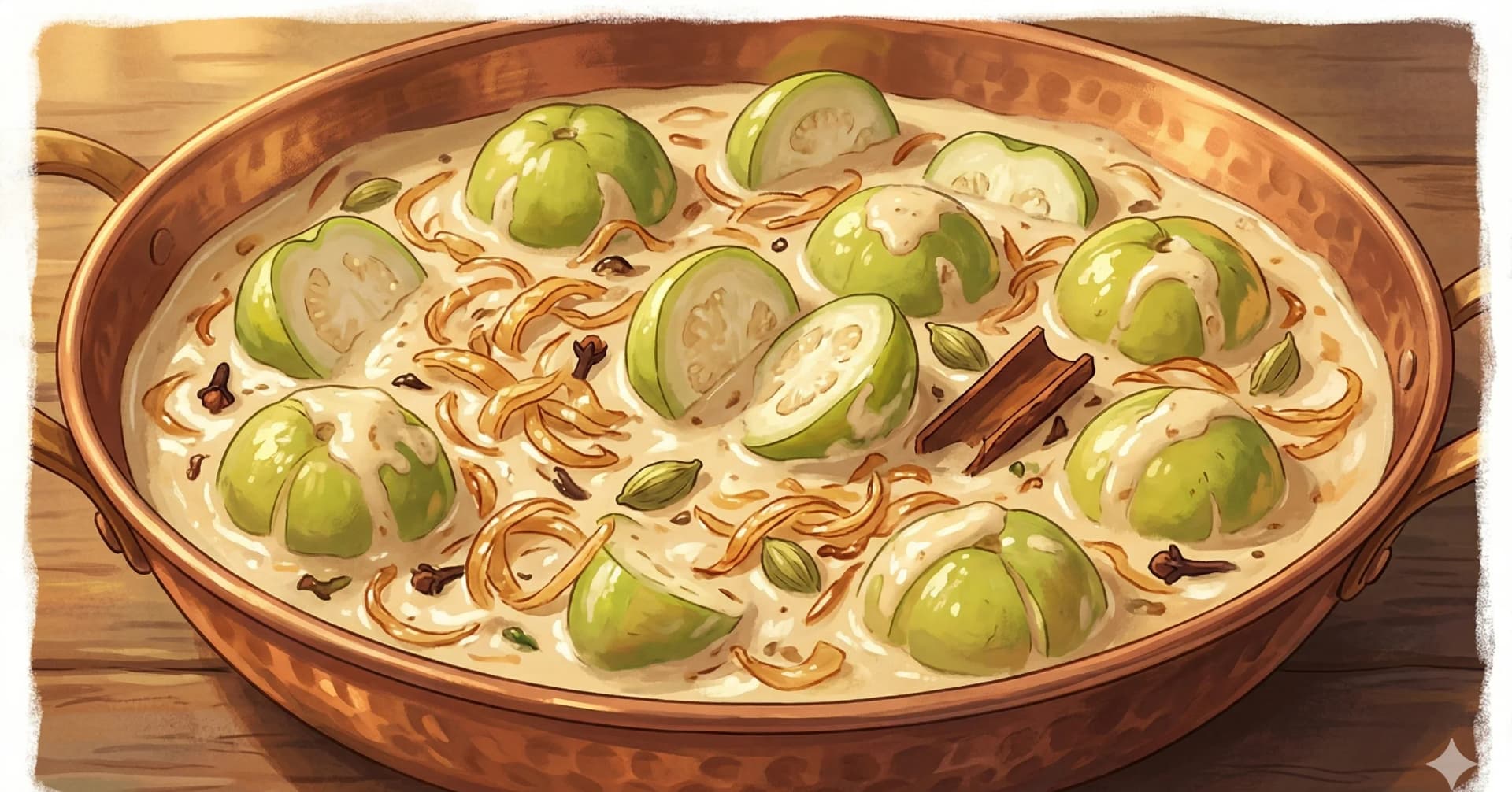
Baby apple gourds marinated in yogurt and brown onion, slow-cooked in a sealed lagan
Tinda — the small, round gourd sometimes called apple gourd or Indian round gourd — is a mild, water-rich vegetable that absorbs what surrounds it with willingness. This is precisely why the dum method suits it so well: sealed in a lagan (a wide, flat-bottomed vessel), the tinda cannot release its moisture into the open air. Instead, the liquid circulates, the marinade penetrates, and the gourd becomes something richer and more complex than any open-pot cooking could achieve.
The marinade here is built on brown onion paste — onions fried to a deep, caramelised gold and blended smooth — combined with thick yogurt, Kashmiri chilli, ginger, garlic, cardamom, mace, and nutmeg. Green chilli paste adds a brighter, more immediate note. The whole paste is seasoned with lime and worked into the tinda before they are cooked in ghee-soaked chopped onion in the base of the lagan.
The result after thirty minutes of sealed heat is a vegetable dish that has fully absorbed its environment: the tinda are soft, their mild sweetness playing against the earthy warmth of the masala, the ghee binding everything into a cohesive whole. It is a vegetarian dish built with the same careful attention as the more celebrated meat preparations of the same tradition.
At a Glance
Yield
Serves 4
Prep
20 minutes
Cook
35 minutes
Total
55 minutes
Difficulty
Easy
Ingredients
- 2¼ lbbaby tinda (apple gourd) (about 5½–6 apples), washed and halved or quartered if large
- ¼ cupKashmiri red chilli paste (or 2 teaspoons Kashmiri chilli powder mixed with water)
- ⅓ cupcoriander powder
- 3¼ tbspginger paste
- 3¼ tbspgarlic paste
- 1 tbspfine salt
- 2 tbsplime juice (about 1½ limes)
- ½ cuprefined oil
- 2¾ ozbrown onion paste (onions fried very dark golden (about ½ onion), then blended)
- ½ lbthick yogurt, whisked smooth
- 2¼ tspmace powder
- 1⅓ tspnutmeg powder
- 2½ tspgreen cardamom powder
- ¾ tspturmeric powder
- 2 tbspgreen chilli paste
- ⅔ cupghee
- 3½ ozonion (about ½–1 onion), roughly chopped
Method
- 1
Make the marinade. In a large bowl, combine all marinade ingredients: Kashmiri chilli paste (25 g), coriander powder (6 teaspoons), ginger paste (50 g), garlic paste (50 g), salt (4 teaspoons), lime juice (1½ limes), oil, brown onion (100 g) paste (75 g), yogurt (250 g), mace (1 teaspoon), nutmeg (½ teaspoon), cardamom powder (1 teaspoon), turmeric (½ teaspoon), and green chilli paste (30 g). Mix until completely smooth.
- 2
Coat the tinda. Add the prepared tinda to the marinade and toss to coat completely. Set aside for 15 minutes.
- 3
Prepare the lagan. Heat the ghee (150 g) in a lagan (or a wide, heavy, flat-bottomed pot) over medium heat. Add the chopped onion and cook until translucent, about 5 minutes.
- 4
Cook dum-style. Add the marinated tinda along with all the marinade into the lagan. Stir once to combine with the onion. Reduce heat to very low. Seal tightly with foil pressed under the lid, then press the lid firmly over it.
- 5
Cook for 30 minutes without lifting the lid. If using charcoal, place lit charcoal on the lid for a more authentic dum result.
- 6
Check and serve. Open carefully away from yourself. The tinda should be completely tender when pierced with a knife, the sauce thick and coating. Adjust salt. Serve with khamiri roti or pilaf rice.
Key Ingredient Benefits
Tinda (Praecitrullus fistulosus, Indian round gourd) is a warm-season vegetable common across North India. It is very high in water content (around 95%) and correspondingly low in calories. In Ayurvedic tradition, it is considered cooling and easy to digest — a vegetable prescribed when the digestive system is under stress.
Green cardamom in the marinade contributes a floral warmth that balances the pungency of the ginger and garlic. It is considered one of the three great aromatics of North Indian cooking alongside mace and nutmeg, with which it appears here as a trio.
Why This Works
Brown onion paste — fully fried, blended to smoothness — provides a caramelised base that gives the sauce body and depth without requiring a long cooking process inside the dum vessel. The work has already been done; the sealed cook is a finishing step, not the primary cooking method.
Lime juice in the marinade has two effects: it balances the richness of the yogurt and ghee, and it begins to soften the tinda slightly before heat is applied. This is particularly useful for a vegetable as dense as tinda. The acid gets the process started.
Green chilli paste added to the marinade (rather than dried chilli alone) ensures a layer of fresh, bright heat that survives the sealed cook better than might be expected. Fresh chilli's heat compounds are more stable than its volatile aromatics, which means the bite remains even after 30 minutes.
Substitutions & Variations
Potato version: Baby potatoes can replace tinda entirely. Par-boil them for 10 minutes before marinating, and increase the dum cooking time to 40 minutes.
No lagan: A wide, shallow Dutch oven or deep sauté pan with a tight lid works well. The principle is the same: the vessel should be wide enough that the tinda sits in a shallow layer rather than piling up, ensuring even cooking.
No ghee: Replace with neutral oil for a vegan version. The sauce will be slightly less rich.
Serving Suggestions
Serve with khamiri roti or a light pilaf such as a cumin rice. As part of a vegetarian North Indian meal, this pairs well with a simple dal and a cooling cucumber raita. Two to three pieces of tinda per person is a comfortable portion as a side dish; four to five as a main.
Storage & Reheating
Keeps refrigerated for 2 days. Reheat gently on the stovetop over low heat, covered. The tinda softens further on standing, which is pleasant. Not suitable for freezing.
Cultural Notes
Lagan ka tinda (लगन का टिंडा, "tinda in the lagan") is the Hyderabadi preparation of tinda (the small round Indian apple gourd, Praecitrullus fistulosus) cooked in a lagan, the wide flat-bottomed copper or brass vessel that gives the dish its name. The lagan allows ingredients to cook in a single shallow layer with maximum contact with the heat below and minimum liquid retention, producing a drier richer concentration of flavor than the same dish cooked in a deeper pot. The dish belongs to the Hyderabadi vegetarian repertoire and appears at Hindu family kitchens and at the vegetarian sections of Hyderabadi banquet menus.
The lagan technique is a distinctive Hyderabadi vessel-driven cooking style. Where dum cooking relies on sealed-pot moisture retention, lagan cooking does the opposite, using a wide shallow vessel to let moisture evaporate and the flavors concentrate. The technique is used for several Hyderabadi specialties (lagan ka murgh, lagan ki seekh, lagan ka tinda) where the desired final texture is rich and slightly dry rather than gravy-heavy. The technique requires constant attention from the cook and produces a dish whose flavor is more concentrated than equivalents cooked in deep pots, suiting the Hyderabadi preference for complex layered spice flavors.
The technique stuffs the tinda and cooks them in the shallow lagan. Small round tinda gourds (about two inches in diameter) are peeled, the tops sliced off as caps, and the inner pith scooped out to leave a hollow shell. A filling is prepared from grated paneer, ground coriander, ground cumin, ground fennel, Kashmiri red chili, ginger paste, green chili, salt, and a small amount of fresh cilantro. The filling is stuffed into the hollowed tinda, the caps are replaced, and the stuffed gourds are arranged in a single layer in the lagan. A base gravy is prepared from sliced onion sautéed in ghee with ginger-garlic, ground tomato, turmeric, ground coriander, and Kashmiri red chili, then poured over the stuffed tinda. The lagan is covered (with a heavy lid or with a flat tray weighted with stones) and cooked over low heat for thirty to forty minutes until the tinda are tender and the gravy has reduced to a thick coating. The dish is finished with a scatter of fresh cilantro and served with rumali roti or naan.
Nutrition Facts
Calories: 445kcal (22%)|Total Carbohydrates: 23.4g (9%)|Protein: 7.2g (14%)|Total Fat: 37.5g (48%)|Saturated Fat: 17.1g (86%)|Cholesterol: 66mg (22%)|Sodium: 208mg (9%)|Dietary Fiber: 5.3g (19%)|Total Sugars: 10.1g
You Might Also Like
Ratings & Comments
Ratings & Comments
Ratings
Share your thoughts on this recipe.
Sign in to rate and comment