Parsi · Indian Cuisine
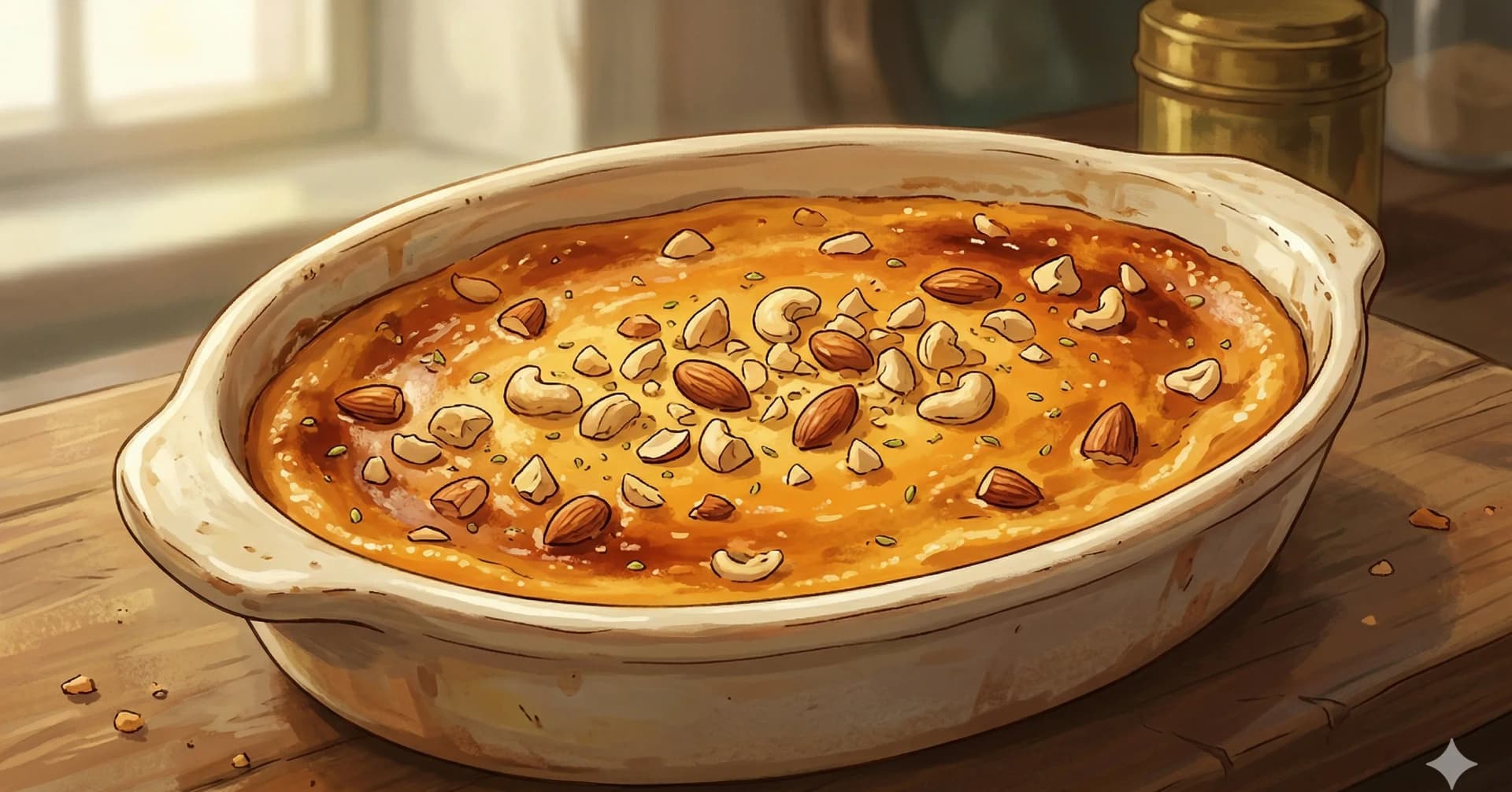
Parsi Cardamom Custard (Laganu Custer)
A Parsi baked bread-and-khoya custard, spiced with cardamom, mace, and rose water
The name reveals its history: laganu means wedding in Gujarati, and this custard is traditionally made for celebrations. It belongs to the family of baked milk puddings found across Persian, Mughal, and South Asian cooking traditions: reduced milk, eggs, and starch combined with aromatic spices and baked until set. The Parsi version adds bread soaked in cream (for texture and richness) and khoya (reduced, semi-solid milk) for depth, plus rose water and the classic Mughal pairing of cardamom and mace.
What results is a dense, slightly firm custard. Less silky than a French crème brûlée, more substantial, with the bread providing something approaching a bread pudding's body. The nuts on top add texture and mark it as a dish for the table, not the everyday pantry.
At a Glance
Yield
Serves 8
Prep
20 minutes
Cook
45 minutes
Total
1 hour 5 minutes
Difficulty
Medium
Ingredients
Method
- 1
Reduce the milk. Place the milk and sugar (200 g) in a heavy pot over medium-low heat. Simmer, stirring occasionally, for 20–25 minutes until reduced by roughly half and thickened slightly.
- 2
Soak the bread (2 slices). Tear the bread into pieces and soak in the cream (200 ml) until completely saturated, about 5 minutes. Add the cream-soaked bread to the reduced milk and stir well, cooking for another 5 minutes until the bread has broken down and the mixture has thickened. Remove from heat and cool to room temperature.
- 3
Preheat oven to 175°C (155°C fan).
- 4
Add eggs (3) and aromatics. Stir the beaten eggs into the cooled milk mixture. Cool is essential, or the eggs will scramble. Add the butter (20 g), vanilla, rose water (2 ml), cardamom (¼ teaspoon), and mace (¼ teaspoon). Mix well.
- 5
Bake. Pour into a buttered baking dish. Scatter the chopped nuts over the top. Bake for 25–30 minutes until the top is golden brown and the custard is just set. It should have a very slight wobble in the centre.
- 6
Cool to room temperature before serving, or serve slightly warm.
Key Ingredient Benefits
Whole milk: The base of the custard, reduced significantly during cooking to concentrate flavor and create the proper rich body. Provides protein, calcium, and the foundation for the dish's signature creamy texture.
Khoya (mawa, evaporated milk solids): Concentrated milk solids that provide intense dairy richness. Khoya is made by simmering whole milk for hours until most of the water evaporates and only the solids remain. Available at Indian groceries pre-made; can be made at home. Provides the dense, fudge-like character that distinguishes Parsi custard from European baked custards.
Heavy cream: Adds additional richness and helps achieve the signature dense texture. The combination of whole milk + khoya + cream is what makes laganu custer distinctly Parsi rather than a simple bread pudding.
Eggs: The custard's structural foundation. The egg yolks provide richness and color; the whites help the custard set properly. Use whole eggs — separating produces a different texture.
Bread: Cubed and soaked in the milk-egg mixture. Day-old bread is essential — fresh bread becomes too mushy. The bread provides the textural element that distinguishes laganu custer from smooth custards.
Cardamom: Freshly ground from green pods. The signature aromatic of Parsi sweet making.
Mace (javitri): The lacy outer covering of nutmeg. Mace has a more delicate, slightly floral flavor than nutmeg and is one of the spices that distinguishes Parsi desserts from broader North Indian preparations.
Rose water: A few drops at the end add the floral note characteristic of Parsi sweets.
Sultanas and nuts: Plumped in warm milk, then folded in. Traditional Parsi laganu custer includes both for textural and visual interest.
Why This Works
Reducing the milk before adding it to the egg mixture concentrates its proteins and sugars, producing a custard that sets firmer and with more flavour than custard made from unreduced milk. The bread and cream provide starch and extra fat, softening the texture and increasing richness.
Cooling the milk mixture before adding eggs is critical. Adding eggs to hot liquid immediately begins to cook them, producing curdled scrambled egg rather than a smooth custard.
Substitutions & Variations
Khoya: Cannot really be substituted without losing the essential Parsi character. Ricotta cheese mixed with milk powder approximates. Mascarpone provides similar richness but different flavor. Skip and increase the cream if khoya is unavailable (the result is less authentic but acceptable).
Bread: Brioche or challah produces the richest result. White sandwich bread is the everyday Parsi household choice. Day-old bread is essential. Sourdough or whole grain produces a different (and not authentic) character.
Heavy cream: Whole milk + butter (3 tablespoons butter per cup of milk) approximates. Half-and-half works but produces a less rich result. Plant-based cream can substitute for vegan versions.
Mace: Nutmeg substitutes (use about 1/3 as much — nutmeg is stronger). Cannot really be skipped without losing some of the signature Parsi character.
Rose water: Orange blossom water is the closest substitute. Vanilla extract is not appropriate — wrong flavor profile.
Eggs: Cannot really be substituted for the custard structure. Egg substitutes don't produce the right texture.
Sweetener: Granulated sugar is standard. Some Parsi households use brown sugar or jaggery for additional depth. Condensed milk replaces both some sugar and some milk in modern shortcut versions.
Nuts: Slivered almonds and pistachios are traditional. Cashews work. Walnuts produce a different but acceptable result. Toast briefly before adding for additional flavor.
Saffron: Optional addition. A pinch of saffron bloomed in warm milk adds color, aroma, and festival association. Common in elaborate Parsi celebration versions.
Baking dish: A rectangular ceramic baking dish (about 8x10 inches) is traditional. Glass works. Cast iron can be used but conducts heat differently — reduce baking time slightly.
Serving Suggestions
Serve at room temperature or slightly warm, cut into squares or scooped into bowls. Parsi celebrations traditionally serve it after a full meal. It is sweet, dense, and a little goes a long way.
Storage & Reheating
Keeps refrigerated for 3 days, covered. Serve at room temperature. Cold custard is dense and less pleasant.
Cultural Notes
Laganu custer (literally "wedding custard" in Parsi Gujarati) is one of the defining sweets of Parsi celebration cuisine. The dish takes its name from its traditional association with lagan (weddings) and other major Parsi celebrations, where it is served as one of several sweet dishes alongside sev, malido, and ravo.
The dish reflects the Parsi community's distinctive culinary fusion of Persian, Indian, and British influences. The custard format (eggs + milk + sugar + bread, baked) is fundamentally British — introduced during the colonial era when Parsi cooks adapted English baked puddings using local ingredients. The use of khoya, cardamom, mace, and rose water transforms what would otherwise be a British bread pudding into something distinctly Parsi.
The Parsi community had particularly close ties to the British colonial establishment in India. Many Parsi families served in colonial administration, trade, and the legal profession, and the community adopted certain British cultural practices (including English breakfast traditions, baked desserts, and certain table manners) more readily than other Indian communities. Laganu custer is one of the clearest culinary expressions of this Anglo-Parsi cultural synthesis — neither fully British nor fully Indian, but distinctly Parsi.
The dish appears at virtually every traditional Parsi wedding, alongside elaborate spreads of patra ni machi (steamed fish in banana leaf), dhansak, salli boti (lamb with potato straws), and other ceremonial dishes. The custard is typically the closing dessert of the meal, served warm or at room temperature in small portions.
The Parsi wedding tradition (lagan) itself is one of South Asia's most distinctive cultural events. The ceremonies typically span multiple days, involve elaborate hospitality, and feature specific traditional foods that are rarely prepared outside the wedding context. Laganu custer is one of these — many Parsi families only prepare the dish for weddings and other major celebrations, even though it can technically be made at any time.
The dish has also become a signature item at Mumbai's famous Parsi restaurants (Britannia & Co., Jimmy Boy, SodaBottleOpenerWala), where it appears on dessert menus year-round as part of the broader Parsi food revival of recent decades.
Nutrition Facts
Calories: 321kcal (16%)|Total Carbohydrates: 37.4g (14%)|Protein: 8.9g (18%)|Total Fat: 15.8g (20%)|Saturated Fat: 7.8g (39%)|Cholesterol: 109mg (36%)|Sodium: 128mg (6%)|Dietary Fiber: 0.4g (1%)|Total Sugars: 32.8g
You Might Also Like
Ratings & Comments
Ratings & Comments
Ratings
Share your thoughts on this recipe.
Sign in to rate and comment