Indian Cuisine
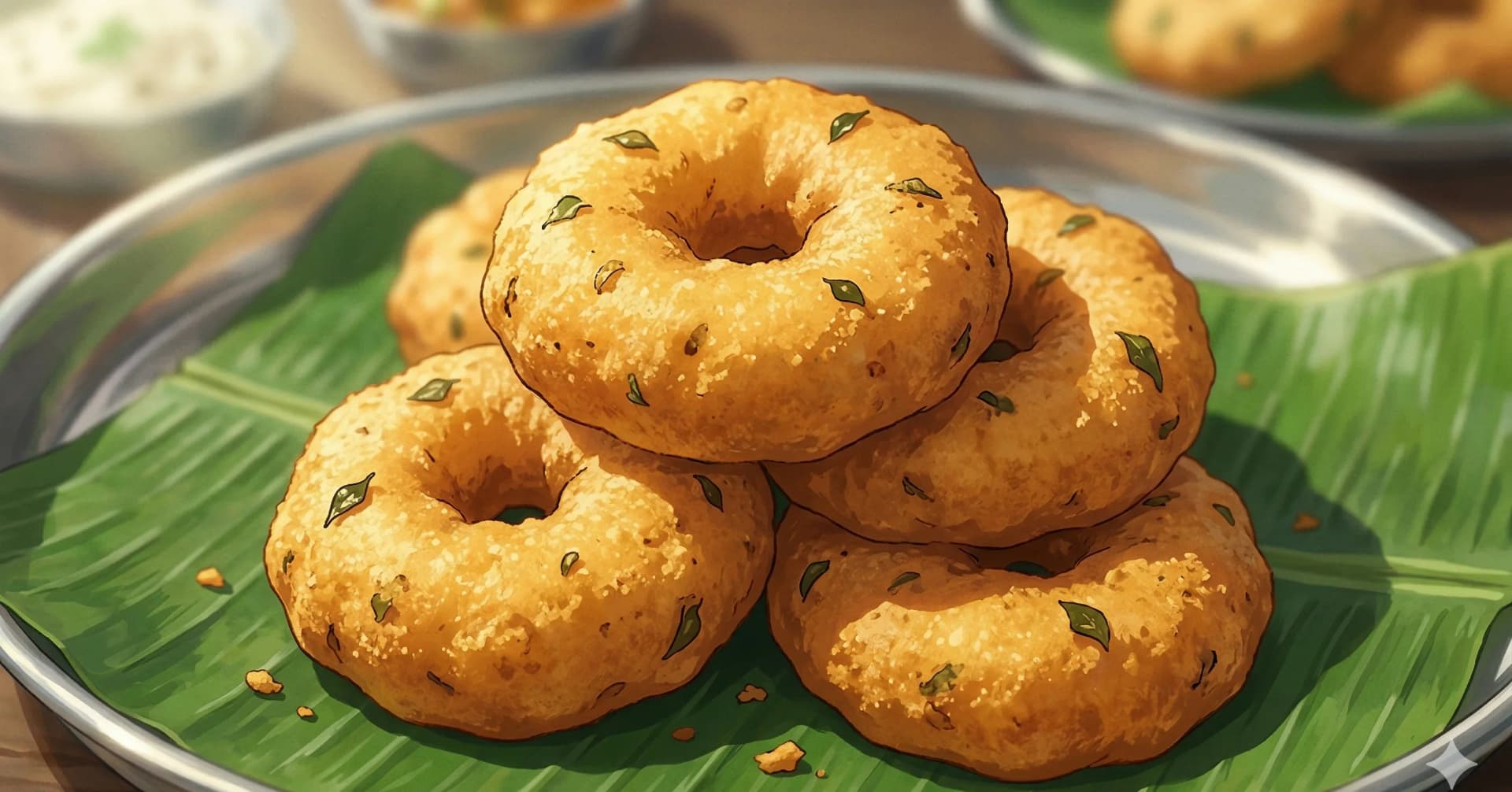
Crispy Lentil Doughnuts (Medu Vada)
South India's crisp, airy lentil doughnut — the essential breakfast companion
In Tamil Nadu and Karnataka, the morning plate arrives with a predictable and deeply satisfying logic: two idlis, one or two vadas, a small bowl of sambar, two chutneys. The vada is the crisp counterpoint to the idli's softness: golden-brown and slightly blistered on the outside, with an interior that is airy and yielding, almost sponge-like. Dunked into sambar, it softens gradually, taking on the curry's warmth while retaining just enough structure to hold together. This is one of South India's great breakfast rituals.
Medu means soft in Kannada, which is both a descriptor of the interior and a reminder of what makes a great vada difficult: the batter must be ground to a specific consistency. Too thin and the vadas spread flat in the oil, losing their ring shape and frying into dense discs. Too thick and they won't develop the airy crumb that gives them their lightness. The right consistency is thick, fluffy, and almost mousse-like. When you drop a small ball of batter into a glass of water, it should float.
The floating test is not mythology. It works because well-ground batter incorporates enough air that its density is lower than water. Under-ground batter is dense and sinks. If your batter sinks, grind further.
The ring-shaping is the other technique to develop. Wet your palm, place a ball of batter in the center, press to flatten, then poke a hole through the center with a wet finger and expand it slightly. The whole thing slides off the hand into the oil with a flick of the wrist. A few practice vadas will be misshapen; by the fifth, it feels intuitive.
At a Glance
Yield
20–24 vadas
Prep
15 minutes active (plus 4-hour soak)
Cook
30 minutes
Total
4 hours 45 minutes (mostly passive soaking)
Difficulty
Medium
Ingredients
- 1 lburad dal (split black gram, hulled, also called white urad)
- 3¼ tbspgreen chillies (2–3 chillies), finely chopped
- 3¼ tbspfresh ginger, finely grated
- ¾ ozonion, very finely chopped
- 1½ tbspcumin seeds
- 1 tbspblack peppercorns, coarsely cracked
- 1⅓ cupfresh curry leaves (about 2 sprigs), finely chopped
- 1 cupfresh coriander, chopped
- ⅞ tspsalt
- 2 cupsneutral oil, for deep frying
Method
- 1
Soak the dal. Wash the urad dal (500 g) in several changes of water until the water runs clear. Soak in plenty of cold water for at least 4 hours, or overnight. The dal will swell and turn slightly white.
- 2
Grind the batter. Drain the soaked dal very well; remove as much water as possible. Grind in a wet grinder or powerful blender with the minimum amount of water needed to keep the blades moving. Add water only a tablespoon at a time. The batter should be very thick, very smooth, and light, almost like a thick whipped cream. This process takes 8–10 minutes in a wet grinder. If using a blender, you may need to stop and scrape down frequently.
- 3
Test the batter. Drop a small ball of batter into a glass of cold water. If it floats, the batter is ready. If it sinks, continue grinding with tiny additions of water.
- 4
Season the batter. Transfer the batter to a bowl. Add green chillies (20 g), ginger (20 g), onion (20 g), cumin seeds (10 g), cracked pepper, curry leaves (2 sprigs), coriander (20 g), and salt (5 g). Fold gently. Do not stir vigorously, which would knock out the air incorporated during grinding. The batter should remain thick and aerated.
- 5
Heat the oil. Pour oil into a deep pan to a depth of at least 6 cm. Heat to 175–180°C over medium-high heat. The oil should shimmer and a small drop of batter dropped in should sizzle immediately and rise to the surface.
- 6
Shape the vadas. Keep a bowl of water nearby. Wet one hand thoroughly. Place 2–3 tablespoons of batter on your wet palm and press into a disc about 6 cm across and 1.5 cm thick. Poke a hole through the center with a wet finger and widen it slightly. The hole will close somewhat during frying, so make it larger than you think necessary. Slide the vada off your palm directly into the oil with a confident flick of the wrist.
- 7
Fry. Fry 3–4 at a time, turning once, for 3–4 minutes per side until evenly golden-brown. The interior should feel cooked through; pierce with a skewer if uncertain, and it should come out clean.
- 8
Drain and serve. Remove with a slotted spoon and drain briefly on paper. Serve immediately with sambar and coconut chutney.
Key Ingredient Benefits
Urad dal (split black gram) is nutritionally exceptional among lentils. It provides approximately 26% protein by dry weight and is particularly rich in iron, calcium, and phosphorus. Despite being a starchy legume, its protein and fibre content moderates glucose absorption. Traditionally used in Ayurveda as a strengthening food, it is considered particularly appropriate for morning consumption.
Curry leaves contribute a distinctive citrusy, slightly spicy aroma from carbazole alkaloids unique to the Murraya koenigii plant. They add a complexity that is unmistakably South Indian and cannot be replicated by any substitute.
Black pepper in its cracked form provides bursts of sharp heat distributed through the vada. Piperine, black pepper's primary bioactive compound, is associated in research with increased bioavailability of other nutrients. In vada, it provides textural contrast and the characteristic flecks visible in the golden crust.
Ginger contributes warmth, and its anti-nausea and pro-digestive properties are among the best-documented of any culinary spice. In medu vada it provides a clean, bright heat that complements the earthy urad dal.
Cumin seeds pop in the oil during frying, releasing their volatile oils in brief, fragrant bursts. Whole seeds in vada are traditional; they provide textural punctuation and earthy warmth.
Why This Works
Urad dal's protein composition is unusual among legumes. Its high glutelin content behaves somewhat like gluten when vigorously ground with water, developing a cohesive, stretchy network that traps air bubbles. This is why well-ground urad batter can achieve the aerated, floating quality. No other lentil does this; rice batter doesn't do it; chickpea batter doesn't do it. This protein network is why medu vada has the unique interior texture it does: a complex crumb structure rather than the dense, compact texture of besan fritters.
Minimum water during grinding is the critical technique point. Water is the enemy of batter aeration. The less water you add, the thicker and airier the batter; the more water, the denser and heavier the result. Every excess tablespoon of water works against you. Drain the soaked dal as thoroughly as possible before grinding.
Frying at the correct temperature ensures the surface sets immediately on contact with the oil, trapping the structure before it can spread. The vada essentially sets in the first 30 seconds of contact, which is why temperature control matters more here than in most frying applications.
Substitutions & Variations
- Sambar vada: After frying, soak the vadas in warm sambar for 10–15 minutes until they have absorbed some liquid and become tender all the way through. A different preparation, more like a braised fritter, beloved in Tamil Nadu.
- Thayir vada / dahi vada: Soak fried vadas briefly in warm water (to remove excess oil), then submerge in whisked yogurt seasoned with salt, cumin, and a touch of sugar. Top with tamarind chutney and red chilli powder. The North Indian name is dahi bhalla.
- Masala vada: A different preparation using chana dal rather than urad, ground coarsely rather than smoothly, with onion and spices mixed through. Produces a denser, more textured fritter.
- Pepper vada: A simpler, more austere version that emphasises black pepper heavily. Reduce aromatics and increase black pepper to 15 g for a more sharply flavoured vada.
- Baked version: Brush shaped vadas with oil and bake at 200°C for 20–25 minutes, turning once. The result lacks the characteristic golden colour and airy crust of deep-fried vadas but is lighter.
Serving Suggestions
The canonical South Indian serving is medu vada with sambar and coconut chutney. The sambar, a tamarind-based lentil and vegetable soup, provides warmth, acidity, and umami; the coconut chutney provides cool, creamy counterpoint. Dunk the vada into the sambar and eat immediately. As part of a full South Indian breakfast plate, vadas sit alongside idli, dosa, and pongal. Street vendors in Chennai and Bengaluru serve them in leaf cups or on banana leaf with a small ladle of sambar poured over, softer and more sauce-laden than the restaurant version.
Storage & Reheating
Medu vada, like most fried lentil dishes, is best eaten immediately. The crisp exterior softens within 20–30 minutes. To reheat, use an oven at 200°C for 6–8 minutes or an air fryer at 190°C for 4–5 minutes; the exterior will recover much of its crispness. Do not microwave. Ground batter can be refrigerated for up to 24 hours; stir gently before using. The batter may ferment slightly overnight, which is actually desirable. Slight fermentation adds a subtle sour note and can improve the batter's lightness further. Shaped, unfried vadas should not be stored.
Cultural Notes
Medu vada (मेदु वडा, medhu vadai in Tamil) is the South Indian fritter of ground urad dal shaped into a doughnut and deep-fried until crisp on the outside and soft inside. The dish is one of the standard accompaniments to idly at the South Indian breakfast table, served alongside coconut chutney and a small bowl of sambar that the diner uses for dipping. The fritter has a documented history in Tamil cooking going back at least a millennium, with references in classical Tamil literature, and the form has been continuous in South Indian kitchens since.
The technical foundation is the urad dal batter. Split skinned urad dal is soaked for four to six hours, drained, and ground with very little water to a thick fluffy paste. The consistency is important, since too much water produces flat heavy vadas while the right consistency produces light airy ones. The ground batter is whipped with a whisk or hand mixer for several minutes to incorporate air, which is what produces the characteristic light interior of a properly made vada. Salt, black peppercorns, finely chopped ginger, curry leaves, green chilies, and sometimes asafoetida go in at the end.
The shaping and frying takes practice. The batter is portioned into balls, then each ball is patted flat between the cook's palms with a small hole pressed in the center to make the characteristic doughnut shape (which helps the interior cook through evenly during frying). The shaped vadas slide into hot oil and fry for three to four minutes until both sides turn deep golden and the surface develops the irregular bumps and ridges that mark a well-made vada. The dish is served immediately, since the texture deteriorates quickly as the vadas cool and the interior moisture migrates outward, softening the crispness. South Indian breakfast restaurants typically serve idly-vada-sambar as a single combination plate at every breakfast service, and the dish appears at festival meals, at the temple prasadam tradition, and at home cooking across Tamil Nadu, Karnataka, and Kerala.
Nutrition Facts
Calories: 354kcal (18%)|Total Carbohydrates: 37.6g (14%)|Protein: 15.7g (31%)|Total Fat: 16.6g (21%)|Saturated Fat: 2.3g (12%)|Cholesterol: 0mg (0%)|Sodium: 74mg (3%)|Dietary Fiber: 11.3g (40%)|Total Sugars: 0.1g
You Might Also Like
Ratings & Comments
Ratings & Comments
Ratings
Share your thoughts on this recipe.
Sign in to rate and comment