Chinese Cuisine
Peking Duck
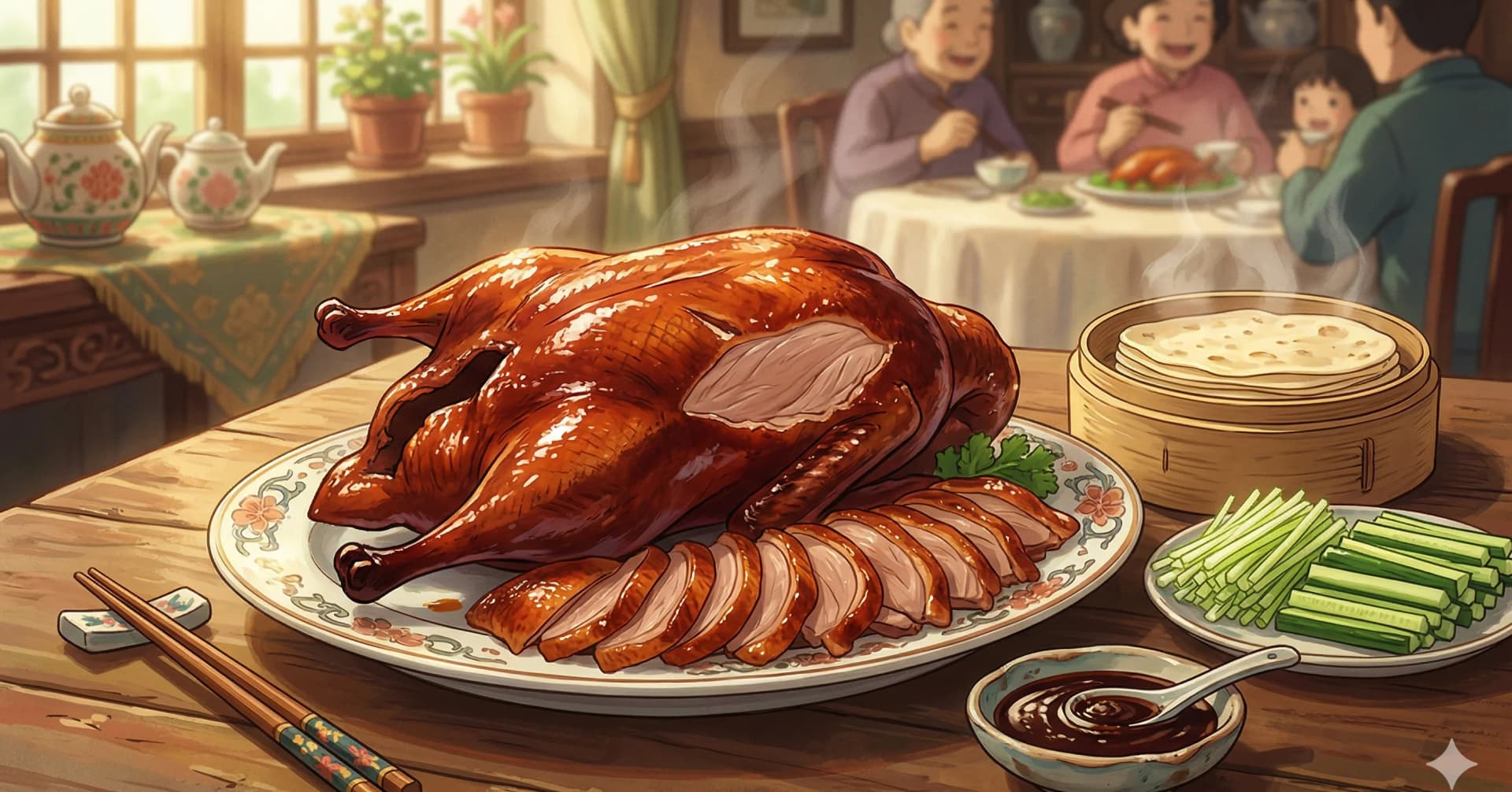
The imperial roast duck with lacquered skin, served with thin pancakes and sweet bean sauce
Peking duck is Beijing's proudest culinary export. For centuries, roast duck shops in the capital have hung whole birds in vertical ovens, producing skin so thin and shattering it crackles when you press it with the flat of a knife. The meat beneath stays tender and rich, having basted in its own rendered fat. Everything about the dish is designed for the table: the slicing, the wrapping, the communal assembly of pancake rolls stuffed with hoisin-brushed duck, ribbons of scallion, and cool sticks of cucumber.
Making Peking duck at home means accepting a few compromises and gaining a few advantages. You will not have a vertical oven or an air pump to separate skin from flesh. But you will have time, a wire rack, and a cold refrigerator. The technique here relies on salting, blanching with boiling water to tighten the skin, brushing with a maltose-vinegar glaze, and then air-drying the bird uncovered in the fridge for one to two days. This extended drying is what transforms ordinary roast duck into something with a lacquered, amber-colored shell that shatters between your teeth.
The cavity gets stuffed with apples, scallions, garlic, star anise, and cassia cinnamon. These aromatics do not season the skin. They perfume the meat from within, keeping the flesh moist and fragrant while the oven does its work on the outside. The two-stage roasting, starting hot and dropping to a lower temperature, ensures that the skin sets and colors before the interior overcooks.
Serve the duck the traditional way. Lay out your pancakes, your sauce, your julienned vegetables, and let everyone at the table build their own rolls. This is not a dish you plate in the kitchen. It belongs in the center of the table, where the conversation is.
At a Glance
Yield
6 servings
Prep
1 day 2 hours
Cook
1 hour 15 minutes
Total
1 day 3 hours 15 minutes
Difficulty
Involved
Ingredients
Duck Ingredients
- 1 wholeduck, about 2.5 kg
- 2 tbspfine salt
- 1½ ozmaltose (or substitute 25 g honey mixed with 10 ml hot water)
- ½ cuphot water
- 1 tsprice vinegar or white vinegar
- 2 stalksscallions
- 1head garlic, halved crosswise
- 2apples, quartered
- 4 wholestar anise
- 4bay leaves
- 2 piecescassia cinnamon (about 3 inches each)
Sauce Ingredients
- 1¾ ozsweet bean sauce (tian mian jiang)
- 1 tspsugar
- 1⅔ tsprendered duck fat (from roasting)
To Serve
- 18to 24 Peking duck pancakes (store-bought or homemade)
- 4scallions, julienned into 3-inch strips
- 1/2English cucumber, peeled, seeded, and cut into thin sticks
Method
- 1
Salt the duck. Pat the duck thoroughly dry inside and out with paper towels. Rub the fine salt evenly over the entire surface and inside the cavity. Set the duck on a wire rack over a rimmed baking tray and leave at room temperature for 1 hour. The salt draws surface moisture and begins seasoning the meat.
- 2
Blanch the skin. Bring about 6 cups of water to a boil. Carefully and slowly pour the boiling water over the duck skin, working from the breast over to the legs and wings. Flip the duck and pour water over the other side. You will see the skin tighten and turn slightly glossy almost immediately. If any feather stubs remain, pull them out with tweezers now.
- 3
Glaze the duck. In a small bowl, dissolve the maltose in the hot water. Stir in the vinegar until fully combined. Using a pastry brush, paint one even layer of the maltose glaze over the entire duck skin. Place the duck back on the wire rack over the tray, uncovered, in the refrigerator. After 1 hour, brush on a second coat of glaze.
- 4
Air-dry the duck. Leave the duck uncovered on its rack in the refrigerator for 24 to 48 hours. The skin should feel dry and papery to the touch by the time you are ready to roast. Do not cover it. A fan pointed at the duck can speed this process if needed.
- 5
Stuff the cavity. Remove the duck from the refrigerator 1 hour before roasting to bring it to room temperature. Place the scallions, garlic, apple quarters, star anise, bay leaves, and cassia cinnamon inside the cavity. Seal both openings with toothpicks or small skewers to prevent the stuffing from falling out.
- 6
Roast, stage one. Preheat a convection oven to 390F (200C). If using a conventional oven, set it to 425F (220C). Place the duck breast-side up on the middle rack. Set a large roasting tray on the rack below to catch dripping fat. Roast for 15 minutes at this high temperature to set and begin browning the skin.
- 7
Roast, stage two. Reduce the oven temperature to 350F (180C) for convection, or 390F (200C) for conventional. Wrap the wing tips and leg ends with small pieces of aluminum foil to prevent burning. Continue roasting for about 60 minutes more. Check the duck with an instant-read thermometer inserted into the thickest part of the inner thigh near the breast. The duck is done when the temperature reads at least 165F (74C). If the skin is browning too quickly but the interior is not yet cooked, loosely tent the top with foil and continue roasting.
- 8
Rest. Remove the duck from the oven and let it rest on the carving board for 15 minutes. Remove and discard the cavity stuffing and toothpicks.
- 9
Make the sauce. While the duck rests, spoon about 1/2 tablespoon of rendered duck fat from the roasting tray into a small pan. Add the sweet bean sauce and sugar. Stir over low heat until small bubbles appear and the sauce is fragrant, about 2 minutes. Transfer to a small serving bowl and whisk to combine.
- 10
Carve and serve. Using a sharp knife, carve the duck into small slices, keeping skin attached to meat. Arrange on a platter. Warm the pancakes by steaming for 2 to 3 minutes. Set out the sauce, julienned scallions, and cucumber sticks. To eat, spread a small amount of sauce on a pancake, add a few slices of duck, some scallion, and cucumber. Fold the bottom up and the sides in to form a roll.
Key Ingredient Benefits
Maltose: A traditional Chinese ingredient made from fermented barley or wheat. It has about half the sweetness of table sugar and produces a uniquely glossy, non-crystallizing glaze. In traditional Chinese medicine, maltose is considered gentle on the digestive system. Its lower glycemic impact compared to sucrose is recognized in modern nutritional literature, though it should still be considered a sugar.
Duck fat: The fat rendered during roasting is roughly 50% monounsaturated fat, 36% saturated, and 14% polyunsaturated. This profile is comparable to olive oil and places it among the more favorable animal cooking fats. In French and Chinese culinary traditions alike, rendered duck fat is prized for its flavor and high smoke point.
Sweet bean sauce (tian mian jiang): Made from fermented wheat flour, this dark, thick condiment is not the same as hoisin sauce, though the two are often confused outside China. Its fermentation produces umami compounds similar to those found in miso.
Why This Works
The maltose glaze is the foundation of the lacquered finish. Maltose is less sweet than honey or sugar but browns more gradually and evenly, producing the deep amber color and glassy surface that defines Peking duck. The vinegar in the glaze lowers the skin's pH, further promoting crisping and browning during roasting.
Blanching with boiling water tightens the collagen in the skin, causing it to shrink and separate slightly from the fat layer beneath. This creates a thin pocket of air between skin and meat that is essential for achieving crackling. The extended air-drying in the refrigerator removes residual moisture so the skin enters the oven already partially dehydrated.
The two-stage roasting approach works because the initial high heat rapidly sets the skin's structure and begins the Maillard reaction, while the lower second stage cooks the meat through gently without burning the now-browned exterior. The cavity stuffing steams from the inside, keeping the breast meat moist even as the skin reaches maximum crispness.
Substitutions & Variations
Maltose: If maltose is unavailable, mix 2 parts honey with 1 part hot water for the glaze. The result will be slightly sweeter and less glossy, but functional.
Sweet bean sauce: Hoisin sauce, yellow soybean sauce, or plum sauce can stand in. Hoisin is sweeter and more assertive, so use a little less sugar if substituting.
Pancakes: Store-bought spring roll wrappers (wheat-based), steamed bao buns, or even butter lettuce cups can serve as wrappers in a pinch. For a related dough technique, see Lo Mai Gai, which also uses a steamed wrapper approach.
Whole duck alternatives: Duck legs or duck breasts can be roasted using the same glazing and drying method, with reduced roasting time. The communal wrapping experience is part of the dish's appeal, however, so a whole bird is strongly recommended.
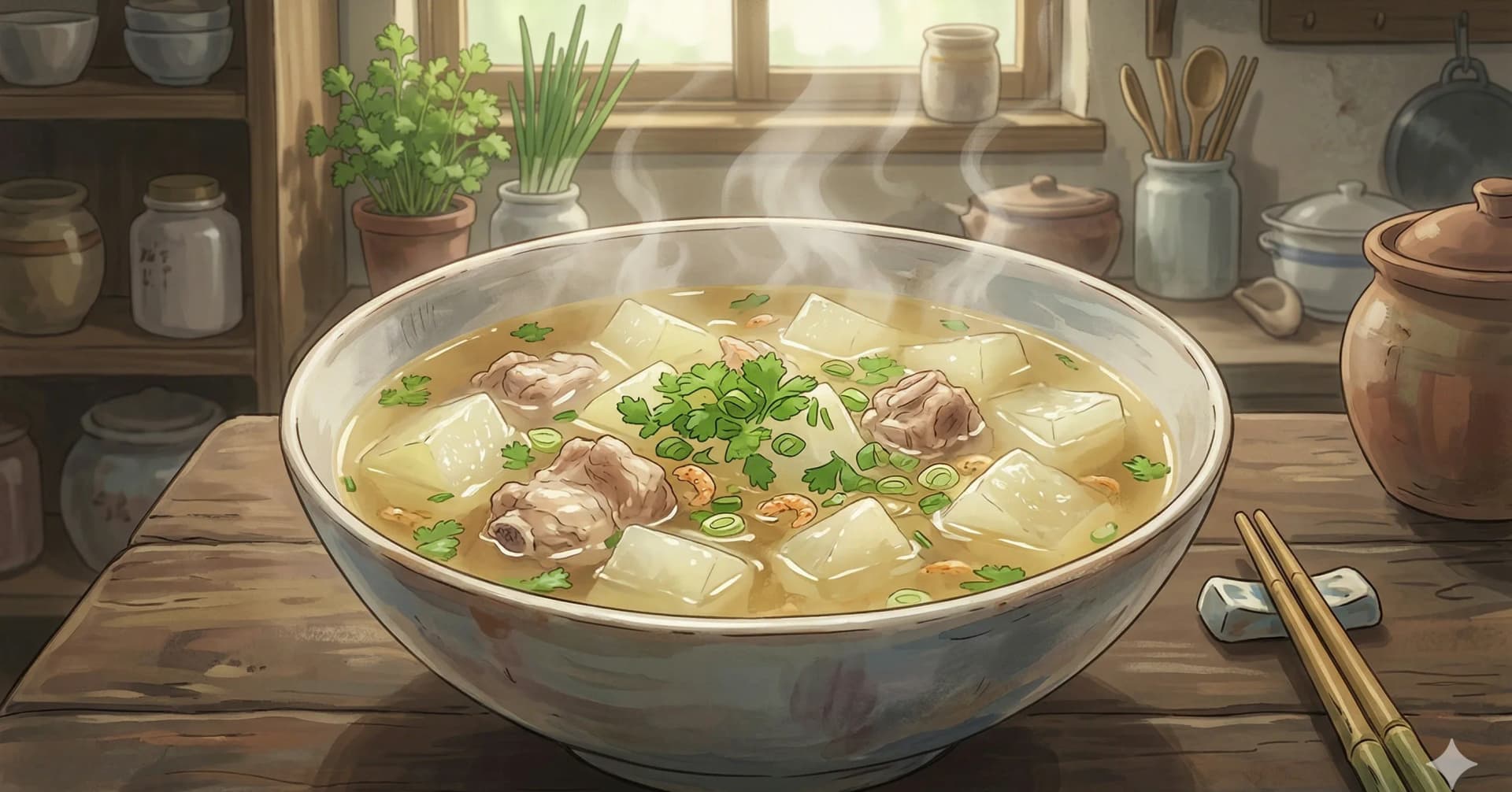
Carcass soup: After carving, break the carcass into smaller pieces and simmer in water for 30 minutes with napa cabbage or winter melon, seasoned simply with salt and white pepper. This is standard practice at Peking duck restaurants in Beijing. See Congee for another approach to making the most of leftover poultry bones.
Serving Suggestions
Peking duck is traditionally the centerpiece of a multi-course Beijing meal. Serve it with the pancakes, sauce, and vegetables as described, and build the rolls at the table. For a fuller spread, start with Hot and Sour Soup and finish with the carcass soup or a bowl of Congee.
For a roasted poultry comparison, Five-Spice Roast Chicken uses some of the same aromatic spices but with a simpler preparation. Tea-Smoked Duck offers a completely different approach to duck, using tea and rice smoke rather than oven roasting.
Storage & Reheating
Leftover duck meat: Store in an airtight container in the refrigerator for up to 3 days. To reheat, spread slices on a baking sheet and warm in a 350F oven for 5 to 7 minutes until heated through and the skin re-crisps slightly. Microwave reheating will soften the skin.
Duck fat: Strain the rendered fat through a fine sieve into a clean jar. Refrigerate for up to 2 months or freeze for up to 6 months. Use for frying vegetables, making the sauce, or enriching Claypot Rice.
Pancakes: Store leftover pancakes in a sealed bag in the fridge for 3 days or freezer for 2 months. Steam for 2 to 3 minutes to refresh before serving.
Cultural Notes
Peking duck (北京烤鸭, Beijing kao ya) is the lacquered roast duck that anchors the imperial cuisine of Beijing and remains one of the dishes most associated with formal Chinese dining anywhere in the world. The dish has a long and traceable lineage. A version of roast duck appears in the Complete Recipes for Dishes and Beverages (饮膳正要), a Yuan dynasty cookbook from 1330, where it is described as a dish prepared for the imperial court. By the Ming dynasty, when the capital moved to Beijing in 1421, the dish had become a fixture of the imperial kitchens, and by the Qing dynasty it had entered commercial restaurants in the city.
Two restaurants define the modern history of Peking duck. Quanjude (全聚德), founded in 1864 by a former cook named Yang Quanren, established the hung-oven method (gualu) in which the ducks are roasted over an open fire of fruit wood, typically jujube or pear, in a large open-mouthed brick oven. The fruit wood gives the skin a faint sweetness and a deep amber color. Bianyifang (便宜坊), the older of the two, dates from 1416 and uses the closed-oven method (menlu) in which the ducks are roasted by the residual heat of pre-burned sorghum stalks. Both methods produce the lacquered red-brown skin that the dish is known for, but the texture and aromatics differ: hung-oven Peking duck has crisper, smokier skin; closed-oven duck has more tender, less crackling skin.
The serving ritual is the dish's defining cultural feature. The whole roasted duck is carved tableside, usually into 80 to 120 thin slices, with the lacquered skin presented separately from the meat. Diners assemble small parcels with thin wheat pancakes (chun bing), strips of cucumber and scallion, a smear of sweet-fermented wheat sauce (tian mian jiang), and a piece of skin or meat, then fold the package and eat it by hand. The carcass is typically taken to the kitchen and returned as a soup made from the bones, completing the meal. In Beijing, the multi-hour Peking duck dinner remains the standard format for marking weddings, business deals, and visits from out-of-town guests.
Nutrition Facts
Calories: 1037kcal (52%)|Total Carbohydrates: 53.3g (19%)|Protein: 50.4g (101%)|Total Fat: 67.9g (87%)|Saturated Fat: 22.7g (114%)|Cholesterol: 174mg (58%)|Sodium: 2945mg (128%)|Dietary Fiber: 3.6g (13%)|Total Sugars: 9.1g
You Might Also Like
Ratings & Comments
Ratings & Comments
Ratings
Share your thoughts on this recipe.
Sign in to rate and comment