Chinese Cuisine
Hong Shao Rou (Red Braised Pork Belly)
Shanghai's iconic slow-braised pork belly in a glossy caramel-soy sauce with warm spices
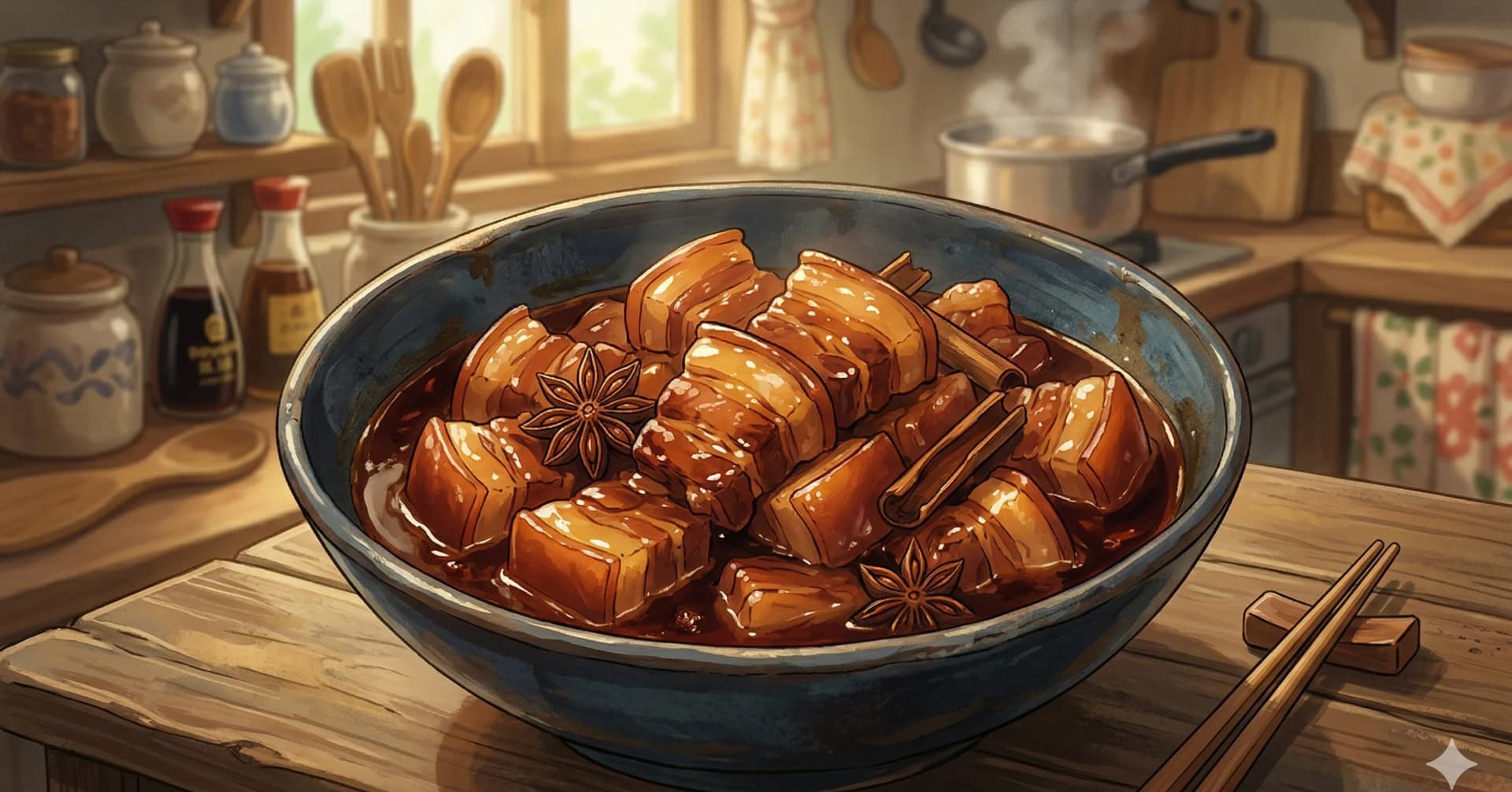
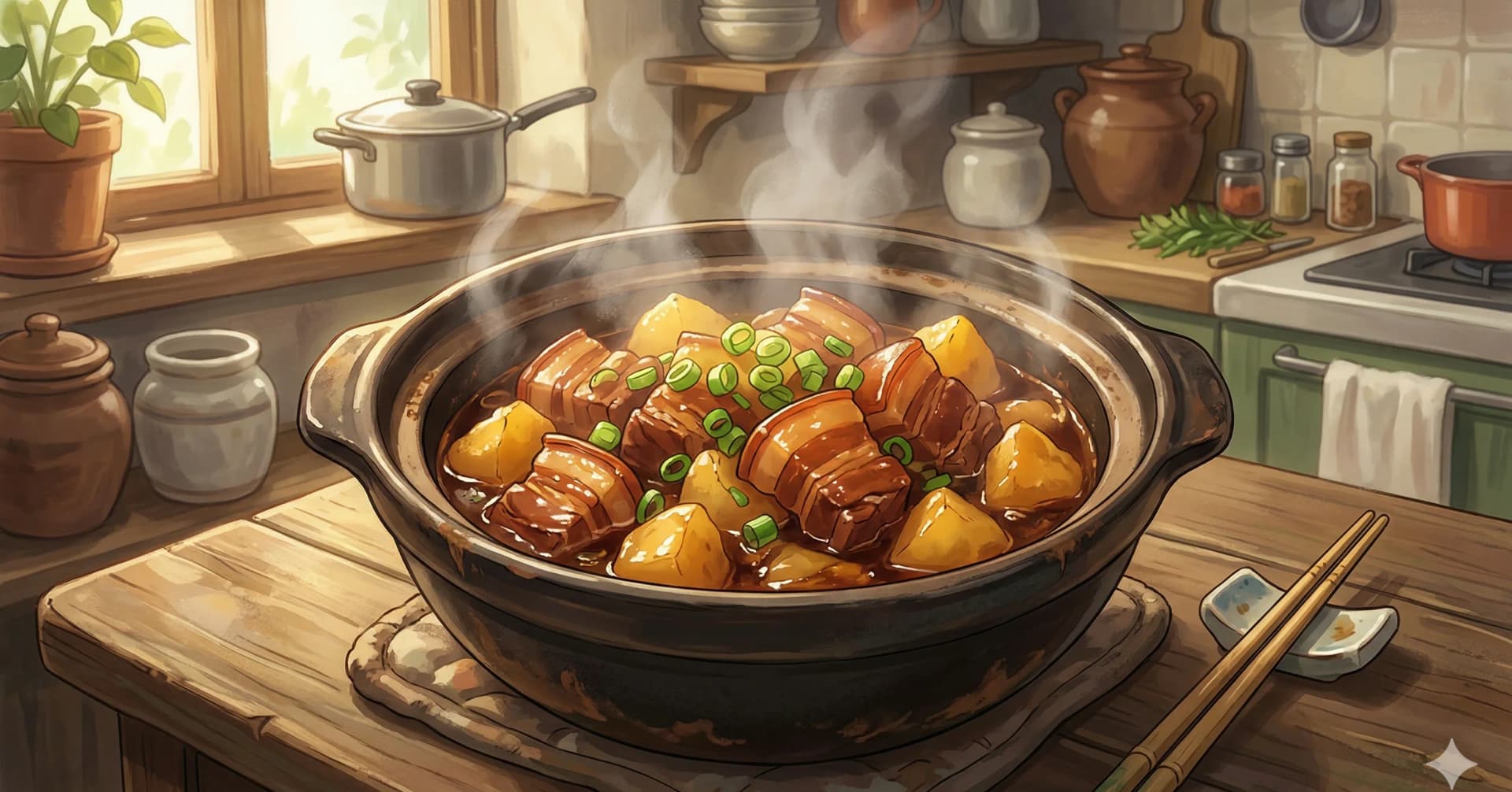
When the lid lifts from a pot of hong shao rou, the steam carries a scent that is impossible to mistake: caramelized sugar mingling with soy sauce, star anise, and the deep, porky richness of belly that has been braising for the better part of two hours. The pork itself has transformed from raw, pale cubes into something almost jewel-like, lacquered in a sauce so dark and glossy it catches the light. A gentle press with a chopstick and the meat yields completely, the layers of fat, lean, and skin having collapsed into a single, trembling whole.
This dish is associated most strongly with Shanghai and the broader Jiangnan region, where the preference for sweet-savory flavors shapes much of the cooking. It is said to have been a favorite of Chairman Mao, a claim that has elevated its reputation but risks obscuring its humbler origins as a home-cooked peasant dish designed to make the most of an inexpensive cut. Every family along the Yangtze Delta has its own recipe, arguing about the ratio of sugar to soy, whether to use rock sugar or white, whether Shaoxing wine is essential or optional.
The practical insight is the caramel. Building a dry caramel from rock sugar before adding the pork is what gives hong shao rou its distinctive color and complex sweetness. The sugar is cooked until it turns amber and fragrant, teetering at the edge of bitterness, and then the pork goes in. This step cannot be rushed or skipped. Without it, the dish is merely soy-braised pork, pleasant but one-dimensional.
At a Glance
Yield
4 servings
Prep
15 minutes
Cook
90 minutes
Total
105 minutes
Difficulty
Medium
Ingredients
- 1¾ lbskin-on pork belly, cut into 3 cm cubes
- 3¼ tbsprock sugar (or 30 g granulated sugar)
- 1 tbspvegetable oil
- 2 tbspShaoxing wine
- 2 tbsplight soy sauce
- 1 tbspdark soy sauce
- 3 slicesfresh ginger, unpeeled
- 3scallions, cut into 5 cm pieces
- 2 wholestar anise
- 1small cinnamon stick (about 5 cm)
- 2dried bay leaves
- 2⅛ cuphot water, approximately
Method
- 1
Bring a pot of water to a boil. Add the pork belly cubes and blanch for 3 minutes. You will see gray foam and impurities rise to the surface. Drain the pork and rinse each piece under warm running water to remove any remaining scum. Pat dry.
- 2
Heat a heavy-bottomed pot or Dutch oven over medium heat. Add the vegetable oil and the rock sugar. Stir gently and continuously as the sugar begins to melt. It will first turn liquid, then foam, then gradually darken from pale gold to a rich amber.
- 3
Watch the caramel carefully. When it reaches a deep amber color and smells like toffee with a faint edge of bitterness, you are at the right point. This takes about 3 to 4 minutes. Do not walk away during this step, as the sugar can burn within seconds.
- 4
Immediately add the blanched pork belly pieces to the caramel. Stir vigorously to coat each piece. The sugar will seize and harden on contact but will melt again as the pork releases moisture. Continue stirring for 1 to 2 minutes, until the pork is evenly coated and lightly browned.
- 5
Add the ginger slices, scallion pieces, star anise, cinnamon stick, and bay leaves. Stir for 30 seconds, allowing the aromatics to bloom in the hot fat.
- 6
Pour in the Shaoxing wine. It will bubble aggressively. Let the alcohol cook off for about 20 seconds.
- 7
Add the light soy sauce and dark soy sauce. Stir to combine. The dark soy sauce will deepen the color to a rich mahogany.
- 8
Pour in enough hot water to just barely cover the pork. Do not drown it. Bring the liquid to a boil over high heat.
- 9
Once boiling, reduce the heat to the lowest possible setting. Cover the pot with a tight-fitting lid. The liquid should be at a very gentle simmer, with just a few lazy bubbles breaking the surface every few seconds.
- 10
Braise for 60 to 75 minutes, checking occasionally to ensure the liquid level is not dropping too quickly. If it reduces below halfway, add a small amount of hot water. The pork is ready when a chopstick slides through the meat with no resistance and the fat layers are trembling and translucent.
- 11
Remove the lid and increase the heat to medium. Cook uncovered for 10 to 15 minutes, stirring gently every few minutes, until the sauce reduces to a thick, glossy coating that clings to each piece of pork. Be careful during this step, as the concentrated sauce can burn. The finished sauce should coat the back of a spoon.
- 12
Remove and discard the star anise, cinnamon stick, bay leaves, and ginger slices.
- 13
Taste the sauce. It should be a balance of sweet, salty, and richly savory. Adjust with a pinch more sugar or a splash of soy sauce if needed.
- 14
Transfer to a warm serving bowl. The pork should glisten with a deep reddish-brown lacquer, each piece tender enough to break apart with chopsticks. Serve with steamed white rice.
Key Ingredient Benefits
Pork belly is high in fat, but the slow braising process renders a significant portion of that fat into the cooking liquid. Skimming the sauce before reducing can further reduce the fat content of the finished dish.
Star anise contains anethole, the compound responsible for its licorice-like flavor. It has been traditionally used in Chinese medicine as a digestive aid, and some research suggests antimicrobial properties.
Rock sugar is less sweet than granulated sugar and produces a cleaner, more crystalline caramel. In Chinese culinary tradition, it is believed to produce a glossier sauce, which may be related to its different crystal structure and lower fructose content compared to white sugar.
Why This Works
The caramel serves multiple purposes. It provides the "red" color that gives the dish its name (hong means red). It adds a complex sweetness that is more nuanced than sugar dissolved in liquid, because the Maillard reaction and caramelization create hundreds of new flavor compounds. And it helps the sauce achieve its characteristic glossy, clinging consistency by contributing to the viscosity of the braising liquid.
Blanching the pork removes blood, impurities, and some excess fat. This results in a cleaner-tasting braise with a sauce that is rich rather than greasy. The brief rinse after blanching ensures no scum carries over into the final dish.
The long, low braise transforms the pork belly's connective tissue. Collagen in the skin and fat layers slowly converts to gelatin, which dissolves into the sauce and gives it body. This is why the sauce thickens naturally as it reduces, without any added starch. The gelatin also gives each piece of pork its characteristic trembling, melt-in-the-mouth texture.
Substitutions & Variations
- Rock sugar: Granulated sugar works, though the caramel will be slightly different in color and flavor. Brown sugar adds molasses notes that are not traditional.
- Pork belly alternative: Pork shoulder (butt) can be used for a leaner version, though you will miss the melt-in-mouth quality of the belly fat. Skin-on is strongly preferred.
- Shaoxing wine: Dry sherry is the closest substitute. Do not use rice vinegar or mirin, which will change the flavor profile significantly.
- Additions: Hard-boiled eggs added during the last 30 minutes of braising are a classic variation. Fried tofu puffs are another traditional addition.
- Pressure cooker: This dish can be made in a pressure cooker in about 35 minutes at high pressure, though purists may argue the flavor is less developed.
Serving Suggestions
Steamed white rice is essential. The sauce is meant to be spooned over rice, and a good bowl of hong shao rou with rice is one of life's genuine pleasures. Balance the richness with a clean, simple vegetable dish, such as stir-fried greens or a cold cucumber salad. Steamed buns are another traditional accompaniment, used to mop up the sauce. For a full meal, add a clear soup and a lighter stir-fry.
Storage & Reheating
Hong shao rou improves overnight, as the flavors continue to meld and deepen in the refrigerator. Store in an airtight container for up to 4 days. The sauce will solidify when cold due to its gelatin content, which is a sign of a well-made braise. Reheat gently in a covered pot over low heat, stirring occasionally, until the sauce liquefies and the pork is warmed through. Freezes well for up to 2 months. Thaw overnight in the refrigerator before reheating.
Cultural Notes
Hong shao rou (紅燒肉, "red-braised pork") is the central pork belly braise of the Chinese culinary tradition, in which cubes of skin-on pork belly are slowly cooked with soy sauce, rock sugar, Shaoxing wine, ginger, and whole spices until the meat becomes spoon-tender, the fat collapses to silken richness, the skin turns gelatinous, and the braising liquid reduces to a glossy mahogany glaze. The dish has dozens of regional variations: the Shanghai version emphasizes sugar and Shaoxing wine for a sweeter glaze; the Hunan version (most famously associated with Mao Zedong, who came from Hunan and praised the dish in his writings) uses fermented chili and is darker, smokier, and slightly spicy; the Sichuan version adds doubanjiang for a peppery edge.
The technique is fundamentally about patience and ratio. The pork belly (chosen with at least four layers of fat and lean, the skin still attached, cut into uniform 1.5-inch cubes) is blanched briefly in boiling water with ginger and Shaoxing wine to remove blood and surface impurities, then drained. In a heavy pot, rock sugar is melted in a small amount of oil over moderate heat until it caramelizes to a deep amber (this caramel base is what gives the finished dish its red-mahogany color). The drained pork goes in, is tossed in the caramel until coated, then dark soy sauce, light soy sauce, Shaoxing wine, ginger, star anise, cassia bark, and just enough water to barely cover the meat are added. The pot covers, the heat drops to a bare simmer, and the dish cooks for ninety minutes to two hours without stirring, lifting the lid only to check the level of the braising liquid and add water if needed.
The cultural place of hong shao rou is grounded in its role as the standard celebration meat dish of Chinese family cooking. The dish appears at Lunar New Year tables across the country, at weddings, at homecoming meals for travelers returning from abroad, and as the central protein course of many Sunday family lunches. The Hunan version achieved particular cultural significance through its association with Mao, who praised the dish as one of his favorites and who is credited with promoting the Hunan style to national prominence after the Communist revolution. Modern Hunanese restaurants in Beijing, Shanghai, and the global Chinese diaspora often offer the dish as Mao Shi hong shao rou (Mao-style red-braised pork) with the fermented chili and slightly spicier seasoning that distinguishes it from the Shanghai version.
Nutrition Facts
Calories: 1048kcal (52%)|Total Carbohydrates: 12.2g (4%)|Protein: 18.5g (37%)|Total Fat: 101.7g (130%)|Saturated Fat: 36.4g (182%)|Cholesterol: 135mg (45%)|Sodium: 684mg (30%)|Dietary Fiber: 0.3g (1%)|Total Sugars: 10.8g
You Might Also Like
Ratings & Comments
Ratings & Comments
Ratings
Share your thoughts on this recipe.
Sign in to rate and comment