Indian Cuisine
Onion Lentil Fritters (Savala Vada)
Crispy Urad Dal Fritters with Sliced Onion, Green Chilli, and Curry Leaves
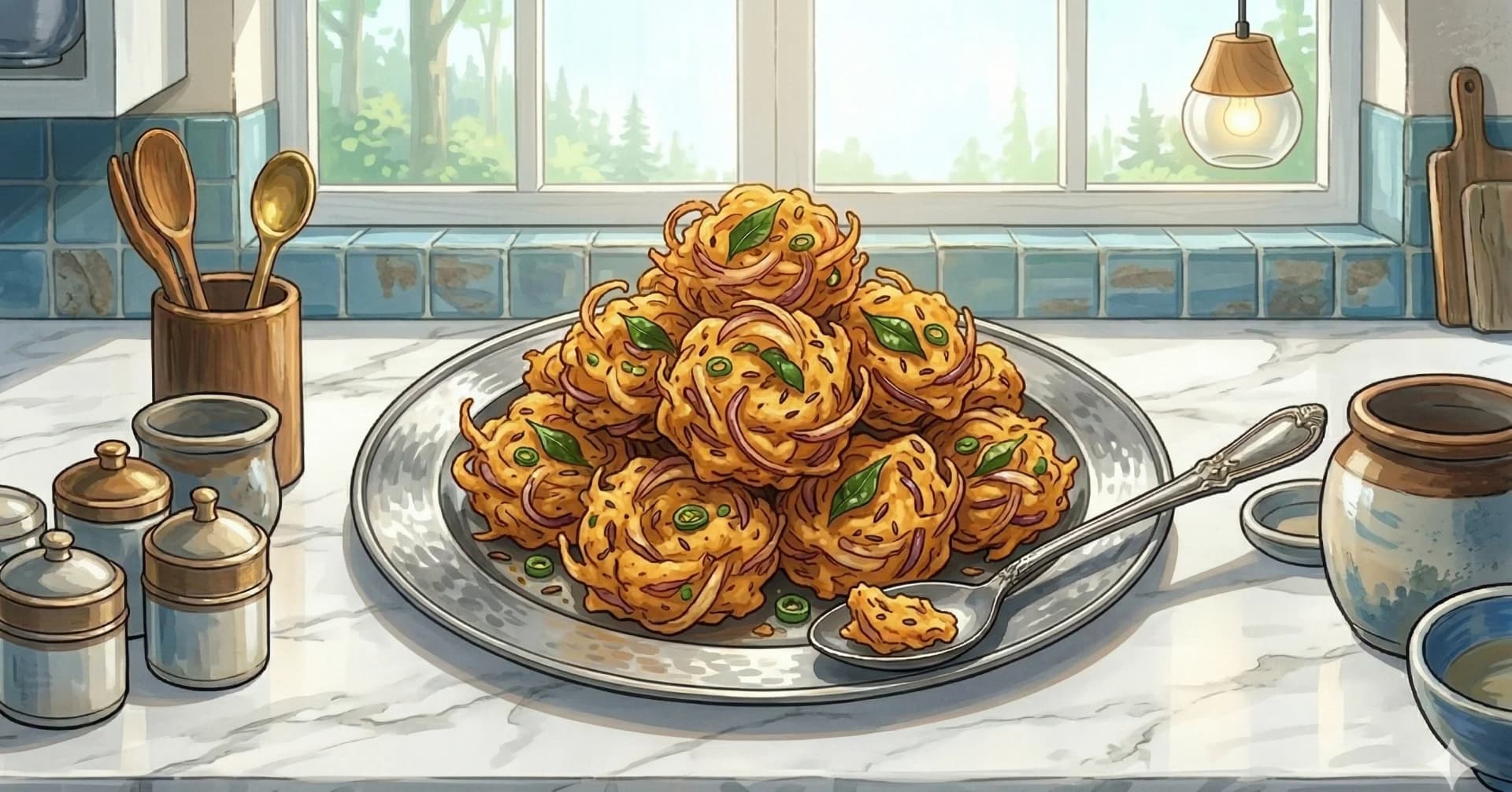
"Savala" is Malayalam for onion, and in this vada, onion is not a seasoning. It is the main event. Sliced and folded through the batter in quantity, it transforms the medu vada template into something more assertive: a fritter with jagged, lacy edges where the onion slices protrude into the oil and caramelise into sweet, dark frills, an interior that is dense and flavourful rather than airy, a crust that holds its crispness longer because the onion's sweetness and moisture have been worked into the batter rather than sitting on top of it.
This is the same urad dal batter used for medu vada, ground with minimal water until thick and beaten until airy, but folding in sliced onion, spinach, curry leaves, and green chilli changes the final texture substantially. The onion releases some moisture during mixing, so the batter tightens around it rather than remaining cloud-like. The result is closer to the Kerala parippu vada in feel: compact enough to be picked up with confidence, crisp enough to shatter at the edges, yielding at the centre.
The double-fry method applies here as it does to all urad dal vadas. The first fry sets the shape. The two-minute rest lets interior steam dissipate. The second fry builds the crust. The onion strands at the edges of the vada will be very dark by the end, almost charred, and this is correct. These are the most intensely flavoured parts of the vada, caramelised and concentrated, the reward for eating to the edge.
Serve within minutes. Savala vada, like most things fried, belongs to the present moment.
At a Glance
Yield
14–16 vadas
Prep
20 minutes (plus 1 hour soaking)
Cook
35 minutes
Total
1 hour 55 minutes
Difficulty
Medium
Ingredients
- ¾ lburad dal (split black gram, skinned)
- ⅓ tspasafoetida, dissolved in 5 ml water
- 1⅔ tspsalt
- 2½ tbspgreen chillies (3–4 chillies), finely chopped
- ¾ cupfresh curry leaves (about 2 sprigs), washed and dried
- 3½ ozonion, peeled, washed (about 1 medium), and finely chopped
- 2¾ ozfresh spinach, stems removed, washed, dried, and finely chopped
- —Oil, for deep frying
Method
- 1
Soak the dal. Wash the urad dal in two or three changes of cold water until clear. Cover with fresh cold water and soak for 1 hour. Drain thoroughly.
- 2
Prepare the aromatics. Dissolve the asafoetida in 5 ml of water. Chop the green chillies. Wash and dry the curry leaves (2 sprigs) completely. Peel, wash, and finely chop the onion (1 medium). Remove stems from spinach, wash, dry, and chop finely.
- 3
Grind the batter. Transfer the drained urad dal to a blender. Grind to a fluffy, thick batter, adding water only in very small amounts, about 6 tablespoons (approximately 90 ml) total across the entire grind. The batter should be thick enough to hold its shape when scooped and should float when a small portion is dropped in water.
- 4
Mix the batter. Transfer to a mixing bowl. Add the dissolved asafoetida water, salt, green chillies, and curry leaves. Beat vigorously with your hand to aerate. Fold in the chopped onion and spinach. Mix well until evenly distributed.
- 5
Heat the oil. Pour oil into a kadhai to a depth of at least 8–10 cm. Heat over medium-high flame until a drop of batter rises immediately to the surface.
- 6
Shape the vadas. Moisten your palm and a flat spatula with water. Scoop about 2 tablespoons of batter onto the moistened spatula and flatten into a round approximately 5 cm in diameter. Make a doughnut hole by pressing a damp index finger through the centre. The edges will be ragged where onion and spinach pieces protrude. This is correct.
- 7
First fry. Invert the spatula over the oil and gently release the vada. Fry over medium heat until light golden, not deeply coloured. Remove and set aside on a rack or plate for 2 minutes.
- 8
Second fry. Return the rested vadas to the oil and fry again over medium heat until deeply golden and crisp. The onion strands at the edges will be very dark. Drain on paper and serve immediately.
Key Ingredient Benefits
Urad dal is the protein foundation: approximately 26% protein by dry weight, with significant iron and B vitamins. Soaking for an hour reduces phytic acid, improving mineral bioavailability.
Onion is the defining ingredient here. The frying process converts onion's sulphur compounds through the Maillard reaction, producing the sweet, caramelised complexity that defines the vada's most darkened edges. Quercetin, one of onion's primary flavonoid compounds, is associated in research with anti-inflammatory activity.
Spinach contributes folate, iron, and vitamin K. The relatively small quantity used here functions more as a flavour accent than a primary ingredient. Its slight earthiness balances the sweetness of the caramelised onion.
Asafoetida is included in the tradition of South Indian legume cooking as a digestive aid and flavour deepener. Dissolved in water before adding, it distributes evenly through the batter.
Why This Works
The same aerated urad dal batter used for medu vada is the foundation, but the addition of sliced onion changes its behaviour. Onion releases moisture on contact with salt, which slightly loosens the batter and makes it denser after mixing. This is a feature, not a problem. The denser batter produces a vada with more structural integrity, one that holds together even with a high proportion of add-ins.
The double-fry is critical. The first fry cooks the interior through and sets the shape without over-darkening the exterior. The two-minute rest allows steam to escape, preventing the crust from being soft from the inside. The second fry builds a genuine shell.
The protruding onion strands at the edges caramelise at a faster rate than the surrounding batter, producing intensely sweet, slightly charred frills that are the most flavourful part of the finished vada.
Substitutions & Variations
- Shallots instead of onion: Kerala shallots (small, purplish, intensely sweet) produce a markedly different and arguably better vada: sweeter, more complex, more specifically South Indian in character.
- More spinach, less onion: Adjust the ratio to 50 g onion and 100 g spinach for a greener, more leafy vada with a milder sweetness.
- Without spinach: Omit entirely for a pure onion vada. Increase the onion to 125 g.
- Extra heat: Use 5–6 green chillies and add ½ tsp of coarsely cracked black pepper to the batter for Kerala tea-stall heat.
- Adding grated coconut: 30 g of fresh grated coconut folded into the batter adds sweetness and moisture to the interior.
Serving Suggestions
Savala vada belongs with strong South Indian tea or filter coffee. The bitterness cuts through the richness of the fried batter cleanly. The canonical accompaniment is coconut chutney. In Kerala households it appears as a tea-time snack or as a side alongside rice and sambar. Eat immediately while the edges are still crackling.
Storage & Reheating
Savala vada holds its texture reasonably well. The denser structure doesn't soften as dramatically as an urad-only vada. It remains good for 30–45 minutes at room temperature. Reheat in an oven at 200°C for 6–8 minutes or in an air fryer at 190°C for 4–5 minutes. Do not microwave. Uncooked batter (before the onion and spinach are folded in) can be refrigerated for up to 24 hours. Once the vegetables are mixed in, fry within 2 hours as the onion will release moisture and thin the batter.
Cultural Notes
Savala vada (சவளா வடை, "onion vada") is the Tamil and Kerala variant of the South Indian vada family in which sliced or chopped onion is added in generous quantity to the urad dal batter, producing a crisp deep-fried fritter with sweet caramelized onion notes throughout. The dish belongs to the everyday South Indian tiffin tradition and appears at tiffin restaurants, tea stalls, and home kitchens across Tamil Nadu, Kerala, and the Tamil-speaking diaspora communities in Sri Lanka, Singapore, Malaysia, and the Gulf.
The vada family in South Indian cooking is broad and the variants reflect regional taste. The foundational medu-vada is the doughnut-shaped urad dal fritter with a hole in the center, made from a plain urad dal batter without significant additions. From this base the regional variants developed: masala vada (with chana dal and ginger), thavala vadai (Tamil festival vada), parippu vadai (the Tamil-Sri Lankan lentil vada), sambar vada (vada soaked in sambar), dahi vada (vada soaked in spiced yogurt), and the onion-forward savala vada which uses generous onion to give the vada its distinctive sweet-savory character. The onion is added at the end of the batter prep so the onion stays in distinct pieces rather than dissolving into the batter, producing a fritter with visible onion texture against the crisp golden shell.
The technique starts with the standard urad dal batter and adds the onion at the end. Whole urad dal is soaked for four hours, then ground in a wet grinder or food processor with a small amount of water into a thick fluffy paste (the right consistency is when a small amount dropped into water floats rather than sinks). Whipped air is incorporated by hand mixing for several minutes, which is the key to a light puffy vada. Sliced onion, chopped green chili, chopped ginger, chopped curry leaves, crushed black peppercorns, asafoetida, and salt are folded into the batter (not over-mixed, since the onion releases water that thins the batter). Oil is heated in a deep kadai to about 170°C. The batter is shaped between wet palms into small round patties (with or without the traditional central hole), and slid carefully into the oil. The vadas fry for three to four minutes per side until deep golden and crisp. The dish is served immediately with coconut chutney and sambar for dipping.
Nutrition Facts
Calories: 336kcal (17%)|Total Carbohydrates: 47.2g (17%)|Protein: 19.7g (39%)|Total Fat: 8.7g (11%)|Saturated Fat: 1.1g (6%)|Cholesterol: 0mg (0%)|Sodium: 2530mg (110%)|Dietary Fiber: 14.6g (52%)|Total Sugars: 1.1g
You Might Also Like
Ratings & Comments
Ratings & Comments
Ratings
Share your thoughts on this recipe.
Sign in to rate and comment