Chinese Cuisine
Cong You Bing (Scallion Pancakes)
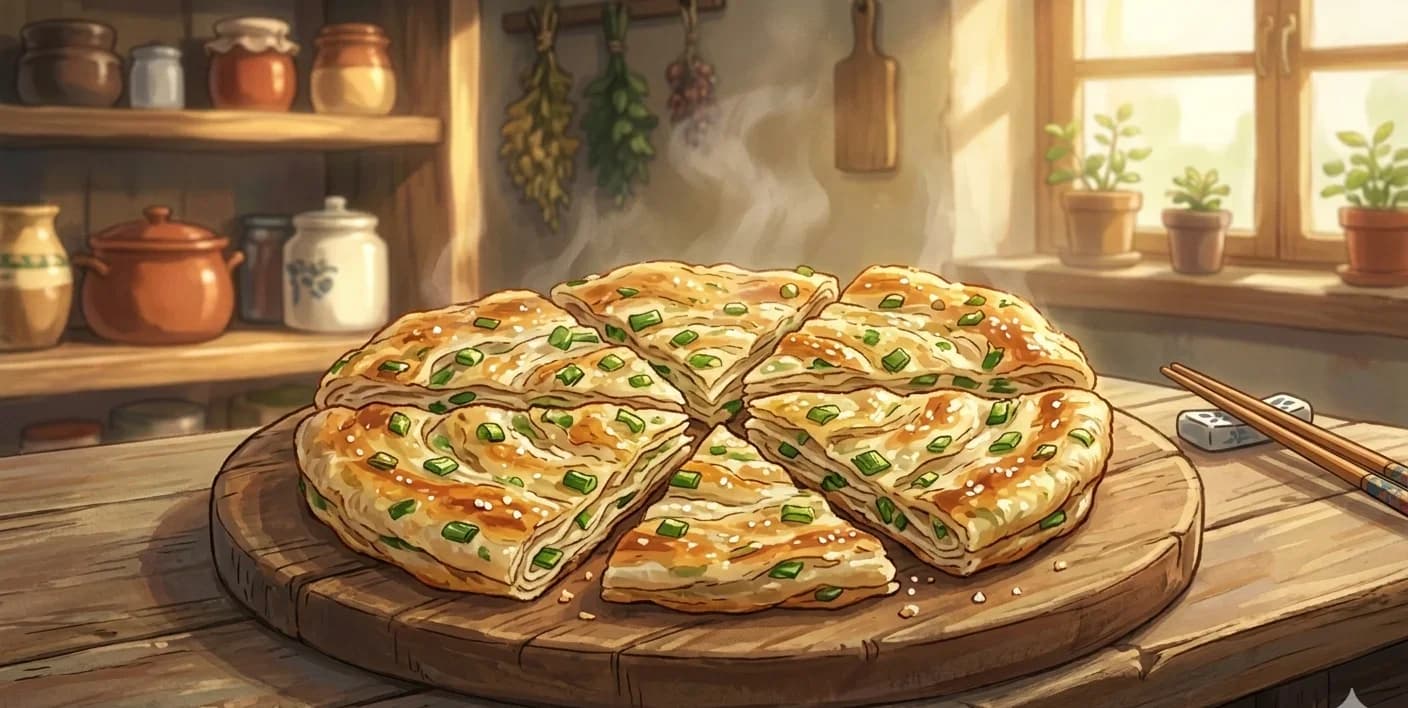
Flaky, layered Chinese flatbread studded with chopped scallions and toasted in a skillet
A well-made scallion pancake pulls apart in your hands, revealing layer after flaky layer with flecks of green scallion trapped between them. The outside is golden and crispy, with a satisfying crunch that gives way to a chewy, tender interior fragrant with sesame oil and the sweet, gentle bite of cooked scallion. It is one of the most fundamental preparations in the Chinese flour-based cooking tradition, and one of the most rewarding to master.
Cong you bing belong to the vast world of northern Chinese wheat-based breads and pancakes, a category of food that developed in the wheat-growing regions where rice was not the daily staple. Scallion pancakes appear at breakfast tables, street stalls, and dinner tables across the country, and every region has its own variation. Some are paper-thin and shatteringly crisp. Others are thick and chewy. The version here aims for the middle ground: thin enough to be flaky, thick enough to be satisfying.
The layers are created by rolling out the dough, spreading it with oil and scallion, then rolling it into a coil and flattening it again. Each turn of the coil creates a new layer, and each layer of oil prevents the dough from fusing together during cooking. This is the same principle behind puff pastry and paratha, adapted for a different culinary tradition. The practical key is the oil layer: it must be thin and even, and the dough must be rolled gently to avoid tearing the layers.
At a Glance
Yield
4 pancakes
Prep
30 minutes (plus resting)
Cook
20 minutes
Total
50 minutes (plus resting)
Difficulty
Easy
Ingredients
- 2⅓ cupall-purpose flour
- ¾ cupboiling water
- —Pinch of salt
- 2⅛ cupscallions (about 6–8), finely chopped
- 2 tbspsesame oil
- ⅞ tspsalt
- 1 tbspvegetable oil
- 2 tbspvegetable oil, divided
Method
- 1
Place the flour and salt in a large bowl. Pour the boiling water over it while stirring with chopsticks. The dough will be shaggy and rough. When cool enough to handle, knead for 5 to 8 minutes until smooth and soft. The dough should feel like an earlobe: supple and slightly tacky. Cover with a damp cloth and rest for 30 minutes.
- 2
While the dough rests, wash and thoroughly dry the scallions. Finely chop them and set aside.
- 3
Divide the rested dough into 4 equal pieces. Keep the pieces you are not working with covered.
- 4
On a lightly floured surface, roll one piece into a thin rectangle or oval, about 3 mm thick and roughly 25 by 15 cm. It does not need to be geometrically perfect.
- 5
Brush the surface with a thin, even layer of sesame oil mixed with vegetable oil (about a tablespoon total). Sprinkle evenly with a quarter of the chopped scallions and a pinch of salt.
- 6
Starting from one long edge, roll the dough tightly into a log, like rolling a carpet. Pinch the ends to seal.
- 7
Coil the log into a spiral, like a snail shell, tucking the tail end underneath. Press down gently with your palm to flatten slightly.
- 8
Let the coiled dough rest for 5 minutes under a damp cloth. This relaxes the gluten and makes rolling easier without tearing the layers.
- 9
Gently roll the coil into a flat disc about 15 to 18 cm in diameter and 5 mm thick. Roll evenly and do not press too hard, or the layers will merge. If the dough resists, let it rest another minute.
- 10
Heat a skillet over medium heat. Add about 8 ml of vegetable oil and swirl to coat.
- 11
Place the pancake in the skillet. Cook for 2 to 3 minutes, until the bottom is golden brown with darker spots and the surface begins to puff slightly with air pockets forming between the layers.
- 12
Flip the pancake and cook the other side for another 2 to 3 minutes, pressing gently with a spatula. Both sides should be crispy and golden, and you should be able to see the beginnings of layers at the edges.
- 13
Transfer to a cutting board. While still hot, use both hands to gently push the sides of the pancake inward from opposite directions, scrunching and compressing it. This breaks the layers apart and creates the flaky, separated texture that is the hallmark of a good scallion pancake.
- 14
Cut into wedges or serve whole. Repeat with the remaining dough portions. Serve hot.
Key Ingredient Benefits
Scallions provide vitamin K, vitamin A, and trace amounts of folate. The allium compounds in scallions have been traditionally associated with immune support in Chinese dietary therapy, and some research suggests antimicrobial and anti-inflammatory properties.
Sesame oil is rich in unsaturated fatty acids and contains sesamin, a lignan compound that research suggests may have cholesterol-lowering and antioxidant effects. A small amount goes a long way in providing flavor.
All-purpose flour provides complex carbohydrates and a modest amount of protein. The gluten it contains is what allows the dough to stretch thin enough to create layers.
Why This Works
The layering technique creates thin sheets of dough separated by films of oil. During cooking, the oil prevents the layers from fusing, while the heat causes steam to form between them, puffing them apart. This is fundamentally the same mechanism as laminated pastry dough, though achieved through coiling rather than the fold-and-turn method used for croissants.
Boiling water dough is essential for the proper texture. It gelatinizes some of the starch and denatures some of the gluten, creating a dough that is soft, extensible, and stays tender when cooked. Cold water dough would produce a chewier, more bread-like pancake with less flakiness.
Scrunching the pancake after cooking is a traditional technique that physically separates the layers. Without this step, the layers exist but are pressed together by the weight of the pancake. The scrunching creates air space between them, making the pancake feel lighter and more flaky.
Substitutions & Variations
- Five-spice version: Add 2 g of five-spice powder to the oil and scallion layer for a warmer, more aromatic pancake.
- Egg scallion pancake: Crack a raw egg onto the pancake during the last minute of cooking the first side, spread it across the surface, flip, and cook until the egg sets. This is a popular street food variation.
- Flaky pastry method: For even more layers, use a roux of flour and oil (1:1 ratio) in place of straight oil between the layers. This produces a richer, more pastry-like result.
- Gluten-free: Scallion pancakes rely heavily on gluten for structure and are difficult to make gluten-free. A rice flour and tapioca starch blend can produce a passable version, but the texture will be fundamentally different.
- Shortcut: Store-bought frozen scallion pancakes are widely available and cook directly from frozen in a skillet. They are a reasonable convenience product.
Serving Suggestions
Scallion pancakes are served as a snack, appetizer, or side dish. They pair well with congee for breakfast, alongside dumplings as part of a spread, or as an accompaniment to braised dishes where their flaky texture can soak up sauce. A simple dipping sauce of black vinegar mixed with a little soy sauce and chili oil is the classic accompaniment. Some people enjoy them plain, torn into pieces and eaten with their hands.
Storage & Reheating
Cooked scallion pancakes can be stored in the refrigerator for up to 2 days. Reheat in a dry skillet over medium heat for 1 to 2 minutes per side to restore crispness. Oven reheating at 190°C for 5 minutes also works well. Uncooked pancakes (rolled out but not yet fried) can be stacked between sheets of parchment paper, wrapped tightly, and frozen for up to 1 month. Cook from frozen, adding 1 to 2 minutes per side.
Cultural Notes
Cong you bing (蔥油餅, "scallion oil pancake") is the northern Chinese laminated flatbread of wheat dough rolled around oil, salt, and chopped scallions, coiled into a spiral, rolled flat again, and pan-fried until both sides are golden, crisp on the outside, and layered with tender flaky interior. The dish has been part of northern Chinese cooking for centuries and appears in regional variations from Shandong, Beijing, Shanghai, and Taiwan, each with slightly different proportions of dough hydration, fat ratio, and folding technique.
The technical heart of the dish is the lamination. A soft wheat dough is rolled flat into a thin sheet, brushed with oil (sometimes mixed with a paste of flour and lard for richer layers), salted, and scattered generously with chopped scallions. The sheet is rolled tightly into a long log, then coiled into a flat spiral like a snail shell, then rolled flat again. The rolling-and-coiling step creates dozens of thin layers separated by oil and scallion, which puff and crisp during pan-frying to produce the signature flaky structure. A well-made scallion pancake, when pulled apart, shows distinct visible layers and releases a strong scallion aroma.
Two regional variations are worth distinguishing. The Shanghai version is thinner, more crisp, and often served whole as a snack with sweet chili sauce or just plain. The Beijing version is thicker, sometimes with multiple scallion layers, and is often cut into wedges and served as part of a meal alongside braised beef or stir-fried vegetables. A Taiwanese variation called cong you bing there has the same name but uses a slightly different folding technique and is often paired with egg, ham, and cheese in night-market versions sold by street vendors. The dish is also the foundation for the broader category of Chinese flat layered breads, which includes the related shao bing (Beijing-style sesame-topped flatbread) and huo shao (oven-baked layered bread from northern China).
Nutrition Facts
Calories: 397kcal (20%)|Total Carbohydrates: 59g (21%)|Protein: 8.2g (16%)|Total Fat: 13.9g (18%)|Saturated Fat: 1.6g (8%)|Cholesterol: 0mg (0%)|Sodium: 606mg (26%)|Dietary Fiber: 2.7g (10%)|Total Sugars: 0.8g
You Might Also Like
Ratings & Comments
Ratings & Comments
Ratings
Share your thoughts on this recipe.
Sign in to rate and comment