Chinese Cuisine
Lu Dan (Soy Braised Eggs)
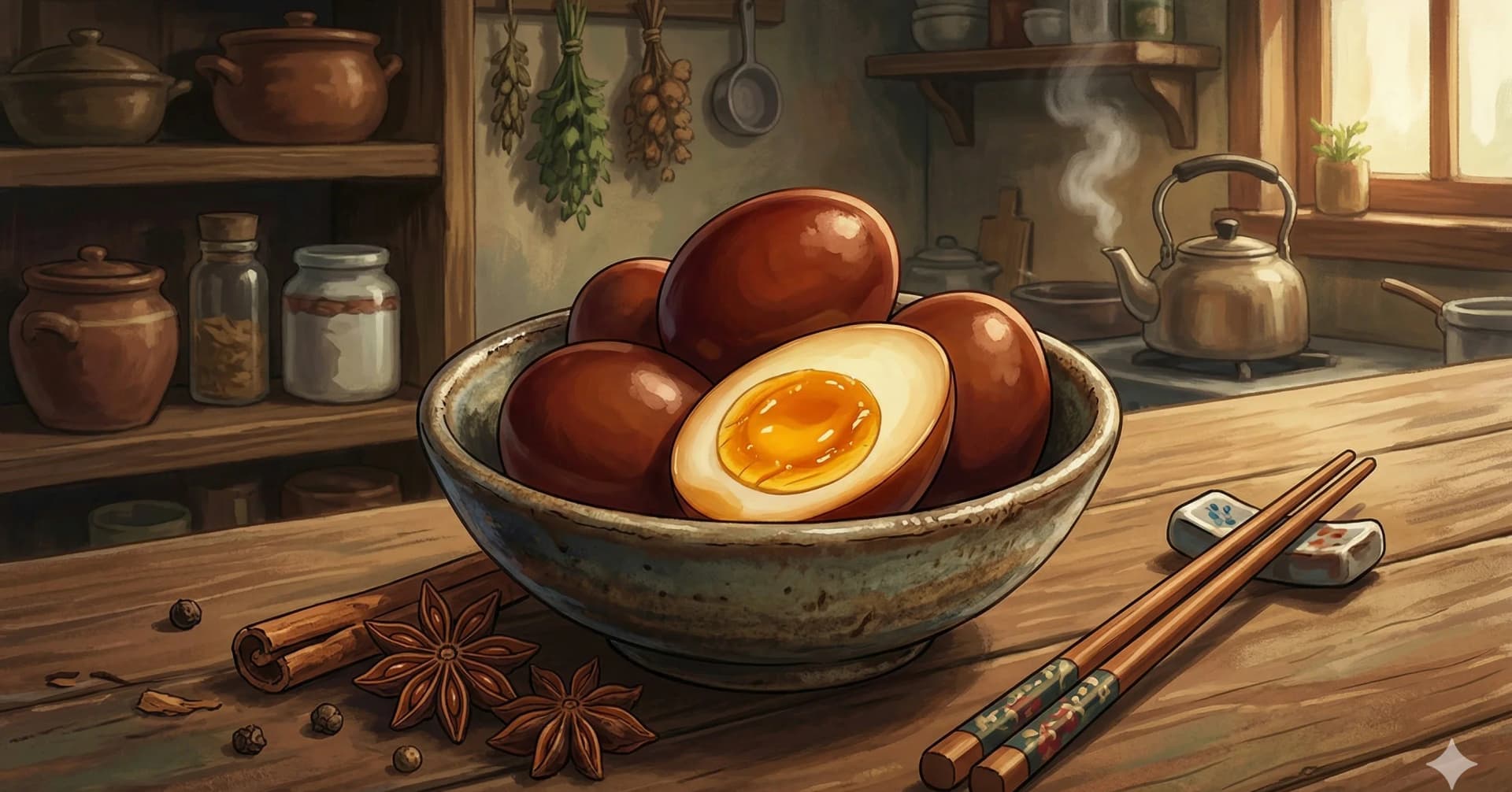
Hard-boiled eggs steeped in a fragrant soy, star anise, and rock sugar braising liquid
Cut a soy-braised egg in half and the transformation is visible in cross-section: a deep mahogany exterior gives way to a ring of amber-stained white, and at the center, a yolk that has taken on a golden, almost ochre hue. The flavor follows the same gradient. The outside carries the concentrated savory-sweetness of the braising liquid, and it softens as you eat toward the center, where the egg's own gentle richness takes over. These are eggs that taste like patience.
Lu dan belongs to the broader family of lu wei, or master-stock braised foods, which is one of the oldest and most widespread techniques in Chinese cooking. A pot of braising liquid, built from soy sauce, rock sugar, and warm spices like star anise and cinnamon, is used to steep meats, tofu, and eggs. In some families and shops, the same master stock has been replenished and used for decades, its flavor deepening with each use. The eggs are the simplest and most common item to emerge from this tradition, sold as street snacks, packed into lunchboxes, and served as a side dish at home.
The practical key is time, not heat. The eggs simmer gently in the braising liquid for 30 minutes, then continue to absorb flavor as they steep off the heat. The longer they sit, up to 2 days in the refrigerator, the deeper the color and flavor penetrate. If you want the most dramatic results, crack the shells gently before steeping to create a marbled pattern that is as beautiful as it is functional, allowing the liquid to reach the egg directly.
At a Glance
Yield
6 eggs
Prep
10 minutes
Cook
30 minutes
Total
40 minutes (plus marinating)
Difficulty
Easy
Ingredients
Eggs
- 6large eggs
Braising Liquid Ingredients
- 2⅛ cupwater
- ¼ cuplight soy sauce
- 2 tbspdark soy sauce
- 1¼ tbsprock sugar (or 10 g granulated sugar)
- 2 tbspShaoxing wine
- 3 wholestar anise
- 1cinnamon stick (about 5 cm)
- 2dried bay leaves
- 1⅔ tspwhole Sichuan peppercorns (optional)
- 3 slicesfresh ginger
- 2dried red chilies (optional)
Method
- 1
Place the eggs in a single layer in a saucepan. Cover with cold water by about 3 cm. Bring to a boil over medium-high heat.
- 2
Once the water reaches a full boil, reduce the heat to low and simmer for 8 minutes for a slightly jammy yolk, or 10 minutes for a fully set yolk.
- 3
Transfer the eggs immediately to a bowl of ice water. Let them cool for at least 5 minutes. This stops the cooking and makes peeling much easier.
- 4
While the eggs cool, prepare the braising liquid. Combine the 500 ml water, light soy sauce, dark soy sauce, rock sugar, and Shaoxing wine in a clean saucepan. Add the star anise, cinnamon stick, bay leaves, Sichuan peppercorns, ginger slices, and dried chilies.
- 5
Bring the braising liquid to a gentle boil over medium heat, stirring until the sugar dissolves. Reduce to a low simmer and let it cook for 5 minutes to allow the spices to infuse. The kitchen will fill with a warm, complex fragrance of anise, cinnamon, and caramelized soy.
- 6
While the liquid simmers, peel the cooled eggs. Tap each egg gently on the counter, rolling it to crack the shell all over, then peel under a thin stream of running water. The shells should come off easily.
- 7
For a marbled effect, crack the shells without peeling and steep the eggs shell-on. The liquid will seep through the cracks and create a beautiful web pattern on the white.
- 8
Gently lower the peeled eggs into the simmering braising liquid. The liquid should cover the eggs completely. If it does not, add a small amount of water.
- 9
Simmer the eggs on the lowest possible heat for 20 minutes. The liquid should barely bubble, with only an occasional lazy ripple at the surface.
- 10
Turn off the heat and let the eggs cool in the braising liquid. They will continue to absorb flavor and color as they steep. Even 30 minutes makes a difference, but overnight is ideal.
- 11
For deeper flavor and color, transfer the eggs and braising liquid to an airtight container and refrigerate for up to 48 hours. The eggs will darken progressively, and the flavor will penetrate further toward the center.
- 12
To serve, remove the eggs from the braising liquid. Cut them in half lengthwise to showcase the gradient of color from the exterior to the yolk.
- 13
Arrange on a plate and, if desired, drizzle with a small spoonful of the braising liquid. Serve at room temperature or slightly chilled.
Key Ingredient Benefits
Eggs are a nutritionally dense food, providing complete protein, choline, and a range of B vitamins. The braising process does not significantly alter the nutritional profile of the egg itself, though it does add sodium from the soy sauce.
Star anise has been traditionally used in Chinese medicine for digestive support and is the natural source of shikimic acid, a compound used in modern pharmaceutical production. Its distinctive licorice-like flavor comes from anethole.
Soy sauce is high in sodium, and the braised eggs will absorb a portion of this during steeping. Those monitoring sodium intake may wish to reduce the soy sauce slightly and compensate with additional water and spices.
Why This Works
The braising liquid functions through osmosis: the concentrated soy-sugar solution gradually moves into the egg white, which acts like a sponge. The longer the eggs steep, the further the flavor and color penetrate. This is why overnight steeping produces dramatically better results than a quick simmer alone.
Rock sugar produces a cleaner, less cloying sweetness than granulated sugar and helps the braising liquid develop a subtle gloss. The warm spices, particularly star anise and cinnamon, contribute aromatic compounds that are fat-soluble, meaning they bind to the fats in the egg yolk more effectively than water-soluble flavors would.
Dark soy sauce is the primary source of the deep mahogany color. It contains caramel coloring that adheres to the egg white's protein structure, creating the characteristic gradient from dark exterior to lighter interior.
Substitutions & Variations
- Tea eggs: Add 15 g of loose black tea (or 3 tea bags) to the braising liquid for the classic tea egg variation. Use the cracked-shell method for the marbled pattern.
- Quail eggs: Use the same braising liquid but reduce the simmering time to 3 minutes for hard-boiled quail eggs. They make an elegant appetizer or snack.
- Master stock expansion: The braising liquid can be reused. After each use, bring it to a boil, add a splash of fresh soy sauce and water to replenish, and refrigerate. It improves with repeated use.
- Lower sodium: Replace half the soy sauce with mushroom broth and increase the sugar slightly. The flavor will be lighter but still satisfying.
Serving Suggestions
Serve lu dan as a side dish alongside congee for breakfast, tucked into a bowl of noodle soup, or sliced over rice as part of a bento-style lunch. They are a welcome addition to a braised meat platter, sitting alongside hong shao rou or braised tofu. As a snack, they need nothing more than themselves. At a dinner table, arrange them cut-side up to show off their color gradient.
Storage & Reheating
Store the eggs in their braising liquid in an airtight container in the refrigerator for up to 5 days. The flavor will continue to deepen over the first 2 days, then stabilize. Serve cold, at room temperature, or gently warmed in the braising liquid over low heat. The braising liquid itself can be strained, brought to a boil, and refrigerated for up to 2 weeks or frozen for up to 3 months for reuse. Not recommended to freeze the eggs themselves, as the texture of the whites becomes rubbery.
Cultural Notes
Lu dan (滷蛋, "braised eggs") is the broader Chinese tradition of eggs simmered in a deeply spiced soy-based braising liquid (lu shui, "master broth") until they take on the dark mahogany color and salty-sweet-aromatic flavor of the liquid. The dish overlaps with chinese-tea-eggs but is technically distinct: tea eggs are cracked-shell eggs steeped in a tea-and-spice solution, while lu dan are peeled hard-boiled eggs braised directly in the master broth. The dish is a fixture of Cantonese, Hokkien, and Taiwanese cooking and shows up at siu mei shops, lu wei stalls, and home kitchens across the broader southern Chinese world.
The master broth (lu shui) is the key technical and cultural element. A traditional lu shui combines light soy sauce, dark soy sauce, rock sugar, Shaoxing wine, ginger, scallion, garlic, star anise, cassia bark, fennel seed, cloves, dried tangerine peel, and sometimes licorice root, simmered slowly to extract flavor. The same broth is reused for cooking multiple batches of lu foods (eggs, tofu, pork belly, chicken wings, beef shank, lotus root, tripe), and a serious lu wei stand will maintain its lu shui for years or decades, replenishing the spices and the soy as the broth is used and adding to the depth as more foods cook in it. The eggs are hard-boiled, peeled, and added to the simmering lu shui for thirty to forty-five minutes, then allowed to steep off the heat for several hours so the color and flavor penetrate the whites.
The dish appears in many specific cultural contexts. Taiwanese 7-Eleven and FamilyMart convenience stores keep crockpots of cha ye dan (tea eggs) and lu dan warming on the counter all day, with the bag of eggs counted out by the customer at the register. Hong Kong cha chaan teng serve them as breakfast and as a side dish with congee or noodles. Hokkien bak kut teh (pork rib soup) shops typically include a small bowl of soy-braised eggs as part of the standard accompaniment. The Taiwanese braised pork rice dish lu rou fan almost always comes with a soy-braised egg on top, and the egg has become inseparable from that dish in the Taiwanese culinary identity.
Nutrition Facts
Calories: 177kcal (9%)|Total Carbohydrates: 8.5g (3%)|Protein: 14.9g (30%)|Total Fat: 9.5g (12%)|Saturated Fat: 3.1g (16%)|Cholesterol: 372mg (124%)|Sodium: 475mg (21%)|Dietary Fiber: 0.1g (0%)|Total Sugars: 6.4g
You Might Also Like
Ratings & Comments
Ratings & Comments
Ratings
Share your thoughts on this recipe.
Sign in to rate and comment