Kashmiri · Indian Cuisine
Kashmiri Fried Lamb Ribs (Tabak Maas)
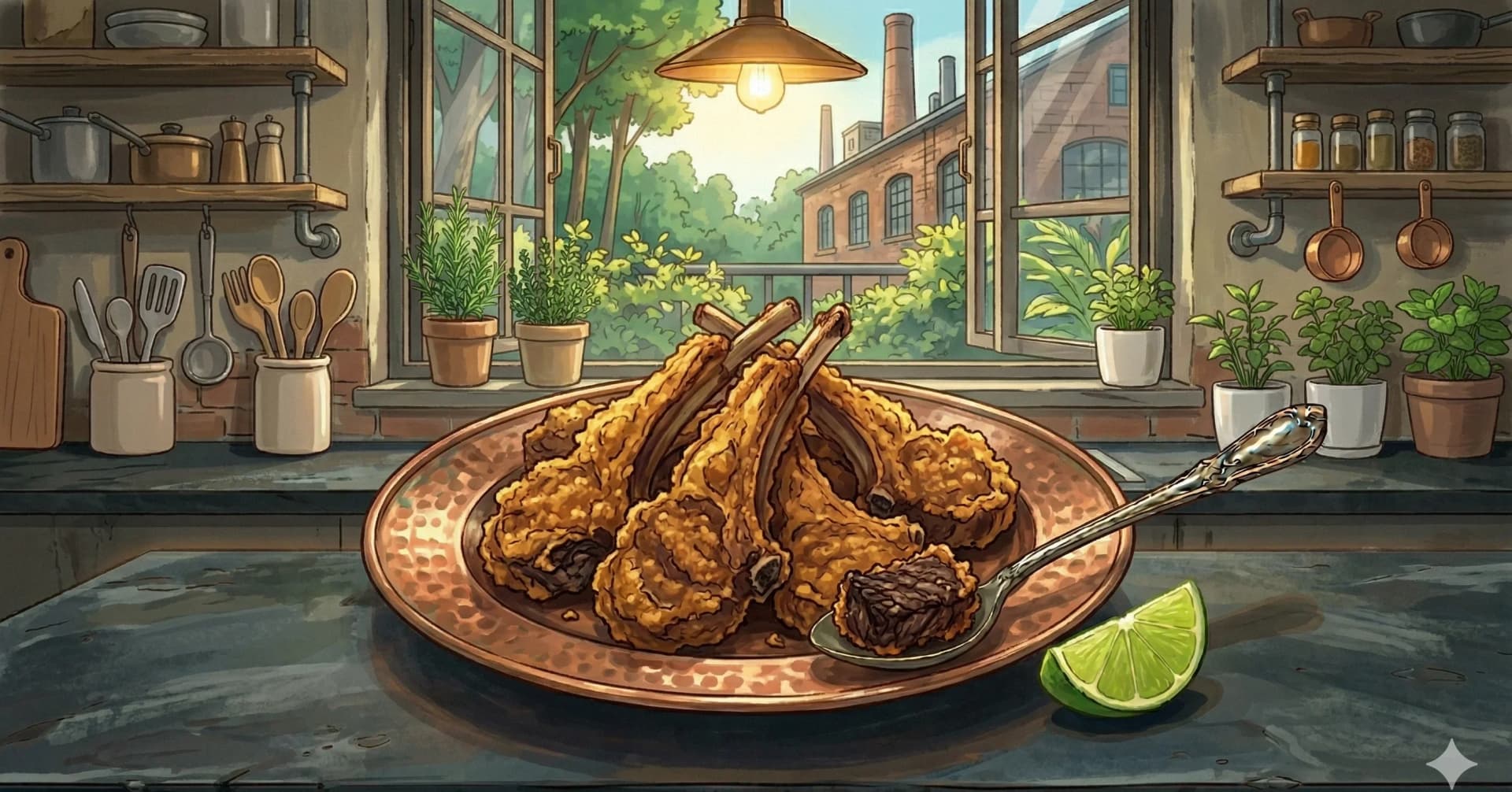
Kashmiri lamb ribs slow-cooked in spiced milk, then fried until crisp and golden
The first course of a Kashmiri Wazwan banquet is not a soup or a salad. It is Tabak Maas. Ribs of lamb, their edges trembling between crisp and yielding, placed on the tami (a large communal platter) before anything else arrives. They are golden-brown verging on copper, fragrant with fennel and dried ginger, with a faint sweetness from the milk they were braised in. The fat underneath the skin has rendered and recrisped, so each rib carries its own glaze.
The Wazwan is the ceremonial feast of the Kashmir Valley, a multi-course meal prepared by the Waza: hereditary master cooks whose craft has been passed down for generations. It can involve thirty-six courses, and Tabak Maas is among the most anticipated. The dish encodes two fundamental principles of Kashmiri Wazwan cookery: extreme patience in the braising stage, and decisive heat at the frying stage. Neither can substitute for the other.
What makes the method unusual is the use of milk as the braising liquid, combined with mustard oil and whole and ground spices. The milk tenderises the lamb, keeps the meat moist as the liquid slowly evaporates, and leaves a fine coating of proteins and fat on the surface of each rib that, once the liquid is gone, begins to fry and caramelise into something extraordinary. The spices (fennel powder, dried ginger, cardamom, clove, cinnamon) are the signature aromatics of Kashmiri cooking, a northern blend that is cooler, more anise-forward and less chilli-dependent than the spice profiles of southern and central India.
The practical insight: do not rush the liquid-evaporation stage. Let it happen on its own schedule over moderate heat. The ribs will tell you when they are ready to fry — you will hear the change from a wet simmer to a dry sizzle.
At a Glance
Yield
Serves 4
Prep
15 minutes
Cook
1 hour 30 minutes
Total
1 hour 45 minutes
Difficulty
Medium
Ingredients
- 2¼ lblamb ribs, cut into individual ribs or short rack sections
- ⅞ cupfull-fat milk
- ½ cupmustard oil
- 2½ tspfennel powder (saunf powder), about 2 teaspoons
- 1⅛ tspdried ginger powder (sonth), about 1 teaspoon
- 1⅛ tspturmeric, about 1 teaspoon
- 1½ tspcardamom powder, about 1 teaspoon
- ⅞ tspground cinnamon, about ¾ teaspoon
- 1⅓ tspground cloves, about 1 teaspoon
- ⅞ tspfine salt, about 1 teaspoon
- 1 tspgaram masala, about 1 teaspoon
- 2 tbspghee (for the final frying stage, if needed)
Method
- 1
Set up the braise. In a wide, heavy-based pan (large enough to hold the ribs in a single layer or close to it) combine the lamb ribs (1 kg), milk, mustard oil (100 ml), fennel powder (5 g), dried ginger powder (3 g), turmeric (3 g), cardamom (3 g), cinnamon (2 g), cloves (3 g), and salt (5 g). Pour over enough cold water to just cover the ribs. The liquid should come up to the level of the meat.
- 2
Cook on high heat. Bring to a full boil over high heat, then reduce to a vigorous simmer. Do not cover. The liquid should bubble actively, not gently. Stir occasionally to ensure the ribs are not sticking and that the spices are evenly distributed. As the liquid reduces, baste the ribs with the spiced liquid. This stage takes 45–60 minutes.
- 3
Watch the transition. As the liquid approaches complete evaporation, reduce the heat to medium and watch closely. The remaining liquid will become silky and spiced-oil-rich. You will see it thickening, turning from watery to glossy. When the last of the liquid is gone, the ribs will be coated in a golden, spiced residue. The sound will shift from a wet simmer to a dry sizzle.
- 4
Fry in their own fat. Once all liquid is evaporated, the ribs will begin to fry in the mustard oil and rendered lamb fat. Turn them with tongs to expose all surfaces. If the pan seems dry, add the ghee (2 tablespoons) now. Fry over medium-high heat, turning every 3–4 minutes, until the ribs are deep golden and slightly crisp on the exterior: the edges should have color, the bone ends slightly darkened, the surface fragrant and lacquered with spice. This takes 15–20 minutes.
- 5
Finish with garam masala (3 g). Remove from heat. Scatter over the garam masala and toss briefly so it coats the ribs. Taste for salt.
- 6
Serve immediately. Tabak Maas is served hot, ideally as a first course before a larger Kashmiri meal.
Key Ingredient Benefits
Lamb ribs are one of the fattier cuts, and here that fat is a feature rather than a flaw. The intramuscular and surface fat renders slowly during the braising stage and becomes the frying medium in the final stage. Bone-in cuts generally provide more collagen and depth of flavour than boneless alternatives; for this dish, the bone is both structural and aromatic.
Mustard oil has one of the most favourable omega-3 to omega-6 ratios of any common cooking oil, and is high in monounsaturated fats. It contains erucic acid, which has historically been subject to regulatory caution. Research at normal dietary quantities has not shown adverse effects in populations with a long history of mustard oil use, which includes Kashmir, Bengal, and much of northern India.
Fennel powder is used generously in Kashmiri cooking and provides its characteristic anise fragrance. Fennel has been traditionally used in South Asian cooking traditions to support digestion; research suggests some compounds in fennel seeds may have carminative properties.
Dried ginger (sonth) is chemically distinct from fresh ginger: the drying process converts gingerols into shogaols, compounds associated with warming properties. Dried ginger has been used in Ayurvedic and Unani traditions for centuries; research suggests shogaols may have anti-inflammatory associations, though this is a developing area of study.
Why This Works
Braising lamb ribs in milk rather than stock or water serves two purposes. The milk proteins coat the surface of the meat as the liquid reduces, creating a fine layer that later caramelises and crisps under the frying heat. The milk's natural sugars also contribute to the golden color of the final crust, accelerating the Maillard browning that gives each rib its characteristic deep, slightly lacquered exterior.
Mustard oil is not merely a cooking fat here. It is structural. Its relatively high smoke point and distinctive flavour survive the long cook and remain as a forward, slightly sharp note in the finished crust. In Kashmiri Wazwan cooking, mustard oil is the baseline fat: its pungency, cooked through, provides the slightly fierce quality that underpins the sweetness of the fennel and cardamom.
The fennel and dried ginger combination (saunf and sonth) is the most Kashmiri of all spice partnerships. Fennel powder gives the spice coating its characteristic anise-forward warmth; dried ginger (sonth) is not simply a substitute for fresh ginger but a distinct spice with earthier, deeper notes. Together they produce an aroma that is immediately recognisable as Kashmiri, nothing like the fresh-herb-forward dishes of southern India or the chilli-sharp north Indian plains.
Substitutions & Variations
Lamb ribs to bone-in lamb chops: Lamb shoulder or neck chops work in the same method. The cooking time may be slightly shorter for chops than for ribs.
Mustard oil to ghee: If mustard oil is unavailable, ghee produces a richer but less pungent result. The character is different (rounder, more buttery) but the technique remains identical.
Milk to full-fat yogurt diluted with water: Some cooks use diluted yogurt (1 part yogurt to 2 parts water) in place of milk. This adds a slight tang and also accelerates browning during the frying stage.
Spice levels: Traditional Wazwan Tabak Maas is not particularly hot with chilli. The heat is warmth from ginger and cardamom, not fire. If you prefer heat, a small amount of Kashmiri red chilli powder (for color more than heat) can be added to the braise.
Serving Suggestions
Tabak Maas is traditionally served as a starter at the Wazwan, placed on the tami before the rice and main courses arrive. In a home setting, serve on a warmed platter with a wedge of lime and a simple mint chutney alongside. It pairs naturally with plain steamed rice and a light Kashmiri yogurt raita to offset the richness. A glass of kahwa (Kashmiri saffron and cardamom tea) is the traditional beverage accompaniment at Wazwan feasts.
Storage & Reheating
Store leftover Tabak Maas in a sealed container in the refrigerator for up to 3 days. The ribs lose their crispness once refrigerated. To reheat and restore some texture, place the ribs in a dry heavy pan over medium-high heat, turning occasionally, until heated through and the exterior has crisped again, about 8–10 minutes. Do not microwave if texture is important; the steam softens the crust. Tabak Maas freezes adequately for up to 6 weeks; defrost overnight and reheat in a pan as above.
Cultural Notes
Tabak-maas (तबक-मास, "ribs of meat") is the Kashmiri Muslim Wazwan dish of lamb ribs first braised in milk, water, salt, fennel, dried ginger, and cardamom until tender, then shallow-fried in ghee until the meat takes on a golden crust and the exterior turns slightly crisp. The dish is among the classic Wazwan offerings (the elaborate Kashmiri Muslim wedding feast that traditionally serves a sequence of up to 36 courses to small groups of four guests sharing a single large platter called traem) and represents the Kashmiri Muslim preference for slow-cooked then dry-finished meat preparations.
The Wazwan tradition is the cultural anchor of the dish. The Wazwan developed in Kashmir during the centuries of Mughal influence (sixteenth and seventeenth centuries onward) when Persian and Central Asian culinary traditions traveled to Kashmir through the Persian-speaking court culture. Over the following centuries the tradition was codified and elaborated by hereditary chef families (the waza community) who served as professional caterers for Kashmiri Muslim weddings and major celebrations. The lead chef of a Wazwan is called the vasta waza, and the apprentices who assist him are also called wazas. Tabak-maas is among the dishes that always appear in a complete Wazwan menu, served partway through the meal as a textural contrast to the saucier rista, gushtaba, and rogan josh.
The technique builds the dish in two stages. Long flat strips of lamb ribs (typically cut from the breast plate, leaving two or three ribs per piece) are simmered in a mixture of milk, water, salt, fennel powder, dried ginger powder, green cardamom, cinnamon, cloves, and bay leaves until the meat reaches the tender-but-not-falling stage (about ninety minutes). The braised ribs are removed from the cooking liquid, patted dry, and shallow-fried in clarified butter (ghee) over medium heat until the surface develops a golden crust and the fat between the ribs renders out. The fried ribs are served hot, the crisp exterior giving way to the soft-braised interior. The dish appears at Wazwan feasts in the Kashmir Valley and at the Kashmiri Muslim community kitchens of Srinagar.
Nutrition Facts
Calories: 938kcal (47%)|Total Carbohydrates: 4g (1%)|Protein: 44g (88%)|Total Fat: 84g (108%)|Saturated Fat: 38g (190%)|Cholesterol: 200mg (67%)|Sodium: 580mg (25%)|Dietary Fiber: 1g (4%)|Total Sugars: 2g
You Might Also Like
Ratings & Comments
Ratings & Comments
Ratings
Share your thoughts on this recipe.
Sign in to rate and comment