Japanese Cuisine
Takoyaki (Octopus Balls)
Crisp-shelled, molten-centered dashi batter balls studded with tender octopus, born on the streets of Osaka
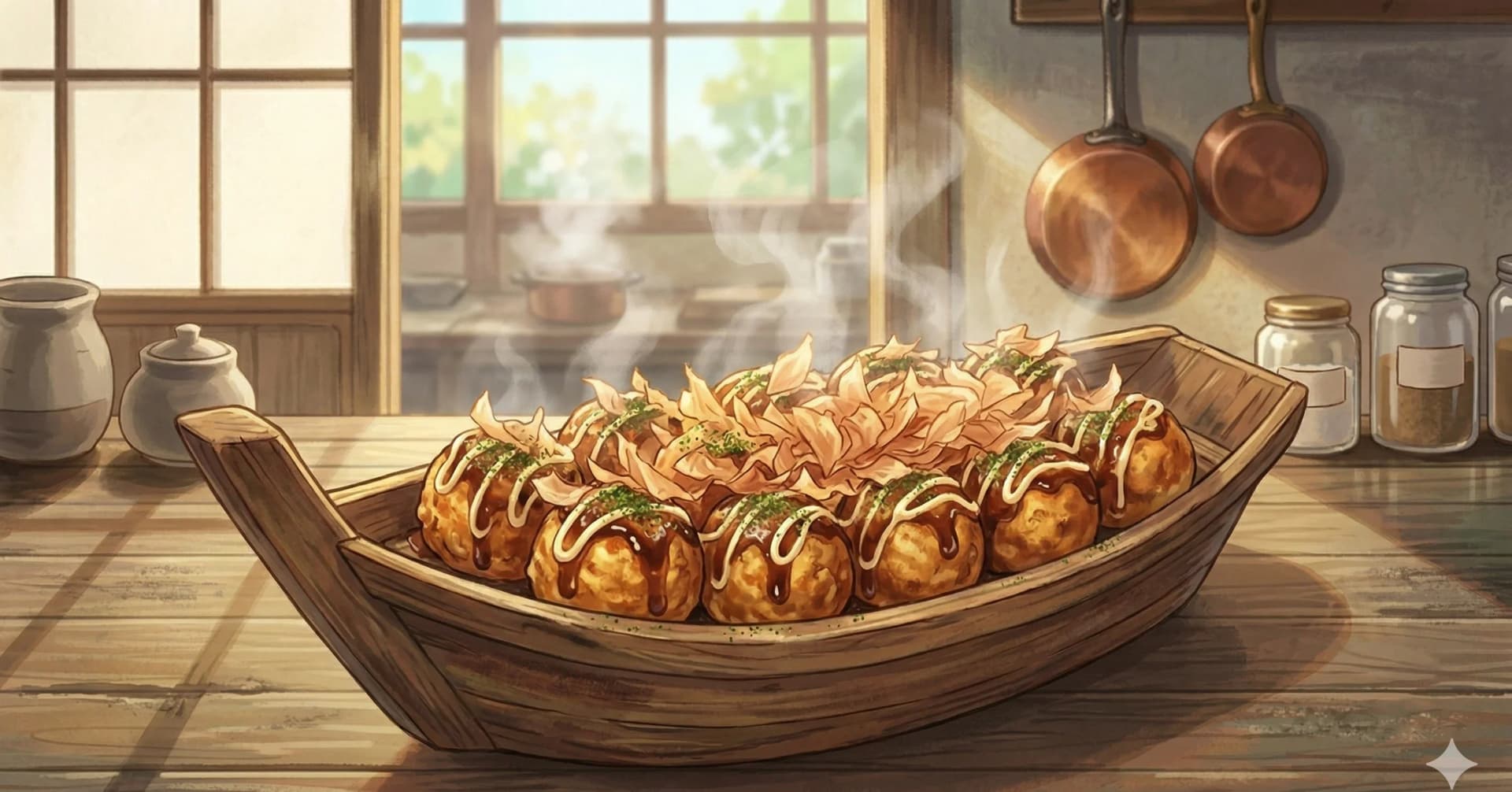
You hear them before you see them. The sound of takoyaki cooking is a rapid, wet sizzle, batter hitting oiled cast iron in quick pours, followed by the tap-tap-tap of metal picks rotating each ball in its mold. Street vendors in Osaka work with a speed that looks choreographed, spinning dozens of balls simultaneously on broad, blackened pans that hold 20, 40, sometimes 80 at once. The finished product arrives in a paper boat: golden spheres, impossibly round, their shells crackled and just barely set, their interiors still liquid and blisteringly hot.
The contrast between outside and inside is everything. A properly made takoyaki has a thin crust that gives way immediately to a creamy, almost custard-like center. The dashi-rich batter is intentionally thin, much thinner than pancake batter, closer to a crepe batter in consistency. This is what allows the interior to stay molten even after cooking. Tucked inside each ball is a piece of tender boiled octopus, a few scraps of tenkasu for textural contrast, pickled ginger for brightness, and scallion for sharpness.
The technique of turning takoyaki is the only real challenge here, and it is a skill that improves rapidly with practice. The first batch will likely be imperfect. By the third or fourth round, you will have found the rhythm. A dedicated takoyaki pan with hemispherical molds is essential. They are inexpensive, widely available online, and useful for all sorts of filled balls beyond traditional takoyaki. Cast iron versions retain heat best, but non-stick electric models are forgiving for beginners and make the turning process easier.
At a Glance
Yield
4 servings (about 40 balls)
Prep
15 minutes
Cook
25 minutes
Total
40 minutes
Difficulty
Medium
Ingredients
Batter Ingredients
Filling Ingredients
For Frying
- —Neutral oil such as vegetable or rice bran, for brushing the pan generously
To Serve
- —Takoyaki sauce (or substitute okonomiyaki sauce or tonkatsu sauce)
- —Kewpie mayonnaise
- —Katsuobushi (bonito flakes)
- —Aonori (powdered green seaweed)
Method
- 1
Whisk the eggs into the cooled dashi stock in a large bowl or measuring jug. Add the soy sauce and salt, then sift in the flour while whisking continuously. The batter should be very thin and completely smooth, similar to heavy cream in consistency. If lumps remain, strain the batter through a fine-mesh sieve. Let it rest for 10 minutes.
- 2
Prepare all the filling ingredients and arrange them within easy reach of the takoyaki pan. Once cooking begins, you will need to work quickly. Have the octopus pieces, tenkasu, scallions, and pickled ginger in separate small bowls. Keep your takoyaki picks or bamboo skewers ready.
- 3
Heat the takoyaki pan over medium heat (or set an electric takoyaki maker to around 200 degrees Celsius). Brush each mold generously with oil, filling the wells and coating the flat surface between them. The pan is ready when a drop of batter sizzles immediately on contact.
- 4
Pour batter into each mold until it just overflows slightly onto the flat surface between the molds. Work quickly with a ladle or use a squeeze bottle for more control. The slight overflow is intentional, as it provides extra batter for forming the complete sphere.
- 5
Drop one piece of octopus into each mold, pressing it gently into the batter. Scatter tenkasu, scallion, and pickled ginger across the entire surface, letting the pieces fall where they may. Precision is not necessary here.
- 6
Cook without touching for about 2 minutes. The batter on the flat surface between the molds will begin to set and turn opaque. The edges inside the molds will start pulling away slightly and firming up.
- 7
Begin turning the balls. Use a takoyaki pick or skewer to poke the edge of the cooked batter and fold the overflow into the mold, then rotate each ball 90 degrees. The uncooked batter from the top will flow down to fill the mold and begin cooking. This is the step that requires practice. Work through the entire pan methodically from one corner, and do not worry if the first few are misshapen.
- 8
Continue rotating the balls every minute or so, turning them a quarter-turn each time, for another 4 to 5 minutes. The goal is an evenly golden-brown sphere on all sides. The exterior should feel crisp and set when you tap it with the pick, while the interior remains soft. A finished takoyaki will spin freely in its mold with a light touch.
- 9
Remove the takoyaki from the pan and transfer to a serving plate or paper boat. They should be uniformly golden, slightly irregular in shape (this is normal and expected for homemade), and very hot inside.
- 10
Brush or drizzle takoyaki sauce generously over the balls. Squeeze Kewpie mayonnaise in thin lines across the top. Pile bonito flakes over everything and watch them dance in the rising steam. Finish with a sprinkle of aonori.
- 11
Serve immediately while the shells are still crisp and the interiors still molten. Warn everyone that the centers are extremely hot. In Osaka, the standard advice is to wait at least one full minute before biting, or to break one open to release the steam.
- 12
Continue cooking remaining batches, re-oiling the pan between rounds. The batter may thicken slightly as it sits; whisk it briefly and add a splash of dashi or water to thin it back to the original consistency if needed.
Key Ingredient Benefits
Octopus is notably rich in vitamin B12, selenium, and iron, while being low in fat compared to most animal proteins. Research suggests that octopus contains taurine, an amino acid traditionally associated with cardiovascular health in Japanese dietary studies. Dashi provides a natural source of umami through inosinic acid without the sodium levels found in many processed stocks. The wheat flour batter contains gluten, making this dish unsuitable for those with celiac disease or gluten sensitivity without substitution.
Why This Works
The batter ratio is deliberately thin, about three parts liquid to one part flour by volume. This produces a batter that sets quickly on contact with the hot oiled molds but stays liquid in the center, creating the signature molten interior. A thicker batter would produce something more like a filled donut, firm throughout, which misses the point entirely.
Generous oiling is critical for two reasons. First, it prevents sticking in the molds, which makes turning possible. Second, the oil essentially shallow-fries the exterior of each ball, creating a crisp shell that contrasts with the soft interior. Cast iron pans, once properly seasoned, develop a natural non-stick surface that improves with each use.
The overflow technique, pouring batter slightly past the rim of each mold, provides the extra material needed to fold over and complete the sphere. Without this excess, you end up with half-spheres or open-topped cups rather than complete balls. The pickled ginger and tenkasu serve structural as well as flavor purposes: the tenkasu absorb some of the liquid batter and create textural pockets, while the ginger provides acid that brightens an otherwise rich and starchy bite.
Substitutions & Variations
- Octopus: If boiled octopus is unavailable, substitute peeled shrimp cut into small pieces, or cubed cheese for a vegetarian version. Sausage and kimchi are popular non-traditional fillings.
- Tenkasu: Crush plain rice crackers or corn flakes as a substitute, or omit entirely.
- Takoyaki sauce: Mix equal parts Worcestershire sauce and ketchup with a small amount of honey as a quick alternative.
- Mentai takoyaki: Add a small dot of mentaiko (spicy cod roe) to each ball along with the octopus.
- Cheese takoyaki: Place a small cube of mozzarella in each mold for a melty center.
- Akashiyaki style: Use a much eggier batter (double the eggs, halve the flour) and serve in warm dashi broth for dipping instead of with sauce.
Serving Suggestions
Takoyaki is quintessential snack food, best served hot in paper boats with toothpicks for eating. It pairs naturally with cold beer, highballs, or chilled green tea. As part of a larger spread, serve alongside okonomiyaki and karaage for an Osaka street food night. In Japan, takoyaki is never considered a main meal but rather a between-meal snack or late-night bite. A simple bowl of miso shiru on the side makes it feel more like a light supper.
Storage & Reheating
Takoyaki are best eaten fresh. If you must store them, place cooled balls in a single layer on a baking sheet, freeze until solid, then transfer to a freezer bag. They keep for up to 1 month frozen. Reheat from frozen in a 200 degree Celsius oven for 8 to 10 minutes, or in the takoyaki pan with a little oil to re-crisp. The microwave will heat them through but the shell will become soft and chewy rather than crisp. Apply all sauces and toppings after reheating.
Cultural Notes
Takoyaki (たこ焼き), "grilled octopus," is the signature street food of Osaka and one of the defining street-stall (yatai, 屋台) preparations in Japan. The modern dish was invented in 1935 by Tomekichi Endo, an Osaka street vendor who took an earlier Hyogo-prefecture egg-and-octopus snack called akashiyaki and reworked it. His key change was adding wheat flour to what had been an almost pure egg batter, which gave the batter the stability to hold a spherical shape during cooking. That single change turned a regional specialty into the icon Osaka now exports to the world.
The cooking itself is a spectacle. A specialized cast-iron pan with rows of hemispherical molds gets very hot, batter with a piece of octopus inside is poured into each mold, and the cook rotates the partially-cooked balls with two metal picks, flipping the soft interiors outward until each ball closes up into a perfect sphere. Good vendors run 100 balls per batch and rotate each one at speed with movements that look choreographed because they basically are. Watching a master at work is half the reason people go. The Dotonbori district in central Osaka is the most famous concentration, with Aizuya, Wanaka, Yamachan, and Kogaryu all competing within walking distance and all claiming their own stylistic identity.
Osaka identity has absorbed the dish. The local phrase takoyaki haha-no-aji ("mother's-flavor takoyaki") points at how often Osaka families make it at home, using portable electric takoyaki grills (takoyaki-ki, たこ焼き器) at weekend gatherings. These home parties have their own slang name, takopa (タコパ, short for takoyaki party), and they are one of the more distinctive forms of casual Osaka entertaining. Friends and family gather around the grill, take turns rotating, and drink beer while they cook.
The dish has spread internationally as a representative Osaka specialty, but the most authentic versions remain in Osaka itself.
Nutrition Facts
Calories: 432kcal (22%)|Total Carbohydrates: 41g (15%)|Protein: 18g (36%)|Total Fat: 16g (21%)|Saturated Fat: 3g (15%)|Cholesterol: 165mg (55%)|Sodium: 680mg (30%)|Dietary Fiber: 1g (4%)|Total Sugars: 3g
You Might Also Like
Ratings & Comments
Ratings & Comments
Ratings
Share your thoughts on this recipe.
Sign in to rate and comment