Japanese Cuisine
Onigiri (Japanese Rice Balls)
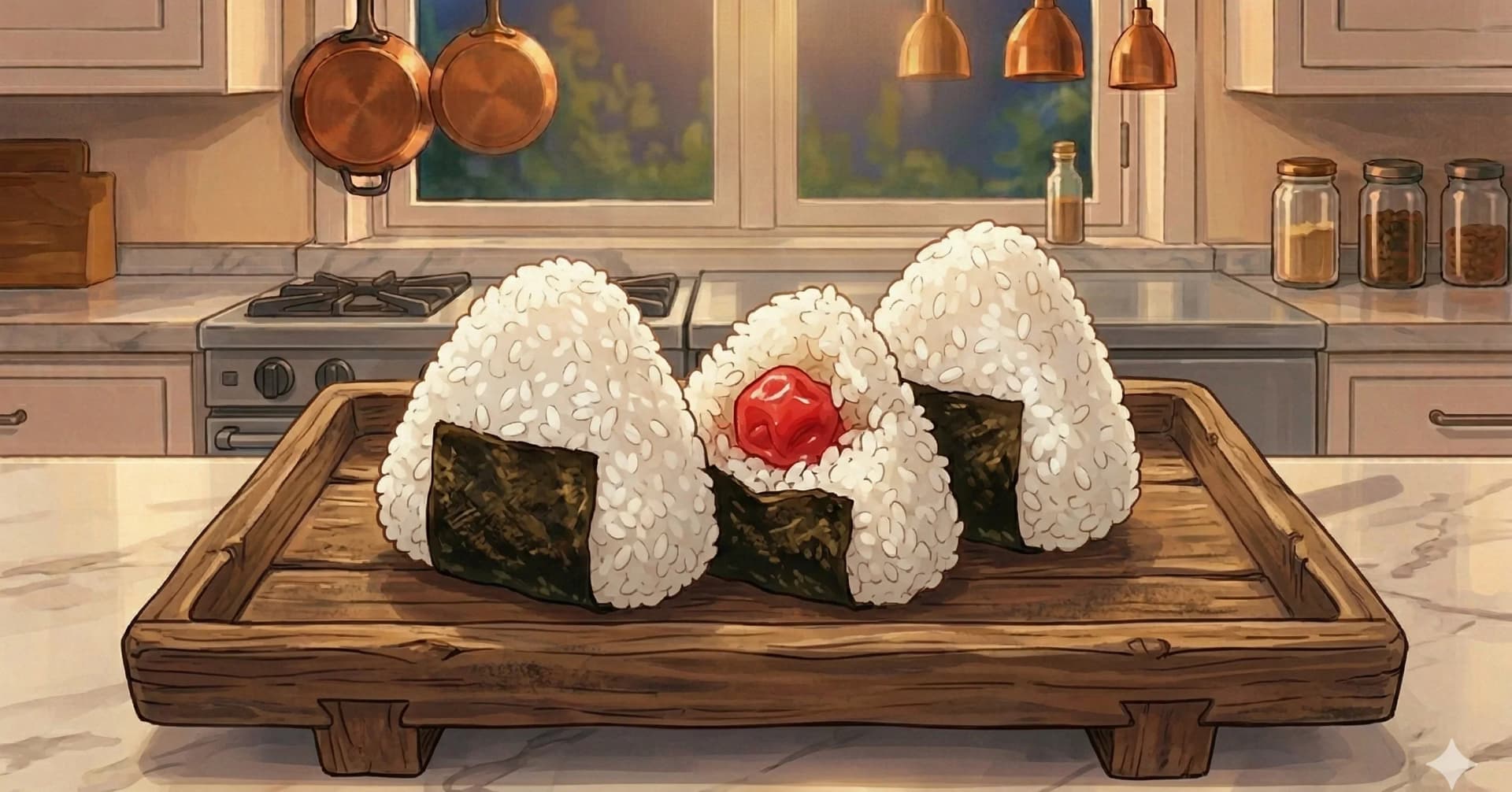
Hand-shaped rice filled with salmon, umeboshi, or tuna mayo and wrapped in toasted nori
Onigiri are portable rice parcels that have fed Japan for well over a thousand years. Archaeologists have found carbonized rice shaped into lumps at sites dating back to the first century, and by the Heian period, soldiers and travelers carried pressed rice as a reliable field ration. Today, onigiri are the single best-selling item in Japanese convenience stores, which tells you something about their staying power: no other snack bridges ancient tradition and modern convenience quite so naturally.
The idea is uncomplicated. You cook short-grain rice, let it cool just enough to handle, season your palms with salt and water, and press the rice around a small pocket of filling. The classic triangle shape is not decorative. It emerged because three flat sides make the rice ball easier to grip and less likely to roll, and the pointed top gives you a place to mark which filling is inside. A strip of nori around the base adds a savory crunch and keeps your fingers clean.
What makes onigiri rewarding to cook at home is the fillings. Salted salmon that you broil and flake yourself, tart umeboshi that cuts through the mild sweetness of the rice, tuna mayo that adds richness, okaka (bonito flakes dressed in soy sauce) that delivers pure umami. Each one changes the character of the rice ball entirely. You can prepare several fillings and let everyone at the table shape their own, which turns the meal into something communal, closer in spirit to making tamago-kake-gohan or assembling a bowl of bibimbap than to following a strict recipe.
Pair a plate of onigiri with a bowl of miso-shiru and a few pickles, and you have a meal that is quiet, balanced, and deeply satisfying.
At a Glance
Yield
9 onigiri
Prep
30 minutes
Cook
30 minutes
Total
60 minutes
Difficulty
Easy
Ingredients
Rice Ingredients
- 1 lbuncooked Japanese short-grain white rice (about 2 rice-cooker cups)
- 2 cupwater
- —Fine sea salt or kosher salt, for shaping
Wrappers
- 3sheets nori seaweed, toasted and cut into strips
Method
- 1
Rinse the rice in a bowl of cold water, swirling gently with your hand. Drain and repeat three or four times until the water runs mostly clear. This removes surface starch that would make the onigiri gummy rather than tender.
- 2
Combine the rinsed rice and 480 ml water in a rice cooker or a heavy-bottomed pot with a tight lid. Let it soak for 20 to 30 minutes. If using a rice cooker, start the cycle. If using a pot, bring to a boil over medium-high heat, reduce to the lowest setting, cover, and cook for 12 to 13 minutes. Remove from the heat and let it steam, still covered, for 10 minutes. Fluff with a rice paddle or fork. The grains should be glossy, slightly sticky, and tender all the way through. ### Prepare the fillings
- 3
For the salted salmon, place the fillet skin-side down on a lined baking sheet and sprinkle both sides generously with salt. Broil or bake at 220 C (425 F) for 10 to 15 minutes until the surface is dry and the flesh flakes apart easily when pressed with a fork. Break into rough flakes, discarding skin and any bones. Set aside.
- 4
For the okaka filling, place the katsuobushi in a small bowl and stir in the soy sauce. The flakes should be evenly moistened but not drenched, with just enough soy sauce to darken them slightly.
- 5
For the tuna mayo, combine the drained tuna, mayonnaise, and soy sauce in a small bowl. Stir until evenly mixed.
- 6
For the umeboshi, pit the plums and tear the flesh into small pieces, roughly the size of a thumbnail. Place on a small plate. ### Shape the onigiri by hand
- 7
Fill a small bowl with water and have your salt nearby. Wet both palms thoroughly, then spread a small pinch of salt (about a two-finger pinch) across your hands. The water prevents the rice from sticking; the salt seasons the surface.
- 8
Scoop about 100 to 120 g of warm rice (roughly a loosely packed handful) onto your non-dominant hand. The rice should still be quite warm but not so hot that it burns. If it is too hot to hold comfortably, let it cool for another few minutes.
- 9
Use your thumb to press a shallow well into the center of the rice. Place about 1 teaspoon of your chosen filling into the well.
- 10
Gently fold the rice around the filling so it is fully enclosed. Cup the rice between both hands and press lightly to compact it into a rough ball. You want firm enough pressure that the ball holds together, but not so much that the rice becomes dense and heavy. The grains should still feel distinct under your fingers.
- 11
To form the triangle, curve your dominant hand into an arched "roof" shape over the top of the rice ball. At the same time, press the sides inward with the base of your other hand. Rotate the ball about a third of a turn and repeat the press. After three rotations, the rice should have three distinct corners and three relatively flat sides. Give it one or two more gentle rotations to even out the shape. Each side should be about 2 cm thick.
- 12
Place the shaped onigiri on a tray lined with parchment paper. Wet and salt your hands again before shaping the next one. Repeat with the remaining rice and fillings. ### Wrap with nori
- 13
Toast each nori sheet briefly by passing it over an open flame or holding it a few centimetres above a hot burner for two or three seconds per side. The nori should tighten slightly and become more fragrant. Cut each sheet into three equal strips along the grain lines.
- 14
Wrap a strip of nori around the base of each onigiri, pressing gently so it adheres to the rice. If you prefer crisp nori, wrap just before eating and store the nori strips separately in an airtight container.
- 15
To identify the fillings, place a small pinch of each filling on top of the onigiri at the peak of the triangle. ### Using a mold (alternative)
- 16
If using an onigiri mold, wet the mold and lid first. Sprinkle a small pinch of salt inside. Fill halfway with rice, add a teaspoon of filling, then cover with more rice. Press the lid down firmly, flip the mold, and release. Wrap with nori as described above.
Key Ingredient Benefits
Japanese short-grain rice: Varieties labeled Koshihikari or Akitakomachi are ideal. Their soft, slightly sticky texture holds the onigiri shape without becoming mushy. Rice labeled "sushi rice" at Western supermarkets is the same grain type and works well. Avoid long-grain rice (basmati, jasmine), which lacks the adhesion needed.
Nori: Sheets of dried, pressed seaweed that provide iodine, iron, and a gentle ocean-like flavor. Store in an airtight container away from moisture. Once opened, nori absorbs humidity quickly and loses its crispness.
Umeboshi: Salt-pickled plums with an intensely sour, salty flavor. A little goes a long way. They are traditionally valued in Japan for their preservative qualities, which is one reason they became a classic onigiri filling for packed lunches.
Katsuobushi: Dried, smoked, and fermented bonito (skipjack tuna) shaved into thin flakes. It is one of the foundational umami ingredients in Japanese cooking, rich in inosinate. Combined with soy sauce, it becomes okaka, a filling that delivers concentrated savory depth.
Salmon: Salting the salmon before broiling draws out moisture and concentrates flavor, creating flakes that stay distinct inside the rice rather than turning to paste. Wild or farmed salmon both work.
Japanese mayonnaise: Kewpie brand uses egg yolks only (no whites) and rice vinegar, giving it a richer, tangier flavor than Western mayonnaise. It is what makes tuna mayo onigiri taste distinctly Japanese.
Why This Works
Japanese short-grain rice has a higher proportion of amylopectin starch compared to long-grain varieties. This gives the cooked grains a natural adhesiveness that allows them to hold together when pressed, without needing any binding agent. The rice essentially glues itself into shape.
Shaping the onigiri while the rice is still warm is not optional. As rice cools, the starch molecules begin to retrograde, becoming firmer and less sticky. Warm rice compresses easily into a cohesive shape. Cold rice crumbles and refuses to hold.
Wetting your hands serves two purposes. The thin film of water prevents the rice from adhering to your skin, and the salt dissolved into that moisture seasons the exterior evenly, creating a subtle savory crust that contrasts with the filling inside.
Toasting the nori drives off residual moisture, which makes it crisper and intensifies its flavor. Untoasted nori can taste papery and flat by comparison.
Substitutions & Variations
Rice type: If you cannot find Japanese short-grain rice, Korean short-grain rice or Italian Arborio rice will hold together reasonably well. Avoid basmati, jasmine, or other long-grain varieties entirely.
Fillings: The possibilities are broad. Mentaiko (spicy pollock roe), shio kombu (soy-simmered kelp strips), leftover teriyaki chicken, pickled takana mustard greens, or even a small piece of cream cheese with a sliver of smoked salmon all work well. The key is that the filling should be strongly flavored and relatively dry. Wet fillings make the rice soggy.
Furikake onigiri: Instead of a center filling, mix 1 to 2 tablespoons of furikake seasoning directly into the warm rice before shaping. This distributes flavor throughout every bite.
Yaki onigiri (grilled): Brush shaped onigiri with soy sauce and grill in a dry frying pan over medium heat until a golden crust forms on each flat side, about 2 to 3 minutes per side. The crust adds a toasty, caramelized dimension. This is also an excellent way to revive day-old onigiri that have dried out slightly.
Onigirazu (rice sandwich): Lay a sheet of nori flat, spread rice in a square, add fillings in a layer, cover with more rice, and fold the nori over like wrapping a parcel. Cut in half to reveal the cross-section. This is a modern variation that allows for bulkier fillings.
Vegan option: Omit all fish-based fillings. Use umeboshi, pickled vegetables, shio kombu, or seasoned shiitake mushrooms. Replace katsuobushi in the okaka filling with finely shredded nori tossed in soy sauce and a drop of sesame oil.
Serving Suggestions
Onigiri are a meal in themselves when paired with a bowl of miso-shiru and a few slices of pickled cucumber or daikon. This is one of the most common light lunches in Japan, and for good reason: the combination of warm broth, salted rice, and sharp pickles covers every basic craving without excess.
For a more substantial spread, set out the fillings and let everyone shape their own onigiri at the table. Add a pot of takikomi-gohan as an alternative rice option, where the grains are already seasoned with mushrooms and soy. The two styles of rice side by side show the range of what Japanese home cooking does with a single ingredient.
Onigiri also travel well as part of a bento box alongside tamago-kake-gohan-style eggs (cooked through for the lunchbox), tamagoyaki, a few edamame pods, and sliced fruit. In Southeast Asia, a similar impulse to wrap starch around savory fillings appears in nasi lemak, where coconut rice is bundled with sambal and anchovies. The two traditions solve the same problem of making rice portable and satisfying in different but equally clever ways.
Storage & Reheating
Fresh onigiri: Best eaten the same day, ideally within 4 to 6 hours of shaping. Keep at cool room temperature (not in the refrigerator if you plan to eat them soon, as cold hardens the rice).
Refrigerator: If you must refrigerate, wrap each onigiri individually in plastic wrap and store in an airtight container for up to 1 day. The rice will firm up. To soften it again, remove the nori, wrap the onigiri loosely in a damp paper towel, and microwave for 30 to 40 seconds until warmed through. Re-wrap with fresh nori before serving.
Freezer: Onigiri freeze well for up to 1 month. Wrap each one tightly in plastic wrap without the nori. To reheat, microwave from frozen for 1 to 2 minutes, turning once, until hot through the center. Wrap with nori after reheating.
Reviving stale onigiri: Day-old onigiri that have dried out can be turned into yaki onigiri. Brush the flat sides with soy sauce and pan-fry in a dry skillet over medium heat until a deep golden crust forms. The soy sauce caramelizes and creates a new layer of flavor that makes the leftovers feel intentional rather than rescued.
Nori: Always store nori separately from the rice if you are packing onigiri for later. Nori that sits against warm, moist rice for more than a few minutes becomes soft and chewy. Wrapping just before eating preserves its crispness.
Cultural Notes
Onigiri (おにぎり), Japanese rice balls, may be the oldest food in the Japanese kitchen. Archaeological digs at Yayoi-period sites (300 BCE to 300 CE) have turned up carbonized rice fragments pressed into rough triangular lumps. If those count, onigiri has been on Japanese tables for more than 2,000 years. The original prehistoric versions were just balls of leftover steamed rice that farmers carried into the fields. The modern onigiri, with its nori wrapper, its filling, and its standardized triangular silhouette, came together in the Edo period (1603-1868).
The convenience-store revolution remade the dish in the late 1970s. In 1978, 7-Eleven Japan introduced the now-standard multi-layer onigiri packaging, the clever wrap that keeps the nori sheet completely dry until the moment you tear a strip and the rice and nori finally meet. The detail sounds small. It is not. A 7-Eleven onigiri tastes noticeably better than its soggier competitors, and the innovation helped establish 7-Eleven as the dominant Japanese convenience-store chain. The four major chains combined now move several billion onigiri a year, with seasonal flavor drops and limited-edition collaborations that customers actually follow.
The classic fillings hold up. Umeboshi (pickled plum), sake (salted salmon), katsuobushi (bonito flakes), tarako (cod roe), kombu (kelp tsukudani). Then there is tuna mayo, a 1983 Japanese-American convenience-store invention that violated every traditionalist instinct and immediately became one of the top-selling fillings in the country. The classic list has expanded into hundreds of regional and seasonal variations.
The triangle shape is partly practical, since triangles stack efficiently in the cold case, and partly old. Three points were historically thought to represent mountain spirits. Some regions use round rice balls and call them omusubi instead. Both are correct. Yaki-onigiri (焼きおにぎり) is the grilled version, brushed with soy sauce until the rice surface caramelizes, and it shows up at izakaya and family dinners alike.
Nutrition Facts
Calories: 208kcal (10%)|Total Carbohydrates: 36g (13%)|Protein: 9g (18%)|Total Fat: 3g (4%)|Saturated Fat: 0g (0%)|Cholesterol: 15mg (5%)|Sodium: 380mg (17%)|Dietary Fiber: 0g (0%)|Total Sugars: 0g
You Might Also Like
Ratings & Comments
Ratings & Comments
Ratings
Share your thoughts on this recipe.
Sign in to rate and comment