Dashi
Also known as: Dashi Stock, Japanese Soup Stock, Ichiban Dashi, Niban Dashi, Kombu Dashi, Awase Dashi
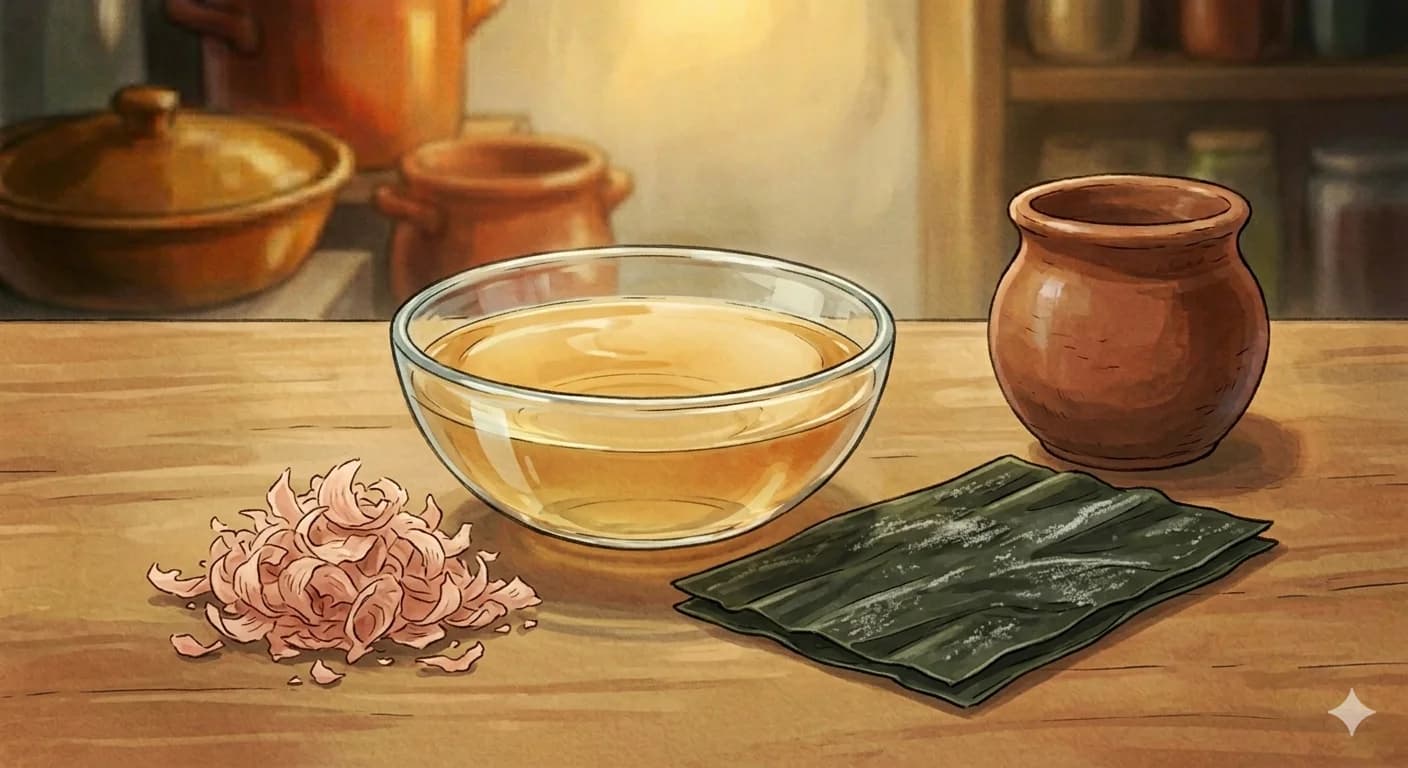
Dashi is the foundational stock of Japanese cuisine, and understanding it is understanding how Japanese food works. At its simplest, dashi is water infused with kombu (dried kelp) and katsuobushi (dried bonito flakes) — two ingredients that together create a liquid so rich in umami that it transforms everything it touches.
What makes dashi remarkable is its speed and purity. Unlike Western stocks that simmer for hours extracting collagen from bones, dashi is made in minutes. Kombu steeps in water as it heats, releasing glutamic acid. Bonito flakes are added, steep briefly, and are strained out. The result is a clear, golden broth that tastes of the sea without tasting fishy — clean, savory, and profoundly satisfying.
Dashi is the reason miso soup tastes like miso soup, the reason simmered vegetables in Japanese cuisine have that indescribable depth, and the invisible hand behind every great bowl of udon, soba broth, and the delicate egg custard called chawanmushi. Without dashi, Japanese cuisine loses its soul.
Key facts at a glance:
- Made from kombu (kelp) and katsuobushi (bonito flakes) — the classic combination
- Extraordinarily rich in umami — glutamic acid from kombu plus inosinic acid from bonito
- Made in under 15 minutes — speed is a defining characteristic
- Foundation of washoku — traditional Japanese cuisine (UNESCO heritage)
- Vegan version available using only kombu, or kombu with dried shiitake
Flavor Profile
Origin
Japan, Hokkaido (kombu), Kochi and Kagoshima (katsuobushi)
Traditional Medicine Perspectives
Traditional Chinese Medicine
Kelp (hai dai/kun bu) is classified as cold and salty in TCM, entering the Liver, Stomach, and Kidney meridians. It is traditionally used to soften hardness, clear phlegm, and promote urination. Dried fish preparations are considered warming and nourishing to qi and blood.
Traditional Japanese Medicine (Kampo)
Kombu was traditionally valued in Japanese folk medicine for supporting thyroid function due to its iodine content, and for promoting digestive health. Bonito was considered a strength-building food. The combination in dashi was seen as a nourishing, easily digestible preparation suitable for the ill and elderly, and it remains a core element of Japanese hospital and convalescent cooking.
Modern Scientific Research
The umami science behind dashi is well established. Glutamic acid from kombu and inosinic acid (IMP) from katsuobushi exhibit a well-documented synergistic effect: together, they amplify perceived umami intensity by up to eight times compared to either compound alone. This synergy is the biochemical foundation of dashi's extraordinary savory depth.
Kombu is one of the richest natural sources of iodine, a mineral essential for thyroid function. It also contains fucoidan, a sulfated polysaccharide that has been studied for potential anti-inflammatory and immune-modulating properties, though research is still in early stages.
Katsuobushi contains high levels of histidine-related compounds, including anserine, which has been studied for its potential antioxidant and anti-fatigue properties. The fermentation process that creates hon-karebushi (the highest grade of katsuobushi) produces additional bioactive compounds. Research into the gut health implications of regular dashi consumption is ongoing, with some studies suggesting that the combination of glutamic acid and other compounds may support digestive mucosal health.
Cultural History
The development of dashi is inseparable from the broader history of Japanese cuisine. Kombu has been harvested from the cold waters around Hokkaido for centuries, and the kombu road (kombu no michi) was a historic trade route that brought kelp from northern Japan to Osaka and Kyoto, where it became central to the refined cooking of the imperial capital.
Katsuobushi — skipjack tuna that is filleted, simmered, smoked, sun-dried, and fermented with mold over months — is one of the most labor-intensive food products in the world. The combination of kombu and katsuobushi in dashi was a culinary breakthrough: Japanese cooks discovered, centuries before Western science, that glutamic acid (from kombu) and inosinic acid (from bonito) together produce a synergistic umami effect far greater than either alone.
This discovery was formalized by chemist Kikunae Ikeda in 1908, who isolated glutamic acid from kombu and coined the word "umami" — literally "pleasant savory taste." Dashi, the humble stock, was the inspiration for identifying the fifth basic taste. In the washoku tradition (designated UNESCO Intangible Cultural Heritage in 2013), dashi is considered the most fundamental skill a cook must master.
Culinary Uses
Ichiban dashi (first dashi) is the primary stock, used where its flavor will be front and center: miso soup, clear soup (sumashi-jiru), and chawanmushi (egg custard). Its clarity and clean flavor are the point. Never boil kombu in the water — remove it just before the water reaches a full boil, or the stock becomes slimy and bitter.
Niban dashi (second dashi) is made by re-simmering the used kombu and bonito with fresh water, sometimes with a small addition of new bonito flakes. This produces a lighter stock perfect for simmering vegetables (nimono), cooking rice, and making the braising liquid for dishes like nikujaga and oden.
Dashi is the starting point for every Japanese noodle broth. For udon, it is combined with soy sauce and mirin to create tsuyu. For soba, the proportions shift. For ramen, dashi may be blended with pork or chicken stock. In each case, the dashi provides the umami backbone.
Beyond soups, dashi enriches tamagoyaki (rolled omelet), is mixed into batter for okonomiyaki and takoyaki, and serves as the poaching liquid for oyakodon and other donburi. A Japanese home cook might use dashi five or six times in a single meal without thinking about it.
Preparation Methods
For ichiban dashi, place a piece of kombu (about 10g per liter of water) in cold water and heat slowly. Remove the kombu just before the water reaches a rolling boil — look for small bubbles forming on the kombu's surface. Add a generous handful of bonito flakes (about 20–30g per liter), let them settle for 30 seconds to 2 minutes, then strain through a fine-mesh sieve or cheesecloth. Do not squeeze the bonito — this clouds the stock.
For a vegan dashi, use kombu alone, or combine kombu with dried shiitake mushrooms (soaked in cold water overnight for the deepest flavor). The shiitake adds guanylic acid, another umami compound that synergizes with glutamic acid from the kombu.
Instant dashi (dashi no moto) is widely used in Japanese home cooking and is a perfectly acceptable shortcut for everyday meals. It comes as granules that dissolve in hot water. For special occasions or when the dashi flavor will be prominently featured, making it from scratch is noticeably superior. Homemade dashi keeps in the refrigerator for 3–5 days or can be frozen in ice cube trays for convenient portioning.
Comments
Share your thoughts on this ingredient.
Sign in to comment0 Comments