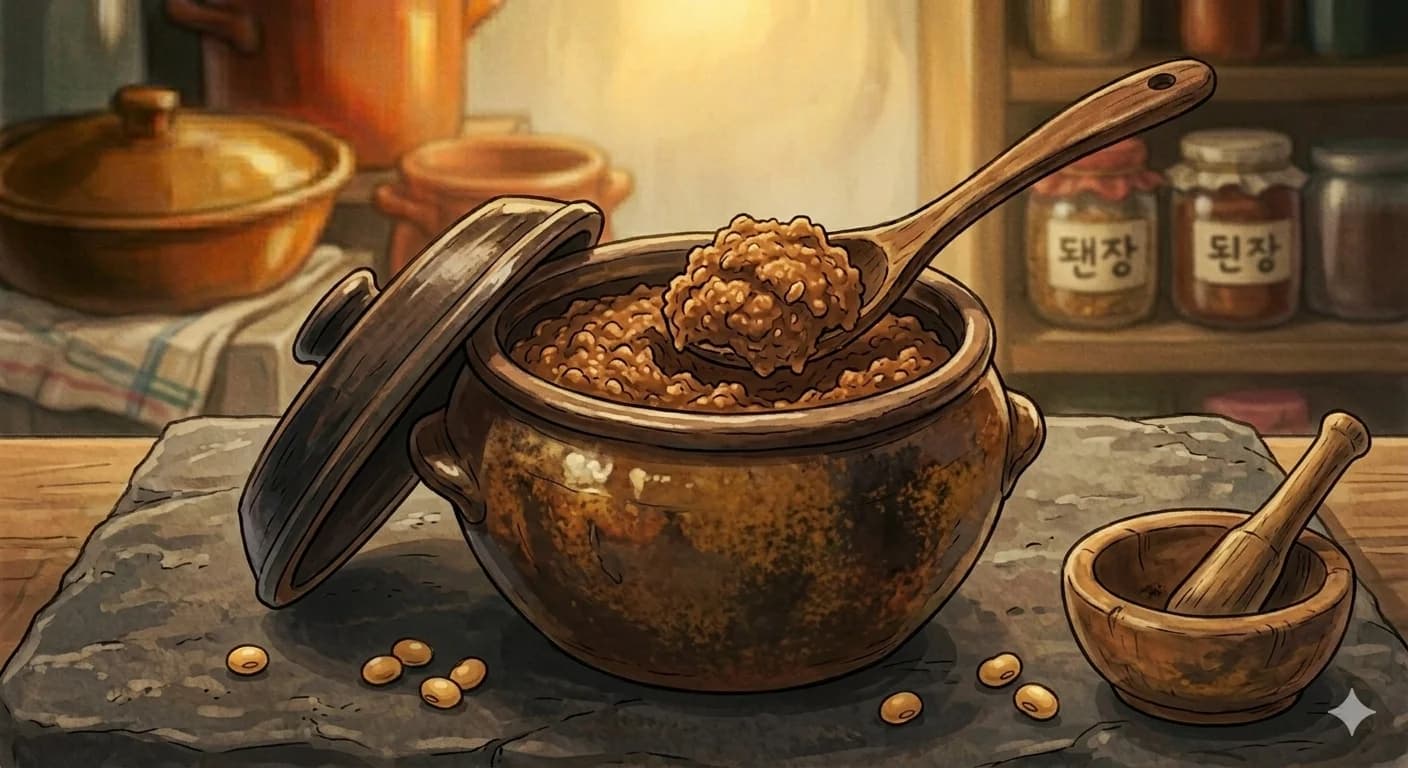
Doenjang
Also known as: 된장, Korean Miso, Korean Soybean Paste, Fermented Soybean Paste
Doenjang is Korea's ancient fermented soybean paste — a fundamental flavor backbone of Korean cooking that is deeper, funkier, and more complex than its Japanese cousin miso.
Where miso tends toward smoothness and subtlety, doenjang is bold, pungent, and unapologetically earthy, with a fermented depth that hits you immediately. It smells like earth and age and fermentation, and it tastes like the distilled essence of umami.
Doenjang is not a condiment you add at the end — it is a foundation ingredient. It forms the base of doenjang-jjigae (soybean paste stew), Korea's most beloved home-cooked soup, and it anchors countless sauces, marinades, and side dishes. A Korean home without a crock of doenjang is almost unthinkable.
Key facts at a glance:
- Korea's ancient fermented soybean paste — funkier and bolder than Japanese miso
- Made from meju — blocks of crushed soybeans fermented with wild microorganisms
- Foundation of Korean cooking — base for stews, sauces, marinades, and banchan
- Rich umami source — one of the most intensely savory ingredients in any cuisine
- Traditionally homemade — jangdok (clay crocks) on the family terrace are a Korean icon
Flavor Profile
Origin
Korea
Traditional Medicine Perspectives
Traditional Korean Medicine
Doenjang is considered warming and associated with the Spleen and Stomach in Korean traditional medicine. It is believed to aid digestion, neutralize toxins, and strengthen the body. Traditionally, fermented soybean paste was considered medicinal food — nourishing and detoxifying. A folk remedy involves applying doenjang to insect stings.
Modern Scientific Research
Doenjang fermentation produces a complex array of bioactive compounds. The fermentation process breaks soy proteins into free amino acids and peptides, which contribute to its intense umami flavor and may have biological activity.
Studies have identified isoflavones (genistein, daidzein) in doenjang, which are converted during fermentation into more bioavailable forms. Korean research has investigated doenjang's potential antioxidant, anti-inflammatory, and antimicrobial properties, though most studies are in vitro or in animal models.
The fermentation also produces Bacillus subtilis and other microorganisms that contribute to the paste's flavor complexity and may have probiotic properties.
Cultural History
Doenjang production in Korea dates back to the Three Kingdoms period (57 BC - 668 AD), and the tradition of making jang (fermented pastes and sauces) is one of the most important culinary practices in Korean culture. The process begins with meju — blocks of cooked, mashed soybeans that are shaped, dried, and left to ferment with naturally occurring wild molds and bacteria.
The jangdok — large clay crocks arranged on an elevated stone platform (jangdokdae) — is one of the most recognizable images of traditional Korean homes. These crocks hold doenjang, ganjang (soy sauce), and gochujang, the three pillars of Korean seasoning.
Traditionally, doenjang-making was a family event tied to the lunar calendar, with specific auspicious days chosen for starting the fermentation. The quality of a household's jang reflected the skill and care of the family.
Culinary Uses
The essential preparation is doenjang-jjigae — a bubbling stew of doenjang, tofu, zucchini, onions, garlic, and chili, often with clams, pork, or anchovy stock. It is served in the stone pot it is cooked in, still boiling at the table, and is the soup that Koreans crave when they are homesick.
Use doenjang as a dipping sauce base — mix with sesame oil, garlic, gochugaru, and a touch of sugar for ssam-jang, the paste served with Korean barbecue lettuce wraps.
Stir a spoonful into stir-fries and braises for instant depth. Use as a marinade for grilled meats and fish. Add to dressings for robust salads. Doenjang is intensely salty and savory, so start with small amounts and build up.
Preparation Methods
Doenjang needs no preparation — it is ready to use from the container. For stews, dissolve it in the broth by pressing through a sieve or stirring vigorously.
Do not substitute miso 1:1 for doenjang. Miso is milder and sweeter; doenjang is bolder and funkier. If substituting, use a heavier hand with miso or blend with a small amount of miso and a touch of fish sauce to approximate doenjang's depth.
Artisanal Korean doenjang (often labeled "traditional" or "handmade") is significantly more complex than mass-produced versions. Look for short ingredient lists — soybeans, salt, and water — rather than those with added wheat or MSG.
Traditional Dishes
- Doenjang-jjigae
- Ssam-jang
- Doenjang-muchim (seasoned vegetables)
- Cheonggukjang-jjigae
- Grilled doenjang mackerel
Comments
Share your thoughts on this ingredient.
Sign in to comment0 Comments