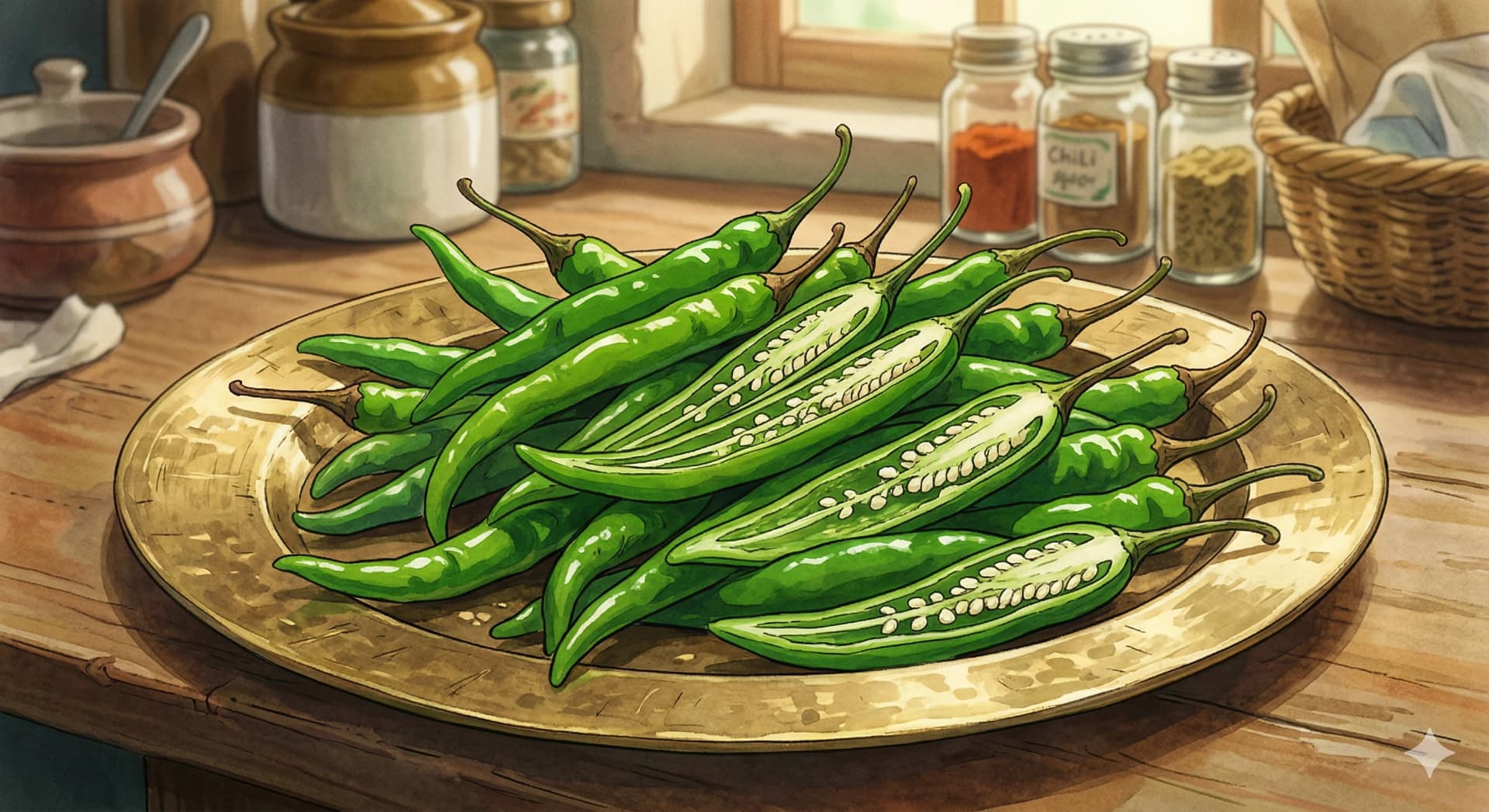
Green Chilies
Also known as: Hari Mirch, Serrano, Thai Green Chili, Capsicum annuum, Capsicum frutescens
Green chilies are the fresh, unripe form of what would, left on the plant, eventually ripen into a red chili. At the green stage, they carry a distinctly different flavor profile from their dried or ripened counterparts: brighter, sharper, grassier, and more vegetal, with a fresh heat that hits quickly and fades faster than the lingering burn of dried red chili.
The chlorophyll and moisture of the unripe fruit contribute a crisp, green-forward flavor dimension that dried chilies simply cannot replicate. This is why Indian cooking so frequently uses both forms in the same dish: green chilies add fresh brightness, while dried red chilies provide depth, color, and a different, more developed heat.
The variety of green chilies used across South Asian cooking is considerable. At one extreme are the small, intensely potent bird's eye chilies (Capsicum frutescens), used across South India and Southeast Asia. At the other end are the large, mild banana peppers or Anaheim-style chilies used for bulk and mild warmth. The most common everyday green chili in North Indian home cooking is a medium-thin chili roughly 3-4 inches long, moderately hot, with a crisp skin and a clean, sharp bite.
Nearly all of the heat is concentrated in the seeds and the white pithy membrane (the placenta) — removing them reduces heat dramatically while preserving the fresh, grassy flavor.
Key facts at a glance:
- Unripe form — green stage of the chili plant, harvested before ripening to red
- Fresh heat — brighter, sharper, and faster-fading than dried chili burn
- Capsaicin location — concentrated in seeds and white pith, not the flesh
- Dual use in Indian cooking — green for brightness, dried red for depth and color
- Vitamin C rich — a single fresh green chili can contain more vitamin C than an orange
Flavor Profile
Origin
Americas (origin), South Asia, Southeast Asia
Traditional Medicine Perspectives
Ayurveda:
Green chilies are considered even more heating than dried red chilies in some Ayurvedic assessments because the fresh form is considered more potent in its immediate effect on the body. They are strongly Pitta-aggravating when consumed fresh and raw, and can cause symptoms of excess Pitta (inflammation, acidity, skin heat) in those already prone to it. They are better tolerated when cooked, as cooking reduces some of the intensity. For Kapha and Vata constitutions in good balance, small amounts of green chili in cooking are considered beneficial for stimulating agni (digestive fire), clearing stagnation, and promoting metabolic activity. Charaka Samhita categorizes the Capsicum genus broadly as having katu (pungent) rasa and ushna (hot) virya, applicable to both fresh and dried forms.
Traditional Chinese Medicine:
Green and fresh chilies are warming Yang foods in TCM, entering the heart and spleen meridians. Their warming action is considered more superficial and acute compared to the deeper warming of dried chili, consistent with the difference in how fresh versus dried forms behave in cooking. They are used to stimulate the stomach, dispel cold, and promote circulation, particularly beneficial in cold-damp climates and constitutions. As with Ayurveda, TCM cautions against fresh chili use in heat patterns, yin deficiency, and inflammatory conditions.
Modern Scientific Research
Green chilies and their ripened, dried counterparts both contain capsaicin as the primary bioactive compound, but green chilies have a notable advantage in one nutritional category: vitamin C. Green, unripe chilies often contain significantly more ascorbic acid than ripe red chilies, because ripening and drying degrade vitamin C substantially.
Capsaicin in green chilies activates the same TRPV1 receptor as in red chilies, producing the familiar heat sensation. Research on TRPV1 activation includes metabolic stimulation, reduced appetite, pain modulation, and cardiovascular effects.
Local anesthetic properties of capsaicin, arising from its ability to deplete substance P at nerve terminals with repeated exposure, form the basis of pharmaceutical capsaicin preparations used in topical pain management.
Antioxidant compounds in green chilies, including quercetin, luteolin, and various carotenoids, contribute to the anti-inflammatory research profile of the Capsicum genus.
Cultural History
Green chilies share their origin story with red chili powder: both come from Capsicum species native to the Americas, introduced to South and Southeast Asia by the Portuguese in the early 16th century. The fresh green form quickly became embedded in daily cooking life across the region.
In India, green chilies became so fundamental that a dal cooked without any green chili in the tempering would be considered slightly incomplete. Chutneys, the fresh condiment category, rely almost entirely on green chilies for their heat, blended with cilantro, mint, or coconut depending on the region.
In Thai cuisine, the small, intensely hot fresh green chili is the backbone of green curry paste — substituting dried red chili would produce a fundamentally different dish.
This illustrates how cooking traditions in different parts of Asia independently developed sophisticated applications around fresh green chili that are specific, irreplaceable, and culturally central.
Culinary Uses
The most fundamental use of green chilies in South Indian and North Indian cooking is in tempering: one or two whole green chilies added to hot oil at the start of cooking. Kept whole with the stem on, they impart flavor gently without the aggressive punch of sliced or ground chili.
This is a deliberate technique: the whole, intact chili does not rupture and release its capsaicin-laden seeds into the dish. Slit chilies release more heat than whole ones. Sliced chilies release more still. Ground or blended chilies, as in chutneys, release the most.
Green chutneys — blended from green chilies, fresh cilantro or mint, ginger, garlic, lime juice, and salt — are one of the most versatile condiments in the world.
A good green chutney works equally well alongside samosas, spread inside a sandwich, stirred into yogurt for a quick raita, or drizzled over biryani.
Preparation Methods
Whole in tempering: Add 1-2 whole green chilies (stem intact) to hot oil at the start of cooking. They will swell and blister slightly. Leave in the dish or remove before serving.
Slit for moderate heat: Cut chilies lengthwise down the middle without separating the halves. This exposes the interior while keeping the chili intact, releasing more heat than whole but less than sliced.
De-seeded for flavor without heat: Cut off the stem, slit lengthwise, and scrape out seeds and white pith with a spoon or knife. The remaining flesh retains the fresh, grassy chili flavor with significantly reduced heat.
Blended for chutney: Blend whole green chilies with cilantro, mint, ginger, garlic, lime, and salt. Taste and adjust. For a milder chutney, remove seeds before blending.
Pickling: Slit whole green chilies and stuff with a mixture of salt, mustard powder, turmeric, and fenugreek powder. Pack into a jar with mustard oil. Ready in 2-3 days, and the flavor deepens over a week.
Traditional Dishes
- Dal Tadka
- Green Chutney
- Samosas
- Biryani
- Thai Green Curry
- Mirchi Bajji (Stuffed Chili Fritters)
- Egg Bhurji
- Aloo Tikki
- Raita
- Green Chili Pickle
- Shrimp Stir-fry
- Avial
Comments
Share your thoughts on this ingredient.
Sign in to comment0 Comments