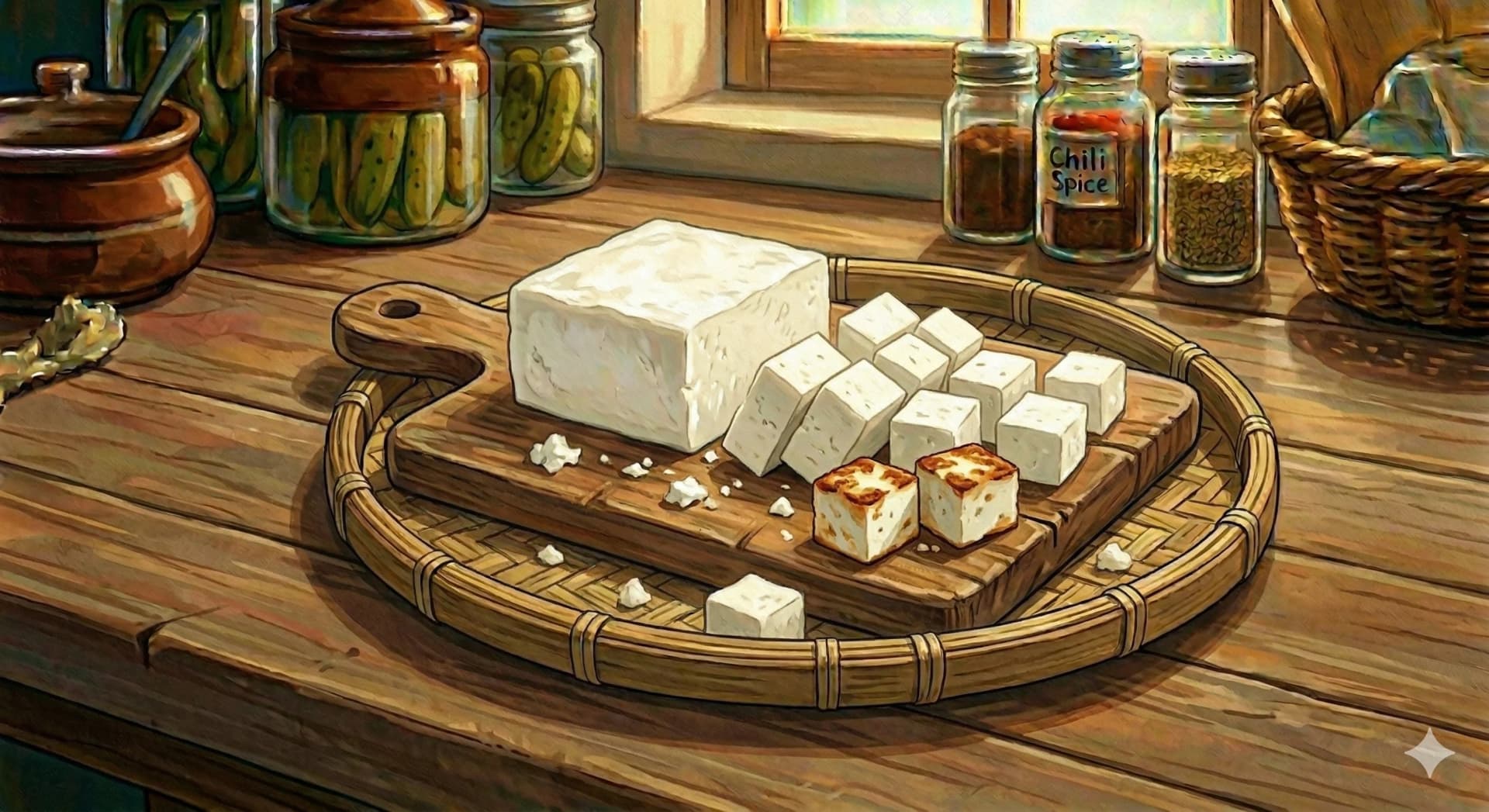
Paneer
Also known as: Indian Cottage Cheese, Chenna (unset form), South Asian Fresh Cheese
Paneer is a fresh, non-aged cheese that forms the cornerstone of vegetarian cooking across the Indian subcontinent, especially in the north. Unlike almost every other cheese in the world, paneer is acid-set rather than rennet-set: the milk is curdled using lemon juice, vinegar, or whey, making it entirely suitable for strict vegetarians who avoid animal-derived rennet. The result is a firm, white cheese with a mild, milky flavor and a dense, slightly springy texture.
What distinguishes paneer from Western fresh cheeses is its behavior under heat. Paneer does not melt. Its protein structure, altered by acid coagulation rather than enzymatic action, holds together firmly when grilled, pan-fried, or simmered in a curry. This quality makes it extraordinarily versatile: it can be cubed and fried until golden, threaded onto skewers and cooked in a tandoor, or added to a braise without dissolving into the sauce. It absorbs surrounding flavors while contributing its own quiet richness, acting almost like a blank canvas for the spices and aromatics around it.
Home-made paneer and commercial paneer differ significantly. Fresh, home-made paneer is softer, more yielding, and more delicate in flavor, often used immediately after pressing. Commercial paneer, while convenient, tends to be denser and can turn rubbery when cooked, particularly if it has been refrigerated for several days. Experienced cooks often soak commercial paneer in warm water before use to restore some of its original softness.
Key facts at a glance:
- Acid-set fresh cheese — suitable for strict vegetarians, no rennet needed
- Does not melt — holds shape when grilled, fried, or simmered
- Complete protein source — 18-20 grams per 100g, with all essential amino acids
- Mughal culinary heritage — developed under the influence of the Mughal court
- Bengali chenna — the unpressed version, foundation of the entire Bengali sweet tradition
- Home-made vs. commercial — significantly different in texture and flavor
Flavor Profile
Origin
Indian Subcontinent, Persia, Afghanistan
Traditional Medicine Perspectives
Ayurveda:
Paneer is considered a sattvic food in Ayurvedic thought, meaning it promotes clarity, calmness, and nourishment without overstimulating the mind or body. It is classified as heavy and nourishing (guru, brimhana), making it particularly recommended during recovery from illness or for those who are underweight or depleted. Its cooling nature is thought to balance Vata and Pitta doshas, though its heaviness may increase Kapha if consumed in excess. Ayurvedic texts emphasize consuming paneer fresh rather than aged, as freshness preserves its vital quality (prana).
Modern Scientific Research
Paneer is a complete protein source, containing all essential amino acids, and is particularly valued in vegetarian diets where animal protein from meat is absent. A 100-gram serving provides roughly 18 to 20 grams of protein along with significant calcium, phosphorus, and fat-soluble vitamins A and D. Because it is unfermented, it does not contain probiotics, but it is generally well-tolerated by those with moderate lactose sensitivity, as much of the lactose is lost in the whey during curdling.
Research into the nutritional comparison between home-made and commercial paneer consistently finds that home-made paneer retains more moisture and has a softer texture, while commercial varieties are often heat-treated in ways that alter their protein structure.
The fat content of paneer varies significantly depending on the fat content of the source milk: full-fat milk produces richer, more pliable paneer, while toned or low-fat milk produces a drier, more crumbly result.
Cultural History
The origins of paneer are debated. Some food historians trace it to Persia and Afghanistan, where similar fresh cheeses were made and carried along with Mughal rulers into the Indian subcontinent during the 16th century. Others argue for an older, independent origin within the subcontinent itself, pointing to references to milk curdling in ancient Sanskrit texts. What is certain is that paneer, in its present form as a pressed, firm cheese, became deeply embedded in North Indian foodways and received its greatest culinary development under the Mughal court.
The Mughals brought with them a tradition of rich, nut-based, cream-enriched cooking that found its natural vegetarian expression in paneer. Dishes like shahi paneer (royal paneer) and paneer makhani reflect this heritage directly: the "shahi" designation signals cashew cream sauces, saffron, and the opulence of courtly banqueting. This Mughlai influence distinguishes North Indian paneer cookery from its South Indian counterparts, where paneer is less central and coconut-based preparations dominate.
In Bengal and other parts of eastern India, the same curdled milk solids are used in a different form: chenna — not pressed but soft and crumbly, forming the foundation of the entire Bengali sweet tradition including rasgulla, rasmalai, sandesh, and cham cham.
Culinary Uses
In North Indian cooking, paneer serves as the primary protein in countless vegetarian dishes. Cubed paneer is pan-fried in ghee or oil until golden on the outside, then added to spinach-based palak paneer, tomato-cream gravies, or dry spiced preparations. The frying step creates a light crust that helps the paneer hold its shape in wet curries. For grilled preparations like paneer tikka, the cheese is marinated in spiced yogurt and cooked at high heat, emerging with charred edges and a smoky, concentrated flavor.
Paneer also appears in stuffed preparations: crumbled paneer mixed with green chili, coriander, and spices fills parathas and samosas.
In Bengali cooking, soft chenna is kneaded with sugar and cardamom to make sandesh, or shaped into balls and simmered in sugar syrup for rasgulla — the same ingredient, handled differently, produces results that span savory main courses and delicate, syrup-soaked sweets.
Preparation Methods
To make paneer at home, bring 1 liter of full-fat whole milk to a rolling boil. Remove from heat and stir in 2 to 3 tablespoons of lemon juice or white vinegar. The milk will curdle immediately, separating into white curds and yellowish-green whey. If curdling is incomplete, return briefly to low heat.
Line a colander with a double layer of cheesecloth and pour in the curdled milk. Rinse the curds gently with cool water to remove any residual sourness from the acid. Gather the cheesecloth, squeeze out excess whey, and tie it in a knot.
For soft chenna, use immediately. For firm paneer, place the wrapped bundle under a heavy weight (a pot filled with water works well) for 30 minutes to 2 hours depending on desired firmness. Refrigerate in cold water and use within 2 to 3 days.
Traditional Dishes
- Palak Paneer
- Paneer Tikka
- Paneer Makhani (Paneer Butter Masala)
- Shahi Paneer
- Mattar Paneer
- Kadai Paneer
- Paneer Bhurji
- Paneer Paratha
- Saag Paneer
- Rasgulla
- Rasmalai
- Sandesh
- Cham Cham
- Paneer Tikka Masala
Comments
Share your thoughts on this ingredient.
Sign in to comment0 Comments