Rajasthani · Indian Cuisine
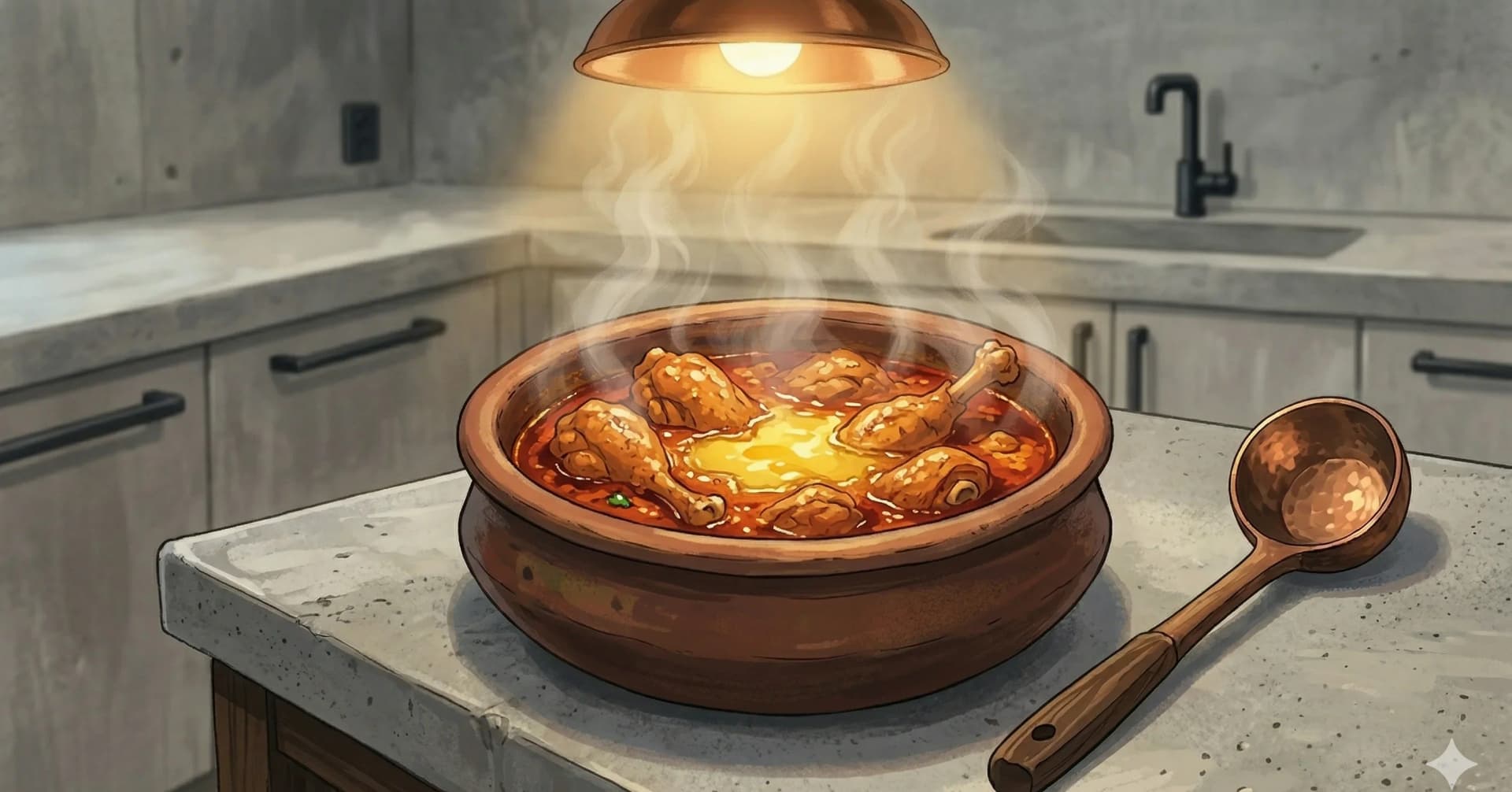
Rajasthani Chicken Curry
Boneless chicken braised in a golden onion-tomato masala with whole spices
Rajasthani cooking is shaped by geography: in a semi-arid region where fresh vegetables are scarce and water is precious, the cuisine developed around meat, dried legumes, and dairy. Chicken curry in this tradition is not the same as its Punjabi counterpart. The base is similarly built on fried onions and tomato, but the spicing leans toward warming whole spices rather than a heavily powdered masala, and the dish has a cleaner, more direct character.
This is the foundational chicken curry of the Rajasthani kitchen, used as a base recipe in its own right and as the starting point for more elaborate preparations like murgh ka soweta. The technique follows the same architecture as North Indian curry: whole spices bloomed in hot oil, onions fried to deep golden, ginger-garlic paste and ground spices added, tomato purée cooked until the oil breaks free, and the chicken (seared separately) added to finish.
Using boneless leg (thigh) rather than bone-in pieces is a Rajasthani restaurant preference: boneless thigh has the fat and collagen to remain juicy under the high heat of bhunao cooking, and it produces a cleaner, easier-to-eat result than bone-in curry cuts. The beaten yoghurt folded in toward the end provides both body and a slight tang that lifts the rich masala without thinning it.
A squeeze of lemon and fresh coriander at the very end are not garnishes. They are the brightness that brings the finished dish to life.
At a Glance
Yield
Serves 4–6
Prep
20 minutes
Cook
40 minutes
Total
1 hour
Difficulty
Medium
Ingredients
- 1½ lbboneless chicken leg (thigh), cut into 4 cm pieces
- 7 ozonion (about 1–1½ onions), finely chopped
- 6 oztomatoes (about 1–1½ tomatoes), puréed or very finely chopped
- 1¼ ozplain yoghurt, beaten
- 1 tspgaram masala powder
- ¼ cupfresh coriander, roughly chopped
- ⅔ tspsalt
- 1¾ tbspwhole garam masala (1 small cinnamon stick, 2 black cardamom, 3 green cardamom, 4 cloves, 1 bay leaf, ½ teaspoon black peppercorns)
- ½ cupneutral oil, divided
- 1⅓ tsplemon juice (about ½ lemon)
- 2½ tspKashmiri red chilli powder
- ⅓ tspturmeric powder
- 1½ tbspginger-garlic paste (combined)
Method
- 1
Sear the chicken. Heat 2 tablespoons of the oil in a wide heavy pan over high heat. Season the chicken with a small pinch of salt (¾ teaspoon), a pinch of turmeric (¼ teaspoon), and a small pinch of chilli powder. Sear the chicken pieces in batches without overcrowding, for 3–4 minutes until golden on the outside. Remove to a plate. The chicken will finish cooking in the masala. Set aside.
- 2
Bloom the whole spices. In the same pan, heat the remaining oil over medium heat. Add all the whole garam masala (15 g) spices: cinnamon, cardamom, cloves, bay leaf, peppercorns. Stir for 30–45 seconds until fragrant and the bay leaf has softened.
- 3
Fry the onions. Add the finely chopped onions and cook over medium-high heat, stirring regularly, for 12–14 minutes until deeply golden brown. The colour here is important. Pale onions produce a flat-tasting masala.
- 4
Add pastes and spices. Add the ginger-garlic paste (23 g) and stir for 2 minutes. Add the Kashmiri chilli powder (1 teaspoon) and remaining turmeric. Stir for 30 seconds. Add the salt.
- 5
Cook the tomatoes (165 g). Add the tomato purée and stir well. Cook over medium heat, stirring frequently, for 8–10 minutes until the oil separates from the masala and pools at the edges. The masala should look glossy and dense, not wet.
- 6
Add the chicken and yoghurt (35 g). Add the seared chicken pieces to the masala and stir to coat. Add the beaten yoghurt a little at a time, stirring constantly. Bring to a boil, then reduce to a simmer. Cook covered for 15–18 minutes until the chicken is cooked through and tender.
- 7
Finish. Add the garam masala powder (½ teaspoon) and stir. Add the lemon juice (½ lemon). Taste and adjust salt. Scatter the fresh coriander (5 g) over the top and serve immediately.
Key Ingredient Benefits
Kashmiri red chilli provides the colour of this curry without excessive heat. Its carotenoid compounds produce the vivid brick-red that is the visual signature of North Indian restaurant-style curries. These compounds are fat-soluble, meaning the oil in the masala helps fix them visually and makes them nutritionally available.
Yoghurt (Lactobacillus cultures) adds lactic acid tang and protein to the gravy. The lactic acid in yoghurt also acts as a mild tenderiser when the chicken sits in it during the final braise, softening muscle fibres slightly. Fermented dairy like yoghurt is associated in dietary research with gut microbiome diversity.
Boneless chicken leg (thigh) contains more intramuscular fat and connective tissue than breast, which means it remains juicy under sustained cooking heat that would dry out breast meat. The collagen in thigh meat also dissolves into the braising liquid during cooking, giving the gravy slightly more body than a breast-based curry would produce.
Why This Works
Searing the chicken before it enters the masala creates browning on the surface that cannot develop in a wet braise. The Maillard compounds formed in those 3–4 minutes of direct contact with a hot oiled surface contribute a roasted, slightly caramelised note to the finished curry. This is the reason almost all Rajasthani restaurant-style curries call for separately searing rather than adding raw chicken directly.
Adding beaten yoghurt in stages rather than all at once prevents the dairy proteins from coagulating too suddenly in the hot masala, which would produce curdled white specks in the sauce rather than a smooth integration. Beaten yoghurt (thoroughly whisked to break up the protein structure) is also more stable than unbeaten yoghurt when heated, for the same reason.
Substitutions & Variations
Bone-in chicken: Use 1 kg of bone-in curry-cut chicken pieces and increase the covered braise to 25–30 minutes. The gravy will be richer from the bone collagen.
Lamb: Replace with 700 g of boneless lamb shoulder; increase the braise to 45–55 minutes until fully tender.
Deeper colour: Add 1 tablespoon of tomato paste dissolved in the tomato purée for a deeper, more concentrated colour and slightly sweeter baseline.
Serving Suggestions
Serve with missi roti or plain paratha for a traditionally Rajasthani pairing, or with basmati rice. A bowl of dal or fresh yoghurt alongside provides contrast to the spiced gravy. This curry also serves as the base for murgh ka soweta, the corn and yoghurt enriched Rajasthani preparation built on top of this same recipe.
Storage & Reheating
Refrigerates well for 3 days; freezes for up to 1 month. The flavours deepen overnight. Reheat over low-medium heat with a splash of water, covered, until hot through.
Cultural Notes
Rajasthani chicken curry (राजस्थानी चिकन करी) is the regional Rajasthani variation of chicken curry, built around the distinctive Rajasthani spice profile that emphasizes dried red chilies (Rajasthan's Mathania chili variety is highly prized), heavy use of yogurt and ghee for the marinade, mustard oil for the cooking medium, and a generally hotter, more aggressively spiced character than the Punjabi and Awadhi chicken preparations. The dish reflects the broader Rajasthani cooking tradition that developed in a hot dry climate with limited vegetable variety, leading to a cuisine that uses preserved ingredients (dried chilies, yogurt-based marinades, ghee-based cooking) more heavily than the wetter cuisines of north-central India.
The Mathania chili is worth distinguishing. The chili variety grown around the village of Mathania in Jodhpur district of Rajasthan is treated as the premium Rajasthani dried chili: it has a deep red color, a relatively mild heat level (lower than the very hot Guntur chili of Andhra Pradesh), and a complex fruity aroma that develops in slow cooking. Rajasthani chicken curry made with Mathania chili paste has the bright red color and the distinctive Rajasthani flavor that distinguishes the regional version from generic Indian chicken preparations.
The technique combines marinade and slow cook. Bone-in chicken pieces are marinated for at least four hours in thick yogurt, ginger-garlic paste, Mathania chili paste, turmeric, ground coriander, ground cumin, and salt. The cooking starts with browning sliced onions in mustard oil until deep golden, then ginger-garlic, then whole spices (cinnamon, cloves, black cardamom, bay leaf), then the marinated chicken with all of its marinade. The dish cooks at moderate heat for fifteen to twenty minutes uncovered so the yogurt-based gravy reduces and concentrates, then water is added to thin the gravy, the pot covers, and the curry simmers for forty-five minutes to an hour until the chicken is tender. The dish is finished with garam masala, a swirl of fresh ghee, and a scatter of fresh cilantro. The pairing with bajre ki roti (pearl millet flatbread, the Rajasthani staple bread), with rice, or with the Rajasthani batti (baked wheat dumpling) is the standard regional serving format. The dish appears at family meals across Rajasthan and at Rajasthani-themed restaurants in Jaipur, Jodhpur, Udaipur, and the global diaspora.
Nutrition Facts
Calories: 309kcal (15%)|Total Carbohydrates: 4.4g (2%)|Protein: 29.4g (59%)|Total Fat: 18.7g (24%)|Saturated Fat: 4.1g (21%)|Cholesterol: 106mg (35%)|Sodium: 770mg (33%)|Dietary Fiber: 0.9g (3%)|Total Sugars: 2.4g
You Might Also Like
Ratings & Comments
Ratings & Comments
Ratings
Share your thoughts on this recipe.
Sign in to rate and comment