Chinese Cuisine
Gouqi Ji Tang (Chinese Wolfberry Chicken Soup)
A gentle, golden broth built on classic Chinese herbal soup tradition
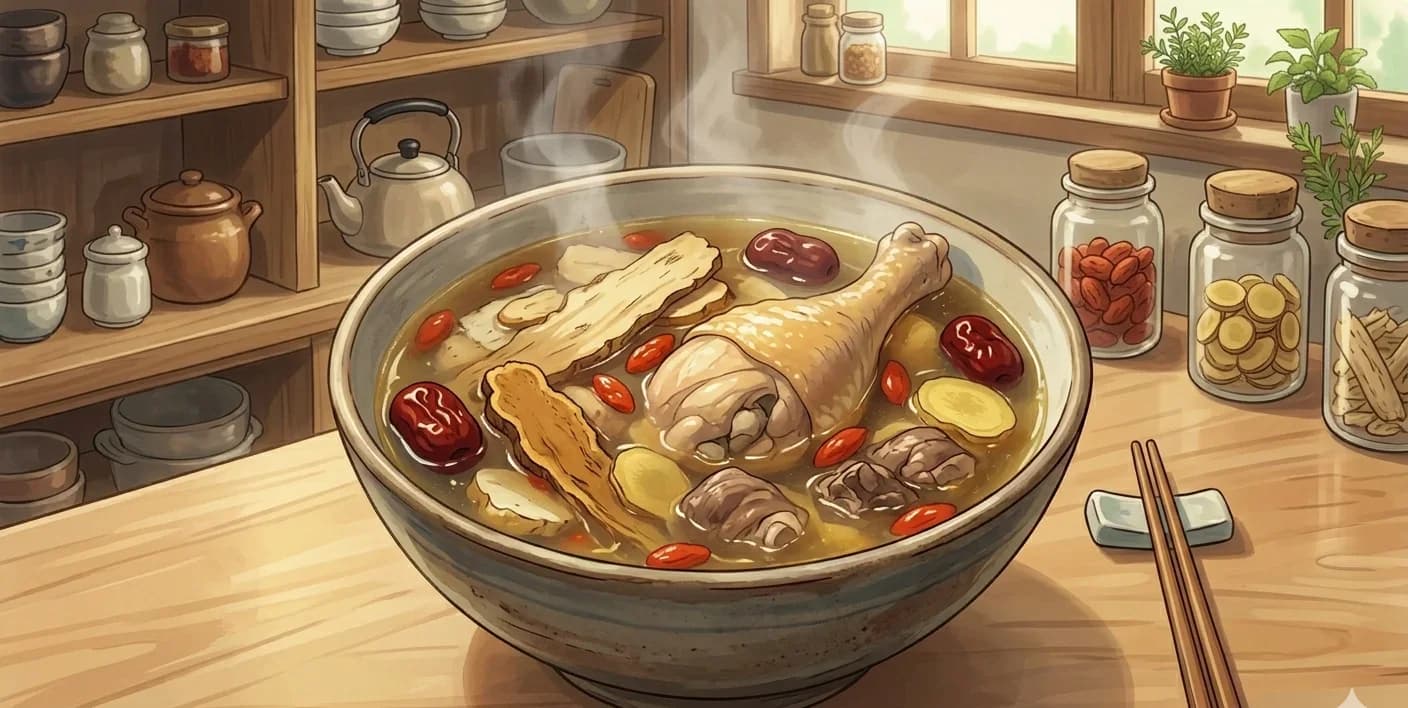
This is one of the foundational soups of Chinese home cooking, the kind that simmers quietly on a Sunday afternoon while the whole house fills with the deep, sweet fragrance of ginger and dried fruit. Gouqi ji tang translates simply as wolfberry chicken soup, but that name undersells what you get in the bowl: a broth that is rich and slightly sweet from the dried longan and red dates, earthy from codonopsis and astragalus, and brightened by the little burst of color from the goji berries floating on top.
The herbs here are not exotic additions. They are pantry staples in millions of Chinese kitchens, sold in every Asian grocery store in small packets. Astragalus (huang qi) gives the broth a faint, pleasant bitterness that rounds out the sweetness of the dates. Codonopsis (dang shen) adds a mild, almost potato-like depth. Together with goji berries and longan, they build layers of flavor that plain chicken stock simply cannot replicate.
The one technique worth paying attention to is time. You can simmer this soup for one hour and get something very good. Simmer it for two or three hours and you get something different: the broth turns a deeper amber, the sweetness concentrates, the herbs give everything they have. Start it early if you can.
The chicken itself stays tender and pulls apart easily at the bone. Serve it shredded back into the bowl or alongside for people to pick at. Either way, this soup is comfort in its oldest, simplest form.
At a Glance
Yield
4 to 6 servings
Prep
10 minutes
Cook
2 hours
Total
2 hours 10 minutes
Difficulty
Easy
Ingredients
- —1.5 to 2 kg bone-in, skin-on chicken thighs, or 1 whole chicken cut into pieces
- 1thumb-sized piece fresh ginger, sliced into coins
- 4green onions, left whole
- 1 ozdried goji berries (gou qi zi)
- 10 piecesdried longan flesh (long yan rou)
- 1 ozdried Chinese wild yam (huai shan), about 10 pieces
- 5dried red dates (hong zao), pitted or unpitted
- 5 piecescodonopsis root (dang shen), broken into sections
- 4 piecesastragalus root (huang qi)
- —Salt to taste
- —White pepper to taste
- —Chopped cilantro or sliced green onion for garnish
Method
- 1
Start the chicken. Place chicken in a large pot and add 6 to 8 cups of cold water, enough to just cover the meat. Bring to a simmer over medium-high heat, then immediately reduce to medium-low. Let the chicken cook gently for 30 minutes, skimming any grey foam from the surface as it rises. The broth will clarify as the foam is removed.
- 2
Add aromatics and herbs. Give the goji berries, longan, wild yam, red dates, codonopsis, and astragalus a quick rinse under cold water. Add them to the pot along with the ginger coins and whole green onions. The broth will begin to take on a golden amber color within the first 15 minutes of herbal cooking.
- 3
Simmer low and slow. Continue to simmer uncovered or partially covered for 1 to 2 more hours, depending on how deeply flavored you want the broth. At 1 hour it will be sweet and light. At 2 hours it deepens into something more complex and concentrated. Top up with a little water if the level drops significantly.
- 4
Strain and serve. Remove the chicken pieces to a cutting board. Pour the broth through a fine mesh strainer, discarding the spent astragalus and codonopsis (they have given what they have). The red dates, goji berries, and wild yam are all edible and can be returned to the bowl. Skim any excess fat from the surface. Season with salt and white pepper.
- 5
Finish. Pull the chicken meat from the bones and add back to the strained broth, or serve the pieces whole. Ladle into bowls and scatter with cilantro or green onion.
Key Ingredient Benefits
Goji Berries (Gou Qi Zi). Used in Chinese cooking for centuries both as a flavoring and as a medicinal ingredient. In Traditional Chinese Medicine, goji berries are associated with supporting kidney and liver function, and with improving vision. Modern research has explored their antioxidant content, particularly zeaxanthin, which may support eye health. Research is ongoing and preliminary; goji berries should not be treated as a remedy for any specific condition.
Astragalus Root (Huang Qi). One of the most widely used herbs in TCM, traditionally considered an adaptogen used to strengthen the immune system and support energy. Some clinical research suggests it may have immunomodulatory effects. People on immunosuppressant medications should consult a doctor before using astragalus regularly.
Codonopsis Root (Dang Shen). Often used as a milder alternative to ginseng in everyday cooking. Traditionally associated with supporting digestion and energy. The flavor contribution to the soup is subtle, earthy, and slightly sweet.
Dried Red Dates (Hong Zao). A staple of Chinese cooking and herbal medicine. Traditionally believed to tonify the blood and calm the spirit. They also contribute natural sweetness and a small amount of iron.
Dried Longan (Long Yan Rou). The dried flesh of longan fruit, sweet and intensely flavored. Used in TCM to calm the mind and support sleep. In soup, they function partly as a sweetener and partly as a textural element.
Why This Works
The two-stage approach here is important. Starting the chicken in cold water and bringing it up slowly draws out the proteins and impurities into the water before they set, which is why you get that grey foam. Skimming it away is what gives you a clear, clean broth rather than a murky one. If you blanch the chicken first in boiling water (which some recipes suggest), you get similar clarity with less skimming required.
The herbal mix is carefully balanced. Codonopsis and astragalus provide the earthy savory backbone. Red dates and longan contribute natural sweetness without any added sugar. Goji berries brighten the color and add a very mild tartness at the end. The ginger threads through all of it, keeping the whole bowl warm and aromatic without dominating.
Using bone-in, skin-on pieces matters here. The collagen and fat from bones and skin are what give the broth its body and that faint, satisfying slickness on the lips. Boneless chicken breast produces something thinner and less rounded. Thighs are more forgiving over long simmer times and stay tender where breast meat would dry out.
If you want to take this broth in a slightly different direction, consider comparing it to Hong Zao Ji Tang, which leans harder into the red date sweetness, or Wu Ji Tang, which uses silkie chicken for a darker, more mineral-rich base.
Substitutions & Variations
No codonopsis or astragalus? The soup is still very good with just goji berries, longan, and red dates. These are the easiest to find and contribute the most flavor. The astragalus and codonopsis add depth but are not essential for a pleasant result.
Silkie chicken. For a darker, more minerally broth, substitute silkie chicken for regular chicken. See Wu Ji Tang for a version built around this ingredient.
Add-ins. After straining the broth, you can add a handful of baby spinach, sliced shiitake mushrooms, or soaked wood ear fungus and simmer for 5 minutes before serving. This turns the soup into a more substantial meal.
Pressure cooker. Combine all ingredients and cook at high pressure for 30 minutes. The broth will be richly flavored. Let pressure release naturally for best results.
Slow cooker. Cook on low for 6 to 8 hours or high for 3 to 4 hours. Good for a hands-off approach.
Serving Suggestions
This soup is a meal in itself when served with steamed jasmine rice. Ladle the broth into rice bowls and eat it alongside Bai Qie Ji or a simple stir-fry. At Chinese family tables it often appears as one dish among several, with the broth drunk throughout the meal.
For a fuller spread, serve alongside Congee for a warming, gentle dinner. The soup also pairs beautifully with a plate of Ginger Scallion Beef or steamed vegetables with oyster sauce.
A small dish of soy sauce and sliced chili on the side for dipping the chicken pieces is traditional and welcome.
Storage & Reheating
The strained broth keeps well in the refrigerator for up to 4 days. The fat will solidify on top when cold and can be lifted off easily before reheating, which is actually a good thing: you can skim as much or as little as you like. The soup reheats beautifully on the stovetop over medium heat; do not boil it hard or the broth can turn cloudy again.
Freeze the broth without chicken for up to 3 months. Store in portions for easy weeknight use.
Cultural Notes
Gou qi ji tang (枸杞雞湯, "wolfberry chicken soup") is the simpler Chinese herbal chicken soup built around gou qi zi (枸杞子, wolfberry, sometimes called goji berry), the small red dried berry that has become a heavily exported Chinese herbal food worldwide. The soup is among the gentlest and most accessible of the broader yao shan (herbal-food) tradition, with a sweet rather than bitter flavor profile that makes it palatable to diners who find the more medicinal-tasting dang gui chicken soup too challenging. The dish appears widely in Cantonese, Hokkien, and Taiwanese home cooking and is often the first herbal soup that Chinese mothers teach to children.
The traditional preparation simmers a whole chicken (or chicken legs) with a small handful of dried wolfberries, several jujube dates (hong zao), ginger, and Shaoxing wine for ninety minutes to two hours. The wolfberries soften and plump in the simmering broth, releasing their natural sweetness and a faint floral note that pairs well with the chicken stock. The dish is finished with a small amount of salt and white pepper just before serving, and the diners eat both the chicken and the rehydrated wolfberries along with the broth. Some preparations add slices of dried Chinese yam (shan yao) or astragalus root (huang qi) for additional complexity, though the simplest version uses just chicken, wolfberries, and jujube.
The wolfberry has a long documented history in Chinese herbal medicine. The plant is described in the Shennong Bencao Jing (Divine Farmer's Materia Medica, compiled in the second century CE) as a tonic herb associated with longevity and vision. Modern research on wolfberries has identified compounds including zeaxanthin, lutein, and various polysaccharides, with studies on antioxidant and visual-health effects appearing in journals including Nutrients and the Journal of Nutrition. The clinical evidence for specific therapeutic uses remains modest, but the berries are widely consumed as a gentle traditional tonic, and the soup itself is treated culturally as a warming everyday dish rather than as medicine.
Nutrition Facts
Calories: 418kcal (21%)|Total Carbohydrates: 17.7g (6%)|Protein: 30.2g (60%)|Total Fat: 23.4g (30%)|Saturated Fat: 6.2g (31%)|Cholesterol: 172mg (57%)|Sodium: 209mg (9%)|Dietary Fiber: 1.7g (6%)|Total Sugars: 10.6g
You Might Also Like

Ratings & Comments
Ratings & Comments
Ratings
Share your thoughts on this recipe.
Sign in to rate and comment