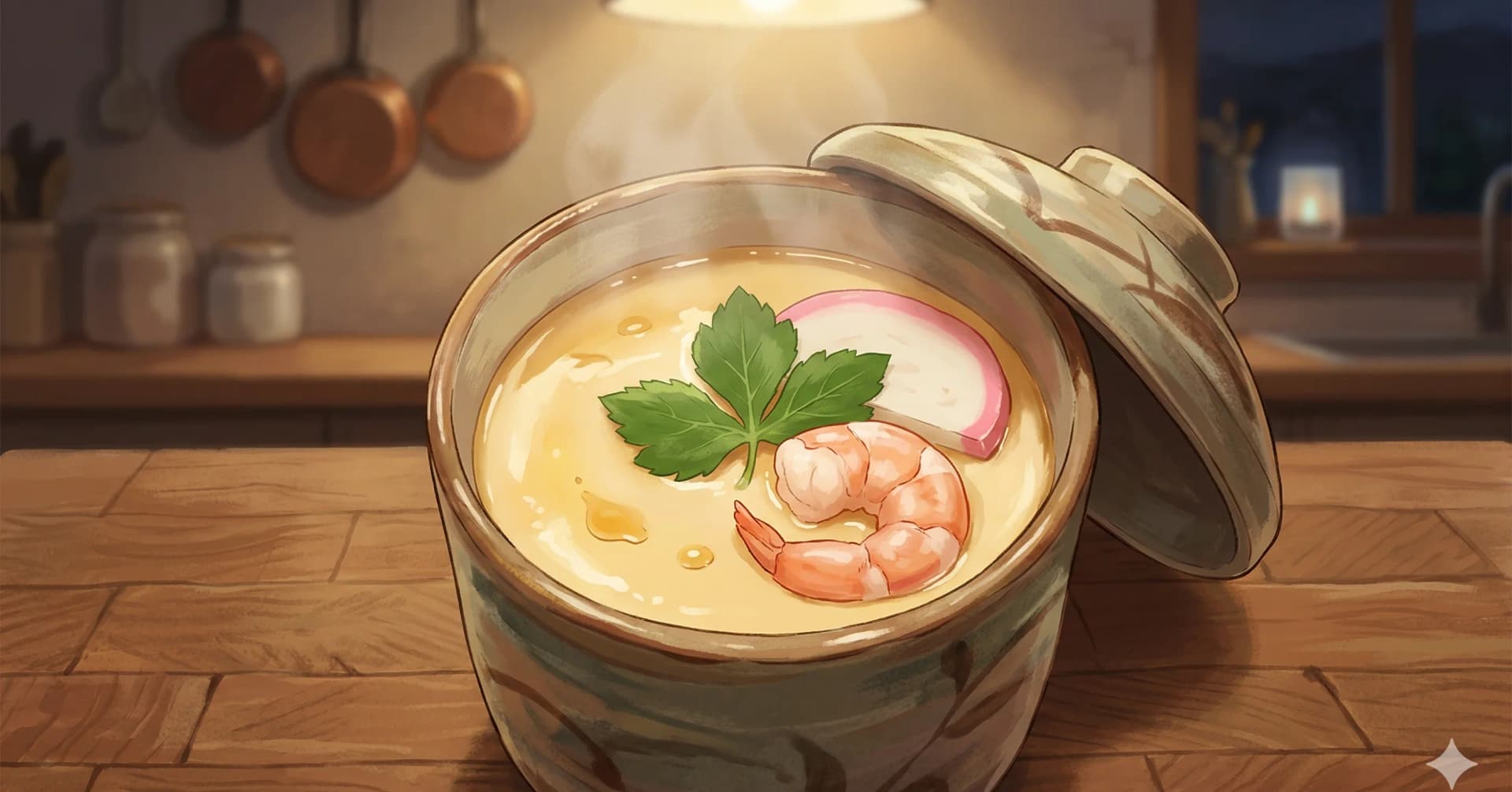
Japanese Cuisine
Chawanmushi (Japanese Savory Steamed Egg Custard)
A delicate steamed custard of dashi and egg, hiding small treasures of chicken, mushroom, and fish cake beneath its trembling surface
Chawanmushi means, quite literally, "steamed in a tea cup." The name tells you almost everything you need to know about this dish: it is small, it is gentle, and it belongs in a vessel you would hold carefully in both hands. In the landscape of Japanese home cooking, chawanmushi occupies a quiet but important place. It appears at the start of a meal or tucked between courses, offering a pause of soft texture and clean, saline warmth before richer dishes arrive.
The custard itself is little more than beaten egg thinned with dashi, the kelp-and-bonito stock that forms the backbone of so much Japanese cooking. The ratio matters: roughly one part egg to three parts dashi by weight, seasoned lightly with soy sauce and mirin. This produces a custard that barely holds together, trembling when you touch the cup and yielding instantly to a spoon. It is closer in spirit to a savory panna cotta than to a Western quiche or frittata.
What makes chawanmushi interesting is what you hide inside. Small pieces of chicken, slices of kamaboko fish cake, a shiitake cap, perhaps a ginkgo nut or a prawn. These are not toppings but buried ingredients, discovered as you eat your way down. Each spoonful is slightly different from the last. The technique is forgiving once you understand two things: strain the egg mixture so no chalazae or air pockets remain, and keep the steam gentle so the custard sets evenly without pitting or bubbling. If you have made Gyeran-jjim, the Korean steamed egg, you already understand the principle. Chawanmushi is its quieter, more refined cousin.
At a Glance
Yield
4 servings
Prep
20 minutes
Cook
25 minutes
Total
45 minutes
Difficulty
Medium
Ingredients
Custard Ingredients
Filling Ingredients
- 3½ ozchicken thigh or tenderloin, cut into 1 cm pieces
- 1 tbspsake (for marinating chicken)
- 4 sliceskamaboko (fish cake), about 5 mm thick
- 2fresh shiitake mushrooms, stems removed, caps quartered
- 1 ozshimeji mushrooms, trimmed and separated into small clusters (optional)
- 4small prawns, peeled and deveined (optional)
- 8ginkgo nuts, shelled and blanched (optional)
To Garnish
- 4 sprigsmitsuba (Japanese parsley), stems loosely knotted
- —Or a few leaves of flat-leaf parsley as a substitute
Method
- 1
Marinate the chicken. Toss the chicken pieces with the sake in a small bowl. Set aside for 10 minutes while you prepare the remaining ingredients. The sake draws out any raw odor and lightly seasons the meat.
- 2
Prepare the fillings. Remove and discard the shiitake stems. Quarter the caps. If using shimeji, trim the root cluster and separate into small bundles of 3 to 4 stems. If using prawns, pat them dry. Slice the kamaboko into half-moons or decorative shapes. If using ginkgo nuts, blanch them briefly in boiling water and slip off their thin skins.
- 3
Make the custard mixture. Crack the eggs into a medium bowl and beat gently with chopsticks or a fork. You want to combine the yolks and whites thoroughly without incorporating air. Avoid whisking vigorously. Add the cooled dashi, mirin, soy sauce, and salt. Stir until evenly combined.
- 4
Strain the mixture. Pour the custard through a fine-mesh strainer into a clean bowl or spouted measuring cup. Press any solids through with the back of a spoon. This step removes the chalazae and any small lumps, which is what gives the finished custard its perfectly smooth, glassy texture.
- 5
Fill the cups. Divide the marinated chicken among four chawanmushi cups or heatproof teacups (about 200 ml capacity each). Add the shiitake pieces, shimeji, prawns, ginkgo nuts, and kamaboko, distributing them evenly. Pour the strained custard mixture over the fillings until each cup is about 80 percent full. Use a spoon to gently pop any surface bubbles.
- 6
Prepare the steamer. Fill a pot or steamer base with water to a depth that reaches about halfway up the sides of the cups. Bring the water to a boil, then reduce the heat until the water is at a steady but gentle simmer, around 80 to 90 C (176 to 194 F). The water should not be at a rolling boil.
- 7
Steam the custards. Carefully lower the filled cups into the pot. If your cups have lids, place them on now. If not, cover each cup tightly with aluminum foil. Place the pot lid on top, leaving it very slightly ajar by inserting a chopstick or folded towel between the lid and the rim. This small gap lets excess steam escape and prevents the custard from overheating, which would cause it to pit and become spongy.
- 8
Cook at a gentle heat. Steam for 20 to 25 minutes over low heat. The custard is done when the surface looks set and pale yellow, and a thin skewer or toothpick inserted into the center comes out with clear liquid rather than milky, uncooked egg. The custard should jiggle gently when you tap the cup, like a just-set panna cotta. If the liquid runs cloudy, replace the lid and steam for another 2 to 3 minutes.
- 9
Garnish and serve. Place a knotted mitsuba sprig on top of each custard. Replace the lids and serve immediately or while still warm. Eat with a small spoon, working from the top down to discover the fillings nestled inside.
Key Ingredient Benefits
Dashi: The foundation stock of Japanese cuisine, made from kombu (kelp) and katsuobushi (dried bonito flakes). It is one of the purest expressions of umami in any culinary tradition. Kombu is naturally rich in glutamic acid, while bonito provides inosinic acid. Together they create a synergy that amplifies savory perception. Dashi is virtually calorie-free and contains trace minerals from the seaweed, including iodine. If you enjoy dashi-based soups, try Miso Shiru, the daily miso soup that uses the same stock as its base.
Eggs: Each egg contributes about 6 g of complete protein along with fat-soluble vitamins A, D, and E. The lecithin in egg yolks acts as a natural emulsifier, helping the custard maintain its smooth, homogeneous texture during steaming.
Shiitake mushrooms: Fresh shiitake add a woodsy, slightly meaty depth to the custard. They contain ergothioneine, an amino acid with antioxidant properties, and are one of the few plant-based sources of vitamin D when exposed to sunlight. Dried shiitake can be substituted; rehydrate them in cold water for several hours and use the soaking liquid as part of your dashi for added depth.
Ginkgo nuts: These small, jade-green nuts have a mild, slightly bitter flavor and a waxy texture that softens during steaming. They are a traditional chawanmushi filling and are also common in Oden, the simmered one-pot dish. In traditional Chinese and Japanese medicine, ginkgo nuts have been associated with respiratory health, though they should be eaten in moderation.
Why This Works
The egg-to-dashi ratio is the most important variable. At roughly 1 part egg to 2.5 parts dashi by weight, the custard sets into a texture that is barely solid, trembling and silky rather than firm or rubbery. A higher proportion of egg would produce something closer to a Western baked custard. A lower proportion and it would not set at all.
Straining the egg mixture is not optional. Egg whites contain chalazae, the twisted rope-like strands that anchor the yolk. If left in, these create small, firm white specks throughout the custard. Straining removes them entirely and also catches any unmixed egg white, producing a uniformly smooth result.
Gentle, indirect steam is the second critical factor. Egg proteins coagulate between 62 and 70 C (144 to 158 F). If exposed to temperatures much above 85 C, the proteins tighten aggressively and squeeze out water, creating the characteristic pitting and holes that signal an overcooked custard. Leaving the pot lid slightly ajar regulates the internal temperature and allows excess steam to vent.
Dashi itself contributes more than flavor. The glutamic acid from kombu and the inosinic acid from bonito flakes create a synergistic umami effect that is far greater than either compound alone. This is why dashi-based chawanmushi tastes so deeply satisfying despite containing very few ingredients.
Substitutions & Variations
Dashi alternatives: If you do not have kombu and bonito flakes, instant dashi granules (hondashi) dissolved in hot water work well. For a vegetarian version, use kombu dashi or shiitake dashi. Lightly salted chicken stock is a workable substitute, though the flavor profile will shift away from the traditional Japanese character.
Protein swaps: Replace the chicken with small cubes of firm white fish, scallops, or crab meat. For a vegetarian filling, use cubes of silken tofu, edamame, and lily bulb (yurine). The steaming time remains the same.
Kamaboko alternatives: If kamaboko is unavailable, use surimi (imitation crab sticks) cut into pieces, or simply omit it. The custard is still satisfying without it.
Mushroom options: King oyster mushrooms sliced into coins, enoki mushrooms in small bundles, or reconstituted dried shiitake all work in place of fresh shiitake and shimeji.
Toppings instead of fillings: For a more elegant presentation, steam the custard plain and place toppings like a single prawn, a small pile of ikura (salmon roe), or a dab of yuzu kosho on top after steaming. The warm custard gently warms the toppings without cooking them further.
Korean cousin: If you want a bolder, more rustic version of steamed egg, try Gyeran-jjim. It uses a higher egg-to-liquid ratio and is steamed vigorously in a hot stone pot, producing a puffier, more souffled texture.
Serving Suggestions
Chawanmushi is traditionally served as one element of a multi-course Japanese meal, usually early in the sequence. At home, it works beautifully alongside a bowl of steamed rice and Miso Shiru as part of a simple weeknight dinner. It also pairs naturally with noodle dishes like Udon, where its soft custard contrasts with the chew of thick wheat noodles. In cooler weather, serve it as a starter before a pot of Oden, where many of the same ingredients, such as kamaboko and shiitake, appear in a different form. For a breakfast that is gentle on the stomach, chawanmushi alongside Tamago Kake Gohan, the raw egg over rice dish, makes a protein-rich start to the day. A small cup of chawanmushi also makes a thoughtful addition to a bento box, packed warm in a thermos-style container.
Storage & Reheating
Refrigerator: Store covered chawanmushi cups in the refrigerator for up to 2 days. The custard will firm up slightly as it chills, which is normal.
Reheating: The best method is to re-steam the cups for 2 to 3 minutes over gentle heat until warmed through. Alternatively, microwave on low power (50 percent) in 30-second intervals. Avoid high heat, which will toughen the custard.
Not recommended for freezing: The high water content of the custard causes it to become grainy and weep liquid after thawing. Make chawanmushi fresh for the best texture.
Make-ahead tip: You can prepare the strained custard mixture and the fillings up to a day in advance. Store them separately in the refrigerator. When ready to cook, bring the custard mixture to room temperature, fill the cups, and steam as directed.
Cultural Notes
Chawanmushi (茶碗蒸し) gets its name from its vessel: a small lidded ceramic cup designed for drinking tea. That detail matters. It tells you the dish was conceived as a single intimate portion, kept warm under its own lid, not as something to share. It belongs to the kaiseki (懐石) repertoire and to careful home cooking, and the format hasn't really changed in centuries.
The technique is harder than it looks. You whisk egg with dashi at roughly a 1:3 ratio by volume, then steam it gently enough that the protein sets into a barely-trembling jelly rather than breaking into curds. Too much heat and you get pits and bubbles. Too little and it never sets. Japanese cooks judge each other's chawanmushi on surface alone: a mirror-smooth top, no craters, no fine bubbles. Anyone can taste whether it was done right.
The fillings shift through the year. Spring brings cherry blossom, young bamboo shoot, and mitsuba. Summer leans into cold uni and sweet pumpkin. Autumn means chestnut, matsutake, ginkgo nut. Winter wants lily bulb, taro, crab. This is the shun (旬) principle, the idea that an ingredient at its peak should set the menu rather than the other way around. Chawanmushi happens to be one of the cleanest expressions of shun in the Japanese kitchen.
It is also the dish you cook for someone who isn't well. Soft, warm, easily swallowed, full of dashi umami without anything sharp. Japanese mothers feed it to children with no appetite and to grandparents recovering from surgery. The cup itself sits comfortably in cupped hands, which is part of the point.
Nutrition Facts
Calories: 138kcal (7%)|Total Carbohydrates: 2g (1%)|Protein: 14g (28%)|Total Fat: 7g (9%)|Saturated Fat: 2g (10%)|Cholesterol: 175mg (58%)|Sodium: 480mg (21%)|Dietary Fiber: 0g (0%)|Total Sugars: 1g
You Might Also Like

Ratings & Comments
Ratings & Comments
Ratings
Share your thoughts on this recipe.
Sign in to rate and comment