Indian Cuisine
Spinach Lentil Fritters (Cheera Vada)
Kerala Urad Dal and Spinach Fritters
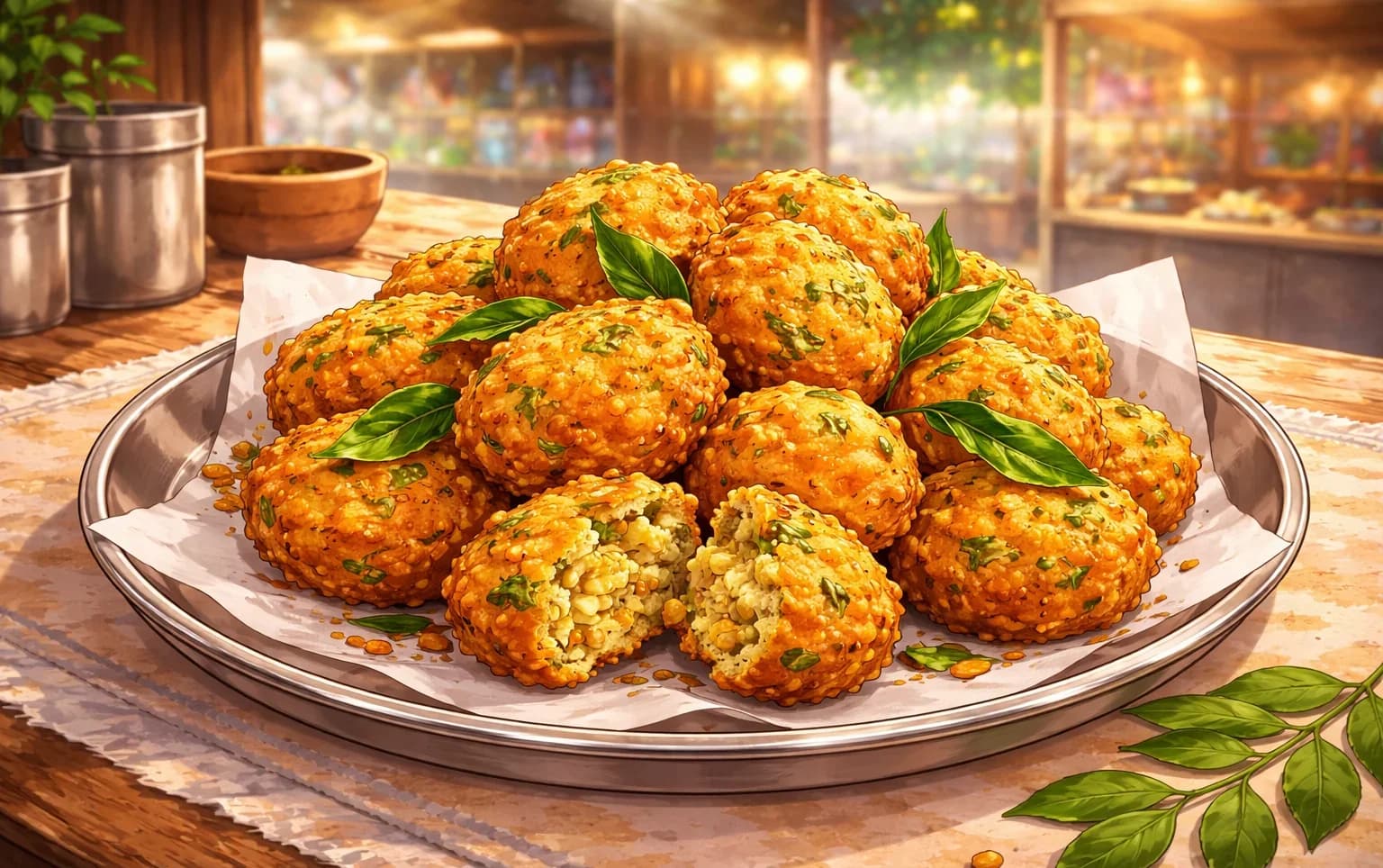
In Kerala, "cheera" is a broad, affectionate term for leafy greens, most often spinach, sometimes amaranth, and these leaves find their way into everything from simple stir-fries to the morning's first preparation. In cheera vada, they become part of a batter that is otherwise the same foundation as the medu vada: soaked urad dal whipped to an airy, cloud-like paste.
What makes this vada distinct is not the shape but the interior. Done correctly, the batter is not heavy. It should be light enough that a spoonful set on your palm leaves barely a trace of weight. The spinach, chopped fine and folded in at the end, adds a quiet earthiness and a speckled green interior visible only when you break one open, steam curling out from the centre.
The double-fry is essential, not optional. The first fry sets the shape and cooks the interior through, but the vada will be soft, almost spongy when lifted from the oil. Two minutes of rest off the heat lets the steam redistribute. The second fry is where the crust forms: genuinely crisp, with a faint shatter when you press it. That contrast between crackling shell and yielding interior is the whole point.
Asafoetida, dissolved briefly in water before being added to the batter, distributes evenly and contributes its characteristic warm, onion-like depth. Green chillies go in whole, slit and deseeded. You can leave the seeds if you prefer more heat. Curry leaves are non-negotiable. They belong here completely.
Serve immediately, while the crust holds, alongside freshly made coconut chutney. Cheera vada does not wait.
At a Glance
Yield
12–14 vadas
Prep
15 minutes (plus 1 hour soaking)
Cook
30 minutes
Total
1 hour 45 minutes
Difficulty
Medium
Ingredients
- ¾ lburad dal (split black gram, skinned)
- ⅓ tspasafoetida (hing), dissolved in 5 ml water
- 1⅔ tspsalt
- 2½ tbspgreen chillies, slit, deseeded (3–4 chillies), and finely chopped
- ¾ cupfresh curry leaves (about 2 sprigs), washed and dried thoroughly
- 3¼ ozfresh spinach or amaranth leaves, stems removed, washed, dried, and finely chopped
- —Oil, for deep frying
Method
- 1
Soak the dal. Wash the urad dal in two or three changes of cold water until the water runs clear. Cover with fresh cold water and soak for 1 hour. Drain thoroughly. Any excess water will make the batter slack and heavy.
- 2
Prepare the aromatics. Dissolve the asafoetida in 5 ml of water in a small bowl. Wash, slit, deseed, and finely chop the green chillies. Wash the curry leaves (2 sprigs) and dry them completely. Moisture on the leaves causes dangerous spattering in hot oil.
- 3
Grind the batter. Transfer the drained urad dal to a blender. Add water in very small quantities, beginning with 2 tablespoons and adding more only as necessary between additions. Aim for approximately 80 ml total across the entire grind. The finished batter should be very thick, pale, and airy. It must hold its shape when scooped onto your palm without spreading.
- 4
Test and mix. Drop a small ball of batter into a bowl of water. If it floats, the batter is properly aerated and ready. Transfer to a mixing bowl. Add the dissolved asafoetida water, salt, green chillies, and curry leaves. Beat vigorously with your hand or a wide spoon to aerate further.
- 5
Add the spinach. Remove stems, wash, dry, and finely chop the spinach. Fold into the batter gently but thoroughly until the leaves are evenly distributed throughout.
- 6
Heat the oil. Pour oil into a kadhai to a depth of at least 8–10 cm. Heat over medium-high flame. Test with a drop of batter; it should rise immediately to the surface.
- 7
Shape and first fry. Moisten your palm and a flat spatula with water. Scoop about 2 tablespoons of batter onto the spatula and flatten into a round approximately 5 cm in diameter. Dip your index finger in water and press through the centre to create a hole. Invert the spatula over the oil and gently release the vada. Fry over medium heat, turning once, until the vada is light golden, not deeply coloured. Remove and rest on a rack for 2 minutes.
- 8
Second fry. Return the rested vadas to the oil and fry again over medium heat until deeply golden and audibly crisp when tapped. Drain on paper and serve immediately.
Key Ingredient Benefits
Urad dal is among the most protein-dense legumes in the Indian pantry, carrying significant iron and B vitamins alongside. The soaking step reduces phytic acid, which can otherwise bind to minerals and limit their absorption. A practical reason behind a practice long predating nutritional science.
Asafoetida has a long tradition in Indian cooking as a digestive companion to legume-heavy dishes. Used in tiny quantities, it makes its presence felt. Whether the digestive benefit holds at culinary doses isn't well-established by clinical research, but the tradition is consistent across multiple regional cuisines.
Spinach contributes folate, iron, and vitamin K. Iron from plant sources is better absorbed alongside vitamin C; if you serve this with a lime-spiked chutney, you naturally improve iron bioavailability.
On deep frying: Oil uptake in vada is meaningfully lower than expected when the batter is correctly prepared (thick and aerated) and oil is at the right temperature. Vadas dropped into insufficiently hot oil absorb significantly more oil before the exterior sets.
Why This Works
The two-stage grind with minimal water produces the lightness that defines a medu-style vada. Urad dal ground with very little water traps air within its protein matrix. Adding too much water collapses those air pockets and produces a dense, leaden fritter. The floating test is the traditional quality check, and a reliable one.
The double-fry addresses the classic problem of a crust that softens as it cools. The first fry cooks the interior and sets the shape. The two-minute rest allows residual steam to escape rather than condensing against the crust from inside. The second fry, shorter but no less important, caramelises the exterior proteins and starches into a structural shell.
Dissolving asafoetida in water before adding ensures even distribution through the batter rather than uneven pockets.
Substitutions & Variations
- Amaranth for spinach: Traditional cheera in Kerala often refers to red or green amaranth rather than spinach. Both work; amaranth has a slightly more robust, mineral flavour.
- Adding ginger: A ½-inch piece of fresh ginger ground with the dal is common in many Kerala households and adds clean warmth.
- Without the hole: Drop spoonfuls of batter directly into oil for a rounder, more rustic dumpling, closer in form to a bonda but with the same flavour.
- Reducing chilli heat: Deseed all the chillies completely; the flavour remains but heat drops significantly.
Serving Suggestions
Cheera vada is best eaten within five minutes of leaving the oil. Serve with:
- Fresh coconut chutney: ground coconut, green chilli, ginger, tempered with mustard seeds and curry leaves
- Sambar for dipping: the tangy lentil broth counterpoints the richness of the fried batter
- As part of a Kerala breakfast alongside filter coffee
Storage & Reheating
Vadas are best eaten freshly fried. If you have leftovers, store in an airtight container at room temperature for up to 6 hours. Reheat in a preheated oven at 180°C for 8–10 minutes, or briefly re-fry in hot oil for 2–3 minutes. Do not refrigerate. Cold makes the interior dense and gummy.
Uncooked batter can be refrigerated for up to 24 hours. Bring to room temperature and beat briefly before frying.
Cultural Notes
Cheera vada (ചീരവട, "spinach fritter") is the Kerala variation of the broader South Indian vada family that incorporates finely chopped spinach (cheera) into a chana-dal-and-urad-dal batter base, producing a green-flecked savory fritter that is one of the standard Kerala tea-time snacks. The dish belongs to the broader category of seasonal vegetable vadas that Kerala home cooking produces from whatever leafy greens are available: cheera vada with red or green amaranth, ulli vada with onion, and palak vada with cultivated spinach in newer adaptations.
The technique starts with the dal soak and grind. Chana dal and a smaller portion of urad dal are soaked together for two to three hours, then drained and ground coarsely so the texture stays crumbly rather than smooth. Finely chopped fresh spinach (any tender leafy green works: traditional Kerala recipes use the local cheera amaranth varieties, but spinach, kale, or chard can substitute) is mixed into the ground dal along with chopped raw onion, ginger, green chilies, curry leaves, asafoetida, and salt. The mixture is portioned into small flat patties and deep-fried in coconut oil. Kerala cooking strongly prefers coconut oil over the vegetable oils used elsewhere in India, and the coconut oil contributes a faint nuttiness to the finished fritter.
The cultural place of cheera vada is the Kerala tea shop (chaya kada) snack tradition and the small home gathering. The fritters are typically prepared in mid-afternoon and consumed with a strong cup of milky chai or filter coffee around four or five o'clock, as the standard Kerala break between lunch and the late dinner hour. The dish also appears at the larger Onam and Vishu festival distributions across Kerala (the two main Kerala state holidays in August and April respectively), where seasonal greens are abundant and the vada format allows for serving large gatherings efficiently. The dish travels through the Kerala diaspora to the Gulf states (Dubai, Doha, Muscat, Riyadh) and increasingly to South Indian restaurants in North America and Europe, where Malayali cooks reproduce the Kerala tea-shop format for their displaced communities.
Nutrition Facts
Calories: 266kcal (13%)|Total Carbohydrates: 37g (13%)|Protein: 16g (32%)|Total Fat: 7g (9%)|Saturated Fat: 1g (5%)|Cholesterol: 0mg (0%)|Sodium: 812mg (35%)|Dietary Fiber: 11.6g (41%)|Total Sugars: 0.2g
You Might Also Like
Ratings & Comments
Ratings & Comments
Ratings
Share your thoughts on this recipe.
Sign in to rate and comment