Chinese Cuisine
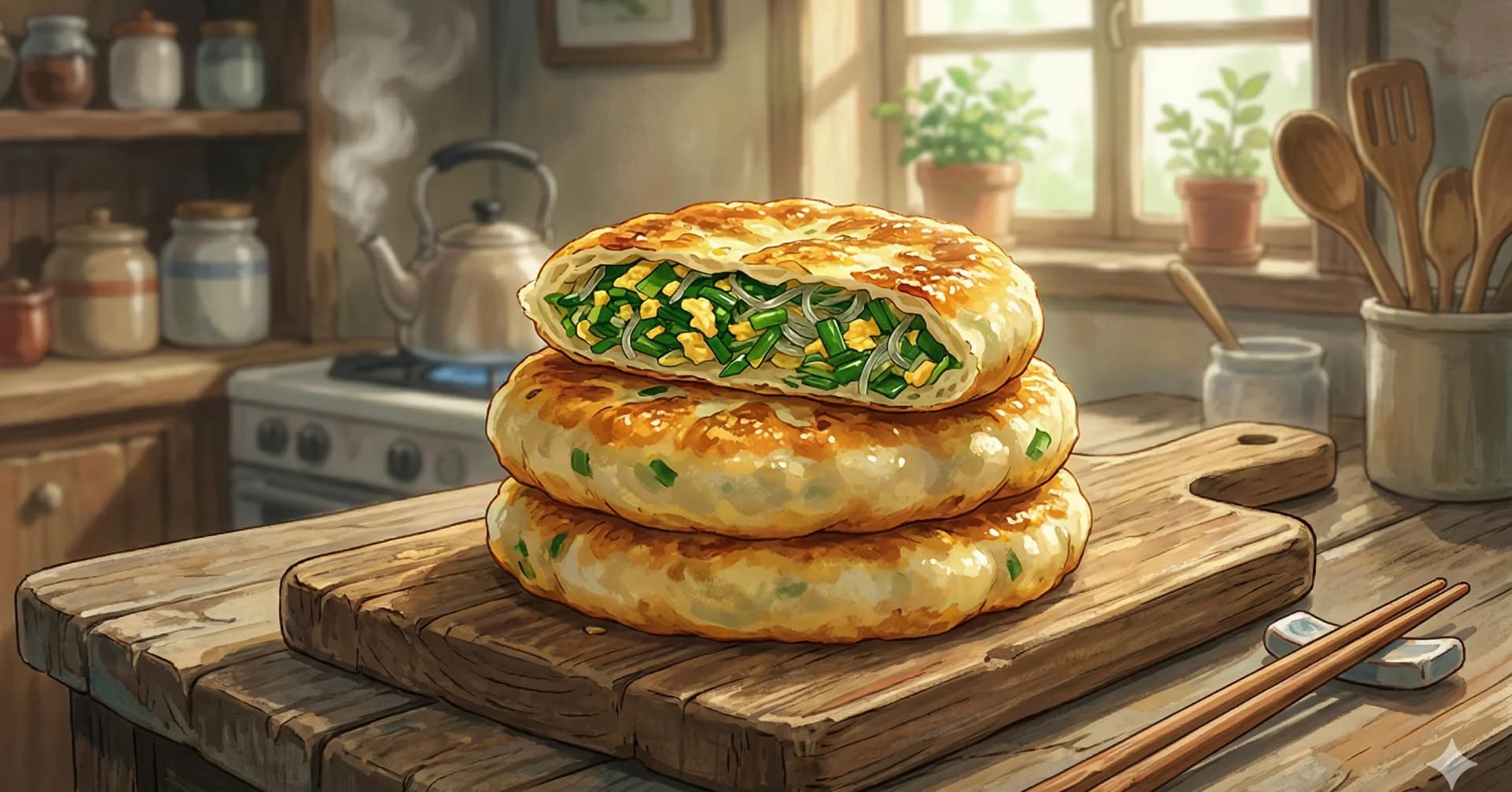
Jiu Cai He Zi (Chive Pancakes)
Crispy pan-fried flatbreads stuffed with Chinese chives, scrambled egg, and glass noodles
The first bite through the golden, blistered crust reveals a filling that is unmistakably aromatic: Chinese chives, with their bold, garlicky punch, softened just enough by the heat to release their fragrance without losing their bite. Mixed with ribbons of scrambled egg and slippery glass noodles, the filling is at once rich, savory, and satisfying, encased in a wrapper thin enough to shatter slightly when you bite down.
Jiu cai he zi are a northern Chinese staple, found at street stalls, night markets, and breakfast tables across the wheat-growing regions. They belong to the broad family of Chinese filled flatbreads, sitting alongside scallion pancakes and xian bing (meat pies) in the everyday repertoire. The filling of chives and egg is the most classic and most popular, though variations with shrimp, pork, or tofu exist.
Chinese chives (jiu cai) are not the same as Western chives. They are flat-leafed, pungent, and intensely garlicky, with a flavor that softens beautifully when enclosed in dough and pan-fried. Their season peaks in spring, when they are at their most tender and fragrant, and in northern China, the arrival of fresh spring chives is closely associated with the making of these pancakes.
The practical key is the dough. A hot water dough (made with boiling water) creates a wrapper that is soft, pliable, and easy to roll thin. It seals well, puffs slightly during cooking, and crisps to a golden finish without becoming tough or chewy.
At a Glance
Yield
6 pancakes
Prep
30 minutes
Cook
20 minutes
Total
50 minutes
Difficulty
Medium
Ingredients
Dough Ingredients
- 2 cupall-purpose flour
- ⅔ cupboiling water
- —Pinch of salt
Filling Ingredients
- 7 ozChinese chives (jiu cai), washed and dried
- 3large eggs
- 1 ozglass noodles (mung bean vermicelli), soaked and drained
- 1 tbspsesame oil
- 2 tsplight soy sauce
- ½ tspsalt
- ⅞ tspwhite pepper
For Frying
- 1 tbspvegetable oil (for scrambling eggs)
- 2 tbspvegetable oil, divided
Method
- 1
Make the dough. Place the flour and salt in a bowl. Pour the boiling water over it while stirring with chopsticks until a shaggy mass forms. When cool enough to handle, knead for 5 to 7 minutes until smooth and soft. The dough should be very pliable, not elastic like bread dough. Cover with a damp cloth and rest for 20 minutes.
- 2
Soak the glass noodles in hot water for 5 minutes, until soft and translucent. Drain and cut into short lengths, about 3 cm. Set aside.
- 3
Beat the eggs and scramble them in a lightly oiled skillet over medium heat, breaking them into small pieces. The eggs should be just set and not browned. Transfer to a large bowl and let cool.
- 4
Cut the Chinese chives into pieces about 5 mm long. Add them to the bowl with the scrambled eggs. Add the chopped glass noodles, sesame oil, light soy sauce, salt, and white pepper. Toss gently to combine. The filling should smell intensely garlicky and savory.
- 5
Divide the rested dough into 6 equal pieces. Roll each piece into a ball.
- 6
On a lightly floured surface, roll each ball into a thin circle about 18 cm in diameter. The dough should be thin enough to almost see through in places.
- 7
Place about 60 g of filling on one half of the circle, leaving a 1 cm border. Fold the other half over to create a half-moon shape. Press the edges firmly to seal, then fold the edge over itself or crimp with a fork for extra security.
- 8
Press the filled pancake gently with your palm to flatten it slightly and distribute the filling evenly. Be careful not to tear the dough.
- 9
Heat a large skillet over medium heat. Add about 5 ml of vegetable oil and swirl to coat.
- 10
Place 1 to 2 pancakes in the skillet (do not crowd). Cook over medium heat for 3 to 4 minutes per side, until the surface is golden brown and blistered with small pockets of air. Adjust the heat as needed to prevent burning.
- 11
The pancake is ready when both sides are deeply golden, the edges look slightly puffed, and the dough feels firm and crispy when tapped. The chives inside will have softened and released their fragrance, which you will smell clearly.
- 12
Transfer to a cutting board and let rest for 1 minute. Repeat with the remaining pancakes, adding more oil to the skillet as needed.
- 13
Cut each pancake in half or into wedges with a sharp knife or kitchen scissors. The filling should hold together, with the chives bright green and the egg golden.
- 14
Serve hot with a small dish of Chinkiang black vinegar for dipping.
Key Ingredient Benefits
Chinese chives (jiu cai) are rich in vitamin A, vitamin C, and contain allicin-like compounds similar to garlic. They have been traditionally used in Chinese medicine as a warming food associated with kidney health and blood circulation. Modern research supports their antioxidant properties.
Glass noodles (mung bean vermicelli) are made from mung bean starch. They are naturally gluten-free and provide easily digestible carbohydrates. Mung beans have been traditionally associated with cooling and detoxifying properties in Chinese dietary therapy.
Eggs provide complete protein and a range of micronutrients, including choline, which is essential for brain function.
Why This Works
The boiling water dough creates a softer, more pliable wrapper than cold water dough because the hot water partially gelatinizes the starch, which inhibits gluten development. This means the dough stretches easily without springing back, rolls thin without tearing, and remains tender when cooked rather than turning chewy.
Chinese chives release moisture as they heat, which means the filling must be assembled just before wrapping to prevent the liquid from soaking through the dough. The glass noodles act as a moisture absorber, soaking up the chive juices as they soften and preventing the filling from becoming too wet.
The scrambled egg serves as a binder, holding the filling together so it does not shift around inside the pancake. It also adds richness and fat, which carries the chive flavor and makes each bite more satisfying.
Substitutions & Variations
- Chinese chives: Regular Western chives are milder and thinner but can work. Increase the quantity by 50 percent and add a clove of minced garlic to compensate for the reduced pungency.
- Glass noodles: Finely shredded dried tofu skin (dou fu pi) is a traditional alternative that adds a chewier texture.
- Eggs: For a vegan version, replace the egg with crumbled extra-firm tofu seasoned with turmeric for color.
- With shrimp: Adding 100 g of chopped raw shrimp to the filling creates a more luxurious version. The shrimp will cook through during pan-frying.
- Shape variation: Some cooks roll the filling into a long cylinder, coil it into a spiral, and flatten it into a round pancake for a different presentation.
Serving Suggestions
Chive pancakes are typically served as a snack, breakfast item, or light meal. They pair well with a bowl of congee or millet porridge and some pickled vegetables. For a fuller meal, serve them alongside a simple soup and a cold dressed salad. They are also excellent as part of a dumpling and pancake spread, served alongside potstickers and scallion pancakes.
Storage & Reheating
Cooked chive pancakes can be stored in an airtight container in the refrigerator for up to 2 days. Reheat in a dry skillet over medium heat for 2 to 3 minutes per side to restore crispness. Microwave reheating softens the crust. Uncooked, assembled pancakes can be frozen in a single layer, separated by parchment paper, for up to 1 month. Cook from frozen, adding 1 to 2 extra minutes per side over medium-low heat.
Cultural Notes
Jiu cai he zi (韭菜盒子, "chive box") is the northern Chinese pan-fried filled flatbread of yeasted wheat dough wrapped around a filling of Chinese garlic chives (jiu cai), scrambled egg, and sometimes glass noodles or dried shrimp, sealed into a half-moon parcel and griddled until both sides are golden and the filling is hot through. The dish belongs to the broader northern Chinese tradition of filled flatbreads (xian bing) that includes related preparations with pork-and-cabbage, beef-and-onion, and seasonal vegetable fillings. The garlic chive version is the most strongly seasonal and the most strongly identified with home cooking rather than restaurant menus.
Chinese garlic chives (jiu cai) are distinct from Western chives and worth specifying. The plant produces long flat green leaves about the width of a pencil, with a pronounced garlicky aroma that is much stronger than Western chives or scallions. The leaves are sold in bundles at Chinese markets year-round, but the plant peaks in spring and early summer, and traditional northern Chinese home cooking treats spring chive pancakes as one of the seasonal milestones of the cooking year. The chives are washed, dried thoroughly (excess water turns the filling soggy), and finely chopped before mixing with scrambled egg and a small amount of sesame oil, salt, and white pepper.
The dough is the simpler half of the dish. A soft yeasted wheat dough (sometimes a hot-water dough for a more tender chew) is rolled into small rounds about four inches across. A spoonful of filling goes on one side, the dough folds over into a half-moon shape, and the edges are pleated or crimped tightly to seal. The filled pancake goes into a hot dry skillet (no oil or just a few drops) and is cooked over moderate heat for three to four minutes per side until the dough turns golden and the filling sets. The dish is served hot, often with a small dish of black vinegar and chili oil for dipping. In Beijing and broader northern home cooking, jiu cai he zi appears at family breakfasts, as a light lunch, and as a snack with afternoon tea, with the cook making a batch of twenty or thirty at a time to feed several meals over the next day or two.
Nutrition Facts
Calories: 271kcal (14%)|Total Carbohydrates: 37.9g (14%)|Protein: 8.7g (17%)|Total Fat: 9.2g (12%)|Saturated Fat: 1.5g (8%)|Cholesterol: 93mg (31%)|Sodium: 408mg (18%)|Dietary Fiber: 2.1g (8%)|Total Sugars: 0.8g
You Might Also Like
Ratings & Comments
Ratings & Comments
Ratings
Share your thoughts on this recipe.
Sign in to rate and comment