Punjabi · Indian Cuisine
Egg Curry (Anda Curry)
Hard-boiled eggs in a silky, golden onion-tomato masala
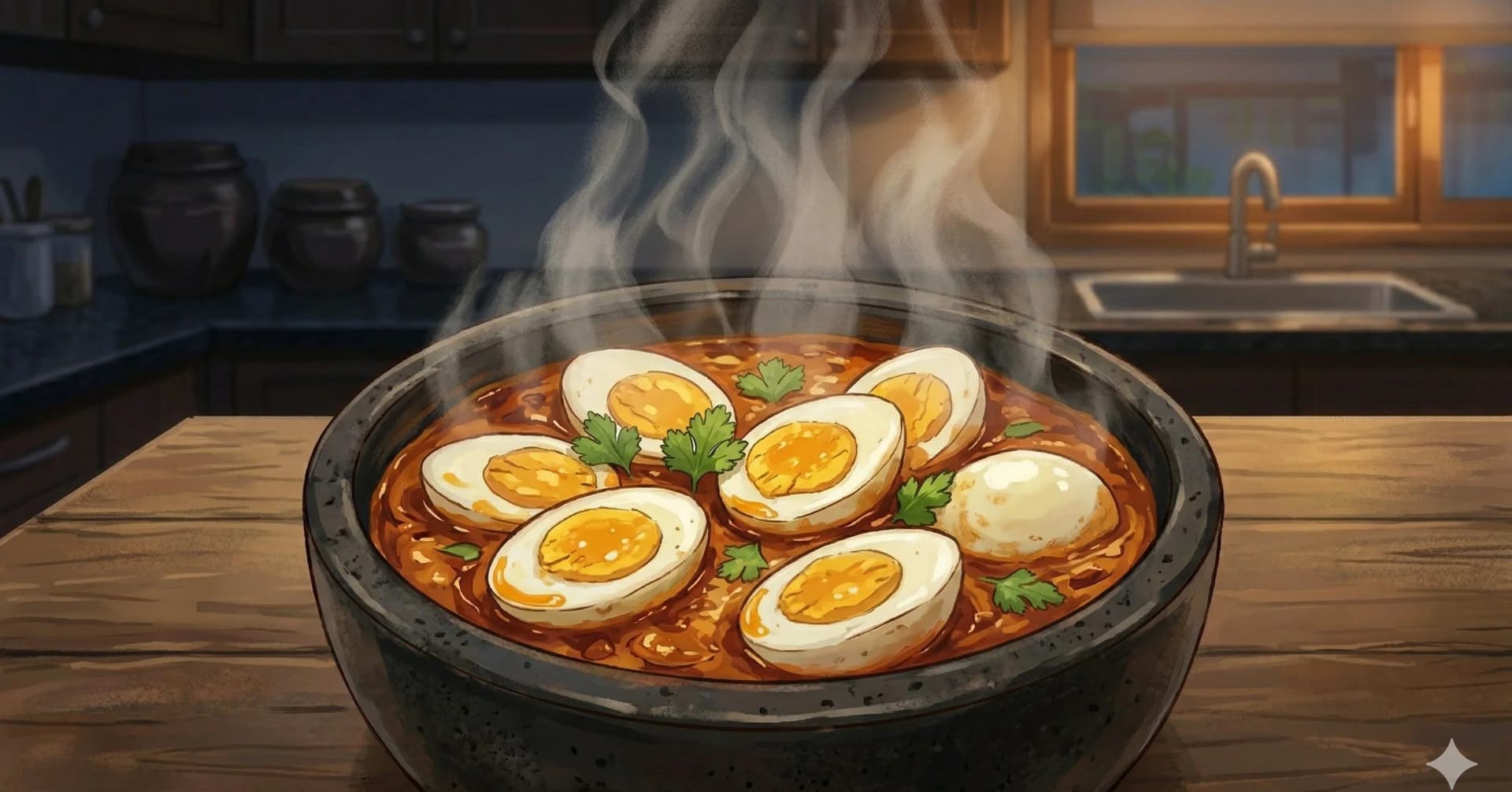
Crack the shell off a hard-boiled egg, score the white in a few places with a knife tip, and lower it into a simmering masala. Within minutes the gravy seeps into the cuts, staining the white gold, and the egg absorbs enough flavor to transform from something plain into something entirely satisfying. This is anda curry, and it is one of the most practical, unfussy dishes in the North Indian home kitchen.
Egg curry appears across India in countless regional variations. The Punjabi version tends toward a richer, creamier gravy built on onions cooked to a deep gold, tomatoes reduced until the oil separates, and a restrained blend of ground spices. It is not a complex curry. The masala exists to complement the egg, not to bury it. The finished gravy should be smooth, clinging, and just thick enough to coat a spoon.
In Punjabi households, anda curry occupies the space reserved for meals that come together quickly when the pantry is otherwise bare. Eggs are always available. Onions, tomatoes, ginger, garlic, and basic spices are the permanent fixtures of any Indian kitchen. The result is a dish that punches well above its ingredients in terms of comfort and satisfaction.
The practical note here is scoring the eggs before adding them to the gravy. Without cuts in the surface, the smooth white acts as a barrier, and the egg tastes bland against the rich masala. Scoring allows the gravy to penetrate, and simmering for even five minutes makes a noticeable difference.
At a Glance
Yield
Serves 4
Prep
15 minutes
Cook
30 minutes
Total
45 minutes
Difficulty
Easy
Ingredients
- 8large eggs
- 2⅔ tbspneutral oil or ghee
- 2⅓ tspcumin seeds
- 2bay leaves
- 3green cardamom pods, lightly crushed
- 3cloves
- 6½ ozonions (about 1–1½ onions), finely chopped
- 1 tbspginger-garlic paste
- 2green chillies, slit lengthwise
- 7 oztomatoes (about 1½–2 tomatoes), finely chopped (or 150 g canned crushed tomatoes)
- 2¾ tspred chilli powder
- 2¾ tspcoriander powder
- 1⅓ tspcumin powder
- 1⅛ tspturmeric
- 1 tspsalt
- 1 cupwarm water
- 1⅔ tspgaram masala
- 2 tbspcream (optional, for richness)
- ¾ cupfresh coriander, roughly chopped
Method
- 1
Boil the eggs. Place the eggs in a single layer in a saucepan and cover with cold water by 2 cm. Bring to a full boil over high heat. Once boiling, reduce heat to a gentle simmer and cook for 10 minutes. Transfer immediately to a bowl of cold water and let cool for 5 minutes. Peel carefully. The yolks should be fully set but not chalky or grey at the edges.
- 2
Score and optionally fry the eggs. Make 3 to 4 shallow cuts across each peeled egg with a knife, cutting about 3 mm into the white. This allows the gravy to penetrate. For a richer version, heat a tablespoon of oil in a small pan and fry the scored eggs for 2 to 3 minutes, turning gently, until the surface is lightly golden and blistered. This step is optional but adds texture and helps the eggs hold up in the gravy.
- 3
Start the tempering. Heat the oil or ghee (40 ml) in a wide, heavy-based pan over medium heat. Add the cumin seeds (5 g). When they begin to sizzle and release their toasted aroma (about 15 seconds), add the bay leaves (2), cardamom pods (3), and cloves (3). Let the whole spices sizzle for 30 seconds.
- 4
Cook the onions. Add the chopped onions (180 g) and stir to coat. Cook over medium heat for 10 to 12 minutes, stirring occasionally, until deep golden brown. The onions should be dark enough that the raw, sharp smell has been replaced entirely by a sweet, caramelized fragrance.
- 5
Add ginger-garlic paste and chillies. Add the ginger-garlic paste (15 g) and green chillies (2). Cook for 2 minutes, stirring, until the raw garlic smell fades.
- 6
Add tomatoes and ground spices. Add the chopped tomatoes (200 g), red chilli powder (5 g), coriander powder (5 g), cumin powder (3 g), turmeric (3 g), and salt (6 g). Stir well to combine. Cook over medium heat for 8 to 10 minutes, mashing the tomatoes with the back of a spoon, until the mixture is thick, the tomatoes have broken down completely, and the oil separates from the masala at the edges. This is the point at which the masala is properly cooked.
- 7
Add water and build the gravy. Add the warm water (250 ml) and stir well, scraping any browned bits from the bottom of the pan. Bring to a gentle boil, then reduce heat to low and simmer for 5 minutes. The gravy should be smooth and the consistency of a thick soup.
- 8
Smooth the gravy (optional). For a silky gravy, use an immersion blender or transfer to a blender and puree until smooth, then return to the pan. This step is a matter of preference. Some cooks prefer a chunkier gravy with visible onion pieces.
- 9
Add the eggs. Gently lower the scored eggs into the simmering gravy. Spoon gravy over each egg to coat. Simmer over low heat for 5 to 6 minutes, basting the eggs once or twice with the gravy. The cuts in the egg whites will absorb the golden masala, and the surface will take on a warm orange-gold color.
- 10
Add garam masala and cream. Sprinkle the garam masala (5 g) over the gravy and stir gently. If using cream (30 ml), drizzle it in now and swirl to incorporate. The cream rounds the acidity of the tomatoes and gives the gravy a velvety quality.
- 11
Finish with coriander. Remove from heat. Scatter the fresh coriander (15 g) over the top. Let the curry rest for 3 minutes before serving.
- 12
Serve. Transfer to a serving dish, arranging the eggs with the scored side facing up so the golden gravy lines are visible. Serve hot.
Key Ingredient Benefits
Eggs are a complete protein source, containing all essential amino acids. They are also a significant source of choline, vitamin D, and B12. The yolk contains the majority of the egg's nutrients, including fat-soluble vitamins A, D, E, and K. Concerns about dietary cholesterol from eggs have evolved in recent years, with research suggesting that for most people, moderate egg consumption does not significantly impact cardiovascular risk. Eggs have been a staple protein source in Indian cooking for centuries, particularly valued in households where meat consumption is limited.
Cumin (Cuminum cyminum) provides the warm, earthy base note of this masala. In Ayurvedic practice, cumin is traditionally used as a digestive aid, considered to stimulate agni (digestive fire). Research has explored cumin's potential effects on digestion and blood sugar regulation, though clinical evidence remains in early stages.
Tomatoes provide acidity and umami to the gravy. They are high in lycopene, a carotenoid that research suggests may have antioxidant properties. Cooking tomatoes in oil, as in this recipe, is associated with increased lycopene bioavailability.
Why This Works
Scoring the eggs before simmering in the gravy solves the fundamental problem of egg curry: the hard-boiled egg is, by nature, a sealed, smooth-surfaced protein with no way for flavor to enter. The cuts create channels for the masala to penetrate the white, and even a few minutes of simmering produces a noticeable difference in flavor when the egg is bitten into.
The optional frying step serves two purposes. It creates a lightly blistered, golden surface that has more texture than a plain boiled egg, and it partially seals the exterior so the egg holds together better during simmering. In many North Indian households, frying the eggs is considered essential rather than optional.
Cooking the onion-tomato masala to the point of oil separation ensures that the raw flavors of the alliums and the acidic sharpness of the tomatoes have been cooked out. What remains is a concentrated, savory base in which the ground spices have been fried rather than merely simmered. This is the same principle that applies across Indian masala cooking.
Substitutions & Variations
Boiled egg substitute: Paneer cubes (200 g, lightly fried) can replace the eggs for a different protein. The technique remains identical.
Creamier version: Replace the water with 150 ml of cashew paste (cashews soaked and blended smooth) for a Mughlai-style egg curry with a richer, nuttier gravy.
South Indian variation: Omit the cream and whole spices. Add mustard seeds, curry leaves, and a pinch of fenugreek to the tempering. Use tamarind paste (1 teaspoon) instead of tomatoes for a tangier, thinner gravy.
Spice level: For a milder curry, reduce the red chilli powder to half and use Kashmiri chilli powder for color without excessive heat.
Serving Suggestions
Egg curry pairs naturally with steamed rice, jeera rice, or any flatbread: roti, naan, or paratha. The gravy is designed to be spooned over rice or soaked up with bread. In a fuller meal, serve alongside a dry vegetable dish like aloo gobhi or bhindi masala, a dal, and a simple salad of sliced onions and cucumber. Egg curry is also excellent with biryani rice as a side gravy.
Storage & Reheating
Egg curry keeps in the refrigerator for up to 2 days. The eggs will firm up slightly as they sit in the gravy, which is not unpleasant. Reheat gently over low heat, adding a splash of water if the gravy has thickened. The gravy alone (without eggs) can be made a day ahead and refrigerated; add freshly boiled and scored eggs when reheating. Freezing is not recommended, as the texture of hard-boiled egg whites becomes rubbery after thawing.
Cultural Notes
Anda curry (अंडा करी, "egg curry") is the everyday Indian curry of hard-boiled eggs simmered in an onion-tomato gravy spiced with the standard North Indian spice profile: turmeric, kashmiri red chili powder, ground coriander, cumin, and garam masala. The dish is the egg-based parallel to chicken-curry-punjabi and serves as the everyday protein curry for vegetarians who eat eggs and for non-vegetarians who want a faster preparation than chicken or mutton. The dish appears across the Indian subcontinent in regional variations: the Punjabi version is rich with onion-tomato gravy, the Kerala version uses coconut milk and curry leaves, the Bengali version is lighter with mustard oil, and the South Indian version often adds tamarind and curry leaves.
The technique starts with the boiled eggs. Whole eggs are hard-boiled for ten to twelve minutes, peeled, and either left whole or scored with shallow cuts on the surface to help the gravy penetrate. Some traditional preparations also pan-fry the peeled eggs briefly in oil with turmeric and salt to develop a golden surface and a slightly chewy exterior, which adds textural contrast against the smooth gravy. The eggs are set aside while the curry base is prepared.
The gravy follows the standard North Indian onion-tomato format. Sliced onions are deeply browned in ghee or oil, ginger-garlic paste is added, then ground spices (turmeric, kashmiri red chili powder, ground coriander, cumin, garam masala) are bloomed in the oil, then chopped tomatoes are cooked until they break apart and form a thick masala paste. Water is added to thin the gravy to a curry consistency, and the boiled eggs are added for the last ten minutes so they absorb the spice without overcooking. The dish is finished with garam masala, fresh cilantro, and sometimes a swirl of cream. The pairing with roti, naan, or jeera-pulao is the standard household serving format. The dish is also a fixture of Indian railway food, served at the dining cars of long-distance trains and at the small refreshment stalls at major railway stations, where the long shelf life of boiled eggs and the easy reheating of the curry make it a practical large-scale meal preparation.
Nutrition Facts
Calories: 243kcal (12%)|Total Carbohydrates: 8.3g (3%)|Protein: 14g (28%)|Total Fat: 17.1g (22%)|Saturated Fat: 7.7g (39%)|Cholesterol: 392mg (131%)|Sodium: 189mg (8%)|Dietary Fiber: 1.4g (5%)|Total Sugars: 3.9g
You Might Also Like

Ratings & Comments
Ratings & Comments
Ratings
Share your thoughts on this recipe.
Sign in to rate and comment