Goan · Indian Cuisine
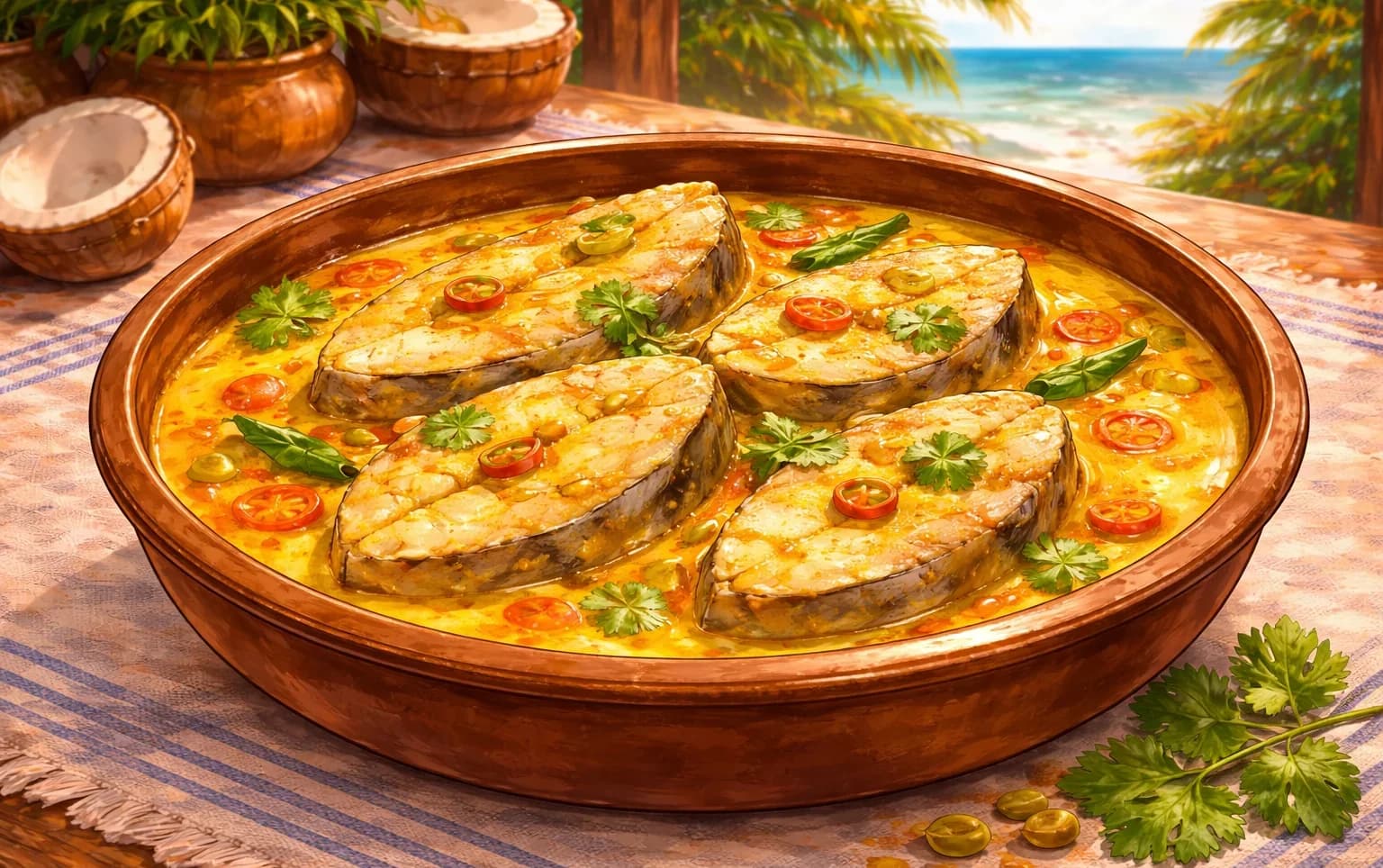
Fish Caldeen
A gently spiced Goan coconut milk curry with cumin, pepper, and a thread of vinegar
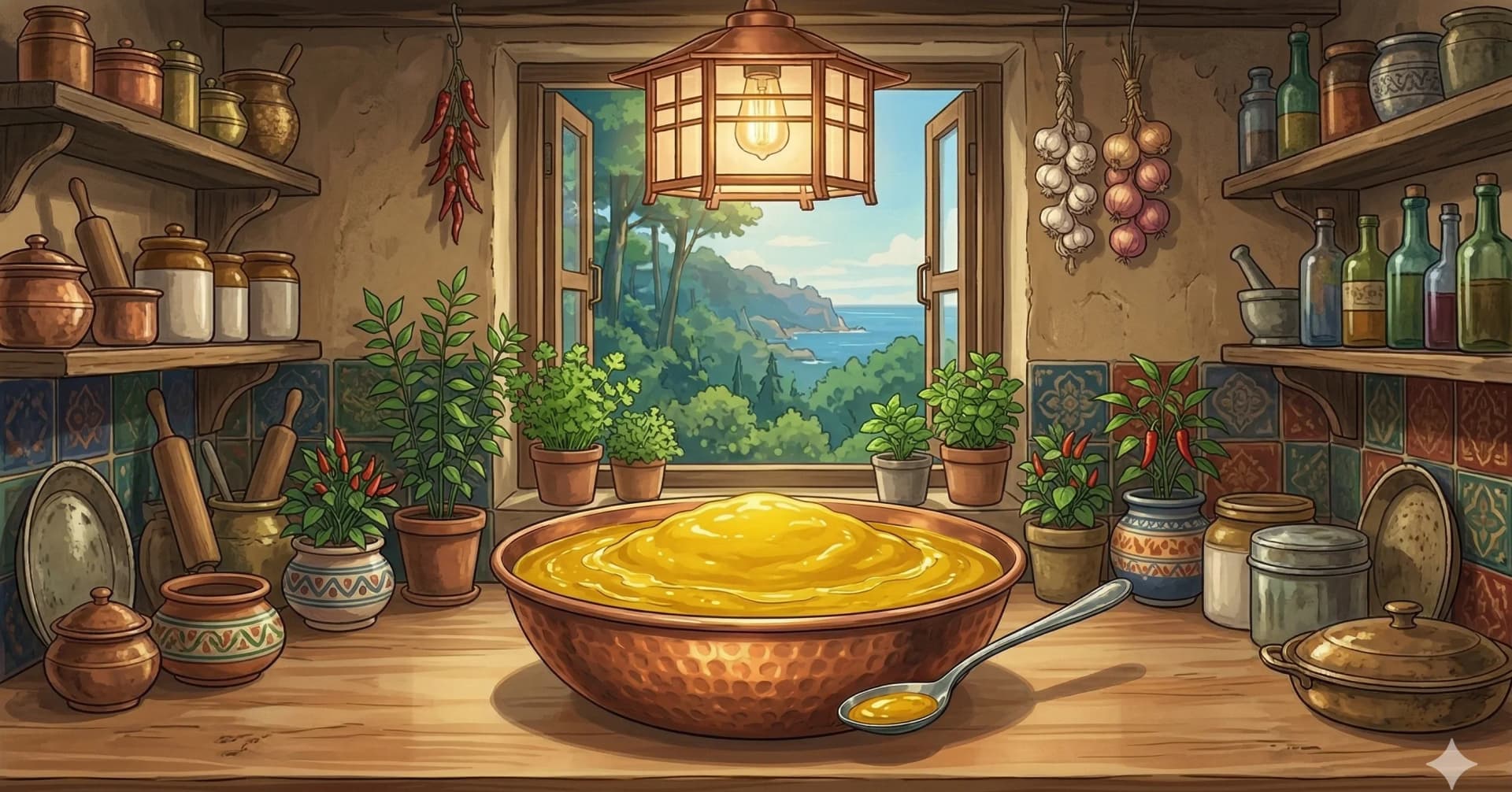
Not all Goan curries announce themselves loudly. Fish caldeen is the quiet counterpoint to the fiery, vinegared, red-stained vindaloo and the deeply spiced fish curry. A pale, almost delicate coconut milk preparation that suits days when the palate wants warmth rather than fire.
The sauce is built from coconut milk extracted in two stages: a thick first press for richness and a thinner second press for the cooking liquid. Ground together with the coconut are cumin, whole peppercorns, coriander seeds, and turmeric. Gentle heat and gentle spice, barely enough to colour the milk beyond the palest yellow. Sliced onion and tomato provide the savoury base. Green chillies bring freshness. The vinegar, just a tablespoon, closes the dish with a brightness that the coconut needs but cannot supply on its own.
The fish is added last, to the simmering coconut broth, and cooked only until it is done. No longer. Overcooking destroys the texture that makes caldeen worth eating: fish that flakes cleanly, holds its shape in the bowl, and drinks in the surrounding sauce without losing itself in it.
This is the food of Goan home kitchens, made quickly on weekday evenings, served with plain boiled rice in the way that is both the simplest and the most satisfying combination in this cuisine.
At a Glance
Yield
Serves 4
Prep
20 minutes
Cook
20 minutes
Total
40 minutes
Difficulty
Easy
Ingredients
Fish Ingredients
- 2¼ lbfirm white fish (such as pomfret, kingfish, sea bass, or snapper), cleaned and cut into steaks or large pieces
- 1⅔ tspfine salt, plus extra for salting the fish
Coconut Milk Ingredients
Curry Ingredients
- 5½ ozonions (about 1 onion), finely sliced
- 2¾ oztomatoes (about ½–1 tomato), roughly chopped
- 2 tbspneutral oil
- 1 tspgreen chillies (about 1–2 chillies), finely sliced
- 2 tspwhite vinegar
Method
- 1
Salt (2 teaspoons) the fish. Pat the fish pieces dry and season on both sides with a little salt. Set aside.
- 2
Make the coconut (150 g) milk. Place the grated coconut in a blender with the cumin (¼ teaspoon), peppercorns, coriander seeds (½ teaspoon), turmeric (½ teaspoon), and 100 ml of water. Blend until smooth. Strain through a fine sieve, pressing well. This is the thick coconut milk. Return the pressed coconut to the blender with another 200 ml of water, blend again, and strain. This is the thin coconut milk. Keep the two extracts separate.
- 3
Fry the base. Heat the oil in a wide pan over medium heat. Add the sliced onions (150 g) and fry for 6–7 minutes until soft and beginning to colour at the edges. Add the tomatoes (80 g) and cook for 3 minutes until softened.
- 4
Build the curry. Add the thin coconut milk to the pan. Bring to a gentle simmer and cook for 5 minutes.
- 5
Cook the fish. Add the salted fish pieces and the sliced green chillies (1–2 chillies) to the simmering broth. Cook over medium heat for 6–8 minutes, turning the fish gently once, until it is just cooked through. It should flake when pressed at its thickest point.
- 6
Add thick coconut milk and vinegar (10 ml). Add the thick coconut milk and vinegar. Heat gently for 2 minutes. Do not boil after adding the thick coconut milk, or it will separate. Adjust salt.
- 7
Serve immediately with plain boiled rice.
Key Ingredient Benefits
Fresh coconut milk contains medium-chain triglycerides (MCTs), particularly lauric acid, which has been studied for its antimicrobial properties and its distinctive metabolic pathway. Unlike most dietary fats, MCTs are rapidly absorbed and metabolised. Traditional Goan cooking relies on coconut not as a health ingredient but as a structural one. Its emulsifying fats create the sauce's characteristic body and smoothness.
Coriander seeds and cumin are both associated with digestive support in Ayurvedic tradition. In Goan cooking, they appear more often in ground spice pastes than as whole tempering spices. The coastal tradition grinds spices with coconut to form the foundational sauce, rather than tempering them in oil.
Why This Works
The two-press coconut milk technique (thick and thin) mirrors the approach used in Thai, Sri Lankan, and many South and Southeast Asian coconut curries. Thin coconut milk is used for cooking (it is more stable, less likely to split) while the thick milk is added at the end for richness, used briefly and gently. Combining both produces a sauce with depth and creaminess that neither press alone can achieve.
Adding vinegar at the very end preserves its acidity. Long cooking would cook it off, flattening the brightness it contributes. The quantity used here is small, but its effect is measurable: it lifts the coconut sweetness and provides the faint sourness that characterises Goan coastal cooking.
Substitutions & Variations
Canned coconut milk: Use one 400 ml can of full-fat coconut milk in place of the fresh extract. Use half the can for cooking and add the rest at the end. The flavour will be slightly different but the dish works well.
Prawns: Replace fish with large prawns (peeled). Reduce cooking time to 3–4 minutes.
Tamarind instead of vinegar: A small ball of tamarind dissolved in warm water provides a similar acidic note with a fruitier character. More traditional in some variations.
Serving Suggestions
Serve in shallow bowls over plain steamed rice. The pale, fragrant broth should flood the rice. A small bowl of prawn pickle or lime pickle alongside is traditional. As part of a Goan meal, caldeen pairs well with a more robust preparation. The contrast of mild and hot, pale and red, is a structural principle of the Goan table.
Storage & Reheating
Best eaten fresh, the same day. If storing, keep covered in the refrigerator for up to 1 day. Reheat very gently over low heat. Do not boil. The coconut milk can separate and the fish can overcook easily on reheating. Not suitable for freezing.
Cultural Notes
Caldeen (कलडीन, also spelled caldine) is the Goan mild coconut-based fish curry that sits at the gentler end of the Goan fish curry spectrum, distinguished from the sharp ambotik and the standard goan-fish-curry by its lighter coloring, milder spicing, and the absence of aggressive heat. The dish uses turmeric for color (rather than kashmiri red chili), green chilies for gentle heat, ginger and garlic, a few coriander seeds, and a generous amount of thick coconut milk as the gravy base. The dish is most commonly associated with the Goan Catholic Sunday lunch tradition and the everyday meal of older Goan family households.
The word caldeen derives from the Portuguese caldo (broth), reflecting the dish's hybrid Portuguese-Goan origin. The Portuguese colonial era brought broth-based and stew-based cooking techniques to the Goan kitchen, and caldeen represents one of the gentler Goan adaptations of these techniques: a creamy mild stew that pairs naturally with steamed rice and that suits the eating preferences of children and elderly diners alongside the spicier ambotik and recheado preparations that anchor the main Goan meal.
The technique cooks the fish gently in the coconut gravy. White-fleshed fish (typically pomfret, sole, or seer fish) is cut into thick fillets, rubbed with turmeric and salt, and set aside. A base of sliced onions, ginger, garlic, slit green chilies, and a small amount of coriander powder is sautéed in coconut oil until the onions are translucent (not brown, since the dish should stay pale). Thin coconut milk is added and brought to a gentle simmer, then the fish is added and cooks for eight to ten minutes until just done. Thick coconut milk is added off the heat for richness, along with a small squeeze of lime for brightness. The dish is finished with fresh curry leaves and chopped cilantro. The dish appears at Goan family Sunday lunches alongside rice, sometimes paired with a sharper accompanying preparation like a vegetable foogath or a small dish of Goan pickle for textural and flavor contrast.
Nutrition Facts
Calories: 539kcal (27%)|Total Carbohydrates: 13.2g (5%)|Protein: 53.2g (106%)|Total Fat: 32.3g (41%)|Saturated Fat: 23g (115%)|Cholesterol: 125mg (42%)|Sodium: 191mg (8%)|Dietary Fiber: 7g (25%)|Total Sugars: 4.9g
You Might Also Like
Ratings & Comments
Ratings & Comments
Ratings
Share your thoughts on this recipe.
Sign in to rate and comment