Chinese Cuisine
Jianbing (Chinese Breakfast Crepe)
A crispy, savory street food crepe with egg, scallion, cilantro, hoisin, and a crunchy fried cracker
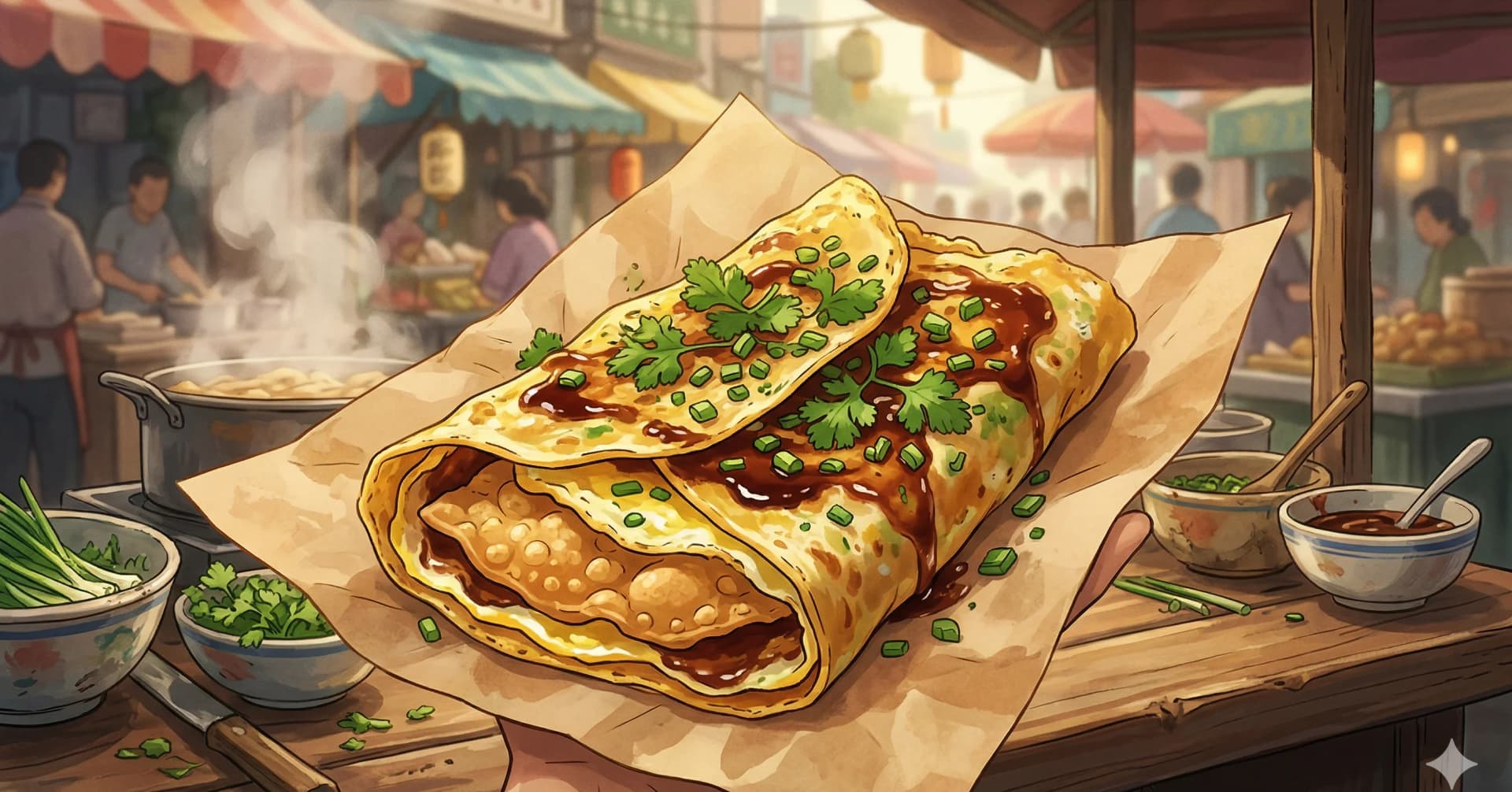
Every morning across northern China, the jianbing vendors set up their carts. The large, round griddle heats up, and within minutes the line forms. The process is mesmerizing to watch: a thin batter is spread across the griddle in a perfect circle, an egg is cracked on top and spread with a quick swipe, scallions and cilantro are scattered over the surface, a layer of sauce is brushed on, and then the crucial element, a crispy fried cracker, is laid in the center before the whole thing is folded into a neat packet. The first bite delivers everything at once: the crispy shatter of the cracker, the softness of the crepe, the richness of the egg, the sharp sweetness of the hoisin, and the fresh bite of scallion and cilantro.
Jianbing originated in the Shandong region and has become one of the most popular breakfast street foods in all of China. It is fast food in the truest sense, assembled in under two minutes by practiced hands, wrapped in a bag, and eaten on the walk to work. Despite its speed, every element has a purpose: the batter, traditionally made with mung bean flour, cooks thin and crispy. The egg provides protein and binds the toppings. The cracker adds the textural crunch that makes the whole thing addictive.
The practical key for home cooks is the pan. A large, flat, non-stick skillet or crepe pan is essential. The batter must be spread thin and evenly, and it needs a surface it will not stick to. If you have a crepe pan, this is its moment. Practice the spreading motion before you add batter: it should be a quick, confident swipe from the center outward.
At a Glance
Yield
4 crepes
Prep
15 minutes
Cook
20 minutes
Total
35 minutes
Difficulty
Medium
Ingredients
Batter Ingredients
To Assemble
- 1large egg
- ⅓ cupscallions, finely chopped
- ½ cupfresh cilantro, roughly chopped
- 2 tsphoisin sauce
- 1 tspchili sauce or Sriracha (optional)
- 1fried wonton wrapper or fried thin cracker (see note)
- —Vegetable oil for cooking
For Frying
- 8square wonton wrappers
- —Vegetable oil for frying
Method
- 1
Make the batter. Combine the mung bean flour, all-purpose flour, and salt in a bowl. Add the water gradually while whisking to create a smooth, thin batter with no lumps. It should have the consistency of heavy cream. Let it rest for 10 minutes.
- 2
Prepare the crispy crackers. Heat about 2 cm of vegetable oil in a small pan to 180°C. Fry the wonton wrappers one at a time for 15 to 20 seconds per side, until golden and crispy. They will puff up slightly and become rigid. Drain on paper towels. These can be made ahead.
- 3
Set up your assembly station near the stove. Have the batter, eggs, scallions, cilantro, hoisin sauce, chili sauce, and fried crackers all within arm's reach. Jianbing assembly happens fast.
- 4
Heat a large non-stick skillet or crepe pan over medium heat. Brush with a thin layer of vegetable oil.
- 5
Stir the batter (it settles). Pour about 80 ml of batter onto the center of the pan. Using the back of a ladle or a crepe spreader, quickly spread the batter in a thin, even circle, working from the center outward. The layer should be very thin, almost translucent in places.
- 6
Let the crepe cook for about 30 seconds, until the surface begins to set and the edges start to dry.
- 7
Crack an egg directly onto the surface of the crepe. Use the back of a spoon or a spatula to spread the egg quickly and evenly across the entire surface. Work fast, as the egg will begin to set immediately.
- 8
Before the egg is fully set, scatter chopped scallions and cilantro across the surface. Let the egg finish setting, about another 30 seconds. The surface should be firm and opaque.
- 9
Flip the entire crepe in one confident motion. Cook the egg side down for 20 to 30 seconds, until the egg is golden in spots.
- 10
Flip back to egg side up. Brush hoisin sauce across the surface. Add chili sauce if desired. The sauces should cover most of the surface in a thin, even layer.
- 11
Place a fried wonton cracker (or two, slightly overlapping) in the center of the crepe.
- 12
Fold the crepe: fold the left third over the center, then fold the right third over that, creating a long rectangle. Then fold the bottom up and the top down to create a neat packet, or simply fold in half.
- 13
Slide the folded jianbing onto a plate or into a paper wrapper. Cut in half if desired.
- 14
Repeat with the remaining batter. Serve immediately, while the cracker inside is still crunchy.
Key Ingredient Benefits
Mung bean flour is naturally gluten-free (though it is combined with wheat flour in this recipe) and is a source of plant protein, fiber, and B vitamins. Mung beans have been traditionally associated with cooling and detoxifying properties in Chinese dietary therapy.
Eggs provide complete protein, choline, and a range of B vitamins. Each jianbing contains one egg, making it a relatively protein-rich breakfast option.
Cilantro is a source of vitamins A and K and contains natural chelating compounds. Its distinctive flavor is a signature element of the jianbing experience.
Why This Works
Mung bean flour gives the crepe its characteristic flavor and crispness. It has a slightly earthy, savory taste that regular wheat flour alone does not provide, and it crisps more effectively due to its different starch composition. The combination of mung bean and wheat flour creates a batter that is strong enough to hold together when spread thin but crispy enough to provide texture.
Spreading the egg directly on the partially set crepe is the genius of the jianbing. The egg bonds with the crepe's surface as it cooks, creating a single, integrated layer rather than two separate ones. This makes the finished product easier to fold and eat, and ensures that every bite contains both crepe and egg.
The fried cracker is not optional. It is the textural heart of the dish, providing the crunch that contrasts with the soft crepe and the saucy toppings. Without it, a jianbing is pleasant but unremarkable. With it, the interplay of textures elevates the entire experience.
Substitutions & Variations
- Mung bean flour: Chickpea flour (besan) is the most accessible substitute and produces a similar flavor and texture. Pure wheat flour works but lacks the distinctive taste.
- Crispy cracker: A Chinese you tiao (fried dough stick), torn into pieces, is the traditional premium filling. Fried breadstick pieces, crispy shallots, or even crushed tortilla chips can substitute for the crunch element.
- Sauces: Tianmianjiang (sweet wheat paste) is the more traditional sauce in some regions, used instead of or alongside hoisin. Fermented tofu (fu ru) mixed into a paste is another traditional option.
- Additions: Shredded lettuce, pickled mustard greens, or a slice of Chinese ham can be added before folding.
- Gluten-free: Use 100 percent mung bean flour or chickpea flour for the batter, and substitute the wonton cracker with a rice cracker.
Serving Suggestions
Jianbing is a complete breakfast on its own, designed to be eaten on the go. It pairs naturally with a cup of hot soy milk (dou jiang) or a bowl of congee. For a more substantial brunch spread, serve alongside other Chinese breakfast items: steamed buns, soy milk, and pickled vegetables. Jianbing can also serve as a satisfying snack or light lunch.
Storage & Reheating
Jianbing is strictly an eat-now food. The cracker inside begins to soften within minutes of assembly, and the crepe loses its crispness as it cools. The batter can be made up to 1 day ahead and refrigerated, and the fried crackers can be made several hours ahead and stored in an airtight container. But the final assembly and cooking must happen just before eating. There is no way to reheat a jianbing and restore its original texture.
Cultural Notes
Jian bing (煎餅, "fried pancake") is the northern Chinese street breakfast crepe that originated in Shandong province and Tianjin and spread across the country as the prototypical morning street food. The dish is a thin batter pancake (made from a mixture of wheat and mung bean or millet flour) cooked on a circular flat griddle, topped with an egg cracked directly onto the cooking surface, brushed with sweet bean sauce and chili sauce, scattered with scallion and cilantro, layered with a sheet of fried crispy bao cui (薄脆, thin and crispy fried wheat cracker), folded into a rectangular packet, and served in a paper bag for the customer to eat on the way to work.
The dish is the standard morning food for tens of millions of office workers and students across north and central Chinese cities, where jianbing carts park near subway stations, office buildings, and university campuses from five in the morning until ten or so. The cook at a jianbing cart performs the assembly in about ninety seconds: ladle batter onto the hot griddle, spread it with a wooden T-shaped spreader into a thin disc, crack an egg on top and spread it with the same tool, flip the pancake to cook the other side briefly, brush with sweet bean and chili sauces, add scallion and cilantro, place the bao cui in the center, fold the pancake into a square packet over the bao cui, and hand it to the customer in a paper sleeve.
The Tianjin version (jian bing guo zi, "jianbing wrapping fried dough") is widely regarded as the original and most refined form. The Tianjin version uses a mung bean flour batter (which gives the pancake a faint nuttiness and a yellow color), and the cracker filling is a specific fried dough strip called guo zi rather than the more generic bao cui. The Tianjin Municipal Government has issued a formal recipe specification for the dish, and the city's traditional jianbing masters operate with apprenticeship lineages that go back multiple generations. The Beijing version is similar but slightly less precise about the cracker filling and more generous with the chili sauce, and the Shanghai version often adds Western-style ham, lettuce, and even cheese as the dish travels into more fusion territory.
Nutrition Facts
Calories: 240kcal (12%)|Total Carbohydrates: 32.3g (12%)|Protein: 6.1g (12%)|Total Fat: 9.2g (12%)|Saturated Fat: 0.5g (3%)|Cholesterol: 47mg (16%)|Sodium: 420mg (18%)|Dietary Fiber: 1.3g (5%)|Total Sugars: 1.1g
You Might Also Like
Ratings & Comments
Ratings & Comments
Ratings
Share your thoughts on this recipe.
Sign in to rate and comment