Maharashtrian · Indian Cuisine
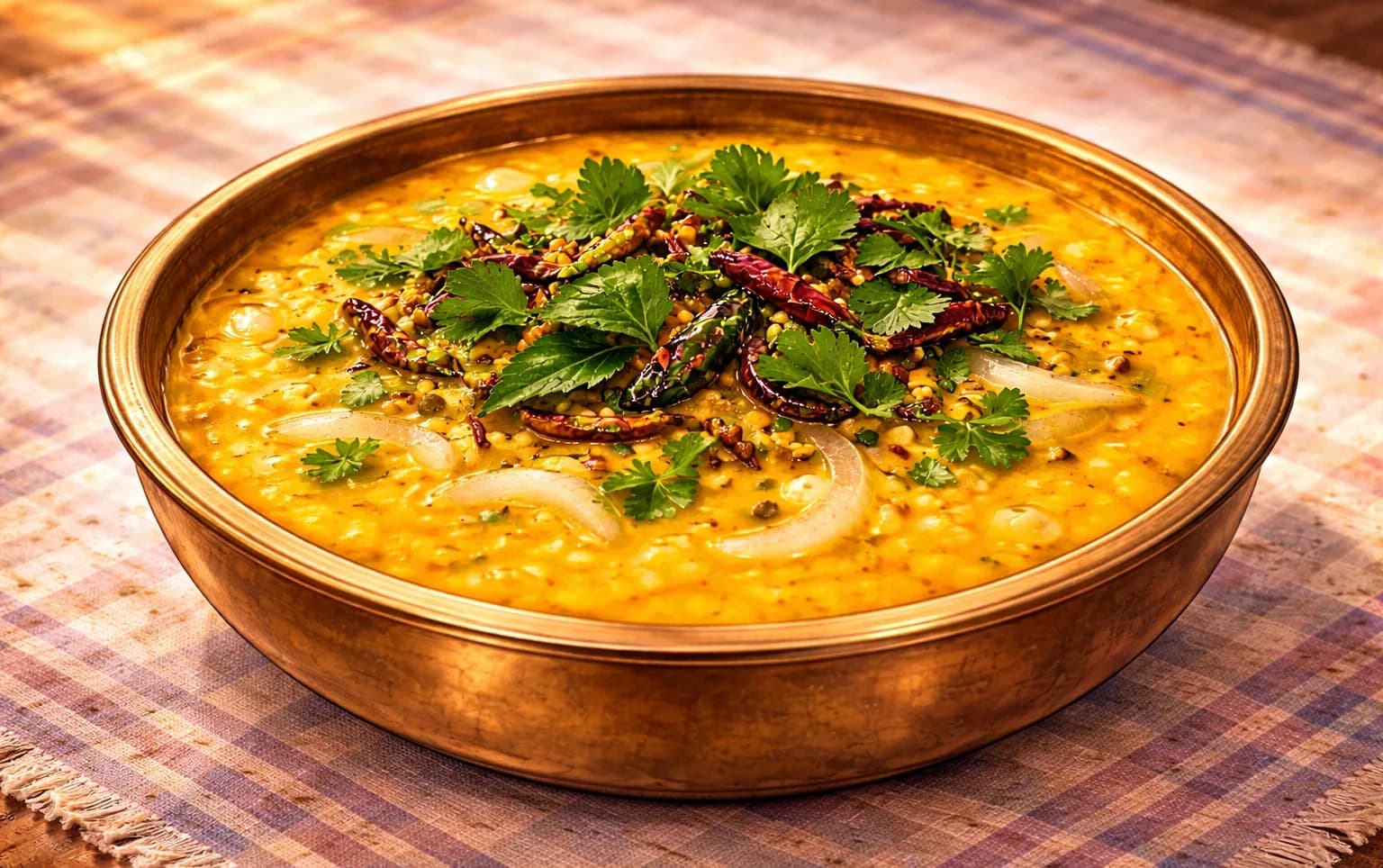
Onion Coconut Curry (Kandyache Pitley)
Maharashtra's thick onion and chickpea flour preparation — spiced, stirred to smoothness and eaten with rice or bhakri
Maharashtrian village cooking has a genius for making chickpea flour do everything. Pitley is the simplest expression of this. No deep-frying, no battering, no elaborate technique. Just besan, water, onion, a tempering of mustard seeds and curry leaves, and continuous stirring. The result is something between a thick porridge and a very soft polenta: golden, slightly elastic, deeply savory.
"Kandya" means onion in Marathi. "Pitley" comes from the verb "pitne," meaning to grind or press. The name captures both the ingredient and the technique: the onions are cooked until soft and giving, and the besan is worked in gradually until it transforms from a grainy slurry into a smooth, uniform mass.
This is farmhouse food. Sustaining and quick, made from what the pantry always holds. It appears on tables across Maharashtra as a side with rice or as the main event with a thick jowar or bajra bhakri. In its simplicity it is unassailable. The mustard seeds crackle and release their heat; the curry leaves perfume the oil before the onions arrive; garlic gives the preparation a low sweetness as it softens. The besan comes in slowly, with constant stirring. The moment you stop, lumps form and the texture is lost. Patience with the spoon is the only skill required.
It is one of those dishes you can make start to finish in under 20 minutes, eat from the pan if you like, and feel fully fed after.
At a Glance
Yield
4 servings
Prep
10 minutes
Cook
15 minutes
Total
25 minutes
Difficulty
Easy
Ingredients
- 2¼ cupbesan (chickpea flour)
- 3½ ozonion (about ½–1 onion), finely chopped
- ½ cupgarlic, finely chopped
- 1⅔ tspmustard seeds
- ⅓ cupcurry leaves (about 10–12 leaves)
- 1⅞ tspturmeric powder
- 1⅔ tspsalt, or to taste
- 1¾ tbspred chilli powder
- ½ cupcoriander leaves, chopped, to garnish
- 2 tbspoil
- 1¾ cupwater (approximately)
Method
- 1
Temper the oil. Heat oil in a wide, heavy-bottomed pan over medium heat. Add the mustard seeds. Wait for them to crackle and pop. This takes 30–45 seconds. Once they are popping, add the curry (10–12 leaves) leaves (stand back; the leaves will spit in the hot oil). Let the curry leaves crisp for 20 seconds.
- 2
Add aromatics and spices. Add the chopped garlic first, then the chopped onion. Stir and cook over medium heat for 5–6 minutes until the onion is translucent and soft. Add the turmeric powder and red chilli powder. Stir through.
- 3
Season and add water. Add the salt and pour in approximately 400 ml water. Stir to combine. Bring to a gentle simmer.
- 4
Add besan. This is the critical step. Lower the heat to medium-low. Begin adding the besan gradually, a small handful at a time, while stirring continuously with a wooden spoon or whisk. Do not stop stirring. As you add more besan, the mixture will thicken. Continue stirring to prevent lumps.
- 5
Cook until smooth. Once all the besan is incorporated, continue cooking over low heat, stirring constantly, for 6–8 minutes. The pitley will pull away from the sides of the pan, develop a sheen, and the raw smell of besan will give way to a nutty, cooked aroma. Taste for salt. The texture should be smooth, thick, and hold its shape softly when spooned.
- 6
Serve. Turn out onto plates or serve directly from the pan. Garnish with chopped coriander. Eat hot.
Key Ingredient Benefits
Besan (chickpea flour): High in plant protein (approximately 22 g per 100 g) and dietary fiber, with a lower glycemic index than refined wheat flour. It is one of the most important protein sources in traditional Indian vegetarian cooking. Besan is naturally gluten-free.
Mustard seeds: The crackled seeds contribute their oil-soluble flavor compounds to the cooking medium. They are widely used as a tempering spice across South and West Indian cuisines.
Curry leaves: Fresh or dried, curry leaves have an unmistakable warm, slightly citrusy fragrance. Use fresh when you can. Dried curry leaves are substantially less aromatic.
Garlic: Used here for savoury depth, not sharpness. By the time it softens in the oil with the onions, most of its pungency has mellowed. Traditional cooking attributes many digestive and warming properties to garlic; research on its cardiovascular effects continues.
Why This Works
The tempering of mustard seeds in hot oil is a flavour extraction technique. The heat causes the seeds' volatile compounds (particularly allyl isothiocyanate) to bloom into the oil, creating a foundation of sharp, pungent warmth that seasons everything added after it.
The slow addition of besan to a simmering liquid, with constant stirring, hydrates the starch granules gradually and evenly. Adding besan all at once to liquid produces clumps because the outer starch granules hydrate and form a barrier before the inner ones are reached. Gradual addition and continuous motion prevent this.
Besan gelatinizes at a lower temperature than wheat flour, and it browns at the edges before sticking. The signs of properly cooked besan are the toasted smell and the way the paste pulls cleanly from the pan.
Substitutions & Variations
- Onion-free version: Pitley can be made without onion (just garlic, or just tempering) for those who avoid it. The result is leaner but still satisfying.
- Adding tomato: Some home cooks add a chopped tomato with the onion for a slightly sour note, common in Vidarbha-region versions.
- Kanda-lasun masala: A teaspoon of Maharashtrian kanda-lasun masala stirred in with the spices adds a complex chilli-garlic heat particular to this regional cuisine.
- With coconut: A tablespoon of fresh grated coconut folded in at the end adds a coastal sweetness.
- Thinner consistency: For a pouring sauce rather than thick paste, use up to 600 ml water and reduce the besan to 150 g.
Serving Suggestions
- Traditionally served with jowar bhakri (sorghum flatbread) or bajra bhakri (millet flatbread).
- Works equally well over plain rice with a ladling of the pitley and a slick of ghee.
- A small dish of fresh chilli-garlic thecha (coarsely pounded green chillies and garlic) on the side is the traditional accompaniment.
- Pitley eaten the next morning, cold from the refrigerator and spread on bhakri, is one of the quiet pleasures of Maharashtrian home cooking.
Storage & Reheating
Store in an airtight container in the refrigerator for up to 2 days. The pitley will firm considerably as it cools. To reheat, break it up into a pan, add 2–3 tablespoons of water, and stir over medium-low heat until it loosens and comes back to its original smooth consistency. Adjust seasoning. Do not freeze. The texture becomes grainy.
Cultural Notes
Kandyache pithle (कांद्याचे पिठलं, "onion gram flour") is the Maharashtrian rural and working-class dish of a thick chickpea-flour porridge cooked with sliced onions, garlic, green chilies, and turmeric, served over plain rice or alongside bhakri (the Maharashtrian millet flatbread). The dish is one of the most strongly identified preparations of the Maharashtrian rural cooking tradition and one of the most economical: chickpea flour and onion are pantry staples in every Maharashtrian household, and the dish takes ten minutes to prepare from start to finish, making it the standard quick lunch when fresh vegetables are not available or when the cook needs a fast filling meal.
The dish has cultural identity rooted in the Maharashtrian agricultural calendar. Pithle bhakri (the chickpea-flour porridge with millet flatbread) is the food of Maharashtra's farming families, eaten in the fields during the planting and harvest seasons when there is no time for elaborate cooking. The dish became one of the markers of Maharashtrian rural identity and was carried into the urban Maharashtrian kitchen as nostalgia food for migrants from the villages, where it now appears at home meals alongside the more elaborate festival preparations and the everyday rice-and-amti.
The technique is fast and forgiving. Sliced onions are softened in oil with a tempering of mustard seeds, cumin seeds, asafoetida, curry leaves, and finely chopped green chilies. Garlic is added and cooked briefly, then turmeric and a small amount of kashmiri red chili powder bloom in the oil. Water is added (about one cup per quarter cup of chickpea flour), brought to a simmer, and the chickpea flour is whisked in gradually with constant stirring to prevent lumps. The mixture continues to cook at low heat for five to seven minutes until the chickpea flour cooks through (raw chickpea flour has a bitter flavor that must dissipate) and the porridge thickens to the consistency of thick soup. A final scatter of chopped cilantro and a small amount of grated jaggery or lemon juice (depending on the family tradition) completes the dish. The pairing with bhakri (jowar or bajra flatbread) is the traditional Maharashtrian rural format; the urban variation uses rice. The dish has spread through the Maharashtrian diaspora to Mumbai's working-class Mill District restaurants and the small Marathi eateries of the Konkan coast.
Nutrition Facts
Calories: 255kcal (13%)|Total Carbohydrates: 35.5g (13%)|Protein: 12.3g (25%)|Total Fat: 7.2g (9%)|Saturated Fat: 0.9g (5%)|Cholesterol: 0mg (0%)|Sodium: 73mg (3%)|Dietary Fiber: 6.1g (22%)|Total Sugars: 6.6g
You Might Also Like
Ratings & Comments
Ratings & Comments
Ratings
Share your thoughts on this recipe.
Sign in to rate and comment