Dum · Indian Cuisine
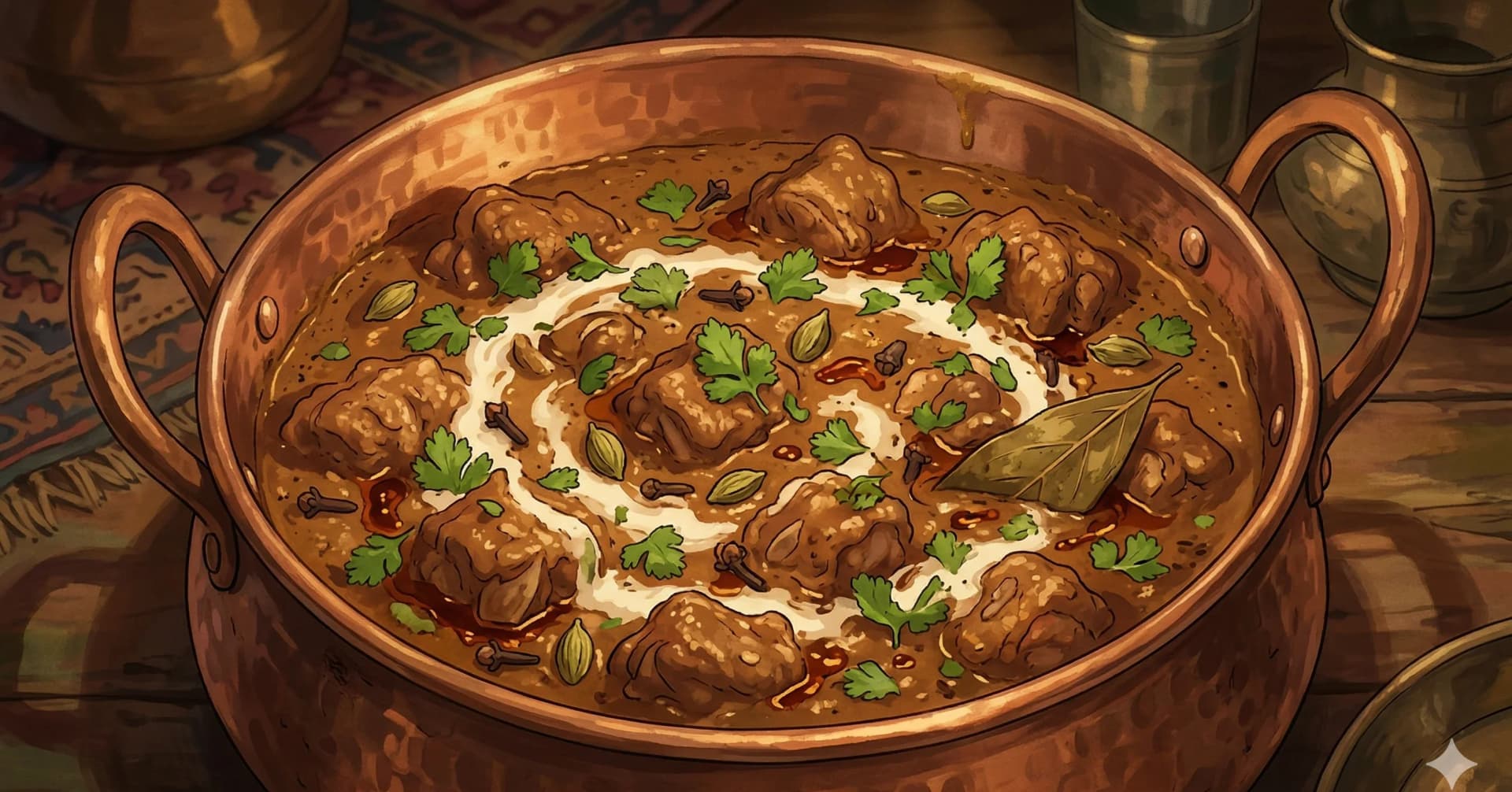
Lamb & Chicken Duo (Lehm e Murgan)
Awadhi lamb in a rich paste of fried nuts, coconut, and poppy seeds, finished with kewra
This is a dish built in layers — and the Awadhi kitchen invented a word for each of them. The majoon is the nut-and-coconut paste that gives the sauce its extraordinary body and richness. The bouquet garni — whole spices tied in muslin and suspended in the gravy throughout cooking — is borrowed from a French technique that Lucknow cooks adopted and made their own, using it to infuse flavour without leaving whole spices in the finished dish. And the final addition of kewra — distilled from the screwpine flower — marks the dish as done, as considered, as arriving at the table from a kitchen with standards.
The meat is marinated briefly in lemon juice and salt, then seared without its marinade to build a crust, then cooked in a deeply layered gravy of yogurt, onion, and the majoon. The majoon itself is built from cashewnuts fried golden, then chironji and poppy seeds, then desiccated coconut — each fried separately in the same oil, developing its own character before being ground together into a paste that becomes the backbone of the sauce.
The result is a lamb dish unlike a standard korma: richer and nuttier, with a coconut depth and a spice complexity that the whole-spice bouquet garni leaves its mark on through the full cook time. A dish for the serious table.
At a Glance
Yield
Serves 4–6
Prep
30 minutes + 15 minutes marinating
Cook
1 hour
Total
1 hour 45 minutes
Difficulty
Involved
Ingredients
Lamb Ingredients
- 2¼ lbbone-in lamb, cut into large pieces
- 1¼ tbsplemon juice
- 1⅔ tspfine salt
Nut Paste Ingredients
- 1 ozraw cashewnuts
- ¼ ozchironji (charoli)
- 1¾ ozdesiccated coconut
- 3½ tbspwhite poppy seeds, soaked in warm water for 30 minutes and drained
Spice Blend Ingredients
- 3–4 wholecloves
- 4–5green cardamom pods, lightly bruised
- 2–3black cardamom pods, lightly bruised
- 1small piece of mace (1 g)
- 1short cinnamon stick (2 g)
Gravy Ingredients
To Finish
- 2⅛ tspblack pepper, ground
- 2 tspkewra water
- —Fresh coriander and green chillies, to garnish
Method
- 1
Marinate the lamb. Combine lemon juice (20 ml) and salt (10 g) in a bowl. Add the lamb pieces, mix to coat, and marinate for 15 minutes.
- 2
Make the bouquet garni. Place all the whole spices in a small square of muslin cloth and tie securely with kitchen string, leaving enough string to hang over the rim of the cooking vessel.
- 3
Make the majoon. Heat enough ghee in a frying pan for shallow-frying. Fry the cashewnuts (30 g) over medium heat until golden, then remove. In the same oil, fry the chironji (10 g) until pale golden, remove. Fry the poppy seeds (30 g) briefly until just fragrant, remove. Finally, fry the desiccated coconut (50 g) until golden and nutty-smelling, remove. Cool all the fried ingredients, then transfer to a blender with 30 ml water and blend to a completely smooth paste. Set aside.
- 4
Prepare the onions. Peel and halve the onion (for the 60g): slice half and blend the other half to a smooth paste. Keep separate.
- 5
Sear the lamb. Heat the remaining ghee in a heavy handi. Increase to high heat, drain the lamb pieces to remove the marinade, and add to the hot ghee. Sear for 1½–2 minutes per side to create a golden crust. Remove and set aside.
- 6
Build the gravy. Reduce heat to medium. Add the sliced onions to the handi and sauté until golden. Add the seared lamb back in, along with the garam masala (if using), and stir for 1 minute. Add the onion paste, garlic paste (10 g), and ginger paste (10 g), and fry for 1 minute.
- 7
Add yogurt. Remove the handi from heat momentarily. Stir in the whisked yogurt with coriander powder (½ teaspoon) and red chilli powder (5 g). Return to heat and add the bouquet garni (tying the string to the handle to keep the spice bundle suspended in the gravy). Fry until the fat leaves the sides of the gravy, stirring constantly.
- 8
Braise with stock. Add the lamb stock (600 ml) and bring to a boil. Cover and simmer over medium heat, stirring occasionally, for 35–40 minutes until the lamb is cooked through.
- 9
Add the majoon. Reduce heat to low. Stir in the nut paste and cover. Simmer for 5 minutes, stirring occasionally. Then reduce to the very lowest heat, add the black pepper (5 g), stir, cover, and cook for 10 minutes more.
- 10
Finish. Remove from heat. Discard the bouquet garni. Add the kewra water (10 ml), stir, and adjust seasoning. Garnish with coriander and green chillies. Serve with roomali roti.
Key Ingredient Benefits
Poppy seeds (khus khus) in savoury cooking are used as a thickening agent — soaked, ground, and added to gravies for body rather than for flavour. They are high in dietary fibre and contain oleic acid. They have no narcotic properties when used culinarily; the opiates in the opium poppy (Papaver somniferum) are in the latex, not the seeds.
Chironji (charoli, Buchanania lanzan) are small lentil-shaped seeds with a flavour reminiscent of almonds, used across both sweet and savoury Indian preparations. They are high in healthy fats and provide a mild, nutty richness.
Kewra water (kewra) is the fragrant distillate of Pandanus odorifer flowers. In Unani medicine, it is traditionally considered cooling. Culinarily, it is a finishing note — added at the very end to preserve its delicate floral character, which evaporates quickly with heat.
Why This Works
Frying each nut and seed separately — rather than together — is the difference between flavour and muddle. Cashewnuts need more time and heat than chironji; coconut needs different management from poppy seeds. Cooking each to its own ideal point, then grinding them together, produces a majoon that is the sum of distinct developments rather than an average.
The bouquet garni technique (whole spices in muslin) is a practical solution to a real problem in Indian cooking: whole spices cooked into a long braise release their oils thoroughly, but leave textures and visual distractions in the finished dish. The muslin allows all the extraction to happen while keeping the cooking vessel clean and the finished dish elegant.
Cooking on very low heat for the final stages, after the nut paste is added, is essential. The paste is high in fat and will stick and scorch at any significant heat. The patience required here is what separates a finished Awadhi preparation from an attempted one.
Substitutions & Variations
No chironji: Replace with an equal weight of pine nuts or blanched almonds, fried to a similar golden colour.
No kewra: Rose water (at half the quantity) provides a floral finishing note with a different character. Or omit entirely. The dish is still excellent.
Chicken version: Replace lamb with bone-in chicken pieces. Reduce braising time to 20–25 minutes and use chicken stock.
Serving Suggestions
Serve with roomali roti for the traditional pairing. The bread's thinness and softness suit the rich, cling-textured gravy. A table with this dish alongside a biryani, a cooling raita, and sliced raw onion represents an Awadhi feast at its most classical. For a smaller meal, two to three pieces of lamb per person with a simple pulao is complete.
Storage & Reheating
Keeps refrigerated for 3 days, improving overnight. Reheat slowly on the stovetop over the lowest flame, stirring gently and adding a splash of water if needed. The nut paste in the gravy can stick as it reheats — patience and low heat prevent this. Freezes well for up to 1 month; thaw overnight and reheat gently.
Cultural Notes
Lehm-e-murgan (لحم مرغن, लह्म-ए-मुर्गन, "rich chicken meat") is the Indo-Persian chicken preparation from the broader Mughlai and Hyderabadi court traditions, in which boneless chicken pieces are slow-cooked in a yogurt-based gravy enriched with cream, ground cashews, fried onion paste, and the Mughlai aromatic spice mix of green cardamom, mace, nutmeg, and saffron. The dish name carries the Persian-Arabic lehm (meat) and the Persian murgan (chickens), reflecting the deep Persian linguistic and culinary heritage of the Indian Muslim court cuisines that adopted Persian vocabulary alongside Persian cooking techniques.
The Indo-Persian culinary lineage shaped many of the cream-and-yogurt-rich Mughlai chicken preparations. Persian court cuisine (the cuisine of the Safavid empire and the broader Persianate world from the sixteenth century onward) developed elaborate techniques for stewing meats in nut-thickened cream-rich gravies, and these techniques traveled to India through the Persian-speaking scholars, soldiers, and chefs who moved between Persia and the Mughal court at Delhi, Agra, and Lucknow, and later between Persia and the Nizami court at Hyderabad. The lehm-e-murgan preparation sits in this broader family, distinguished by its rich cream and saffron finish that signals a banquet preparation rather than an everyday dish.
The technique cooks the chicken gently to preserve the silkiness of the gravy. Boneless chicken (typically a mix of breast and thigh, cut into curry-size pieces) is marinated in yogurt, ginger-garlic paste, salt, and white pepper for an hour. Onions are sliced thinly and deep-fried into dark golden birista, then ground with soaked cashews into a smooth paste. The marinated chicken is sautéed briefly in ghee until lightly colored, then the cashew-onion paste, whisked yogurt, green cardamom, mace, nutmeg, white pepper, and a small amount of water are added. The pot is covered and cooked over low heat for twenty-five to thirty minutes (chicken cooks faster than lamb so the time is shorter). A small amount of cream and a pinch of saffron infused in warm milk are added off the heat for the rich finish, and the dish is scattered with fresh cilantro before serving with sheermal, naan, or basmati pulao.
Nutrition Facts
Calories: 642kcal (32%)|Total Carbohydrates: 7.8g (3%)|Protein: 36.9g (74%)|Total Fat: 51g (65%)|Saturated Fat: 25.4g (127%)|Cholesterol: 149mg (50%)|Sodium: 645mg (28%)|Dietary Fiber: 2.8g (10%)|Total Sugars: 2.4g
You Might Also Like
Ratings & Comments
Ratings & Comments
Ratings
Share your thoughts on this recipe.
Sign in to rate and comment